
Table of Contents >> Show >> Hide
- Meet the Pumpkin Toadlet
- 10 Bizarre Facts About Pumpkin Toadlets
- 1. They’re the Size of a Fingernail (and Look Like Walking Candy)
- 2. Their Skin Is Laced with a Super-Potent Neurotoxin
- 3. Their Bones Literally Glow Through Their Skin
- 4. They Can’t Hear Their Own Love Songs
- 5. They’re Hilariously Bad at Jumping
- 6. They Skip the Tadpole Stage Entirely
- 7. Their Whole World Is a Few Leaf Piles Wide
- 8. Miniaturization Warped Their Skeletons
- 9. Scientists Keep Finding New, Equally Strange Relatives
- 10. They’re Both Safe (for Now) and Weirdly Iconic
- Field Notes & Experiences: Imagining Life with the Pumpkin Toadlet
- Conclusion
If you’ve ever wished a Cheeto could come to life and wobble through the forest, good news: nature has already done that. Meet the pumpkin toadlet, a frog so tiny, toxic, and gloriously weird that it feels custom-made for a Listverse countdown. These bright orange micro-frogs from Brazil’s Atlantic Forest have glowing bones, terrible balance, and love songs they literally cannot hear. Yes, really.
Below are ten of the strangest, science-backed facts about pumpkin toadletsplus some field-style “experience” stories at the end for extra nerdy fun.
Meet the Pumpkin Toadlet
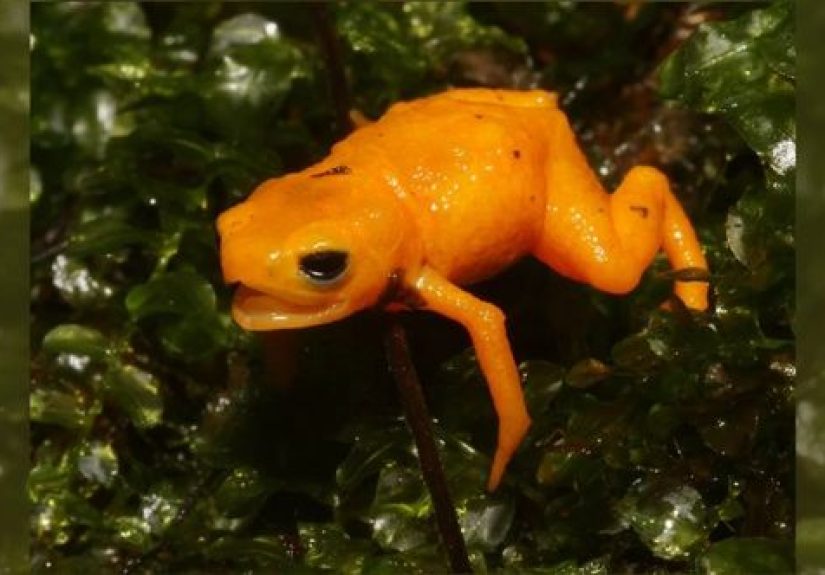
Pumpkin toadlets (most famously Brachycephalus ephippium) are tiny, day-active frogs that live in the leaf litter of Brazil’s Atlantic Forest. Adults are only about 0.5–0.8 inches long (12–20 millimeters), making them among the smallest frogs on Earth. Their skin is a vivid yellow-orange, and their bodies look almost toy-like: short, chunky limbs, tiny toes, and big black eyes in a perfectly Halloween-themed color scheme.
Despite their cartoonish appearance, these frogs are no joke. They’re highly toxic, loaded with powerful neurotoxins, and armed with some of the strangest biological features ever recorded in amphibians.
10 Bizarre Facts About Pumpkin Toadlets
1. They’re the Size of a Fingernail (and Look Like Walking Candy)
First, the obvious: pumpkin toadlets are ridiculously small. A fully grown adult can comfortably sit on the tip of your thumb with room to spare. Some species top out at around 18 millimeters longabout the width of a U.S. penny.
Combine that size with their neon pumpkin coloration and you get an animal that looks less like a frog and more like a novelty eraser somebody dropped in the forest. Their miniaturized bodies even come with simplified skeletons and fewer bones than larger frogs, which adds to their odd, blocky shape.
In short: if Halloween candy evolved legs, it would look suspiciously like a pumpkin toadlet.
2. Their Skin Is Laced with a Super-Potent Neurotoxin
Underneath the cuteness is serious biochemical firepower. Pumpkin toadlets pack tetrodotoxin and several related toxinsthe same general family of compounds that makes pufferfish dangerous to eat. Studies have found these toxins concentrated in their skin, liver, and ovaries, with the skin showing the highest levels.
One of the analogues, 11-oxotetrodotoxin, is estimated to be four to five times more potent than tetrodotoxin itself. That’s like taking an already dangerous chemical and hitting the “upgrade” button. Their bright orange color is considered aposematic colorationa visual “Do Not Touch” label for predators smart enough to listen.
So while they may look like gummies, they’re more like tiny, toxic warning signs hopping around the forest floor.
3. Their Bones Literally Glow Through Their Skin
As if “tiny and toxic” weren’t enough, pumpkin toadlets have a secret rave mode. Under ultraviolet (UV-A) light, parts of their skeletonespecially in the head and backfluoresce so strongly that the glow shows through their thin orange skin as bright whitish spots.
Fluorescence in land-dwelling vertebrates is already rare. Seeing it shine through skin in living frogs is even stranger. Researchers suspect the glow might help with mate recognition or act as an extra visual warning to predators, but there’s still no definitive answer. It might simply be a weird side effect of their bone structureone of those “evolution did this because it could” situations.
Either way, pumpkin toadlets are basically tiny bio-highlighters scuttling through the leaf litter.
4. They Can’t Hear Their Own Love Songs
Most frogs use sound to attract mates. Pumpkin toadlets… kind of missed that memo. Males produce very high-frequency, faint buzzes as mating calls, but their own ears are too underdeveloped to detect those frequencies. In other words, they literally can’t hear themselvesor each othersing.
Studies show that their inner ear structures have evolved in such a way that they’ve lost sensitivity to the frequency range of their calls. The calls may be evolutionary leftovers, like a vestigial behavioral habit that hasn’t fully disappeared yet. Instead, pumpkin toadlets seem to rely heavily on visual cues: inflating the vocal sac, head movements, and little arm waves to signal to one another.
Imagine hosting a karaoke night where nobody can hear the music but everyone still goes through the motionsthat’s pumpkin toadlet courtship in a nutshell.
5. They’re Hilariously Bad at Jumping
Frogs are famous for explosive, acrobatic leaps. Pumpkin toadlets did not get that talent package. High-speed video and biomechanical studies show that when these frogs jump, they often lose control midair, tumble, and crash land in what can only be described as chaos.
The problem lies in their inner ear canals, which help animals sense balance and orientation. Pumpkin toadlets have the smallest semicircular canals recorded in any vertebrate, and those canals are so tiny that they simply can’t provide reliable balance information during a jump. Their bodies launch like a frog; their nervous systems follow up with “Good luck, buddy.”
Luckily, being tiny and close to the ground means those awkward landings aren’t usually fatal. They just look like they’re tryingand failingto stick a gymnastics dismount every single time.
6. They Skip the Tadpole Stage Entirely
Most frogs lay eggs in water, which hatch into tadpoles that later metamorphose into adults. Pumpkin toadlets take a shortcut. They practice “direct development”: females lay a small clutch of relatively large eggs on land, tucked safely into the leaf litter. When those eggs hatch, tiny fully formed froglets emergeno tadpoles, no ponds, no awkward in-between phase.
This strategy is perfect for life in the moist forest floor, where standing water might be temporary or scarce. It also means the young are born into the same microhabitat they’ll occupy as adults, already suited to a life spent crawling among damp leaves and roots.
Think of it as skipping straight from “egg” to “fun-sized adult” with no tadpole middle school.
7. Their Whole World Is a Few Leaf Piles Wide
Pumpkin toadlets are micro-endemics: many species in the genus Brachycephalus live only on specific mountaintops or tiny patches of Atlantic Forest. Some species are restricted to a single high-elevation forest fragment, meaning their entire known range can be measured in just a few square kilometers.
They spend their lives in the leaf litter, crawling rather than leaping gracefully, hunting for minuscule invertebrates. Because they’re so small and so localized, many species remained unknown to science until the last few decades, and new ones are still being described.
To a pumpkin toadlet, “going on an adventure” probably means climbing from one side of a leaf to the other.
8. Miniaturization Warped Their Skeletons
Shrinking a vertebrate body down to the size of a pencil eraser comes with weird side effects. In pumpkin toadlets, extreme miniaturization has simplified their skeletons: some bones are reduced or absent, certain elements fuse, and the limbs wind up short and stubby. In at least some species, they even have only three fingers on each hand instead of the usual four found in many frogs.
These skeletal quirks likely explain several of their other “failures,” like their poor jumping ability and clumsy movement. Evolution shaved the frog body plan down to the bare minimum needed to function at micro-scaleand grace did not make the final cut.
The result is an animal that looks as if a child drew a frog from memory and then shrunk it in the wash.
9. Scientists Keep Finding New, Equally Strange Relatives
Pumpkin toadlets don’t come in just one model. The genus Brachycephalus has exploded in species diversity as herpetologists explore more mountaintops and valleys in the Atlantic Forest. New fluorescent, toxic, ultra-tiny species are still being described, including recently named relatives like Brachycephalus rotenbergae.
Many of these species share the same basic formulabright color, toxicity, miniaturized skeletonsbut each has its own details in pattern, habitat, or fluorescence. From a scientific perspective, pumpkin toadlets are a natural laboratory for studying how extreme miniaturization and isolation shape evolution.
From a human perspective, they’re also a reminder that entire worlds of strange life can be hiding in a single patch of forest floor.
10. They’re Both Safe (for Now) and Weirdly Iconic
On paper, the classic pumpkin toadlet, Brachycephalus ephippium, is listed as “Least Concern” on the IUCN Red List. It’s relatively widespread compared to some of its cousins, and local populations can be quite common.
But there’s a catch: the Atlantic Forest is one of the most threatened ecosystems on the planet, heavily fragmented by agriculture and development. Many micro-endemic pumpkin toadlets with tiny ranges are more vulnerable, and habitat loss could put them at risk long before casual observers know they exist.
Meanwhile, on the internet, pumpkin toadlets have become cult favorites. Articles and videos lovingly roast them as “frogs that cannot frog,” highlighting their clumsy jumps, glowing bones, and self-unheard love songs. In conservation outreach, that kind of weird fame is a superpowerit’s a lot easier to get people to care about a habitat when its mascot is a tiny orange disaster frog.
Field Notes & Experiences: Imagining Life with the Pumpkin Toadlet
So what is it actually like to encounter one of these micro-frogs? Picture yourself hiking through a misty patch of Atlantic Forest in southeastern Brazil at mid-morning. The air feels like warm soup, the forest floor is thick with brown leaves, and every step releases the scent of wet earth. Somewhere nearby, birds are calling, insects are clicking, and tree frogs are chirping from the canopy.
You kneel down to look more closely at the groundbecause anyone searching for pumpkin toadlets quickly learns that their world is measured in inches, not miles. Your eyes adjust to the carpet of leaves, twigs, and moss. At first, you see nothing but brown. Then a tiny flash of orange catches your eye.
There, perched on a curled leaf, is what looks like a drop of neon paint with legs. The pumpkin toadlet isn’t in any hurry. It moves in slow, deliberate steps, more like a cautious gecko than a jumping frog. When it finally decides to “leap” away from you, it performs a short, awkward hop, spins slightly in midair, and lands in a heap barely a few inches away.
If you were a researcher, you might gently coax the frog into a clear container and take it into a portable dark tent with a UV lamp. Under regular light, it looks like a gummy frog from a candy store. Under UV, pale glowing patches flicker into view across its head and back as the fluorescent bones shine through. For a moment, it doesn’t look realit looks like a CGI creature from a movie about alien worlds.
Back in the field, you’d spend your time slowly scanning the leaf litter, listening for the faintest buzzy calls that most humans can barely hear and that other pumpkin toadlets can’t hear at all. You’d watch males posture and pulse their throats in silent “songs,” occasionally throwing in a tiny arm wave that would be comical if it weren’t so earnest.
After a few days of this, the forest floor itself would start to feel alive with hidden stories. Every curled leaf might shelter one of these poisonous micro-frogs, guarding its clutch of eggs that will hatch straight into miniature adults. You’d realize just how fragile their world is: a single logging project or clearing could wipe out an entire population confined to one hilltop.
Even if you never make it to Brazil, you can “experience” pumpkin toadlets by watching high-speed videos and fluorescence footage from lab studies. Cameras slow their clumsy jumps to a crawl, letting you see every twist and tumble. UV footage reveals their glowing skeletons like nature’s version of a black-light poster.
In a way, that’s what makes pumpkin toadlets such compelling creatures. They live tiny, secretive lives in a remote forest, but modern technology lets us zoom in on their strangest details. We can watch their bones glow, their jumps fail, and their silent songs play out in slow motionand in doing so, we’re reminded that evolution produces not just efficient designs, but also gloriously odd, imperfect ones.
The next time you think you’ve seen everything nature has to offer, remember the pumpkin toadlet: a fingernail-sized frog with glowing bones, lethal skin, bad balance, and a love song no one can hear. It’s the ultimate Listverse animaltiny, toxic, and wonderfully bizarre.
Conclusion
Pumpkin toadlets may be small, but their list of strange traits is long: ultra-potent toxins, fluorescent skeletons, botched jumps, silent-to-themselves love songs, and an entire life spent navigating a few inches of leaf litter. They’re a reminder that evolution doesn’t just make sleek predators and majestic megafauna; it also makes tiny weirdos that seem to break all the rules of what a frog “should” be.
For scientists, pumpkin toadlets are an evolutionary puzzle box. For the rest of us, they’re the perfect mix of adorable and unsettlingexactly the kind of creature that deserves a spot on any “bizarre animals” list. And if their internet fame helps draw attention to the endangered Atlantic Forest they call home, then these little orange chaos beans might just hop their way into conservation history, clumsy landings and all.







 Close
Close