
Table of Contents >> Show >> Hide
- 1. The Cadaver Synod: When a Dead Pope Was Put on Trial
- 2. The Sow of Falaise: A Pig Tried for Killing a Child
- 3. The Savigny Piglets: When Baby Pigs Got a Legal Break
- 4. The Basel Rooster: A Bird Accused of Laying an Egg
- 5. The Rats of Autun: The Defendants Who Missed Court Because of Cats
- 6. The Weevils of Saint-Julien: Insects with Court-Appointed Respect
- 7. The Last Duel of 1386: Jean de Carrouges vs. Jacques Le Gris
- 8. Trial by Ordeal: When the Court Asked God to Read the Evidence
- 9. Benefit of Clergy: The Reading Test That Could Save Your Neck
- 10. Sanctuary: The Legal Power of Running Into a Church
- Why Medieval Legal Cases Were So Bizarre
- Experiences and Reflections Related to Medieval Europe’s Bizarre Legal Cases
- Conclusion
Medieval Europe did not have podcasts, true-crime documentaries, or comment sections full of people yelling “objection!” But it did have courts, clerks, oaths, church law, royal law, village gossip, and an impressive talent for turning everyday problems into legal spectacles. If a pig caused a fatal accident, it might face trial. If crops failed, insects could be summoned to court. If a dead pope remained politically inconvenient, someone might dig him up and prosecute him anyway. Medieval justice was not always irrational, but it often looked extremely strange from a modern courtroom chair.
To understand these bizarre medieval legal cases, we have to remember that law in medieval Europe mixed custom, religion, social order, and public performance. Courts were not only trying to decide guilt; they were trying to restore balance in a world where divine judgment, community reputation, and public punishment all mattered. The result was a legal culture that could be surprisingly procedural and wildly theatrical at the same time.
Below are ten of the strangest legal cases and legal customs from medieval Europe, from animal defendants to trials by combat. Some are well documented, some survive through later chronicles, and some sit on the border between history and legend. All of them show how medieval law could be serious, symbolic, and completely bizarre before lunch.
1. The Cadaver Synod: When a Dead Pope Was Put on Trial
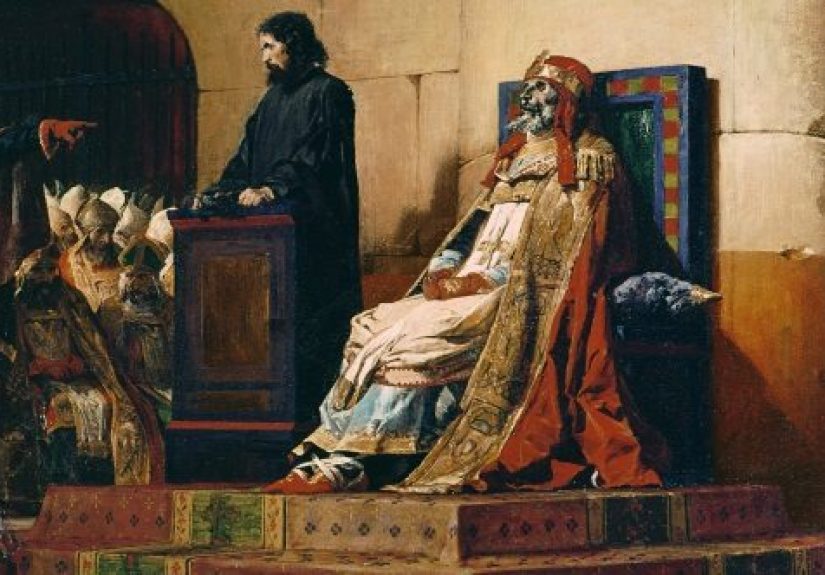
In 897, Pope Stephen VI ordered the body of his predecessor, Pope Formosus, to be exhumed and brought into a church court in Rome. Formosus had been dead for months, which normally limits a defendant’s ability to respond. Medieval politics, however, had never been shy about awkward scheduling.
The corpse was dressed in papal robes and placed on a throne while Stephen VI accused Formosus of crimes including perjury and unlawful occupation of the papal office. A deacon reportedly answered for the deceased pope. The court found Formosus guilty, declared his papal acts invalid, and symbolically stripped him of office.
Why was this done? The Cadaver Synod was not just macabre theater. It reflected a bitter struggle over authority, legitimacy, and factional power in the papacy. By condemning Formosus, Stephen VI tried to erase the legal and spiritual authority of a rival. Unfortunately for Stephen, the performance backfired spectacularly. Public outrage followed, Formosus was later rehabilitated, and Stephen VI was deposed.
As bizarre legal cases go, this one is hard to beat. Modern courts may retry old cases, but they generally stop short of seating the defendant in a chair after burial.
2. The Sow of Falaise: A Pig Tried for Killing a Child
In 1386, in Falaise, Normandy, a sow was tried after causing the death of a child. The animal was not simply destroyed as dangerous livestock. Instead, the case was handled with the grim formality of criminal justice. The pig was accused, convicted, and publicly executed.
To modern readers, the idea of putting a pig on trial sounds like a courtroom sketch written by a farmer with a fever. But medieval animal trials were real, especially in parts of France, Switzerland, and neighboring regions. Animals that caused human deaths could be treated as legal offenders, particularly when their actions disrupted the moral order of the community.
The Falaise case was especially theatrical because the punishment was staged in public. Public justice mattered in medieval Europe. Punishment was not only about the offender; it was a message to the entire community. The sow became a symbol of danger, disorder, and the law’s power to respond even when the defendant had hooves and no legal strategy whatsoever.
3. The Savigny Piglets: When Baby Pigs Got a Legal Break
Another famous French animal trial involved a sow and her piglets in the region of Savigny. The sow was accused of killing a young child, while the piglets were treated as possible accomplices. Yes, medieval law briefly considered whether baby pigs had been part of a criminal conspiracy. It was a tough era for farm animals and legal interns.
The mother pig was found guilty, but the piglets were reportedly spared because there was insufficient evidence that they had participated in the fatal attack. That detail is important. As strange as the case seems, it reveals that medieval courts were not always acting randomly. They could apply ideas of evidence, individual guilt, and legal distinction even in proceedings that look absurd today.
The Savigny case shows why medieval animal trials fascinate legal historians. They were not merely superstition in costume. They also reflected the legal system’s effort to classify responsibility. The sow was treated as the direct offender; the piglets, lacking proof against them, escaped punishment. In other words, the court gave the piglets what every defendant hopes for: reasonable doubt and a very lucky day.
4. The Basel Rooster: A Bird Accused of Laying an Egg
In 1474, the city of Basel saw one of the strangest animal trials in European legal history. A rooster was accused of laying an egg. Today we would assume the bird had been misidentified, or that biology had entered the chat with a complicated explanation. In late medieval Europe, however, a rooster’s egg could be interpreted through fears of witchcraft, unnatural events, and demonic disorder.
The rooster was tried and condemned. The case seems ridiculous now, but in its own world it made a dark kind of sense. Medieval society often treated unusual natural events as signs. A creature crossing the boundary of expected behavior could be viewed as threatening. The law became a way to publicly destroy the perceived threat and reassure the community.
The Basel rooster case also reminds us that medieval legal history cannot be separated from medieval cosmology. Courts were not operating in a purely secular universe. People believed that moral, spiritual, and natural orders were connected. A rooster that allegedly laid an egg was not just a poultry problem. It was a feathered crisis of reality.
5. The Rats of Autun: The Defendants Who Missed Court Because of Cats
One of the most entertaining stories in European animal-trial tradition concerns rats in Autun, France. The rats were accused of damaging crops and were summoned to appear in court. Their lawyer, Bartholomew Chassenee, allegedly argued that the summons had not properly reached every rat and that, even if it had, the defendants could not safely travel to court because cats waited along the roads.
That argument sounds like legal comedy, but it shows the procedural imagination of medieval and early modern courts. If the law was going to summon animals, then someone had to ask whether the summons was valid. Were all defendants notified? Could they appear safely? Was absence contempt of court, or merely sensible rodent behavior?
Whether every detail of the Autun story is perfectly preserved or polished by later retelling, the case captures a real legal tradition: communities sometimes brought proceedings against pests, especially when crops and survival were at stake. In a world where harvest failure could mean hunger, rats were not cute little side characters. They were economic defendants with whiskers.
6. The Weevils of Saint-Julien: Insects with Court-Appointed Respect
In the Alpine region of Saint-Julien, crop-damaging insects were reportedly brought into legal proceedings. The case is often remembered because the insects were treated as parties in a dispute over land, food, and divine order. The argument was not simply “bugs bad.” The court had to consider whether these creatures had a place in creation and whether humans had the right to expel them completely.
This is where medieval law becomes unexpectedly philosophical. If God created all creatures, did insects have a right to exist somewhere? Could people ask the church to curse or banish them? Should the pests be given an alternative plot of land? These questions sound odd, but they reveal how law, theology, and agriculture overlapped.
The weevil proceedings also show why medieval European legal cases can feel bizarre and sophisticated at once. The court did not have modern ecology, pesticides, or crop insurance. It had petitions, priests, lawyers, and the hope that formal procedure might persuade heaven, nature, and hungry insects to cooperate.
7. The Last Duel of 1386: Jean de Carrouges vs. Jacques Le Gris
In 1386, France witnessed one of its most famous judicial duels. Jean de Carrouges accused Jacques Le Gris of a serious attack against Carrouges’s wife, Marguerite. Le Gris denied the accusation. After hearings failed to resolve the matter, the case moved to trial by combat before a large audience near Paris.
Trial by combat rested on the belief that God would grant victory to the truthful party. That belief put everyone in a dangerous legal equation. If Carrouges won, Le Gris would be judged guilty. If Le Gris won, Carrouges would die and Marguerite could be punished as a false accuser. The stakes were horrifyingly high, especially for Marguerite, whose testimony was central but whose fate depended on the outcome of two men fighting.
Carrouges won the duel, and the case became famous as one of the last officially sanctioned judicial combats in medieval France. Today, the duel is often discussed as a dramatic example of the transition from older forms of proof to more evidence-based legal procedure. It also exposes the harsh position of women in medieval courts, where honor, testimony, and male representation could decide life-altering outcomes.
8. Trial by Ordeal: When the Court Asked God to Read the Evidence
Trial by ordeal was not one single case but a major medieval legal practice. In Europe, accused people might be required to carry hot iron, plunge a hand into hot water, or undergo cold-water ordeal. The result was interpreted as divine judgment. If the wound healed cleanly, the accused might be declared innocent. If it festered, guilt was presumed.
To modern readers, this sounds less like justice and more like a terrible team-building exercise. But ordeal had a logic within medieval Christian society. Human witnesses could lie. Documents could be scarce. Reputation mattered, but reputation could be contested. God, people believed, knew the truth. The ordeal was a ritual designed to make divine knowledge visible.
The practice declined sharply after the Fourth Lateran Council of 1215, which forbade clergy from participating in ordeals. Without priests to bless and supervise the ritual, the system lost legitimacy. In England, this helped open the path toward jury trial. The shift did not make medieval justice instantly modern, but it marked a major step away from supernatural proof and toward human fact-finding.
9. Benefit of Clergy: The Reading Test That Could Save Your Neck
Benefit of clergy began as a privilege protecting clerics from secular criminal courts. In medieval England, churchmen claimed that they should be tried in ecclesiastical courts rather than ordinary royal courts. Over time, this privilege became one of the strangest legal escape routes in English law.
Because clergy were expected to be literate, the ability to read a passage could help a defendant claim clerical status. Eventually, the rule expanded and transformed, allowing some first-time offenders to avoid the harshest penalties for certain crimes. The famous “neck verse” from the Bible became associated with this practice because reading it could help prove eligibility.
Was this bizarre? Absolutely. Imagine a courtroom where the difference between severe punishment and mercy might depend partly on whether you could read Latin. But the practice also shows how medieval law was shaped by institutions. The church was not merely a spiritual authority; it was a legal power with its own courts, privileges, and procedures.
Benefit of clergy eventually became a legal fiction, far removed from its original purpose. Still, its medieval roots reveal a world where literacy, status, and jurisdiction could matter as much as the facts of the case.
10. Sanctuary: The Legal Power of Running Into a Church
In medieval Europe, a fugitive who reached a church could often claim sanctuary. This did not always mean permanent freedom, and it certainly did not mean the church handed out complimentary snacks and fake mustaches. But sanctuary could temporarily protect a person from immediate arrest or revenge.
In England, sanctuary seekers might eventually confess and “abjure the realm,” leaving the country under strict rules. In other places, sanctuary created space for negotiation, compensation, or church involvement. The practice reflected a belief that holy places had special legal and moral power. Violence inside sacred space was not just a crime; it was a violation of divine order.
Sanctuary seems strange today because modern states claim near-total authority over criminal procedure. In medieval Europe, however, jurisdiction was fragmented. Kings, lords, bishops, towns, and monasteries all had overlapping power. A church could be more than a building. It could be a legal refuge, a bargaining table, and a timeout corner for a society that badly needed fewer revenge spirals.
Why Medieval Legal Cases Were So Bizarre
These cases look bizarre because medieval law answered different questions than modern law. Today, courts usually ask: What happened? What law applies? What evidence proves it? Medieval courts asked those questions too, but they often added others: What does this event mean spiritually? How has the community been disturbed? Which authority has jurisdiction? Can public ritual restore order?
That is why animals could become defendants, corpses could become political targets, and trial by combat could be treated as proof. Medieval justice was a performance of authority. The community had to see that disorder was being addressed. The punishment, ritual, or judgment often mattered publicly as much as the private facts of the case.
Another reason these cases feel strange is that medieval Europe did not have a single legal system. Law varied by region, class, court, and century. A noble might face a different process than a peasant. A cleric might claim church jurisdiction. A fugitive might find temporary safety in a cathedral. Local customs could survive alongside royal reforms. The result was a legal landscape full of exceptions, loopholes, rituals, and surprises.
Experiences and Reflections Related to Medieval Europe’s Bizarre Legal Cases
Reading about bizarre medieval legal cases is a little like opening a dusty legal filing cabinet and finding a rooster, a sword, a dead pope, and a very nervous rat inside. At first, the stories seem funny because they are so far from modern expectations. We imagine a judge sternly asking a pig how it pleads, or a lawyer requesting travel protection for rats because the neighborhood cats look suspicious. The humor is natural. These cases are strange. They practically arrive wearing bells.
But after the first laugh, the experience becomes more thoughtful. Medieval law reminds us that every society builds justice out of the tools it trusts. Modern courts trust forensic science, written statutes, expert witnesses, appeals, and procedural rights. Medieval communities often trusted oath-taking, reputation, ritual, divine judgment, and public symbolism. Their tools were different because their world was different.
The animal trials are especially revealing. On the surface, they look like pure absurdity. A pig cannot understand guilt. A rooster cannot consult legal counsel. Weevils do not respect court dates, mostly because they are weevils. Yet these cases show communities trying to make sense of harm. When a child died, when crops failed, or when nature behaved in ways people found frightening, the law offered a public script. It said: something wrong has happened, and we will name it, judge it, and respond to it.
The Cadaver Synod offers a different lesson. It shows how law can become a weapon when political power is desperate enough. Trying a dead pope was not really about the dead. It was about the living: their authority, their enemies, their fear of memory, and their need to control the official story. That feels less medieval than we might like to admit. Modern societies still fight over reputations, records, legitimacy, and who gets to define the past.
Trial by combat and trial by ordeal create the strongest emotional reaction because they placed human lives in terrifying procedures. Yet even here, the goal was not random cruelty. People believed that truth could be revealed through divine intervention. The problem, of course, is that belief does not make a method reliable. A strong fighter could win a weak case. A wound could heal or worsen for reasons having nothing to do with innocence. These customs teach us why legal systems gradually moved toward evidence, witnesses, juries, and written procedure.
For modern readers, the best way to approach these medieval legal cases is with two feelings at once: amusement and humility. Amusement, because yes, the rat lawyer has earned his place in history’s comedy hall of fame. Humility, because future generations may look at some of our legal habits and wonder what on earth we were thinking. Every age believes its version of justice is more rational than the last. History quietly raises an eyebrow.
The weirdest medieval cases are not just curiosities. They are mirrors. They show how law reflects fear, faith, power, class, and imagination. They also show that justice has always been a work in progress. Medieval Europe’s courts may have tried pigs, insects, and corpses, but behind those spectacles were serious human concerns: safety, order, authority, memory, and the hope that wrongdoing could be answered in a way people could understand.
Conclusion
The most bizarre legal cases from medieval Europe are entertaining, but they are more than historical oddities. They reveal a world where law was deeply connected to religion, public ritual, local custom, and social hierarchy. A court could punish an animal, protect a fugitive in a church, settle a case through combat, or stage a posthumous political trial because medieval justice operated in a universe where divine order and human order were intertwined.
From the Cadaver Synod to the Falaise sow, from the Basel rooster to the Carrouges-Le Gris duel, these stories remind us that the history of law is not a straight road from ignorance to enlightenment. It is a long, uneven journey filled with experiments, fears, reforms, and occasional livestock. Medieval Europe’s strangest cases may make us laugh, but they also help us understand how societies use law to explain chaos, control danger, and perform authority in public.







 Close
Close