
Table of Contents >> Show >> Hide
- 1. You're Packing It Like You're Trying to Win a Tetris Championship
- 2. You're Ignoring the Whole “Top Rack vs. Bottom Rack” Situation
- 3. You're Pointing Dirty Surfaces the Wrong Way
- 4. You're Letting Cups and Bowls Hold a Tiny Swimming Pool
- 5. You're Blocking the Spray Arms Without Realizing It
- 6. You're Blocking the Detergent Dispenser, Too
- 7. You're Letting Silverware Snuggle Together
- 8. You're Putting Plastics on the Bottom Rack
- 9. You're Tossing Long Utensils and Big Flat Items Wherever They Fit
- 10. You're Putting Things in the Dishwasher That Should Never Be There
- A Better Dishwasher Loading Routine in 6 Simple Moves
- What Real-Life Dishwasher Experience Usually Teaches You
- Final Thoughts
If your dishwasher keeps delivering glasses with mystery spots, cereal bowls with a side of yesterday, and forks that somehow come out less trustworthy than when they went in, your machine may not be the villain. In many kitchens, the real culprit is the loading strategy. Or, to be more honest, the loading chaos.
Modern dishwashers are pretty smart, but they are not magicians. They still need water to reach every surface, detergent to circulate, spray arms to spin, and dishes to stop behaving like clingy coworkers in a group photo. Load the machine well, and it can handle a surprisingly dirty dinner aftermath. Load it badly, and even the fanciest model can leave you with a full rack of disappointment.
This guide breaks down the most common dishwasher loading mistakes, why they cause poor cleaning and drying, and what to do instead. If you have ever opened the door after a cycle and whispered, “Well, that was useless,” this one is for you.
1. You’re Packing It Like You’re Trying to Win a Tetris Championship
One of the biggest dishwasher mistakes is overcrowding. It feels efficient in the moment. You squeeze in one more plate, tuck a mug behind a bowl, and wedge a skillet into a space that clearly belongs to physics, not cookware. Then the cycle ends and half the load still looks like dinner.
Dishwashers clean by spraying water and detergent through the rack layout. When items are crammed together, water cannot hit every surface, and airflow during drying gets blocked too. The result is stuck-on food, cloudy glasses, and the deeply annoying need to rewash things you already washed.
What to do instead
Leave a little breathing room between dishes. Every plate, bowl, cup, and pan needs enough space for water to move around it. If you cannot see the outline of each item, the load is probably too tight. One extra cycle is still better than one bad cycle plus a second round of hand-washing.
2. You’re Ignoring the Whole “Top Rack vs. Bottom Rack” Situation
Not every item belongs wherever it happens to fit. Dishwashers are designed with zones, and those zones matter. The bottom rack usually gets stronger spray and more heat. The top rack is gentler and better for lighter, more delicate items.
When people put stemware, plastic containers, or coffee mugs on the bottom rack next to a baked-on casserole dish, they are asking for trouble. Plastics can warp, glasses can clink into each other, and oddly placed items can interfere with how the machine is supposed to work.
What to do instead
Use the top rack for cups, glasses, mugs, small bowls, and dishwasher-safe plastics. Reserve the bottom rack for dinner plates, larger bowls, pots, pans, and sturdier items. Think of the dishwasher less like a random cabinet and more like a parking garage with assigned spaces.
3. You’re Pointing Dirty Surfaces the Wrong Way
Dishwashers spray water upward from below, so direction matters. If the dirty side of a plate or bowl is facing away from the spray, the machine has to work harder to reach the mess. That is not a winning setup.
Many manufacturers and cleaning experts recommend placing the food-soiled surfaces so they face the center or the spray source, especially on models where you are struggling with residue. Some newer machines are more forgiving, but the safest rule is still simple: point the dirty side where the water is most likely to hit it.
What to do instead
Load plates vertically and angle bowls, mugs, and curved dishes downward. Face the dirtiest surfaces inward and down toward the spray. If your dishwasher manual gives model-specific guidance, follow that first. Your machine knows itself better than your aunt’s 2009 dishwasher wisdom.
4. You’re Letting Cups and Bowls Hold a Tiny Swimming Pool
If you place cups upright or bowls too flat, water collects inside them during the cycle. Then the load finishes and everything looks technically clean but very wet, which is a fancy way of saying annoying.
Water pooling also increases the chance of residue settling back on surfaces. That is why your “clean” mug sometimes comes out with a suspicious puddle and one lonely breadcrumb clinging to the bottom like it pays rent.
What to do instead
Angle cups, mugs, glasses, and bowls downward so water can drain off. Secure them between the tines rather than balancing them on top of them. If an item has a deep curve, give it extra space so spray can reach inside and water can run out instead of collecting there.
5. You’re Blocking the Spray Arms Without Realizing It
Spray arms need room to rotate. Large platters, frying pans, mixing bowls, cutting boards, and baking sheets can stop them from spinning or partially block the water path. That means the dishwasher is suddenly trying to clean a full load with the enthusiasm of one confused sprinkler.
This is one of those mistakes that is easy to miss because the machine still runs. It just does a bad job while pretending everything is normal.
What to do instead
Before starting the cycle, spin the spray arms by hand if your model allows it. Make sure nothing is sticking out or hanging down in a way that could stop rotation. Put large flat items along the sides or back when possible, not directly over the spray zone.
6. You’re Blocking the Detergent Dispenser, Too
This one hurts because it wastes detergent and your entire cycle at the same time. Large dishes, pans, or cutting boards placed near the front of the lower rack can prevent the detergent cup from opening fully or keep the detergent from dispersing properly.
If the pod is still sitting there at the end of the cycle looking untouched and smug, this is often the problem.
What to do instead
Keep tall or bulky items away from the detergent dispenser area. Place large pans on the sides or toward the back of the bottom rack, not right in front of the dispenser door. The detergent has one job. Give it a clear path to go do it.
7. You’re Letting Silverware Snuggle Together
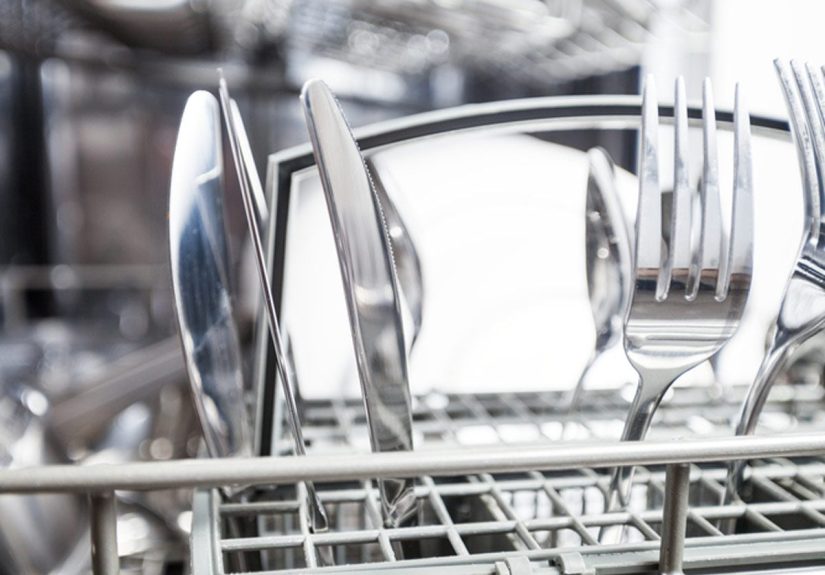
When spoons nest together or forks clump into a metallic bouquet, water cannot reach every surface. That is why silverware often comes out with bits of food still stuck between pieces. It is not rebellion. It is bad spacing.
There is also the classic loading debate: handles up or handles down? The most practical answer is that not every utensil should be treated the same way. Safety matters, but so does cleaning performance.
What to do instead
Mix up the silverware instead of grouping identical items together. Alternate spoon direction so they do not nest. Forks often clean well tines-up, while knives should generally go blade-down for safety. Grab your model’s silverware basket covers or slots if it has them, because separation is the whole game here.
8. You’re Putting Plastics on the Bottom Rack
Dishwasher-safe plastic does not mean indestructible plastic. The lower rack sits closer to the heating element in many machines, and that extra heat can warp containers, lids, and lightweight pieces. Best case, they come out bent. Worst case, they come out looking like modern art.
What to do instead
Keep plastics on the top rack unless your dishwasher manual specifically says otherwise. Angle containers downward like you would cups and bowls, and avoid trapping lids tightly against other items. Give plastic room to dry, because it is already the diva of the dishwasher world.
9. You’re Tossing Long Utensils and Big Flat Items Wherever They Fit
Spatulas, ladles, tongs, reusable straws, serving spoons, baking sheets, and cutting boards are awkward. Because they are awkward, people tend to shove them into the first available spot. Unfortunately, that spot is often terrible.
Long utensils can fall through the rack, block the spray arms, or prevent cups from sitting properly. Large flat items can create a wall that stops water and detergent from reaching the rest of the load.
What to do instead
Lay long utensils flat on a third rack if you have one, or place them securely on the top rack where they will not poke through or interfere with movement. Put baking sheets and cutting boards along the sides, never across the front like a tiny kitchen barricade.
10. You’re Putting Things in the Dishwasher That Should Never Be There
Yes, the dishwasher is convenient. No, it is not a magical spa for every kitchen item you own. Cast iron, many sharp knives, certain nonstick pans, wood utensils, wood cutting boards, delicate crystal, fine china, and some insulated items can be damaged by dishwasher heat, detergent, or prolonged moisture.
Loading these items “just this once” is how good kitchen tools get ruined. One cycle later, your wooden spoon is cracked, your knife is dull, and your cast iron pan is staring at you like you betrayed the family.
What to do instead
Check the manufacturer care instructions before loading anything questionable. When in doubt, wash valuable or delicate items by hand. The dishwasher is a hardworking appliance, but it should not be asked to destroy your favorite cookware in the name of convenience.
A Better Dishwasher Loading Routine in 6 Simple Moves
Want cleaner dishes without overthinking every fork? Use this routine:
- Scrape off large food scraps, but do not turn pre-rinsing into a full side quest.
- Load the bottom rack with plates, pots, pans, and large bowls.
- Load the top rack with glasses, cups, small bowls, and dishwasher-safe plastics.
- Angle everything downward and give each item space.
- Keep spray arms and the detergent dispenser clear.
- Separate silverware and place sharp items safely.
That is it. Cleaner dishes are less about secret hacks and more about not setting your dishwasher up to fail.
What Real-Life Dishwasher Experience Usually Teaches You
In real kitchens, dishwasher loading mistakes usually reveal themselves slowly, not dramatically. Nobody loads one plate incorrectly and immediately hears a dramatic orchestral warning. Instead, you notice patterns. The cereal bowls are always still wet. The pasta pot never comes clean unless you wash it twice. The forks look fine until you pick one up and find a tiny dried leaf of spinach doing its best to survive modern civilization.
A lot of households learn the hard way through repetition. Someone loads the dishwasher after dinner in a hurry, trying to fit one more pan, one more lunch container, one more mug. The next morning, half the load needs to be rewashed, and suddenly the kitchen has two categories of dishes: “clean enough, probably” and “absolutely not.” That is usually the moment people realize the problem is not the detergent, the water, or the machine. It is the loading pattern.
Families also tend to have dishwasher personalities. There is the over-loader, who treats every cycle like an airline baggage challenge. There is the pre-rinser, who essentially hand-washes everything first and then still uses the dishwasher out of habit. There is the chaotic silverware dropper, who throws twelve spoons together like they are forming a band. And then there is the one person who quietly reloads the whole machine after everyone leaves the kitchen. Every home seems to have that person.
Experience also teaches that the most frustrating mistakes are the invisible ones. A cutting board leaned in front of the detergent cup seems harmless until the soap pod comes out half dissolved. A serving spoon sticking through the rack looks minor until it blocks a spray arm. A bowl that is only slightly too flat seems fine until you unload it and pour out a tablespoon of lukewarm mystery water onto your sock.
Then there is the plastic lesson. Almost everyone has melted or warped something at least once. It is usually a lid. Somehow it is always the lid you actually needed. After that, people tend to become very loyal to the top rack. Pain is a powerful teacher, and so is the sight of a food container that now resembles a folded envelope.
Roommates and couples often discover that dishwasher loading is weirdly emotional. It feels small, but it touches time, routine, and fairness. If one person reloads the machine every night, they are not really mad about the spoon placement. They are mad about doing invisible labor. Oddly enough, learning the correct way to load a dishwasher can reduce not just dirty dishes, but household irritation. Fewer rewashes means less wasted time, less water, and fewer passive-aggressive sighs in the kitchen.
The biggest practical lesson from experience is this: consistency beats cleverness. You do not need a genius-level system. You need a simple one that works every night. Plates in the bottom rack. Glasses up top. Bowls angled. Spray arms clear. Silverware separated. Big items out of the detergent door’s way. Once that becomes routine, the dishwasher starts doing what it was built to do, which is save you effort instead of creating extra work disguised as convenience.
And maybe that is the most relatable dishwasher truth of all. The machine is not asking for perfection. It is just asking you not to stack a soup bowl on top of a sauté pan, block the detergent pod, and then act shocked when the forks come out wearing peanut butter.
Final Thoughts
If your dishwasher has been underperforming, do not rush to blame the appliance. In many cases, a smarter loading method fixes the problem fast. Give items room, use the racks for what they were designed for, keep the spray path clear, and stop letting silverware cuddle so aggressively.
The right dishwasher loading habits can help dishes come out cleaner, dry better, and save you from rerunning the same load like some kind of soapy time loop. A few small changes really can make the difference between sparkling dishes and a rack full of regrets.






 Close
Close