
Table of Contents >> Show >> Hide
- How to Choose a Flowering Vine That Won’t Ruin Your Weekend
- The Big List: 26 Flowering Vines for Fences, Arbors, and Trellises
- 1) Blue Sky Vine (Thunbergia grandiflora)
- 2) Bougainvillea (Bougainvillea spp.)
- 3) Black-Eyed Susan Vine (Thunbergia alata)
- 4) Canary Creeper (Tropaeolum peregrinum)
- 5) Carolina Jessamine (Gelsemium sempervirens)
- 6) Chocolate Vine (Akebia quinata)
- 7) Climbing Nasturtium (Tropaeolum majus)
- 8) Climbing Roses (Rosa spp.)
- 9) Crossvine (Bignonia capreolata)
- 10) Cypress Vine (Ipomoea quamoclit)
- 11) Clematis (Clematis spp.)
- 12) Climbing Hydrangea (Hydrangea anomala subsp. petiolaris)
- 13) Cup and Saucer Vine (Cobaea scandens)
- 14) Firecracker Vine / Spanish Flag (Ipomoea lobata)
- 15) Honeysuckle Vine (Lonicera spp.)
- 16) Hyacinth Bean Vine (Lablab purpureus)
- 17) Madagascar Jasmine (Stephanotis floribunda)
- 18) Mandevilla (Mandevilla spp.)
- 19) Moonflower Vine (Ipomoea alba)
- 20) Morning Glory (Ipomoea purpurea)
- 21) Passion Vine (Passiflora spp.)
- 22) Purple Bell Vine (Rhodochiton atrosanguineus)
- 23) Scarlet Runner Bean (Phaseolus coccineus)
- 24) Star Jasmine / Confederate Jasmine (Trachelospermum jasminoides)
- 25) Trumpet Vine (Campsis radicans)
- 26) Wisteria (Wisteria spp.)
- Training & Care Tips That Make Vines Look “Designed,” Not “Accidental”
- of Real-World “Vine Life” Experience (So You Don’t Learn the Hard Way)
- Conclusion
If your fence looks like it’s auditioning for the role of “World’s Longest Beige Ruler,” a flowering vine can fix that fast.
Vines turn flat, forgettable vertical space into a living wall of color, fragrance, and pollinator traffic. Think of them as
nature’s way of saying, “Nice structure you’ve got theremind if I accessorize?”
The trick is choosing the right climber for the right job. Some vines are polite houseguests. Others are the friend who
“crashes on your couch” and three months later has changed the Wi-Fi password. This guide helps you pick vines that
look amazing on fences, arbors, and trelliseswithout turning your yard into a light botanical horror movie.
How to Choose a Flowering Vine That Won’t Ruin Your Weekend
1) Match the vine’s climbing style to your structure
Vines climb in different ways, and your support needs to match the plant’s personality:
- Twiners wrap stems around supports (great on trellis lattice, cables, pergola posts).
- Tendril climbers grab with little “hands” (excellent for fences and wire panels).
- Clingers use aerial roots to stick (amazing coverage, but choose surfaces wiselymore on that below).
2) Be honest about your sun and your patience
Full sun usually means more flowers. Part shade often means fewer blooms but happier leaves. Deep shade is where you
pick shade-tolerant vines and accept that “flowering” may mean “a few blooms, eventually, when the vine feels emotionally ready.”
If you want instant summer color, annual vines are your fast friends. If you want long-term structure and repeat bloom, go perennial.
3) Choose “vigorous” only if you also choose “pruning shears”
Many of the most dramatic bloomers grow quickly and can get heavy. That’s not a problemunless the support is flimsy,
the vine is aggressive in your region, or you’d rather not spend your Saturdays untangling stems like you’re defusing a plant-based bomb.
When in doubt: pick a well-behaved native option or a vine you can comfortably prune and train.
4) Think about pets, kids, and foot traffic
Some vines have thorns, some have irritating sap, and some have parts that shouldn’t be eaten raw. If your trellis is next
to a walkway, skip thorny vines. If your household includes curious nibblers (human or otherwise), do a quick safety check
for the specific plant you choose.
The Big List: 26 Flowering Vines for Fences, Arbors, and Trellises
Below are standout vinesannual and perennialchosen for their showy blooms, real-world garden performance, and ability
to make vertical structures look intentional (instead of like you’re storing spare lumber upright).
1) Blue Sky Vine (Thunbergia grandiflora)
Big, purplish-blue flowers with a golden throat make this vine look like it belongs in a tropical resort brochure.
It’s a fast grower in warm climates and can be grown as an annual where winters are cold. Give it consistent moisture and
something sturdy to climb.
2) Bougainvillea (Bougainvillea spp.)
This sun-loving stunner gets its color from papery bracts that surround small flowersmeaning it “blooms” like it’s trying
to win a neon sign contest. It’s drought-tolerant once established in warm zones, but watch the thorns and keep it off tight walkways.
3) Black-Eyed Susan Vine (Thunbergia alata)
A cheerful annual with bright blooms (yellow, orange, or white) and dark centers that look like button eyes.
Great for trellises and hanging baskets, and easy from seed. It keeps flowering through summer into fall with regular watering.
4) Canary Creeper (Tropaeolum peregrinum)
Fringed yellow flowers resemble tiny canaries in mid-flight. It’s a quick seasonal climber that adds playful texture to fences and trellises.
Plant after frost, give it sun, and enjoy the pollinator attentionthis vine is basically a nectar café with décor.
5) Carolina Jessamine (Gelsemium sempervirens)
One of the best “late winter into early spring” mood-lifters, with fragrant yellow trumpet blooms.
It’s evergreen in many warm regions and makes a beautiful screen on fences. Provide sun and moisture, then prune after flowering to keep it tidy.
6) Chocolate Vine (Akebia quinata)
Yes, it can smell faintly chocolatey, and yes, that’s delightful. But it’s also vigorous and can be invasive in parts of the U.S.
If you grow it, keep it contained, prune regularly, and avoid planting near natural areas where it can spread.
7) Climbing Nasturtium (Tropaeolum majus)
An annual that’s easy, edible (leaves and flowers), and charmingly informal. Blooms come in warm sunset shades and pair well with cottage-style gardens.
It may need a little help getting started on a trellis, but once it catches, it goes with confidence.
8) Climbing Roses (Rosa spp.)
For romance, fragrance, and that classic arbor moment, climbing roses deliver. Train canes horizontally for better flowering and give them strong support.
They’re not true vines, but they climb beautifully when tied in. Deadhead for repeat bloom on many varieties.
9) Crossvine (Bignonia capreolata)
A vigorous native vine with trumpet-shaped blooms in warm tones that hummingbirds adore.
It can cover large structures and often stays leafy in mild winters. Prune after flowering to keep it within bounds and encourage fresh growth.
10) Cypress Vine (Ipomoea quamoclit)
Airy, fernlike foliage and small red trumpet flowers make this annual look delicatebut it grows fast.
Hummingbirds love it. It may reseed, so pull extras if it gets too enthusiastic. Great for trellises that need quick summer color.
11) Clematis (Clematis spp.)
The queen of variety: big blooms, small blooms, ruffled blooms, single blooms, and colors for days.
Many clematis thrive with “head in the sun, feet in the shade,” so mulch the root zone or plant a low companion at its base.
Pruning depends on typeknow which group you have.
12) Climbing Hydrangea (Hydrangea anomala subsp. petiolaris)
A dreamy choice for shade and north-facing walls, with lacy white blooms and lush foliage.
It can take time to establishthen it takes off. Because it clings with aerial roots, place it where mature size (and attachment) won’t be a problem.
13) Cup and Saucer Vine (Cobaea scandens)
Bell-shaped flowers that shift from greenish to purple give this annual an exotic vibe.
Start seeds indoors early for best performance, then let it race up an arbor or fence. The blooms are large enough to stop you mid-walk for a closer look.
14) Firecracker Vine / Spanish Flag (Ipomoea lobata)
Tubular flowers that open red and fade through orange to yellowlike a living ombré paint sample.
It’s a showpiece annual in most climates (perennial only where frost doesn’t happen). Pollinators treat it like an all-inclusive resort.
15) Honeysuckle Vine (Lonicera spp.)
Sweet fragrance, tubular blooms, and reliable pollinator actionespecially hummingbirds.
Choose species carefully: some are invasive, while native or well-behaved types are garden heroes. Give sun and moderate moisture, then prune after bloom.
16) Hyacinth Bean Vine (Lablab purpureus)
A dramatic annual with purple-tinged foliage, pink-purple flowers, and glossy purple pods.
It’s a canopy-maker for arborsfast. Treat the beans as ornamental unless you’re sure of safe preparation, because raw beans can be toxic.
17) Madagascar Jasmine (Stephanotis floribunda)
Glossy leaves and intensely fragrant white blooms make this feel like a fancy patio upgrade.
In colder zones, it’s often grown in containers and overwintered indoors in bright light. Give it warmth, steady moisture, and a trellis it can twine around.
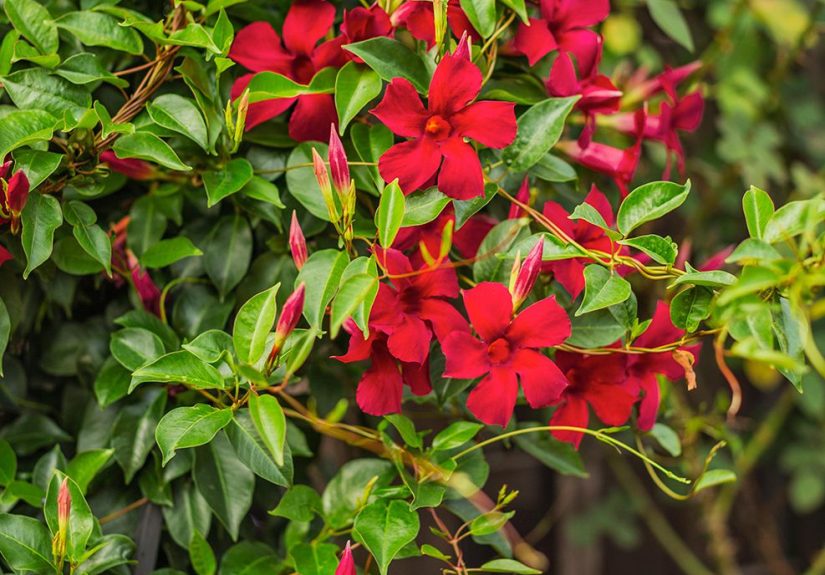
18) Mandevilla (Mandevilla spp.)
Tropical, glossy, and generous with big trumpet blooms in red, pink, or white.
It loves heat and shines in containers with a small trellisperfect for patios and balconies. Bring it indoors before frost if you want to keep it year to year.
19) Moonflower Vine (Ipomoea alba)
Night-blooming, fragrant, and delightfully theatricalflowers open at dusk and can look like they glow.
Great for “moon gardens” or anywhere you hang out in the evening. Provide sun, consistent moisture, and patience until warm nights trigger blooming.
20) Morning Glory (Ipomoea purpurea)
A classic annual that climbs fast and blooms early in the day in blues, purples, pinks, and bicolors.
It often self-sows, so it can come back with enthusiasm. If you want “easy coverage,” it’s a winner; if you want “strict order,” it may test you.
21) Passion Vine (Passiflora spp.)
Uniquely intricate flowers that look like they were designed by a creative committee with unlimited caffeine.
Many types are pollinator magnets and can serve as host plants for butterflies. Some species can spread aggressively, so pick an appropriate type for your region.
22) Purple Bell Vine (Rhodochiton atrosanguineus)
Dangling purple-pink “bells” with a darker inner tube give this vine serious wow factor.
Often grown as an annual where winters are cold, and it can handle a bit of shade better than many bloomers. Train it on a trellis for a cascading, romantic look.
23) Scarlet Runner Bean (Phaseolus coccineus)
A fast annual that doubles as décor and dinner (with proper harvest and cooking).
Scarlet flowers attract hummingbirds, and the vine creates a quick privacy screen on fences or trellises. Great for gardeners who like beauty with benefits.
24) Star Jasmine / Confederate Jasmine (Trachelospermum jasminoides)
Glossy evergreen foliage plus intensely fragrant, starry white flowersthis vine makes patios smell expensive.
It’s easy to train over trellises and pergolas, and once established, it tolerates some drought. Prune after flowering to keep it dense and well-shaped.
25) Trumpet Vine (Campsis radicans)
Huge impact: big clusters of trumpet flowers that hummingbirds can’t resist.
It clings and gets heavy, so it needs a truly sturdy structure. It can spread aggressively by suckers and seed, so plant only if you’re willing to manage itand keep it away from delicate neighbors.
26) Wisteria (Wisteria spp.)
Cascading flower clusters and fragrance make wisteria the grand finale on arbors and pergolas.
In the U.S., choose native American wisteria (Wisteria frutescens) for a more restrained, eco-friendlier option. Avoid invasive Asian species where they’re known to spread. Strong support is non-negotiable.
Training & Care Tips That Make Vines Look “Designed,” Not “Accidental”
- Start with a plan: Decide where you want the vine to go, then tie or weave young stems early. Waiting until it’s “big enough” is how you get the botanical version of cable spaghetti.
- Water smart: Deep water during establishment. After that, many vines handle average moistureexcept container vines, which dry out faster.
- Feed lightly: Too much nitrogen can mean lush leaves and fewer flowers. If bloom is the goal, use balanced feeding and avoid over-fertilizing.
- Prune with purpose: Prune after flowering for many spring bloomers; prune repeat bloomers to shape and encourage new flowering shoots. Always remove dead, weak, and crossing stems.
- Mind the weight: Mature woody vines can be surprisingly heavy. Upgrade your trellis before the vine upgrades it for you (by pulling it down).
of Real-World “Vine Life” Experience (So You Don’t Learn the Hard Way)
Ask gardeners about flowering vines and you’ll hear the same theme: the first season feels like magic, the second season feels like genius,
and the third season is where you discover whether you adopted a charming climber…or a leafy roommate with boundary issues.
The most common “I wish I knew this earlier” lesson is that training matters more than people think. Vines don’t automatically climb in the
direction of your dreamsthey climb toward light, space, and whatever support they can grab. If you guide young stems early (a soft tie here,
a gentle weave there), you get a clean, intentional look: an arbor framed like a doorway, a trellis filled evenly, a fence dressed in blooms
instead of random clumps. If you don’t guide them, you often end up with a dense top-heavy crown and a bare section at eye levellike your vine
decided the best design choice was “all the drama, none of the balance.”
Another real-life truth: “fast-growing” is only a compliment if your structure is ready. Many gardeners start with a cute lightweight trellis
that looks great in the store and folds like a lawn chair after the vine hits peak summer. A better approach is choosing the support first,
especially for woody vines (think wisteria, trumpet vine, climbing hydrangea, and mature rose canes). Treat it like hanging a heavy mirror:
you wouldn’t use a thumbtack, and your pergola shouldn’t either.
Gardeners also learn that bloom timing is everything for outdoor living spaces. If you want summer shade on a pergola, you’ll love fast annuals
or vigorous summer bloomers. If you want spring fragrance greeting you at the gate, you’ll lean toward early bloomers like Carolina jessamine
or a well-chosen honeysuckle. And if you want nighttime ambiance for patios, moonflower turns ordinary evenings into “Did you see that?”
momentsbecause those blooms open like nature’s own time-lapse video.
Then there’s the “invasive-adjacent” learning curve. Many gardeners pick vines based on pictures alone, then discover that some popular choices
can spread beyond the garden, smother shrubs, or reseed with impressive confidence. The smarter, modern approach is simple: check local invasive
plant lists, choose native or non-invasive alternatives when available, and keep vigorous vines contained with pruning and thoughtful placement.
You can still have a lush, flower-covered fence without accidentally giving your neighborhood an unsolicited vine situation.
Finally, experienced gardeners tend to pair vines with a little ground-level strategy. A “cool root zone” trickmulch, low perennials,
or a small shrub at the basecan improve performance for plants that prefer shaded roots (hello, clematis). The result is healthier growth,
better flowering, and fewer mid-summer tantrums. In other words: treat the base well, and the vine returns the favor by making your vertical
spaces look like a garden catalogminus the suspiciously perfect lighting.
Conclusion
Flowering vines are one of the fastest ways to make fences, arbors, and trellises look purposefuland to turn “just a structure” into a real
garden feature. Pick a vine that matches your sun, your zone, and your willingness to prune, and you’ll get years of color, fragrance, and
pollinator-friendly blooms with surprisingly little fuss. Choose carefully, train early, and let your vertical space do the heavy lifting.





 Close
Close