
Table of Contents >> Show >> Hide
- Way #1: Naming Ionic Compounds (Charge Rules the World)
- Way #2: Naming Molecular (Covalent) Compounds (Counting With Style)
- Way #3: Naming Acids (and the Bases That Hang Out With Them)
- Common Mistakes (a.k.a. “How Names Go Off the Rails”)
- A Fast Self-Check Before You Turn It In
- Experience Notes: What Naming Compounds Feels Like in Real Life (About )
- Conclusion
Chemistry has a reputation for being hard, but honestly, the atoms are usually pretty chill.
It’s the names that get dramatic. One minute you’re holding something harmless like table salt,
and the next you’re being asked to spell “tetra…” anything without looking it up. (We’ve all been there.)
The good news: naming compounds isn’t random. It’s a set of rulebooks designed so scientists, students,
and safety labels don’t have to play “guess that mystery powder.” In practice, you’ll name compounds in
three main ways, depending on what type of compound you’re dealing with:
- Ionic compounds (ions + charge-balancing)
- Molecular (covalent) compounds (prefixes + counting atoms)
- Acids (and closely related bases) (special naming patterns)
Below is a clear, example-packed guide to each methodplus common pitfalls and a quick cheat sheet to keep you sane.
Way #1: Naming Ionic Compounds (Charge Rules the World)
Ionic compounds form when a metal (or a positively charged polyatomic ion) bonds with a nonmetal
(or a negatively charged polyatomic ion). The key idea: the total positive and negative charges must balance.
Naming follows that same “who’s positive, who’s negative” logic.
The core pattern
- Name the cation first (the positive ion).
- Name the anion second (the negative ion).
- If the anion is a single element, change its ending to -ide.
- If the metal can have more than one charge, use a Roman numeral to show the charge.
Examples: simple (binary) ionic compounds
NaCl → sodium chloride
CaO → calcium oxide
Notice the second element becomes “chloride,” “oxide,” “sulfide,” and so on.
That “-ide” ending is your neon sign that you’re dealing with a single-element anion.
When metals play “multiple personality”: the Stock system
Many transition metals can form more than one cation (charge). That’s why we write names like:
- FeCl2 → iron(II) chloride
- FeCl3 → iron(III) chloride
The Roman numeral tells you the charge on the metal ion: iron(II) is Fe2+, iron(III) is Fe3+.
No Roman numeral? Then the metal is one of the “predictable charge” elements (like Group 1 and Group 2 metals).
Polyatomic ions: keep the name, don’t switch to “-ide”
Polyatomic ions are charged groups of atoms that behave like a unit. Their names usually end in -ate or -ite,
and you keep those names exactly as-is.
| Common polyatomic ion | Formula | Charge |
|---|---|---|
| ammonium | NH4+ | +1 |
| hydroxide | OH− | −1 |
| nitrate | NO3− | −1 |
| carbonate | CO32− | −2 |
| sulfate | SO42− | −2 |
| phosphate | PO43− | −3 |
Now let’s use them:
- NaNO3 → sodium nitrate
- CaCO3 → calcium carbonate
- (NH4)2SO4 → ammonium sulfate
Hydrates: “salt name + prefix-hydrate”
Some ionic compounds crystallize with water molecules tucked into the structure. These are hydrates.
The dot in the formula (·) is basically chemistry’s way of saying “plus water, but make it fancy.”
- CuSO4·5H2O → copper(II) sulfate pentahydrate
- CoCl2·6H2O → cobalt(II) chloride hexahydrate
The hydrate prefix tells you how many waters: mono- (1), di- (2), tri- (3),
tetra- (4), penta- (5), hexa- (6), and so on.
Way #2: Naming Molecular (Covalent) Compounds (Counting With Style)
Molecular (covalent) compounds usually form between two nonmetals. Instead of swapping electrons and forming ions,
atoms share electronsmeaning you typically don’t name them with charges or Roman numerals.
You name them by counting atoms with Greek prefixes.
The core pattern
- Name the first element.
- Name the second element with an -ide ending.
- Add prefixes to show how many atoms of each element are present.
- Usually skip mono- on the first element (but keep it if it’s the second element and needed).
- If a prefix ends in a or o and the next word starts with a vowel (like “oxide”), you often drop that last vowel (e.g., “tetroxide,” not “tetraoxide”).
Prefix cheat list (1–10)
| Number | Prefix |
|---|---|
| 1 | mono- |
| 2 | di- |
| 3 | tri- |
| 4 | tetra- |
| 5 | penta- |
| 6 | hexa- |
| 7 | hepta- |
| 8 | octa- |
| 9 | nona- |
| 10 | deca- |
Examples that show the rules
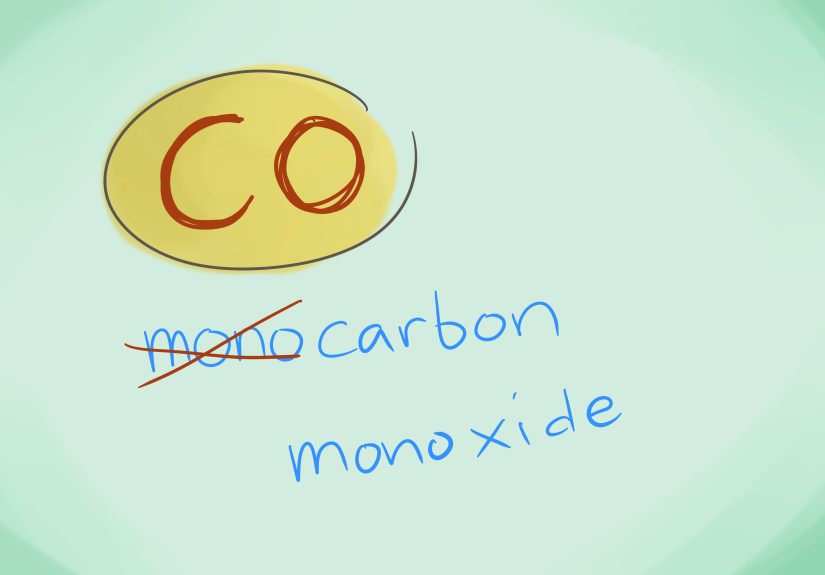
- CO → carbon monoxide (mono- appears on the second element here)
- CO2 → carbon dioxide
- N2O4 → dinitrogen tetroxide
- PCl5 → phosphorus pentachloride
- SF6 → sulfur hexafluoride
A quick reality check: if you catch yourself trying to name a covalent compound with Roman numerals,
pause and ask, “Are these both nonmetals?” If yes, you probably want prefixes instead.
Way #3: Naming Acids (and the Bases That Hang Out With Them)
Acids get special treatment because their names often communicate behavior in water. Many acids start with hydrogen in the formula,
but the naming depends on whether the acid includes oxygen or not.
Step 1: Decide what kind of acid you have
- Binary acids: hydrogen + one nonmetal, no oxygen (examples: HCl, HBr, HF).
- Oxyacids: hydrogen + a polyatomic ion that contains oxygen (examples: HNO3, H2SO4).
Binary acids (no oxygen): “hydro–…–ic acid”
Pattern: hydro + root of nonmetal + ic acid
- HCl (aq) → hydrochloric acid
- HBr (aq) → hydrobromic acid
- HF (aq) → hydrofluoric acid
Note the “(aq)” idea matters in many courses: hydrogen chloride (as a gas) isn’t always treated the same as hydrochloric acid (in water).
If your teacher or textbook cares about states, keep an eye on them.
Oxyacids (contain oxygen): -ate → -ic, -ite → -ous
Oxyacid names come from the oxyanion:
- If the anion ends in -ate, the acid becomes -ic acid.
- If the anion ends in -ite, the acid becomes -ous acid.
Examples:
- HNO3 (nitrate → nitric acid)
- HNO2 (nitrite → nitrous acid)
- H2SO4 (sulfate → sulfuric acid)
- H2SO3 (sulfite → sulfurous acid)
What about hypo- and per-?
Some oxyanions come in a “family” with different oxygen counts. The prefixes stick around in the acid name:
| Oxyanion | Acid |
|---|---|
| ClO− (hypochlorite) | HClO (hypochlorous acid) |
| ClO2− (chlorite) | HClO2 (chlorous acid) |
| ClO3− (chlorate) | HClO3 (chloric acid) |
| ClO4− (perchlorate) | HClO4 (perchloric acid) |
Bases (quick note): often named like ionic compounds
Many bases are ionic compounds that contain hydroxide (OH−). The naming is refreshingly straightforward:
- NaOH → sodium hydroxide
- Ca(OH)2 → calcium hydroxide
- Fe(OH)3 → iron(III) hydroxide
Common Mistakes (a.k.a. “How Names Go Off the Rails”)
1) Using prefixes on ionic compounds
Stop right there. Prefixes (di-, tri-, tetra-) are for molecular (covalent) compounds.
Ionic compounds don’t use them because the formula is controlled by charge balance, not “how many we felt like today.”
2) Forgetting the Roman numeral for variable-charge metals
If the metal can be more than one charge, the Roman numeral matters. “Iron chloride” is like saying “meet me at the restaurant.”
Which restaurant? Which iron?
3) Mixing up -ate and -ite in acids
A tiny spelling change can produce a different compound. Nitrate vs. nitrite isn’t a vibeit’s a different number of oxygens,
and the acid name changes with it (nitric vs. nitrous).
4) Ignoring state cues when your course expects them
Some naming conventions emphasize whether something is an acid in water. If you see “(aq)” on assignments,
it’s a hint that the “acid name” is expected.
A Fast Self-Check Before You Turn It In
- Classify it: ionic, molecular, or acid?
- Scan for metals: a metal + nonmetal often signals ionic.
- Scan for hydrogen first: hydrogen leading the formula can signal an acid (especially in aqueous context).
- Confirm charge balance (ionic): does the formula make sense with the ion charges?
- Count atoms (molecular): do prefixes match subscripts?
- Check endings: -ide (monatomic anions), -ate/-ite (polyatomic anions), -ic/-ous (oxyacids).
If all that checks out, you’re not just guessingyou’re doing chemistry the professional way: methodically,
with fewer accidental explosions of confidence.
Experience Notes: What Naming Compounds Feels Like in Real Life (About )
If you’ve spent any time in a chemistry class (or even just watched someone label a mysterious jar in a lab),
you already know that naming compounds isn’t only an academic exerciseit’s a survival skill for your grade,
your lab partner’s patience, and occasionally the integrity of your eyebrows.
One common experience: the “I swear I knew this yesterday” moment during a quiz. You look at
FeCl3, and your brain offers three options: iron chloride, iron… something, or “panic.”
That’s usually when the naming rules stop being abstract. You remember that iron can have different charges,
the Roman numeral matters, and chloride is always -1. Suddenly, naming feels less like memorization and more like a puzzle
you can actually solve.
Another classic moment happens in labs when you’re labeling samples. Teachers (and safety guidelines) tend to be very unimpressed
by labels like “blue powder” or “maybe copper stuff?” Accurate names reduce confusion, prevent mix-ups, and make it easier to find
information on hazards and handling. Even in beginner labs, students learn quickly that a precise compound name can be the difference
between “right bottle” and “why is this fizzing.”
Group work brings its own special flavor. Someone will suggest naming a molecular compound with a Roman numeral, and another person will
insist on using prefixes for an ionic compound. Then the group has a mini-debate that sounds like:
“But it has two atoms!” / “Yes, and it also has charges.” This is where the classification step becomes the hero of the story.
Once you agree whether it’s ionic or molecular, the naming method usually falls into place.
Students also tend to develop a love-hate relationship with acids. The first time you see the -ate → -ic and -ite → -ous pattern,
it feels like chemistry is finally being nice. Then you meet hypo- and per-, and it’s like the universe whispering,
“You thought we were done?” Still, once you practice with a family like the chlorine oxyacids, the system becomes predictableand
predictable is basically chemistry’s love language.
And yes, there’s the pronunciation phase. People confidently say “di-nitro-gen tet-ra-ox-ide” with the rhythm of a victory speech,
and sometimes it’s correct, and sometimes it’s… close enough for a brave attempt. Over time, naming becomes less about sounding fancy
and more about communicating clearly. The goal isn’t to impress your periodic table; it’s to make sure everyone understands the same compound.
The most useful “experience takeaway” is this: compound naming rewards calm, step-by-step thinking. When you treat it like a checklist
(classify → apply rules → verify), it stops feeling like random vocabulary and starts feeling like a tool you control. And that’s a nice change
from the rest of life, where the rules are often unclear and nobody gives you a prefix chart.
Conclusion
Naming chemical compounds boils down to picking the right rule set:
ionic compounds follow charge logic, molecular compounds use prefixes to count atoms,
and acids follow special patterns tied to their anions (and often their behavior in water).
Learn the patterns, practice with real formulas, and you’ll start to recognize names the way you recognize songs on the radio:
not because you memorized every note, but because your brain knows what to listen for.







 Close
Close