
Table of Contents >> Show >> Hide
- Quick Cast List (Table of Contents)
- Innovations & Firsts That Changed the Remote Forever
- 1) “I Love Lucy” helped standardize the sitcom “look” we still recognize.
- 2) Desi Arnaz and Lucille Ball made a business move that basically invented “reruns as an empire.”
- 3) When Lucy got pregnant, the show tiptoed around the word “pregnant.”
- 4) The pregnancy storyline was carefully vettedbecause classic TV was both bold and terrified.
- 5) “Lucy” didn’t just break barriersit broke the “TV must be made in New York” assumption.
- 6) Desilu didn’t stay smallBall and Arnaz built a real production powerhouse.
- 7) “Mary Kay and Johnny” helped break the “two separate beds” TV taboo.
- 8) Rod Serling wrote a jaw-dropping number of “Twilight Zone” episodes.
- 9) “Star Trek” delivered a milestone kiss that still gets discussed like it happened yesterday.
- 10) Nichelle Nichols’ impact went far beyond TVshe worked with NASA recruitment efforts.
- 11) Martin Luther King Jr. reportedly encouraged Nichols to stay on “Star Trek.”
- Ratings Monsters & Finale Fever (When the Whole Country Watched Together)
- 12) The “M*A*S*H” finale pulled a number that still looks unreal.
- 13) “The Fugitive” helped invent the modern “event finale.”
- 14) “Cheers” closed its doors with tens of millions still at the bar.
- 15) “Seinfeld” proved that “a show about nothing” could end as a giant something.
- 16) “Gunsmoke” wasn’t just popularit was marathon popular.
- 17) “Jumping the shark” wasn’t just a phraseit was a literal moment.
- 18) A clown saying goodbye helped change what audiences expected from TV endings.
- Mayberry, Minneapolis, and Other Places That Feel Like Home
- 19) The “Andy Griffith” theme is basically a stress-relief technique.
- 20) Don Knotts didn’t start with a long-term dealBarney Fife almost wasn’t “Barney Fife.”
- 21) Little Ron Howard didn’t make the rock skip like a pro.
- 22) The show ended on toprare, and kind of legendary.
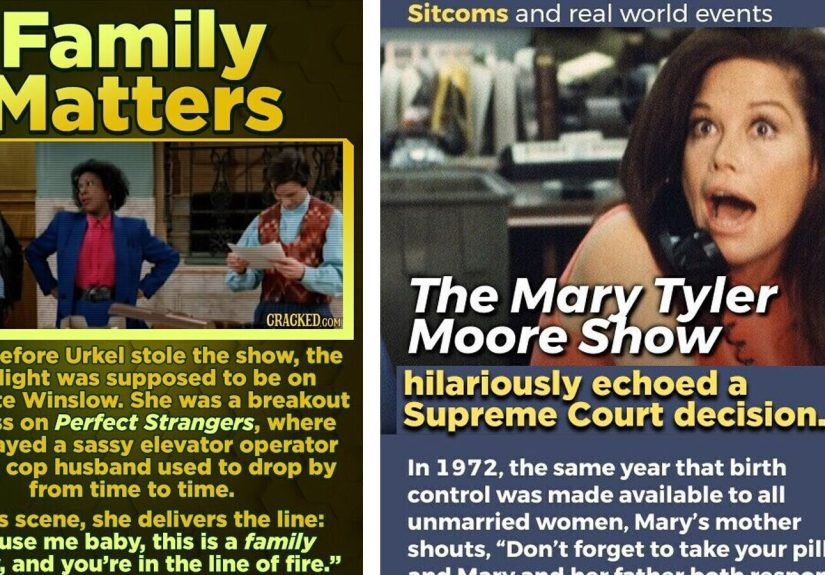
- 23) Minneapolis didn’t just appear on “The Mary Tyler Moore Show”it became part of TV iconography.
- 24) That theme song you can’t stop humming? It has a real rock-and-roll pedigree.
- 25) Minneapolis even got a statue to celebrate the hat toss.
- 26) “Cheers” wasn’t just a setits “Boston bar” DNA has a real-world cousin.
- Props, Gags, and Blink-and-You’ll-Miss-It Details
- 27) The “Dick Van Dyke Show” ottoman trip is one of TV’s most famous stumbles.
- 28) “Gilligan’s Island” famously upgraded its theme lyrics.
- 29) The Munsters had a hot rod that looked like it crawled out of a haunted garage.
- 30) “The Golden Girls” house location is one of TV’s great geography fibs.
- 31) And yesparts of that “Golden Girls” world were recreated on a studio backlot.
- 32) “All in the Family” is often credited with an oddly famous “first”: a toilet flush on TV.
- 33) Carol Burnett’s ear tug wasn’t randomit was a message.
- 34) “The Flintstones” didn’t just bring cartoons to prime timeearly broadcasts also carried old-school sponsorship culture.
- 35) “I Love Lucy” had sponsor-era openings that feel like a museum exhibit now.
- 36) Bonus “Lucy” flex: the reruns still look good because the show was built for longevity.
- Extra (): The Classic-TV ExperienceDown-By-the-Crick Edition
- Conclusion
Classic TV has a special kind of magic: the kind that smells like aluminum-foil antennae, sounds like a theme song you can whistle in your sleep, and
looks like a black-and-white living room where the biggest emergency is somebody using the “good” couch. These shows didn’t just entertain Americathey
taught it how to gather. One episode at a time, they turned family rooms into tiny theaters, turned commercials into shared inside jokes, and turned
“I’ll be right back” into the most dangerous lie a human can tell.
So grab your metaphorical tackle box, head down by the crick, and enjoy 33 bite-sized (but surprisingly filling) bits of classic television trivia.
Some are historic, some are weird, and some are the sort of behind-the-scenes detail that makes you whisper, “Wait… that’s why it looked like that?”
Innovations & Firsts That Changed the Remote Forever
1) “I Love Lucy” helped standardize the sitcom “look” we still recognize.
Instead of filming like a movie and faking laughs later, the show used multiple cameras on film in front of a live audiencecapturing timing, reactions,
and physical comedy with a snap that still feels modern. In other words: Lucy didn’t just fall into hijinks; she fell into television history.
2) Desi Arnaz and Lucille Ball made a business move that basically invented “reruns as an empire.”
A key part of “Lucy” lore is ownership: by insisting on production terms that gave them long-term control, they helped make syndication wildly lucrative.
The result is why classic episodes still circulate like comfort foodbecause America never really stopped rewatching.
3) When Lucy got pregnant, the show tiptoed around the word “pregnant.”
Network standards were so cautious that the series leaned on phrasing like “expecting,” and even used a French title for the episode (“Lucy Is Enceinte”).
It’s one of those moments where TV history reminds you: people were scandalized by things that now feel as normal as a grocery list.
4) The pregnancy storyline was carefully vettedbecause classic TV was both bold and terrified.
The storyline didn’t happen on a whim. It was handled with extra care, including consultation meant to keep it acceptable to broad audiences.
Classic TV often advanced culture… while nervously checking over its shoulder the whole time.
5) “Lucy” didn’t just break barriersit broke the “TV must be made in New York” assumption.
Early television leaned heavily on live, East Coast production. “I Love Lucy” pushed major production into Hollywood-style facilities and workflows.
Translation: it helped TV grow from “a thing we do” into “an industry with infrastructure.”
6) Desilu didn’t stay smallBall and Arnaz built a real production powerhouse.
Desilu expanded aggressively, including acquiring major studio space that gave them the capacity to produce at scale. That growth helped make Desilu a key
player in mid-century American TVa reminder that some of the biggest creative revolutions start as a couple saying, “We can do this ourselves.”
7) “Mary Kay and Johnny” helped break the “two separate beds” TV taboo.
Long before many people think TV allowed it, an early sitcom featuring a married couple showed them sharing a bedsomething later generations often
misattribute to much newer series. Classic TV sometimes moved faster than our collective memory.
8) Rod Serling wrote a jaw-dropping number of “Twilight Zone” episodes.
Serling wasn’t just the hosthe was the engine. He wrote a huge portion of the series’ scripts, which helps explain why the show has such a consistent
voice: morally sharp, socially aware, and always ready to drop a twist like a trapdoor.
9) “Star Trek” delivered a milestone kiss that still gets discussed like it happened yesterday.
The Kirk/Uhura kiss in “Plato’s Stepchildren” is often cited as one of the first interracial kisses on U.S. scripted television.
Beyond the headline, it’s a snapshot of how pop culture can push boundariessometimes in a single, unforgettable beat.
10) Nichelle Nichols’ impact went far beyond TVshe worked with NASA recruitment efforts.
Nichols became deeply associated with NASA’s push to recruit a more diverse astronaut corps, using her visibility to help expand who could picture
themselves in space. Classic TV didn’t just reflect the future; occasionally, it helped hire it.
11) Martin Luther King Jr. reportedly encouraged Nichols to stay on “Star Trek.”
The story endures because it fits the moment: representation mattered, and her role mattered. The power of “Uhura” wasn’t just that she was on the bridge
it’s that millions of viewers saw her there.
Ratings Monsters & Finale Fever (When the Whole Country Watched Together)
12) The “M*A*S*H” finale pulled a number that still looks unreal.
“Goodbye, Farewell and Amen” drew roughly 106 million viewersan all-time high-water mark for a single scripted TV episode in the U.S.
If you weren’t watching, you probably heard about it anyway… from everyone, forever.
13) “The Fugitive” helped invent the modern “event finale.”
Its ending didn’t just conclude a seasonit resolved the central mystery in a way that rewarded long-term viewers. The finale attracted about 78 million
people, proving audiences weren’t just watching plots; they were emotionally investing in them.
14) “Cheers” closed its doors with tens of millions still at the bar.
The finale drew an enormous audience (commonly reported around 80+ million viewers, with some estimates higher). It’s the kind of number that explains why
finales used to feel like national holidaysand why people still quote “Sorry, we’re closed.”
15) “Seinfeld” proved that “a show about nothing” could end as a giant something.
The finale’s audience (often reported in the mid-70-million range) was massiveone of the biggest sitcom endings ever. Even if you hated the finale,
you probably watched it. Hate-watching is also a form of love. (Don’t argue; history agrees.)
16) “Gunsmoke” wasn’t just popularit was marathon popular.
The series ran 20 seasons, making it a defining example of long-running prime-time drama in American television. When people say “they don’t make ’em like
they used to,” “Gunsmoke” is quietly sitting in the corner polishing a 20-season trophy.
17) “Jumping the shark” wasn’t just a phraseit was a literal moment.
The expression traces back to a 1977 “Happy Days” episode where Fonzie water-skis and jumps a shark. Love it or cringe at it, it became the pop-culture
shorthand for “we might be out of ideas, but we are not out of confidence.”
18) A clown saying goodbye helped change what audiences expected from TV endings.
In “Howdy Doody,” Clarabell the Clown famously spoke to say goodbyean early sign that TV could create real emotional closure, not just endless loops of
“see you next week.” Classic TV knew how to hit you in the feelings… with face paint on.
Mayberry, Minneapolis, and Other Places That Feel Like Home
19) The “Andy Griffith” theme is basically a stress-relief technique.
That whistling, that easy pace, that “no one’s locking the door” vibeit’s a theme song that feels like Saturday morning. The music practically hands you
a fishing pole and tells you to stop worrying about emails that don’t exist yet.
20) Don Knotts didn’t start with a long-term dealBarney Fife almost wasn’t “Barney Fife.”
Knotts reportedly began with a limited contract, and the character’s future grew from there. It’s a reminder that classic TV history is full of “happy
accidents” that became iconic.
21) Little Ron Howard didn’t make the rock skip like a pro.
In the opening credits, the splash you see is the kind of movie magic that’s hilariously small: a helping hand from off camera.
Even the most wholesome show ever still needed a crew member doing sneaky splash duty.
22) The show ended on toprare, and kind of legendary.
Ending a run while still a ratings king is unusual. It’s like retiring from a game after scoring the winning touchdownthen casually going fishing as the
stadium is still screaming.
23) Minneapolis didn’t just appear on “The Mary Tyler Moore Show”it became part of TV iconography.
The opening credits were filmed in downtown Minneapolis, and that hat toss at Nicollet Mall became a symbol of TV optimism: one woman, one hat, one
triumphant “I’m gonna make it after all” energy.
24) That theme song you can’t stop humming? It has a real rock-and-roll pedigree.
“Love Is All Around” was written (and performed) by Sonny Curtisyes, the musician and songwriter with deep roots in American popular music.
Classic TV themes weren’t just jingles; they were miniature anthems.
25) Minneapolis even got a statue to celebrate the hat toss.
Over time, the hat toss became so beloved it inspired a public tributeone of those rare moments where TV fandom becomes a physical landmark.
You can practically hear tourists whispering, “Okay, on threethrow!”
26) “Cheers” wasn’t just a setits “Boston bar” DNA has a real-world cousin.
The show’s bar was inspired by a real Boston pub (often cited as the Bull & Finch). Which means you can visit a place where everyone knows your name…
or, at minimum, where everyone knows you’re taking pictures of the sign.
Props, Gags, and Blink-and-You’ll-Miss-It Details
27) The “Dick Van Dyke Show” ottoman trip is one of TV’s most famous stumbles.
That opening gag became iconic because it feels accidentaleven when you know it’s not. It’s a perfect example of classic physical comedy:
simple, readable, and funny in any decade.
28) “Gilligan’s Island” famously upgraded its theme lyrics.
Early versions referenced “and the rest,” but later versions named the Professor and Mary Ann. Even in sitcom land, being “the rest” is a rough deal.
The theme song eventually did what every good friend should do: learn everyone’s names.
29) The Munsters had a hot rod that looked like it crawled out of a haunted garage.
One of the show’s memorable vehiclesthe Drag-U-Lawas built by famed custom car builder George Barris. Classic TV didn’t just design characters;
it designed machines with personality.
30) “The Golden Girls” house location is one of TV’s great geography fibs.
The show is set in Miami, but exterior shots came from a real home in Los Angeles (Brentwood). It’s the classic Hollywood trick:
“Sure, this is Florida. Please ignore the palm trees that look suspiciously California.”
31) And yesparts of that “Golden Girls” world were recreated on a studio backlot.
Over time, the show’s exterior identity became something that could be reproduced for production and tourism. In the classic-TV universe, the house isn’t
just a settingit’s a character fans want to visit.
32) “All in the Family” is often credited with an oddly famous “first”: a toilet flush on TV.
Sometimes trivia is grand (a record-breaking finale). Sometimes it’s… plumbing. Either way, it’s a reminder that classic TV constantly renegotiated what
could be shown and heard in American living rooms.
33) Carol Burnett’s ear tug wasn’t randomit was a message.
Burnett ended shows with a signature tug of her ear as a personal signal to her grandmother. It’s the sweetest kind of “inside joke”:
one that millions saw, but it was meant for just one person.
34) “The Flintstones” didn’t just bring cartoons to prime timeearly broadcasts also carried old-school sponsorship culture.
In early TV, sponsors were deeply woven into the viewing experience, and some classic footage preserves that era’s “now back to our program” flavor.
It’s a time capsule of how television used to sell you things with a wink and a jingle.
35) “I Love Lucy” had sponsor-era openings that feel like a museum exhibit now.
Early episodes included sponsor-specific openings, the kind of thing that makes modern viewers do a double take. It’s proof that TV didn’t just change
culturallyit changed structurally, minute by minute.
36) Bonus “Lucy” flex: the reruns still look good because the show was built for longevity.
The production choices that helped episodes survivevisually and commerciallyare a big reason “Lucy” remains so watchable. In a way,
classic TV didn’t just aim for laughs; it aimed for immortality.
Extra (): The Classic-TV ExperienceDown-By-the-Crick Edition
If you’ve ever fallen into a classic-TV marathon “by accident,” you already know the feeling: you sit down to watch one episode and suddenly it’s
two hours later, you’ve learned three new facts about 1960s sponsors, and you’re emotionally attached to a fictional small town where the biggest crisis is
somebody’s pride and a pie cooling on a windowsill. Classic television has a way of creating comfort that doesn’t depend on plot twists or special effects.
It’s the rhythmsetups, punchlines, the familiar living-room geography, the theme songs that sound like safety blankets.
A lot of people’s “classic TV” memories start with reruns: afternoon blocks on local stations, weekend lineups, or that one channel your grandparents always
seemed to have on. You didn’t always choose the show; the show chose you. Maybe it was “I Love Lucy” and you realized physical comedy could be
mathematically perfect. Maybe it was “The Andy Griffith Show” and you felt the strange peace of a world where neighbors actually talk to each otherwithout
first checking if the conversation is “worth it.” Or maybe it was “The Twilight Zone,” which could make you laugh, sweat, and rethink humanity in under
30 minutes (sometimes in that exact order).
Classic TV also turns into a social sport. People trade trivia like baseball cards: “Did you know the ‘M*A*S*H’ finale drew around 106 million viewers?”
“Did you know the ‘Fugitive’ finale was a massive event before ‘event finales’ were a thing?” “Did you know Mary Tyler Moore tossed her hat at a real
Minneapolis intersection?” Suddenly you’re not just watchingyou’re collecting stories, and the stories make the shows feel alive. That’s why classic TV
trivia is so sticky: it gives you a second layer of enjoyment. The episode is one treat; the behind-the-scenes fact is the cherry on top that you didn’t
know you needed.
And then there’s the vibethe “fishin’ down by the crick” feeling this title is chasing. Classic TV often depicts communities where trust is assumed,
not negotiated. People borrow sugar. Kids roam. Folks sit on porches. Even when the shows are set in big cities, there’s usually an emotional neighborhood:
the bar in “Cheers,” the newsroom energy and friend-group warmth around Mary Richards, the bridge crew camaraderie in “Star Trek.” It’s not that life was
actually simpler; it’s that these shows offered a blueprint for how we wish it could feelsafe enough to laugh, stable enough to breathe, and
warm enough that a theme song can still calm you down decades later.
That’s why people keep returning. In a world that refreshes every five seconds, classic TV is a slow stream you can sit beside. You don’t have to lock your
doors. You just have to hit play.
Conclusion
Classic TV trivia isn’t just “facts”it’s proof that the medium grew up in public, in real time. Shows experimented with production, standards, endings,
music, and representation, and audiences responded like a community (sometimes a 100-million-person community). Whether you’re here for “Lucy” innovations,
record-breaking finales, or the pure balm of Mayberry’s whistling theme, the best part is this: the stories are still watchable, still funny, and still
weirdly good company.





 Close
Close