
Table of Contents >> Show >> Hide
- What It Means to Divide Square Roots
- Way 1: Use the Quotient Rule
- Way 2: Simplify Each Square Root First, Then Divide
- Way 3: Rationalize a One-Term Radical Denominator
- Way 4: Use the Conjugate for a Two-Term Denominator
- Common Mistakes to Avoid
- Quick Strategy Guide
- Final Thoughts on Dividing Square Roots
- Learning Experiences: What Dividing Square Roots Feels Like in Real Life
Dividing square roots can look like the kind of thing invented just to make students sigh dramatically at their notebooks. But once you know the patterns, it becomes much less “math nightmare” and much more “oh, that’s all?” The trick is knowing which method fits the problem in front of you. Sometimes you divide directly. Sometimes you simplify first. Sometimes you have to rationalize the denominator because radicals, apparently, enjoy causing trouble from the bottom of fractions.
In this guide, you’ll learn four practical ways to divide square roots, when to use each one, and how to avoid the classic mistakes that turn a clean problem into algebra soup. We’ll keep the explanations clear, the examples real, and the drama level low.
What It Means to Divide Square Roots
Before we jump into the four methods, here’s the big idea: square roots follow rules. They are not free spirits. If you’re dividing one square root by another, you can often combine them under one radical. If a denominator still contains a square root, the expression usually is not considered fully simplified. That’s when rationalizing the denominator enters the chat.
Here are the questions to ask before solving:
1. Are both terms square roots?
If yes, you may be able to use the quotient rule.
2. Can either radical be simplified first?
This is often the fastest move. A messy expression can become friendly in one step.
3. Is there a radical in the denominator?
If yes, you’ll usually want to rationalize it.
4. Does the denominator have one term or two?
That determines whether you multiply by a simple radical or by a conjugate.
Now let’s break down the four best ways to divide square roots.
Way 1: Use the Quotient Rule
The quotient rule is the most direct method. It says that if you have the square root of a fraction, you can split it into two square roots. And if you already have two square roots being divided, you can often combine them into one.
Basic idea:
√a / √b = √(a / b)
This works nicely when the numerator and denominator create a fraction that simplifies into a perfect square.
Example 1
√50 / √2
Combine under one radical:
√(50 / 2) = √25 = 5
That’s the dream scenario. The radicals disappear, and everyone goes home happy.
Example 2
√27 / √3
√(27 / 3) = √9 = 3
Example 3
√18 / √8
√(18 / 8) = √(9 / 4) = 3 / 2
This method is especially useful when the radicands divide cleanly. If the fraction under the radical becomes simple, you save time and avoid extra steps.
When to Use Way 1
Use the quotient rule when both the numerator and denominator are square roots and their quotient is easy to simplify. It’s the cleanest method, and clean math is always a mood booster.
Way 2: Simplify Each Square Root First, Then Divide
Sometimes using the quotient rule right away works, but it creates an awkward fraction under the radical. In those cases, it can be smarter to simplify each radical first and then divide what’s left.
This method is the algebra version of tidying your kitchen before cooking. Yes, it takes a moment, but everything goes better afterward.
Example 1
√48 / √3
You could combine first:
√(48 / 3) = √16 = 4
That works beautifully. But now look at this one:
Example 2
√72 / √8
Combine first:
√(72 / 8) = √9 = 3
Still easy. Now let’s try a problem where simplifying first feels more natural:
Example 3
4√18 / 2√2
Simplify each part first:
√18 = √(9 × 2) = 3√2
So the expression becomes:
4(3√2) / 2√2 = 12√2 / 2√2
Now divide the coefficients and cancel the common radical:
12 / 2 = 6 and √2 / √2 = 1
Final answer: 6
If you tried to charge straight into the problem without simplifying, you might still get there, but you’d probably take the scenic route through Confusion County.
Example 4
3√20 / 5√5
Simplify √20 first:
√20 = √(4 × 5) = 2√5
Now rewrite:
3(2√5) / 5√5 = 6√5 / 5√5 = 6 / 5
When to Use Way 2
Use this method when one or both square roots can be simplified easily. It often reduces the amount of arithmetic, makes cancellation possible, and keeps the final answer cleaner.
Way 3: Rationalize a One-Term Radical Denominator
Now we’re entering the land of expressions like 5 / √3. The problem here is not that the expression is wrong. It’s that it usually is not considered simplified because the denominator still contains a radical.
To fix that, multiply the numerator and denominator by the same radical. This keeps the fraction equivalent while removing the square root from the denominator.
Example 1
5 / √3
Multiply top and bottom by √3:
(5 / √3) × (√3 / √3) = 5√3 / 3
That’s the simplified form.
Example 2
7 / 2√5
Multiply top and bottom by √5:
(7 / 2√5) × (√5 / √5) = 7√5 / 10
Notice something important: you do not just stick the radical on the top and call it a day. The denominator changes too, and that’s the whole point. Since √5 × √5 = 5, the radical disappears from the bottom.
Example 3
√6 / √11
Multiply top and bottom by √11:
(√6 / √11) × (√11 / √11) = √66 / 11
That’s a nice clean answer.
When to Use Way 3
Use this method when the denominator has a single square root term, such as √3, 4√7, or √11. It is the standard way to rationalize a simple radical denominator.
Way 4: Use the Conjugate for a Two-Term Denominator
This is where square roots get a little theatrical. If the denominator has two terms and one of them includes a square root, multiplying by the same radical will not be enough. You need the conjugate.
The conjugate is the same expression with the opposite sign in the middle.
Examples:
Conjugate of 2 + √3 is 2 − √3
Conjugate of 5 − √7 is 5 + √7
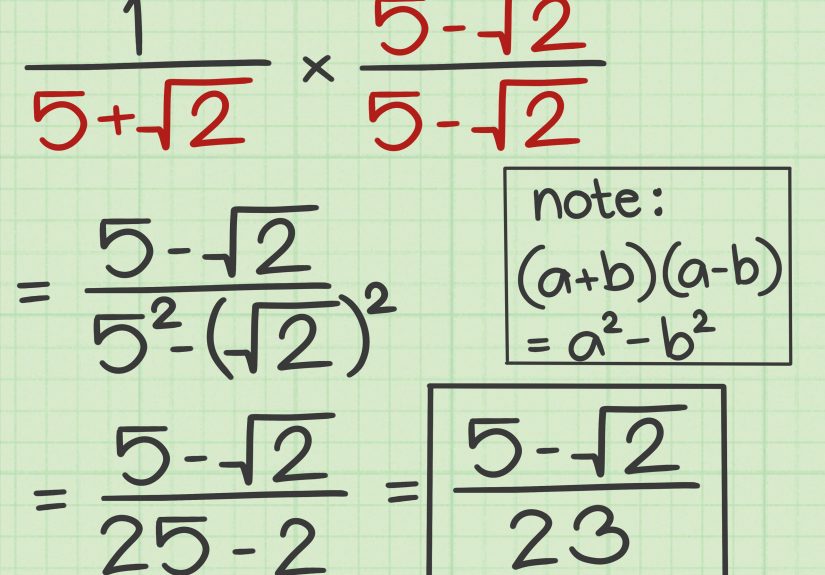
Why does this work? Because when you multiply conjugates, the middle terms cancel. It’s based on the pattern:
(a + b)(a − b) = a² − b²
Example 1
1 / (2 + √3)
Multiply top and bottom by the conjugate, 2 − √3:
[1 / (2 + √3)] × [(2 − √3) / (2 − √3)]
Numerator:
2 − √3
Denominator:
(2 + √3)(2 − √3) = 4 − 3 = 1
Final answer: 2 − √3
Example 2
4 / (3 − √5)
Multiply by the conjugate 3 + √5:
[4 / (3 − √5)] × [(3 + √5) / (3 + √5)]
Numerator:
4(3 + √5) = 12 + 4√5
Denominator:
(3 − √5)(3 + √5) = 9 − 5 = 4
So the expression becomes:
(12 + 4√5) / 4 = 3 + √5
Very satisfying. Almost suspiciously satisfying.
When to Use Way 4
Use the conjugate when the denominator contains two terms, especially a sum or difference involving a square root. This method removes the radical from the denominator without breaking the value of the expression.
Common Mistakes to Avoid
Forgetting to simplify first
Many students go straight into dividing without checking whether the radicals can be reduced. That can make an easy problem feel much harder than it is.
Rationalizing only the numerator
When rationalizing, you must multiply both the numerator and denominator by the same expression. Otherwise, you change the value of the fraction.
Using the wrong conjugate
If the denominator is 4 + √7, the conjugate is 4 − √7, not √7 − 4 and not 4 + √7 again. The whole point is to flip the sign between the two terms.
Stopping too early
After rationalizing, always check whether the numerator can still be simplified. Algebra loves one last little cleanup job.
Ignoring the denominator entirely
If your final answer still has a square root in the denominator, it is often not in simplest radical form.
Quick Strategy Guide
If you’re staring at a square root division problem and your brain has temporarily left the building, use this sequence:
1. Check whether the radicals can be simplified.
2. If both terms are square roots, try the quotient rule.
3. If a radical remains in a one-term denominator, rationalize with the same radical.
4. If the denominator has two terms, use the conjugate.
5. Simplify the result one more time.
That’s it. That’s the whole survival plan.
Final Thoughts on Dividing Square Roots
Dividing square roots is really about pattern recognition. Once you know what kind of denominator you’re dealing with, the method becomes much easier to choose. Some problems collapse instantly with the quotient rule. Others get nicer when you simplify first. And when radicals cling to the denominator like they pay rent there, rationalizing takes care of them.
The good news is that these problems are much more predictable than they look. The bad news is that they still enjoy looking dramatic in textbooks. But now you know the four main ways to handle them, so the next time a radical fraction shows up, you won’t have to guess. You’ll just pick the right method and move on with your life.
Learning Experiences: What Dividing Square Roots Feels Like in Real Life
One of the funniest things about learning how to divide square roots is that the topic almost always looks harder than it actually is. Students often see a fraction with radicals and immediately assume they are about to battle a mathematical dragon. Then, five minutes later, they discover the dragon was really just a lizard wearing a cape.
A very common experience is this: someone learns the quotient rule, gets excited, and starts combining every pair of radicals in sight. For a while, that works. Then a problem like 4√18 / 2√2 shows up, and the student either overcomplicates it or misses the simpler move of reducing √18 first. That moment matters because it teaches a bigger lesson than just radicals. In algebra, the best method is not always the first legal method. Sometimes the smart move is to pause, simplify, and let the problem become less annoying before you attack it.
Another classic experience happens with rationalizing denominators. At first, it feels random. Why are we multiplying by √5 / √5? Why is that allowed? Why does math keep making fractions dress up in new outfits? But once students understand that multiplying by a form of 1 keeps the value unchanged, rationalizing starts to make sense. It stops feeling like a weird school ritual and starts feeling like a cleanup technique. You are not changing the number. You are changing the way it is written so it is easier to work with.
The conjugate method usually creates the biggest “wait… what?” moment. Students often memorize it before they understand it. They hear “change the sign in the middle” and follow the instruction like a recipe. But the real breakthrough happens when they see the middle terms cancel in a product like (2 + √3)(2 − √3). Suddenly, the method has a reason. And once a method has a reason, it becomes easier to remember under pressure.
Test-day experience is another story altogether. Under time pressure, students tend to make one of three mistakes: they forget to simplify first, they rationalize incorrectly, or they stop before the answer is fully cleaned up. That is why short checkpoints help so much. Ask: Is the denominator rational? Can anything still be simplified? Did I multiply both top and bottom? Tiny questions save a surprising amount of points.
Over time, dividing square roots becomes less about memorizing rules and more about building instinct. You start to recognize patterns faster. You notice when a quotient will turn into a perfect square. You spot when a denominator is begging for a conjugate. And perhaps most importantly, you stop panicking when you see radicals in a fraction. That confidence is the real win. The math matters, of course, but the deeper experience is learning that intimidating-looking problems often become manageable once you know what pattern you are looking at. Square roots may never become everyone’s favorite topic, but they definitely become less mysterious once you’ve handled them a few times without the world ending.







 Close
Close