
Table of Contents >> Show >> Hide
- What Was da Vinci’s Mechanical Lion, Exactly?
- The Politics Behind the Purring
- How Could a 1500s Robot Lion Actually Work?
- So Why Did the Original Lion Disappear?
- “Brought to Life”: Modern Reconstructions and Where the Lion Roams Today
- What the Mechanical Lion Reveals About da Vinci’s Genius
- Why “Renaissance Robotics” Feels So Modern
- Conclusion: The Lion Still Has Teeth
- Experiences: What It Feels Like to Watch a 500-Year-Old Idea Start Walking
Leonardo da Vinci has a reputation for being the guy who couldn’t walk past a blank page without sketching something that would make future engineers sigh, smile, and then quietly open a spreadsheet. He painted masterpieces, dissected human bodies for anatomical accuracy, and still found time to doodle inventions that feel suspiciously like prototypes for modern machines. One of his most delightful “because I can” creations wasn’t a tank or a flying contraptionit was a lion. Not a living, roaring, steak-demanding lion. A mechanical lion: part automaton, part diplomatic flex, and part Renaissance-era “ta-da!”
And here’s the fun twist: the original lion vanished into history like a magician’s rabbit. But five centuries laterthanks to surviving notes, eyewitness descriptions, and modern reconstruction workda Vinci’s clockwork big cat is walking again, opening its chest, and basically reminding everyone that “robotics” didn’t start with Silicon Valley. It started with gears, springs, and a genius who couldn’t sit still.
What Was da Vinci’s Mechanical Lion, Exactly?
Picture a courtly event in early 16th-century Europe. There are banners, trumpets, expensive fabric, and the kind of political tension that could curdle milk. Thenout of nowherean artificial lion moves on its own. According to historical accounts, it steps forward, lifts its head, and opens its body to reveal a symbolic surprise: a bouquet of lilies (often tied to French royal imagery). It’s theater, engineering, and propagandaall in one wooden package.
The details vary depending on which account you read (history loves an unreliable narrator), but the core idea stays consistent: da Vinci designed an automaton lion meant to astonish a royal audience, impress a king, and deliver a message without anyone having to write a strongly worded letter.
Why a lion?
Because symbols matterespecially when you’re dealing with kings, popes, and powerful families playing 4D chess with borders. Lions scream strength, authority, courage, and “please don’t invade us.” Even better, “Leo” is baked into the story: Pope Leo X’s name, Leonardo’s name root, and the city of Lyon often connected to the lion’s presentation. In other words, da Vinci wasn’t just building a robothe was building a message.
The Politics Behind the Purring
It’s tempting to imagine da Vinci building the lion purely for joylike a hobbyist who says, “I got bored and made a walking cat out of oak.” But historical context suggests the lion was also political theater. Accounts connect the project to the world of papal diplomacy and French royal power, including moments when Pope Leo X and King Francis I were negotiating alliances and influence.
Gifts weren’t just gifts in Renaissance Europe. They were strategic moves. A mechanical lion that walks, performs, and delivers a symbolic flourish? That’s not a presentthat’s a headline. (If headlines existed the way they do today, it would have been: “LOCAL GENIUS BUILDS ROBOT LION, KING LOSING IT.”)
How Could a 1500s Robot Lion Actually Work?
Here’s the part that makes modern readers lean in: da Vinci didn’t have electricity, microcontrollers, or even a halfway decent hardware store aisle. What he did have was deep knowledge of mechanics and motionplus a lifelong habit of studying anatomy, animals, and how joints carry weight. That matters, because a convincing automaton isn’t just “move forward.” It’s move believably.
The Renaissance toolbox: gears, cams, pulleys, springs
While we don’t have a complete “step-by-step IKEA manual” from da Vinci for the lion, reconstructions and scholarship point to common automata techniques of the era:
- Coiled springs (or wound mechanisms) to store energythink “giant clock.”
- Gear trains to transfer and regulate that energy.
- Cams and followers to convert rotary motion into timed, repeated movements (like stepping, head-turning, jaw-opening).
- Pulleys and cables to pull limbs through controlled arcs.
- Escapement-like timing (in some reconstructions) to keep movement from turning into chaotic flailing.
If you’ve ever looked inside a mechanical clock and thought, “This is too many tiny decisions,” congratulationsyou’ve touched the same logic that makes a mechanical lion plausible. A walking sequence can be choreographed through timed releases and carefully shaped cams. The lion’s “surprise reveal” (opening the chest and presenting lilies) can be triggered at the end of a motion cyclelike a final bow after the performance.
But did it really roar?
Some stories exaggerate the lion’s abilitiesbecause humans have been overhyping tech demos since forever. Modern reconstructions generally focus on what’s mechanically feasible with period technology: walking, head movement, tail movement, jaw motion, and a chest-opening “reveal.” Whether it “roared” as sound is harder to prove, but the lion could certainly simulate “roaring motions” with head and jaw movementenough to make an audience gasp.
So Why Did the Original Lion Disappear?
Because the past is messy. Automata were often built for single eventspageants, royal visits, court celebrationsand then dismantled, repurposed, or lost. Materials degrade. Wars happen. Records scatter. Estates get reorganized by people who do not respect your beautifully crafted spring mechanisms.
In da Vinci’s case, much of what we know comes from later descriptions and fragments across notebooks rather than a single pristine blueprint. Some codices were lost for centuries and only rediscovered much later. So the mechanical lion became a kind of historical unicorn: famous, described, believed, but not physically present… until modern teams decided to rebuild it.
“Brought to Life”: Modern Reconstructions and Where the Lion Roams Today
When people say da Vinci’s mechanical lion has been “brought to life,” they mean something specific: engineers, historians, and craftspeople have created working models based on surviving evidencesketches, related mechanical studies, and historical accounts. Think of it as a collaboration across centuries, where the original “designer” is long gone, but the design intent still shines through.
The 2019 moment: a lion on display, five centuries after da Vinci
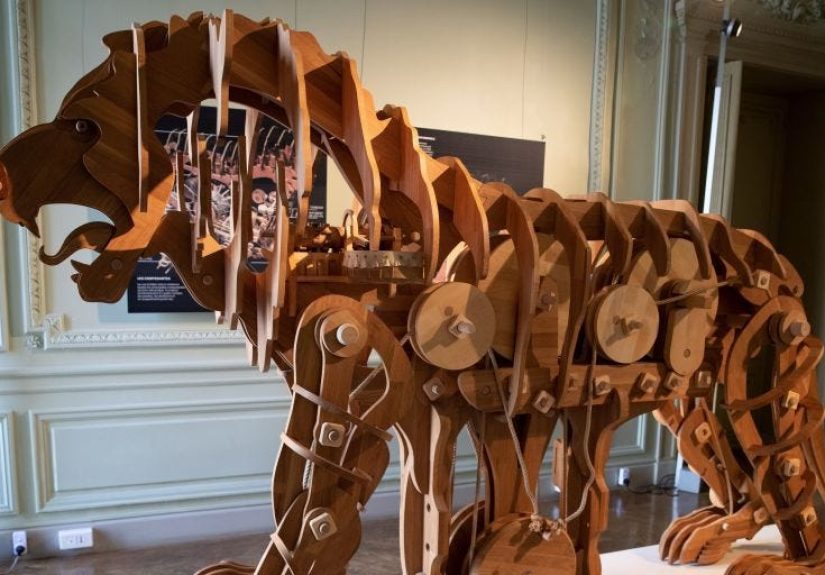
One widely reported reconstruction appeared on public display in Paris as part of tributes tied to the 500th anniversary of da Vinci’s death. The reconstructed lion is largeroughly human-tall and several meters longbuilt primarily of wood with an internal metal mechanism. It’s the kind of object that makes you realize: this wasn’t a cute little desk toy. It was a statement piece.
Earlier builds: the lion walks again
Reconstructions have also been associated with da Vinci-related exhibitions and sites connected to his final years, including displays that interpret the lion as a wind-up, clockwork-style automaton capable of taking steps, moving its head and tail, and revealing fleurs-de-lis. Different reconstructions may emphasize different motions, but the shared goal is the same: translate historical evidence into a working, physical machine.
You can see “da Vinci machines” in the U.S., too
Even if the lion you’re thinking of was displayed overseas, the broader ecosystem of da Vinci reconstructions has been touring for yearsoften with a mechanical lion as a featured model. Major science and museum venues in the United States have hosted exhibitions with full-size or interactive reconstructions of da Vinci’s devices, framing the lion within his broader legacy of automation, engineering, and showmanship.
What the Mechanical Lion Reveals About da Vinci’s Genius
The mechanical lion isn’t just a cool historical gadget. It’s a window into how da Vinci thoughtand why he still matters to modern engineering, design, and even robotics.
1) He designed for emotion, not just function
Modern tech culture loves “use cases.” Da Vinci loved “awe cases.” The lion’s primary job wasn’t productivityit was wonder. It was built to make a room full of powerful people stop talking and stare. That’s user experience design, Renaissance edition.
2) He blended observation with mechanics
Accounts of da Vinci’s work emphasize how intensely he studied natural motion. A convincing lion step requires more than hingesit requires understanding weight transfer, gait rhythm, and body balance. That’s biomechanics before the word existed.
3) He treated machines like living systems
In a good automaton, every motion is coordinated. A step triggers a shift, which triggers a head movement, which triggers a timing sequence. That systems thinkinglinking parts into a choreographyis exactly what makes robotics possible.
4) He understood the power of prototyping
Modern reconstructions highlight something important: even partial notes can encode a design philosophy. When researchers rebuild the lion, they’re not just copying a drawingthey’re testing hypotheses about how da Vinci would solve mechanical problems. Each working model becomes a form of historical “debugging,” bringing clarity to what was once speculative.
Why “Renaissance Robotics” Feels So Modern
If you’ve ever watched a robot dog trot across a stage at a product launch, you’ve seen a direct cousin of da Vinci’s lion: a machine built to demonstrate control, coordination, and craftwhile also making the audience say, “Wait, it can do that?”
The mechanical lion sits at a fascinating intersection:
- Robotics history: early attempts to mimic lifelike motion with purely mechanical systems.
- Art and engineering: a sculptural object whose beauty is part of its function.
- Public spectacle: technology as performance and persuasion.
- STEM education: a perfect hook for teaching gears, motion conversion, and mechanical sequencing.
In other words, it’s not just “a lion.” It’s a masterclass in design thinkingserved with a side of Renaissance drama.
Conclusion: The Lion Still Has Teeth
Five hundred years is a long time for any invention to wait for its encore. Yet da Vinci’s mechanical lion keeps returningnot because we need a clockwork big cat in our daily lives, but because it shows what happens when imagination meets mechanics. It’s proof that innovation isn’t always born from necessity. Sometimes it’s born from curiosity, ambition, and a desire to astonish.
And maybe that’s the real legacy: da Vinci didn’t just build machines. He built moments. The lion was a moving symbolliterallydesigned to turn engineering into emotion. In a world full of screens and software, there’s something deeply satisfying about a wooden creature powered by springs, gears, and human audacity walking forward and saying, without words, “Look what’s possible.”
Experiences: What It Feels Like to Watch a 500-Year-Old Idea Start Walking
Seeing a reconstruction of da Vinci’s mechanical lionwhether in a major museum exhibition, a traveling show, or even a video demonstrationhits differently than reading about it. On paper, it’s “an automaton.” In person, it’s a personality. You don’t just observe it; you anticipate it. The lion becomes a small suspense story: Will it move? How smoothly? Will it wobble? Will it do the famous chest-opening reveal? Your brain, which is extremely used to silent, perfect digital animations, suddenly has to deal with the reality of physical motion: friction, timing, and the soft clack of mechanisms doing their honest work.
The most surprising part is how human the experience feels. Not because the lion is aliveobviously it’s notbut because the machine broadcasts intention. You can sense the choreography: a pause before a step, a slight shift as the internal mechanism transfers force, the way the head movement reads as “attention.” It’s like watching a puppet, except the puppeteer is hidden inside the lion’s body in the form of gears and cams. When it takes those first steps, the effect is oddly emotional: you’re watching a design idea jump centuries and land in the present.
If you’re the hands-on type, the lion also sparks a second kind of experience: the “I want to build something” itch. People walk out of these exhibits thinking about linkages, not just history. You start noticing mechanical storytelling everywherekitchen timers, wind-up toys, old clocks, even the way door hinges guide motion. The lion makes you realize that a lot of modern technology is still built on ancient principles: store energy, control release, convert rotation into a predictable pattern. It’s not magic. It’s clever constraint.
There’s also a deeply satisfying educational moment that happens when you connect the lion to your own everyday understanding. Imagine explaining it to a kid (or a curious adult who refuses to be impressed unless it’s practical): “It’s like a clock that walks.” Suddenly, the Renaissance feels close. The lion becomes a bridge between abstract history and tangible physics. You can practically trace the movement with your eyes: this gear turns that axle, which pushes that leg, which triggers that cam, which cues the next motion. It’s engineering you can feel, not just compute.
Finally, the lion experience has a strangely modern aftertaste: it reminds you that public “tech demos” have always been a thing. Today we launch products with stage lights and keynote music. Back then, they launched wonder with pageantry and a mechanical animal. The setting changes, but the human reaction is the samelean forward, widen eyes, and try to figure out how it works without ruining the fun. That mix of curiosity and delight is exactly why the mechanical lion still matters. It’s not just an artifact. It’s a feeling: the moment innovation becomes visible, audible, and unforgettable.







 Close
Close