
Table of Contents >> Show >> Hide
- Why Landscape Painting Matters
- 66 Famous Landscape Paintings to Know
- 1. The Tempest Giorgione
- 2. Landscape with Saint Jerome Joachim Patinir
- 3. The Harvesters Pieter Bruegel the Elder
- 4. Hunters in the Snow Pieter Bruegel the Elder
- 5. The Flight into Egypt Annibale Carracci
- 6. The Flight into Egypt Adam Elsheimer
- 7. Landscape with a Rainbow Peter Paul Rubens
- 8. Landscape with Saint John on Patmos Nicolas Poussin
- 9. Seaport with the Embarkation of the Queen of Sheba Claude Lorrain
- 10. View of Haarlem with Bleaching Grounds Jacob van Ruisdael
- 11. The Avenue at Middelharnis Meindert Hobbema
- 12. The Stonemason’s Yard Canaletto
- 13. The Doge on the Bucintoro near the Riva di Sant’Elena Francesco Guardi
- 14. Mr. and Mrs. Andrews Thomas Gainsborough
- 15. Wivenhoe Park John Constable
- 16. The Hay Wain John Constable
- 17. The Fighting Temeraire J. M. W. Turner
- 18. Rain, Steam and Speed J. M. W. Turner
- 19. Wanderer above the Sea of Fog Caspar David Friedrich
- 20. Monk by the Sea Caspar David Friedrich
- 21. Chalk Cliffs on Rügen Caspar David Friedrich
- 22. The Oxbow Thomas Cole
- 23. The Course of Empire: The Savage State Thomas Cole
- 24. Kindred Spirits Asher B. Durand
- 25. The Heart of the Andes Frederic Edwin Church
- 26. Among the Sierra Nevada, California Albert Bierstadt
- 27. Mount Corcoran Albert Bierstadt
- 28. The Lackawanna Valley George Inness
- 29. Approaching Thunder Storm Martin Johnson Heade
- 30. The Bridge at Narni Jean-Baptiste-Camille Corot
- 31. The Cliff at Étretat after the Storm Gustave Courbet
- 32. The Angelus Jean-François Millet
- 33. Hoar Frost at Ennery Camille Pissarro
- 34. Boulevard Montmartre at Night Camille Pissarro
- 35. Impression, Sunrise Claude Monet
- 36. Haystacks (Effect of Snow and Sun) Claude Monet
- 37. The Four Trees Claude Monet
- 38. The Japanese Footbridge Claude Monet
- 39. Water Lilies Claude Monet
- 40. The Seine at Chatou Pierre-Auguste Renoir
- 41. Flood at Port-Marly Alfred Sisley
- 42. The Harbor at Lorient Berthe Morisot
- 43. The Starry Night Vincent van Gogh
- 44. Wheat Field with Cypresses Vincent van Gogh
- 45. Olive Trees Vincent van Gogh
- 46. Mont Sainte-Victoire Paul Cézanne
- 47. Tahitian Landscape Paul Gauguin
- 48. Starry Night Edvard Munch
- 49. The Dream Henri Rousseau
- 50. Open Window, Collioure Henri Matisse
- 51. The Turning Road, L’Estaque André Derain
- 52. The River Seine at Chatou Maurice de Vlaminck
- 53. Birch Forest Gustav Klimt
- 54. Avenue in Schloss Kammer Park Gustav Klimt
- 55. Murnau, Train and Castle Wassily Kandinsky
- 56. Black Mesa Landscape, New Mexico / Out Back of Marie’s II Georgia O’Keeffe
- 57. Lake George Reflection Georgia O’Keeffe
- 58. Ground Swell Edward Hopper
- 59. Cape Cod Morning Edward Hopper
- 60. Stone City, Iowa Grant Wood
- 61. Christina’s World Andrew Wyeth
- 62. Mountains and Sea Helen Frankenthaler
- 63. Ocean Park Series Richard Diebenkorn
- 64. A Bigger Grand Canyon David Hockney
- 65. Steep Street Wayne Thiebaud
- 66. Untitled Landscape Works Joan Mitchell
- What These Famous Landscape Paintings Teach Us
- How to Appreciate Landscape Paintings Like a Pro
- Experiences and Reflections: Living With Landscape Paintings
- Conclusion
- SEO Tags
Landscape paintings are proof that artists have been saying “touch grass” for centuriesonly with better lighting, deeper symbolism, and occasionally a mountain that looks like it has a personal destiny. From misty Romantic cliffs to glowing Impressionist gardens, world-famous landscape paintings do more than show pretty views. They capture how humans understand nature, time, travel, spirituality, labor, beauty, fear, freedom, and the occasional suspiciously dramatic cloud.
The best landscape paintings are not simply outdoor decoration. They are visual arguments. A storm may suggest political anxiety. A river bend may show the tension between wilderness and settlement. A field of wheat may become a portrait of emotion. A garden bridge may quietly announce the arrival of modern art. This guide explores 66 landscape paintings from world-famous painters, moving across centuries, styles, countries, and moodsfrom Renaissance observation to Post-Impressionist color, American wilderness, modern cityscapes, and abstract landscapes that still feel rooted in earth, sea, and sky.
Why Landscape Painting Matters
Landscape painting became a major art form because artists gradually realized that nature did not need to stand politely in the background while saints, kings, and mythological heroes got all the attention. In early European art, landscape often served as setting. By the 17th century, Dutch and French painters helped elevate it into a subject of its own. Later, Romantic painters made mountains and storms feel emotionally enormous, while Impressionists turned light itself into the main character.
Today, famous landscape paintings remain powerful because they are easy to enter and hard to exhaust. You can admire the colors first, then notice the technique, then discover the hidden meanings. A great landscape painting works like a window, a memory, and a mirrorall without needing Wi-Fi.
66 Famous Landscape Paintings to Know
1. The Tempest Giorgione
Giorgione’s mysterious Venetian scene, painted around 1508, is often discussed as one of the earliest landscapes in Western art where the atmosphere feels as important as the figures. Its stormy sky, ruined architecture, and unresolved story make it a landscape with secrets.
2. Landscape with Saint Jerome Joachim Patinir
Patinir helped pioneer panoramic landscape painting in the early 16th century. In works like Landscape with Saint Jerome, religious narrative becomes almost secondary to the vast blue-green world stretching beyond the saint.
3. The Harvesters Pieter Bruegel the Elder
Painted in 1565, The Harvesters transforms rural labor into a grand seasonal landscape. The workers eat, cut grain, and rest under summer heat, making the countryside feel alive, useful, and wonderfully human.
4. Hunters in the Snow Pieter Bruegel the Elder
This winter masterpiece from 1565 offers a bird’s-eye view of hunters returning through snow while villagers skate below. It is cold enough to make you reach for a sweater, yet full of life, rhythm, and tiny daily details.
5. The Flight into Egypt Annibale Carracci
Carracci’s early 17th-century landscape blends biblical subject matter with a calm, classical countryside. The figures are small, while the natural world feels balanced and architectural.
6. The Flight into Egypt Adam Elsheimer
Elsheimer’s 1609 painting is famous for its nocturnal sky. The Milky Way, moonlight, and firelight create a spiritual landscape that feels both intimate and cosmic.
7. Landscape with a Rainbow Peter Paul Rubens
Rubens brought Baroque richness to landscape. His rainbow, fields, and glowing sky make nature feel abundant, theatrical, and almost ediblelike the countryside ordered extra drama.
8. Landscape with Saint John on Patmos Nicolas Poussin
Poussin’s classical landscapes are structured, philosophical, and serene. In this work, landscape becomes a stage for contemplation, where rocks, trees, and ruins speak in calm, measured tones.
9. Seaport with the Embarkation of the Queen of Sheba Claude Lorrain
Claude Lorrain became one of history’s most influential landscape painters. His luminous harbors and golden light shaped the ideal landscape tradition for generations.
10. View of Haarlem with Bleaching Grounds Jacob van Ruisdael
Ruisdael’s Dutch landscapes celebrate big skies, low horizons, and everyday industry. In this painting, clouds dominate the view like slow-moving architecture.
11. The Avenue at Middelharnis Meindert Hobbema
This 1689 painting turns a simple road lined with trees into a masterpiece of perspective. It proves that a straight path can still lead to visual excitement.
12. The Stonemason’s Yard Canaletto
Canaletto is best known for Venetian views, but this painting feels unusually informal. It captures a worksite, city architecture, and open air with sharp detail and casual charm.
13. The Doge on the Bucintoro near the Riva di Sant’Elena Francesco Guardi
Guardi’s Venetian scenes sparkle with movement, water, boats, and ceremony. His cityscapes remind us that landscape painting can include urban theater, not just mountains behaving majestically.
14. Mr. and Mrs. Andrews Thomas Gainsborough
Part portrait, part landscape, this 18th-century painting places land ownership front and center. The countryside is not background; it is social status in leafy form.
15. Wivenhoe Park John Constable
Constable painted English countryside with affection and freshness. Wivenhoe Park combines estate portraiture, sky studies, water, cattle, and pastoral calm.
16. The Hay Wain John Constable
One of the most famous British landscape paintings, The Hay Wain shows a rural wagon crossing shallow water. Its everyday subject helped reshape landscape painting as something immediate and emotionally sincere.
17. The Fighting Temeraire J. M. W. Turner
Turner’s sunset scene shows an old warship being towed to be broken up. It is a seascape, a history painting, and a farewell song for an era.
18. Rain, Steam and Speed J. M. W. Turner
Here, Turner turns modern transportation into atmospheric spectacle. The train rushes through rain and vapor, proving that landscape painting could handle the Industrial Revolution without losing its poetry.
19. Wanderer above the Sea of Fog Caspar David Friedrich
Friedrich’s solitary figure facing fog-covered mountains became an icon of Romantic art. It captures awe, uncertainty, ambition, and the feeling of checking your life choices at a scenic overlook.
20. Monk by the Sea Caspar David Friedrich
This stark painting reduces land, sea, and sky to emotional essentials. The tiny monk emphasizes human smallness before nature’s vast silence.
21. Chalk Cliffs on Rügen Caspar David Friedrich
White cliffs, sea, trees, and figures combine in a Romantic vision of beauty and danger. Friedrich makes the landscape feel spiritual without needing to shout.
22. The Oxbow Thomas Cole
Thomas Cole’s 1836 masterpiece shows a bend in the Connecticut River after a storm. It contrasts wilderness with cultivated farmland, raising questions about settlement, nature, and American identity.
23. The Course of Empire: The Savage State Thomas Cole
Part of Cole’s famous series, this painting uses landscape to tell a story about civilization’s rise and fall. Nature becomes both setting and moral witness.
24. Kindred Spirits Asher B. Durand
This Hudson River School painting honors Thomas Cole and poet William Cullen Bryant within a majestic wilderness. It presents nature as a place of friendship, memory, and national imagination.
25. The Heart of the Andes Frederic Edwin Church
Church’s enormous 1859 painting offers a sweeping, detailed view inspired by South American travel. Audiences once experienced it almost like a cinematic event, only with fewer popcorn crumbs.
26. Among the Sierra Nevada, California Albert Bierstadt
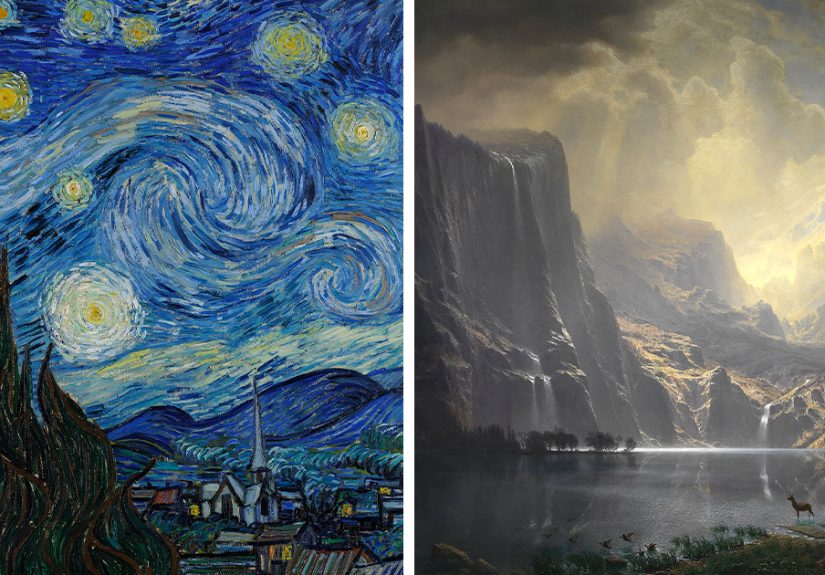
Bierstadt’s grand Western landscapes helped shape popular visions of the American frontier. This painting pairs glassy water, glowing mountains, and theatrical scale.
27. Mount Corcoran Albert Bierstadt
This dramatic mountain scene draws on Bierstadt’s travels through the American West, though the exact view is imagined. That mix of observation and invention is part of its magic.
28. The Lackawanna Valley George Inness
Inness combines landscape beauty with signs of industry. Railroad tracks, tree stumps, and rolling land create a subtle conversation about progress and environmental change.
29. Approaching Thunder Storm Martin Johnson Heade
Heade’s seacoast storm scene builds tension through light, shadow, and stillness. The weather feels like it is holding its breath.
30. The Bridge at Narni Jean-Baptiste-Camille Corot
Corot’s Italian landscapes helped bridge classical tradition and modern outdoor painting. His soft tones and balanced forms influenced later French artists.
31. The Cliff at Étretat after the Storm Gustave Courbet
Courbet’s coastal view is solid, physical, and direct. The cliff does not politely pose; it exists with weight, texture, and stubborn Realist confidence.
32. The Angelus Jean-François Millet
Although centered on two peasant figures, The Angelus is deeply tied to rural landscape. Field, labor, prayer, and evening light merge into a quiet image of daily life.
33. Hoar Frost at Ennery Camille Pissarro
Pissarro made rural roads, fields, and villages central to Impressionism. This frosty scene captures winter light with crisp, unsentimental beauty.
34. Boulevard Montmartre at Night Camille Pissarro
Landscape painting also includes cityscape. Pissarro’s Paris boulevard glows with artificial light, traffic, and modern urban energy.
35. Impression, Sunrise Claude Monet
Monet’s 1872 harbor scene helped give Impressionism its name. The loose brushwork and glowing orange sun changed how artists and viewers thought about perception.
36. Haystacks (Effect of Snow and Sun) Claude Monet
Monet’s haystack series studies the same subject under changing light and weather. The humble stack becomes a laboratory for color, atmosphere, and time.
37. The Four Trees Claude Monet
Monet painted poplars along the Epte River near Giverny in 1891. The vertical trees, reflections, and changing light turn a simple riverbank into visual music.
38. The Japanese Footbridge Claude Monet
Monet’s Giverny garden paintings blur bridge, pond, flowers, and reflection. They point toward abstraction while remaining rooted in a real place he cultivated carefully.
39. Water Lilies Claude Monet
Monet’s late water lily paintings dissolve horizon and depth. They invite viewers to float inside color, reflection, and atmosphere rather than stand outside a scene.
40. The Seine at Chatou Pierre-Auguste Renoir
Renoir’s river scenes show leisure, light, and Impressionist softness. Water becomes a place of movement and social pleasure.
41. Flood at Port-Marly Alfred Sisley
Sisley was one of Impressionism’s great landscape specialists. His flooded village views turn unusual weather into shimmering studies of reflection.
42. The Harbor at Lorient Berthe Morisot
Morisot’s harbor painting combines modern life, open air, and delicate brushwork. It reminds us that Impressionist landscape was never a men-only picnic.
43. The Starry Night Vincent van Gogh
Painted in 1889 at Saint-Rémy, The Starry Night transforms the view from observation into emotional vision. The sky swirls, the stars pulse, and the village sleeps through one of art history’s most famous nights.
44. Wheat Field with Cypresses Vincent van Gogh
Van Gogh’s cypress trees twist upward like green flames. The wheat field, clouds, and mountains vibrate with energy, making landscape feel intensely alive.
45. Olive Trees Vincent van Gogh
In Van Gogh’s olive grove paintings, trunks, soil, leaves, and sky seem to move together. Nature becomes rhythm, not scenery.
46. Mont Sainte-Victoire Paul Cézanne
Cézanne painted Mont Sainte-Victoire repeatedly, using color patches and structural brushwork to build form. His mountain became a turning point between Impressionism and modern art.
47. Tahitian Landscape Paul Gauguin
Gauguin’s landscapes use bold color and simplified shapes. His tropical scenes are less about accurate description than symbolic mood and decorative force.
48. Starry Night Edvard Munch
Munch’s night landscapes are psychological, moody, and often lonely. His skies do not simply sit overhead; they press inward on human feeling.
49. The Dream Henri Rousseau
Rousseau’s jungle scene is fantastical rather than observed firsthand. Dense leaves, hidden animals, and dream logic create a landscape of imagination.
50. Open Window, Collioure Henri Matisse
Matisse turns a window view into a bold color experiment. The harbor beyond the window becomes part landscape, part interior, part Fauvist fireworks show.
51. The Turning Road, L’Estaque André Derain
Derain’s Fauvist landscape uses wild color to energize the road, trees, and houses. It is not a quiet walk; it is a parade of paint.
52. The River Seine at Chatou Maurice de Vlaminck
Vlaminck’s thick brushwork and explosive color make the riverbank feel raw and immediate. Fauvism gave landscape painting a louder voice.
53. Birch Forest Gustav Klimt
Klimt’s forest scenes are patterned, decorative, and immersive. The trees form a shimmering screen, almost like nature wearing a jeweled coat.
54. Avenue in Schloss Kammer Park Gustav Klimt
This square-format landscape turns a tree-lined path into a dense, patterned field. Klimt makes walking through a park feel like entering a tapestry.
55. Murnau, Train and Castle Wassily Kandinsky
Kandinsky’s early landscapes push color toward abstraction. The train, town, and castle are still recognizable, but emotion begins to outrun description.
56. Black Mesa Landscape, New Mexico / Out Back of Marie’s II Georgia O’Keeffe
O’Keeffe’s New Mexico landscapes reduce desert forms to bold color and sculptural clarity. Her hills and mesas feel both ancient and startlingly modern.
57. Lake George Reflection Georgia O’Keeffe
O’Keeffe’s Lake George works explore water, reflection, and simplified natural form. They show how a familiar place can become nearly abstract through close looking.
58. Ground Swell Edward Hopper
Hopper’s 1939 seascape looks sunny at first, but the central buoy adds unease. The painting turns open water into a quiet psychological mystery.
59. Cape Cod Morning Edward Hopper
Hopper’s Cape Cod scenes often feel still, bright, and emotionally charged. Landscape and architecture become containers for anticipation.
60. Stone City, Iowa Grant Wood
Grant Wood’s rolling hills, tidy roads, and stylized buildings turn the Midwest into a patterned dream. The landscape feels both local and mythical.
61. Christina’s World Andrew Wyeth
Wyeth’s famous field and distant farmhouse create a haunting rural landscape. The figure matters, but the dry grass, slope, and horizon carry much of the emotion.
62. Mountains and Sea Helen Frankenthaler
This 1952 abstract painting helped open new possibilities for landscape. Its washes of color suggest natural space without describing it literally.
63. Ocean Park Series Richard Diebenkorn
Diebenkorn’s abstract compositions were inspired by Southern California light and space. Geometry becomes a memory of landscape.
64. A Bigger Grand Canyon David Hockney
Hockney’s multi-canvas work reimagines the Grand Canyon through bright color and shifting viewpoint. It is landscape painting with panoramic ambition and pop energy.
65. Steep Street Wayne Thiebaud
Thiebaud’s San Francisco cityscapes exaggerate streets into candy-colored slopes. They prove that urban landscape can be playful, vertiginous, and deliciously strange.
66. Untitled Landscape Works Joan Mitchell
Joan Mitchell’s abstract paintings often respond to remembered landscapes, weather, fields, and seasons. Her brushwork turns landscape into sensation rather than illustration.
What These Famous Landscape Paintings Teach Us
The 66 works above show that landscape painting is never one single thing. It can be scientific, spiritual, political, decorative, emotional, or experimental. Bruegel uses landscape to organize village life and seasonal labor. Claude Lorrain uses it to create ideal light. Turner uses it to dissolve the world into atmosphere. Cole and Church use it to build American identity. Monet uses it to study perception. Van Gogh uses it to externalize feeling. Cézanne uses it to rebuild vision from color and structure.
That variety is why landscape art remains popular. A viewer does not need a degree to feel the pull of a painted sky. But the more you learn, the more the landscape opens. A tree may be a design element. A storm may be a symbol. A road may suggest time, migration, class, or memory. Even a haystack can become a revolution if Monet is holding the brush.
How to Appreciate Landscape Paintings Like a Pro
Look at the Horizon
The horizon controls how you enter the image. A low horizon gives the sky power. A high horizon emphasizes land, labor, or pattern. No horizon at all, as in some late Monet works, can make you feel suspended inside pure atmosphere.
Study the Light
Light is the heartbeat of landscape painting. Is it sunrise, sunset, storm light, moonlight, snow glare, or artificial city light? Artists often use light to shape mood before you even notice the subject.
Notice the Human Scale
Figures in landscape paintings are often tiny for a reason. They can show humility, labor, loneliness, exploration, or vulnerability. In Romantic art especially, the small figure before vast nature becomes a philosophical statement wearing boots.
Ask What Is Being Left Out
Landscape paintings can be beautiful and selective. A peaceful valley may hide histories of displacement. A grand wilderness may be imagined rather than exact. A rural scene may idealize hard labor. Looking closely means enjoying the beauty while also asking smart questions.
Experiences and Reflections: Living With Landscape Paintings
Spending time with landscape paintings is a little like taking a slow walk without leaving the room. At first, the experience seems simple: you see trees, water, mountains, fields, or clouds. Then the painting starts negotiating with your attention. You notice a path that curves out of sight, a boat too small for the sea around it, a patch of sunlight that feels warmer than the rest of the canvas, or a sky that seems to know something the people below do not.
One of the best ways to experience famous landscape paintings is to compare how different artists treat the same basic ingredients. Give Monet, Van Gogh, and Cézanne a field, and you get three completely different worlds. Monet asks, “What is the light doing right now?” Van Gogh asks, “What is the soul of this place feeling?” Cézanne asks, “How can color build the mountain so it stays solid?” Same planet, different operating systems.
In a museum, landscape paintings also affect your body. A huge Hudson River School canvas can make you step back, widen your eyes, and feel almost tourist-sized. A small Corot can pull you closer, asking for quiet attention. A Turner can make you squint into mist and motion. A Hopper seascape may look calm, then suddenly feel like the beginning of a very polite thriller. The best landscapes change temperature as you look at them.
For home decor, landscape paintings and prints are popular because they create atmosphere without demanding too much drama. A misty mountain print can make a reading corner feel calm. A bright Matisse view can wake up a dining area. A Monet garden can soften a bedroom. A desert landscape inspired by O’Keeffe can bring warmth and structure to a modern room. The trick is to choose a landscape that matches the emotional weather you want in the spacenot just the sofa.
Writers, designers, travelers, and artists can also use landscape paintings as creative training. They teach composition: where to place weight, how to lead the eye, how to balance emptiness and detail. They teach mood: a gray sky can be tender, not dull; a road can create suspense; a single tree can carry the emotional workload of an entire paragraph. They also teach patience. Unlike fast digital images, landscape paintings reward slow looking. They invite you to stay long enough for the quiet parts to speak.
Most importantly, landscape paintings remind us that nature is never just “out there.” It is filtered through culture, memory, politics, science, religion, and personal feeling. A painted mountain can be a real mountain, a national symbol, a spiritual test, a formal experiment, or a giant triangular excuse to invent modern art. That is the joy of the genre: the view is always bigger than the view.
Conclusion
The story of 66 landscape paintings from world-famous painters is really the story of how artists learned to see the worldand how they taught us to see it differently. From Bruegel’s snowy villages to Turner’s storms, from Cole’s American wilderness to Monet’s shimmering gardens, from Van Gogh’s night sky to Hockney’s Grand Canyon, landscape painting keeps reinventing the relationship between people and place.
These masterpieces remain unforgettable because they offer more than scenery. They offer atmosphere, memory, movement, emotion, and meaning. Whether you love peaceful gardens, dramatic cliffs, glowing skies, or abstract color fields, landscape art gives you a place to wanderand, thankfully, no hiking boots are required.
SEO Tags
Note: This article was written as original, web-ready content based on synthesized information from reputable museum and art-history resources. Source links are intentionally not included in the article body.





 Close
Close