
Table of Contents >> Show >> Hide
- Before You Cover Anything: The Safety Rules That Matter
- The 8 Best Ideas for Covering an Electrical Panel
- 1) Hinged Artwork (The “Gallery Wall With a Secret”)
- 2) Shallow Cabinet Door (Not a Deep CabinetA Door)
- 3) Hinged Mirror (Brightens the Space and Disappears the Panel)
- 4) Sliding “Barn Door” Panel (Compact and Dramatic)
- 5) Removable Decorative Panel (Magnetic or Clip-On Cover)
- 6) Fabric Curtain or Mini Roller Shade (Softens Utility Areas)
- 7) Paint or Wallpaper the Panel Door (Camouflage Mode)
- 8) Folding Screen or Room Divider (Flexible and Fast)
- Quick Checklist: “Will This Cover Pass the Common-Sense Test?”
- Common Mistakes (AKA “How DIY Turns Into ‘Why Is the Inspector Frowning?’”)
- Extra : Real-World Experiences Homeowners Run Into (and What They Learn)
- Conclusion
Electrical panels are like the house’s “brain”vital, slightly intimidating, and never invited to be in the family photos.
Unfortunately, builders often place them right where your eyes land first: a hallway, laundry room, kitchen pass-through,
or that one wall you wanted to call “minimalist” (but now looks like “industrial utility chic”).
The good news: you can absolutely make a breaker box blend inas long as it stays safely and quickly accessible.
The goal is “hidden in plain sight,” not “sealed behind a secret bookshelf that requires a quest and a screwdriver.”
This guide walks through eight smart, decor-friendly ways to cover an electrical panel without creating a safety problem,
plus practical tips, measurements to keep in mind, and real-world lessons homeowners learn the hard way.
Before You Cover Anything: The Safety Rules That Matter
If you remember nothing else, remember this: your electrical panel must remain readily accessible.
That means someone can reach it quickly for operation, inspection, or maintenance without moving obstacles, climbing,
or using tools (keys are sometimes treated differently depending on the situation and who needs access). In plain English:
don’t turn “flip the breaker” into an escape room.
Keep the working space clear
- Don’t block the panel with furniture, stacked storage, or built-ins you can’t move quickly.
-
A common rule of thumb used in many settings is keeping about 36 inches of clear space in front,
at least 30 inches of width, and about 6 feet 6 inches of headroom.
Exact requirements can vary by installation conditions and local enforcement, so treat these as minimums and confirm locally. - The panel door needs to open at least 90° without interference.
Don’t modify the panel itself
- Never drill into the panel door or cabinet.
- If you paint or wallpaper the outside of the panel door, keep material out of seams and edgesnothing should migrate inside.
- Avoid anything that could trap moisture or heat. “Cozy” is for throw blankets, not electrical equipment.
Local rules win
Electrical codes and inspector interpretations can vary by city and state. If you’re selling a home, renovating,
or doing a built-in solution, it’s worth asking your local authority (or a licensed electrician) what they’ll accept.
A cover that’s “probably fine” can still fail an inspection if it isn’t considered readily accessible.
The 8 Best Ideas for Covering an Electrical Panel
Each idea below is designed around the same principle: make it pretty, but keep it fast to open.
Bonus points if it’s lightweight, swings out of the way, and doesn’t invite you to store a mountain of stuff in front of it.
1) Hinged Artwork (The “Gallery Wall With a Secret”)
This is the classic solution because it’s cheap, flexible, and doesn’t require carpentry superpowers.
Mount a framed print or canvas over the panel on a simple hinge so it swings open like a tiny door.
From the front it looks like decor; from the side it’s “oh hey, electricity.”
- Best for: hallways, laundry rooms, mudrooms
- Pro tip: Use a magnetic catch so the art stays closed but pops open instantly.
- Avoid: extra-heavy frames that require two people to lift (not “readily accessible”).
Style it up by choosing art that matches nearby colors, or build a small cluster of frames and make only one hinged.
It’s like a magic trick, but instead of rabbits you get circuit breakers.
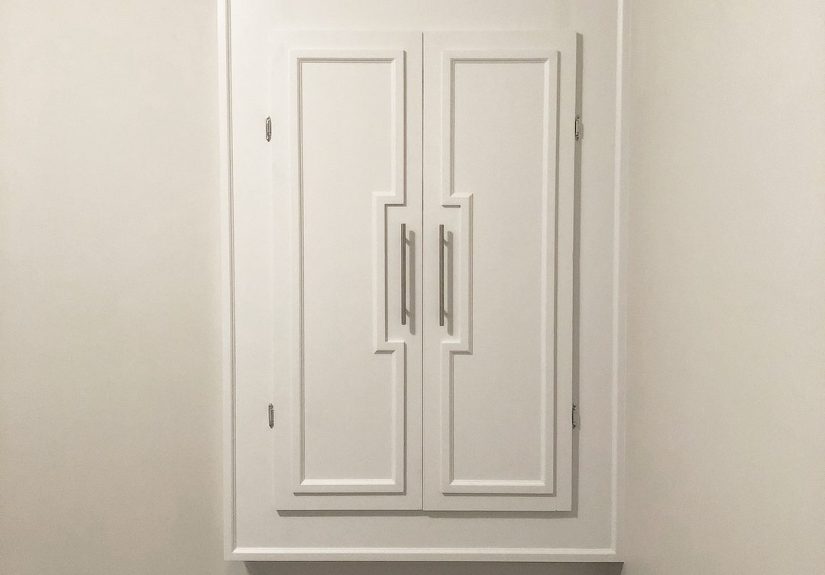
2) Shallow Cabinet Door (Not a Deep CabinetA Door)
A shallow, door-only cover can look built-in without becoming a storage trap.
Think of it as a decorative cabinet face: a framed shaker-style door, a simple flat panel, or even a vintage cupboard door
mounted on hinges. The key is keeping it shallow so it doesn’t interfere with working clearance and doesn’t tempt you
to “just store a few things” right in front of the panel.
- Best for: utility rooms, basements, garages (where you want it tidy)
- Design idea: Match the door style to nearby cabinetry or built-ins.
- Make it easy: Add a simple knob or pull so anyone can open it quickly.
3) Hinged Mirror (Brightens the Space and Disappears the Panel)
Mirrors are excellent at redirecting attention. Nobody stares at a breaker box when they’re busy checking their hair.
A hinged mirror cover works especially well in narrow hallways or entryways where you want more light and the illusion of space.
- Best for: entryways, corridors, small laundry areas
- Safety note: Keep it lightweight and securely mounted so it can swing open smoothly.
- Extra smart: Choose shatter-resistant acrylic mirror if you’re worried about weight.
4) Sliding “Barn Door” Panel (Compact and Dramatic)
If your panel sits on a wall where a swinging cover would bump into something, a sliding solution can be a neat workaround.
A mini barn-door-style panel (or any sliding decorative panel) can move sideways to reveal the electrical panel quickly.
It also adds personalityrustic, modern, coastal, you name it.
- Best for: tight spaces where hinges are awkward
- Style options: reclaimed wood look, painted MDF, fluted panels, cane webbing
- Watch out: Don’t install tracks or trim that reduce required clearance or make access fiddly.
5) Removable Decorative Panel (Magnetic or Clip-On Cover)
A lightweight decorative panel can hide the electrical panel while staying easy to remove in seconds.
Some homeowners use a thin framed art panel, a metal sheet with printed artwork, or a purpose-made magnetic cover.
The advantage is speed: lift it off, and you’re in.
- Best for: renters or anyone who wants a no-permanent-hardware approach
- Choose wisely: Look for stable attachment that won’t fall off, but doesn’t require tools.
- Keep it smart: Avoid adhesives that could leave residue around the panel edges.
6) Fabric Curtain or Mini Roller Shade (Softens Utility Areas)
For a quick, cozy fix, use a small curtain panel or roller shade to conceal the breaker box.
This works well in laundry rooms, finished basements, or craft areas where you want softer visuals.
The important part: the fabric must pull aside instantly, and nothing should be stored in front of the panel.
- Best for: laundry rooms, craft rooms, finished basements
- Install idea: A slim curtain rod mounted above the panel; use tiebacks for easy access.
- Safety note: Keep fabric away from damp areas and avoid anything that could snag on the panel door.
7) Paint or Wallpaper the Panel Door (Camouflage Mode)
Sometimes the best “cover” is making the panel disappear visually. Painting the panel door the same color as the wall
(or applying wallpaper to the outside surface only) can dramatically reduce the “big gray metal rectangle” effect.
It’s also one of the least bulky options, which helps you maintain proper clearances.
- Best for: minimalist rooms, modern spaces, tight hallways
- Fun idea: Paint it as a faux cabinet front with simple trim lines (purely decorative).
- Important: Don’t allow paint, paste, or paper to creep into seams or inside the panel.
8) Folding Screen or Room Divider (Flexible and Fast)
If your electrical panel is in an open area (like a basement hangout space or a multipurpose room),
a folding screen can hide the view without touching the wall at all. It’s movable, adjustable,
and makes access easyjust scoot it aside.
- Best for: finished basements, studios, open utility areas
- Design win: Use a screen that matches your decor themeboho rattan, modern slats, or classic fabric panels.
- Don’t do this: Don’t place the screen and then pile storage behind it. That defeats the whole safety purpose.
Quick Checklist: “Will This Cover Pass the Common-Sense Test?”
- Can you access the panel in seconds? (No tools, no moving furniture, no gymnastics.)
- Does the panel door open freely at least 90°?
- Is the working area kept clear? (No storage in front of it.)
- Is the cover lightweight and stable?
- Does it avoid moisture, heat-trapping, and drilling into the panel?
Common Mistakes (AKA “How DIY Turns Into ‘Why Is the Inspector Frowning?’”)
Turning the cover into storage
Deep cabinets and heavy built-ins are tempting because they hide everything. They also invite clutter,
and clutter is the enemy of “readily accessible.” If the space in front becomes a storage nook,
you’ve created the exact hazard codes try to prevent.
Using screws, complicated latches, or heavy panels
If you need a tool to remove the cover, it’s not quick access anymore. If it takes two people to lift,
it’s not quick access either. Keep it simple: hinges, magnets, clips, or lightweight lift-off designs.
Forgetting about dedicated space
In many installations, the area around/above electrical equipment is expected to remain clear of certain foreign systems
(think pipes or leak sources overhead). Even if your cover looks perfect, don’t create a scenario where plumbing or
drip-prone features end up directly above an electrical panel.
Extra : Real-World Experiences Homeowners Run Into (and What They Learn)
Homeowners tend to discover the “breaker box problem” at the worst possible time: right after painting the hallway,
during a kitchen refresh, or five minutes before guests arrivewhen someone notices the panel and says,
“Wow, that’s… very visible.” The first instinct is usually to hide it fast. A big canvas print gets leaned against the wall,
a tall plant gets dragged into position, and suddenly you’ve created the world’s most fashionable obstacle course.
It looks better… until the day you actually need the panel.
One of the most common lessons people report is how often they unexpectedly need access.
It’s not always a dramatic power outage. Sometimes it’s a tripped breaker from a vacuum cleaner,
a space heater, a new air fryer, or that holiday light display that felt “totally reasonable” in the moment.
If the cover is awkwardsay, a heavy mirror that must be lifted straight upyour “quick fix” becomes a daily annoyance.
That’s why hinged solutions (art or a shallow door) win so often in real homes: you can swing them open with one hand,
flip the breaker, and get back to your life.
Another experience that comes up a lot is the “inspection surprise.” A homeowner might install a gorgeous built-in cabinet
over the panel thinking, “It has a door, so it’s accessible.” Then an electrician or inspector points out that the cabinet
encourages storage, reduces working space, or requires moving objects to reach the panel. The homeowner ends up modifying
the projectsometimes ripping out shelves or converting the cabinet into a door-only facade. The takeaway: if you’re going
to invest time and money, design the solution around access first, aesthetics second. You can absolutely have bothjust
don’t put the decor goals in the driver’s seat.
People also learn that “camouflage” can be surprisingly effective. Painting the panel door the wall color, adding a subtle
wallpaper pattern, or placing it within a gallery wall often makes it disappear without adding bulk. In smaller spaces,
minimal thickness matters. A hallway that feels comfortable with a flat panel can feel cramped with a protruding cabinet box.
That’s why so many homeowners end up favoring low-profile options: paint, wallpaper on the outside surface only,
or a hinged frame that sits nearly flush.
Finally, many homeowners discover the power of a simple household rule: the area in front of the panel stays clear.
Even the best cover can fail in real life if it becomes the default landing zone for laundry baskets, backpacks,
wrapping paper, or “I’ll deal with this later” piles. The most successful setups combine a fast-opening cover
with a deliberate no-clutter habit. It’s not glamorous, but it’s the difference between “cute hidden panel”
and “why is the electrician sighing.”
Conclusion
Covering an electrical panel doesn’t have to mean compromising safety or code expectations.
Pick a solution that opens quickly, stays lightweight, and preserves working clearancethen have fun making it look intentional.
Whether you choose hinged artwork, a shallow decorative door, a sliding panel, or simple camouflage paint,
the best electrical panel cover is the one you can forget about… until you need it, and then it works instantly.







 Close
Close