
Table of Contents >> Show >> Hide
- 1. Dolphins Use “Names” to Recognize One Another
- 2. Crows and Ravens Can Plan Ahead
- 3. Dogs Can Learn Words, Not Just Your Snack Schedule
- 4. Bees Can Handle Basic Math and Even Understand Zero
- 5. Elephants Show Self-Awareness and Body Awareness
- 6. Rats Show Empathy and Prosocial Behavior
- 7. Octopuses Solve Problems in a Completely Alien Way
- 8. Cuttlefish Can Wait for a Better Reward
- 9. Cockatoos Can Build and Use Toolkits
- 10. Fish Are Smarter Than Their Reputation Suggests
- What Animal Intelligence Really Teaches Us
- Personal Reflections: The Everyday Experiences That Make Animal Intelligence Feel Real
- Conclusion
Humans love giving ourselves gold stars for being clever. We write symphonies, build skyscrapers, and invent apps that remind us to drink water. Very impressive. But the natural world has been running its own intelligence lab for millions of years, and the results are wildly humbling. Animals are not “smart” in one neat, human-shaped way. They solve problems, remember details, communicate, plan ahead, cooperate, and adapt to challenges using minds shaped by very different lives.
That is what makes animal intelligence so fascinating. A dolphin does not need to file taxes to be brilliant. A crow does not need a college degree to outthink a puzzle box. A bee, despite carrying a brain the size of a sprinkle, can still manage feats that make some humans feel emotionally attached to their calculator. The more scientists study cognition across species, the more obvious it becomes that intelligence is not a single ladder with humans sitting smugly on the top rung. It is more like a sprawling tree with many branches, each one showing off a different kind of genius.
So if you have ever looked at a dog, bird, octopus, or fish and thought, “Cute, but probably not exactly plotting world domination,” this article is for you. Here are ten amazing ways animals are smarter than many people realize, along with a reminder that nature has been doing advanced problem-solving long before humans started putting inspirational quotes on office walls.
1. Dolphins Use “Names” to Recognize One Another
Dolphins are not just noisy swimmers with permanent smiles. Research has shown that bottlenose dolphins develop unique signature whistles that function a lot like names. Other dolphins can recognize these sounds and respond to them, which suggests that identity matters deeply in dolphin society.
Why this is so impressive
Human beings use names as symbolic labels. That is a pretty sophisticated social tool. Dolphins appear to do something similar with sound, using specific whistles to keep track of individuals in a world where visibility is limited and social relationships are complex. Some studies also suggest dolphins remember familiar whistles for years, maybe even decades. That is less “cute sea mammal” and more “underwater social network with excellent long-term memory.”
It also points to an important truth about animal cognition: social intelligence is a form of intelligence. Knowing who is who, maintaining relationships, and communicating identity are not simple tasks. They require memory, learning, and flexible communication.
2. Crows and Ravens Can Plan Ahead
Corvids, the bird family that includes crows and ravens, have become the overachievers of the animal intelligence world. They use tools, solve multi-step problems, and in some experiments have shown signs of foresight. In other words, they do not just deal with the moment. They seem able to prepare for what comes next.
Not bad for an animal people once called “birdbrained”
New Caledonian crows are famous for crafting and using tools, including sticks shaped to reach food hidden in tight spaces. Some research has shown they can use tools in sequence, choosing one object to get another object that helps them finally reach a reward. That kind of behavior suggests more than trial and error. It hints at mental representation, flexible problem-solving, and possibly planning.
Ravens are just as impressive. In controlled studies, they have demonstrated the ability to save useful items for future use and wait for a better reward instead of grabbing the smaller one immediately. That sounds suspiciously like self-control, a trait many humans abandon the second fries are involved.
3. Dogs Can Learn Words, Not Just Your Snack Schedule
Most dog owners believe their pets understand a lot more than they let on, and science is steadily proving that this confidence is not entirely based on wishful thinking and emotional dependence. Some dogs can learn the names of dozens, even hundreds, of objects. A rare group often called “gifted word learner” dogs can rapidly connect words to specific toys and remember those labels over time.
More than obedience
This matters because it moves dogs beyond simple command training. It suggests that at least some dogs can form stable mental links between a word and an object, which is a meaningful cognitive skill. Recent work has even found that certain exceptional dogs can learn words by overhearing human interactions, not just through direct training.
No, your dog is probably not secretly critiquing your playlist. But canine intelligence clearly includes far more than sitting, staying, and pretending not to hear you when bath time is announced.
4. Bees Can Handle Basic Math and Even Understand Zero
If you still think insects run on pure instinct, bees would like a brief word. Actually, several carefully designed experiments suggest bees can do things that look an awful lot like numerical reasoning. They have been trained to distinguish quantities, perform simple addition and subtraction tasks, and even treat zero as less than one.
Tiny brain, oversized reputation
This is the part where people usually blink and say, “Wait, bees?” Yes, bees. Their brains are tiny, but tiny does not mean simple. These insects can learn rules, remember them, and apply them in new situations. That is not a robotic response. That is flexible cognition.
Bees have also shown the ability to learn novel tasks, including moving objects to reach rewards. The lesson here is deliciously humbling: intelligence is not always about having the biggest brain. Sometimes it is about using a very small brain extraordinarily well.
5. Elephants Show Self-Awareness and Body Awareness
Elephants have long had a reputation for memory, but modern research shows their intelligence goes much deeper. In one landmark study, an Asian elephant passed a version of the mirror self-recognition test, a classic experiment used to explore whether an animal understands that the reflection it sees is itself.
Knowing “me” is a big deal
Self-recognition is important because it may reflect a level of self-awareness that goes beyond simple perception. Elephants have also shown body-awareness in problem-solving tasks, understanding when their own bodies are physically blocking success. That sounds obvious to us because humans do it constantly without thinking, but cognitively speaking, it is a meaningful achievement.
Add in elephants’ rich social lives, strong family bonds, and ability to learn from older group members, and you get a species whose intelligence is social, emotional, and practical all at once. They are not just remembering where the water is. They are navigating relationships, environments, and obstacles with remarkable sophistication.
6. Rats Show Empathy and Prosocial Behavior
Rats are not usually the poster children for emotional intelligence, which is unfair and honestly kind of rude. Studies have shown that rats will help trapped companions, even when there is a tempting food reward nearby. In some cases, they choose to free another rat before eating chocolate. That is a level of generosity that would make certain dinner guests extremely uncomfortable.
Helping behavior is not trivial
Prosocial action suggests that rats are sensitive to the distress of others and motivated to do something about it. Scientists debate exactly how similar this is to human empathy, but the broader point stands: social mammals may possess emotional and cognitive capacities once dismissed as uniquely human.
This challenges the old idea that intelligence is only about logic puzzles or tool use. Sometimes being smart means reading a social situation, responding appropriately, and acting in ways that benefit others. In rat society, apparently, kindness is not just a nice extra. It may be part of the cognitive toolkit.
7. Octopuses Solve Problems in a Completely Alien Way
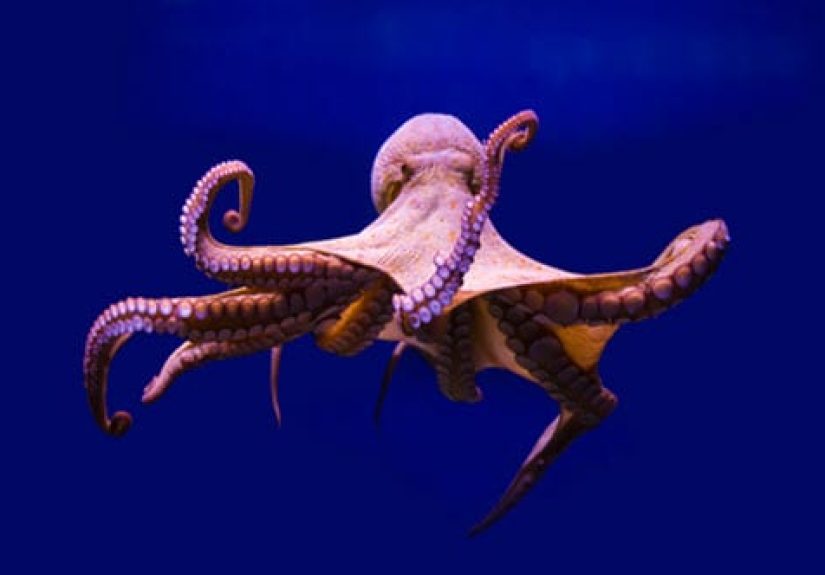
Octopuses are the ultimate reminder that intelligence does not have to look familiar to be real. These animals can navigate mazes, manipulate objects, escape enclosures, and open containers to reach food. They are curious, exploratory, and often startlingly inventive.
Eight arms, one weirdly brilliant system
Part of what makes octopus intelligence so mind-bending is that much of their nervous system is distributed through their arms. In a sense, an octopus is not just thinking with one central brain. Its arms can handle information and movement with surprising independence. This creates a form of problem-solving that feels less like a human mind and more like a team meeting held entirely by tentacles.
Yet the results are unmistakable. Octopuses learn from experience, adapt to challenges, and manipulate their environments in flexible ways. Their intelligence is not a copy of ours. It is its own masterpiece.
8. Cuttlefish Can Wait for a Better Reward
Cuttlefish, close relatives of octopuses, have also entered the animal cognition hall of fame. In experiments inspired by the famous “marshmallow test,” cuttlefish were willing to delay eating an okay snack if waiting meant they would get a better one later.
Self-control is serious business
Delayed gratification is often linked to planning and executive control. It suggests an animal can inhibit an immediate impulse in favor of a better future outcome. That is a meaningful cognitive skill, especially in a creature many people could not pick out of a lineup.
Cuttlefish are not just patient, either. Other studies suggest they have strong memory abilities and may remember what they ate, where they found it, and when they found it. Put all that together and you have an animal that is not merely reacting. It is tracking information across time and using it strategically.
9. Cockatoos Can Build and Use Toolkits
Parrots are famous mimics, but imitation is only the beginning. Goffin’s cockatoos have amazed researchers by solving complex mechanical tasks and even using combined tools to reach a goal. In some experiments, they have selected or modified tools depending on the problem in front of them.
This is engineering with feathers
Tool use is often treated as a headline sign of intelligence because it requires understanding relationships between objects, actions, and outcomes. Cockatoos do not just peck randomly until something good happens. They can show flexibility, persistence, and a knack for solving new problems.
That matters because these birds are not simply repeating hardwired behaviors found in the wild. In several studies, they invented solutions in novel situations. In plain English, they improvised. And improvisation is one of the clearest signs that a mind is doing something more than following a script.
10. Fish Are Smarter Than Their Reputation Suggests
Fish have spent years suffering from terrible public relations. “Memory of a goldfish” has been used as an insult for ages, even though fish cognition is far richer than many people assume. Research has shown that some fish can count approximately, recognize individual animals, use tools, and in certain controversial but fascinating studies, even respond to mirrors in complex ways.
No, they are not just swimming in circles
Cleaner wrasse, for example, have become famous in cognition research because of their sophisticated social behavior and their responses in mirror-based experiments. Other fish species use objects to crack open food or manipulate prey, which suggests practical problem-solving. Some even maintain social traditions and learn from others.
The bigger lesson is that intelligence does not require fur, feathers, or a face that humans find relatable. Fish live in complex environments, and many species appear far better at navigating those worlds than our stereotypes would ever predict.
What Animal Intelligence Really Teaches Us
If there is one theme running through all these examples, it is this: intelligence is diverse. Humans are excellent at language, abstract reasoning, and inventing passwords we immediately forget. But other animals excel at social memory, navigation, sensory processing, bodily control, environmental manipulation, and survival strategies we could never replicate without technology and a very nervous instruction manual.
Scientists are increasingly moving away from ranking animals on a single human-centered scale. That shift matters. A bee is not a failed human. An octopus is not a weird underwater toddler. An elephant is not merely a giant memory machine. Each species has evolved ways of understanding and responding to the world that make sense for its own life.
That is why animal intelligence is so thrilling to study. It pushes us to stop asking, “Which animal is most like us?” and start asking, “What forms of intelligence exist out there that we have barely begun to appreciate?” Frankly, that second question is a lot more interesting.
Personal Reflections: The Everyday Experiences That Make Animal Intelligence Feel Real
The science is fascinating, but what really makes this topic stick is experience. Plenty of people have had those strange little moments around animals that make them stop mid-thought and think, “Okay, you definitely understood more than I expected.” It might be a dog waiting by the exact drawer where the leash is kept, not because it got lucky, but because it has built a mental map of routines, sounds, and objects. It might be a crow watching traffic patterns before dropping a nut in the road for cars to crack, which feels less like instinct and more like a tiny urban strategist with feathers.
I think that is why stories about animal intelligence spread so quickly. They feel personal. A person watches a parrot solve a household problem, or sees a cat manipulate a door handle with suspicious confidence, and suddenly the line between “animal behavior” and “active thinking” gets a lot blurrier. Even common backyard encounters can be revealing. Birds remember where food appears, squirrels adjust their routes when a new obstacle is added, and pets often learn the emotional weather of a home faster than the humans living in it.
One reason these experiences matter is that they make the research easier to understand. It is one thing to read that elephants show body-awareness. It is another to watch a large animal pause, assess a situation, and deliberately reposition itself as if it is mentally working through the problem. It is one thing to hear that bees can learn rules. It is another to realize a creature weighing less than a paper clip can still adapt its behavior based on memory and reward.
These experiences also keep us humble. Humans tend to assume that if another mind does not operate like ours, it must be simplistic. But daily life with animals often suggests otherwise. Animals notice patterns. They anticipate outcomes. They remember what worked before. They adjust. Sometimes they even surprise us in ways that feel almost mischievous, which may be the clearest sign of all that something interesting is happening behind those eyes.
Maybe that is the most powerful takeaway from the whole conversation about animal intelligence. It is not only about proving that animals are clever. It is about training ourselves to pay better attention. Once you do, the world starts to look much less like a stage full of instinct-driven creatures and much more like a planet crowded with different kinds of minds, each solving the same basic problems of life in its own style. And honestly, that makes a walk through the park, a visit to the aquarium, or even ten minutes with the family dog feel a lot more extraordinary.
Conclusion
Animals do not need to think exactly like humans to be intelligent. Dolphins label one another with sound. Corvids plan ahead. Dogs learn words. Bees handle numerical concepts. Elephants show self-awareness. Rats help their companions. Octopuses solve problems with an almost alien design. Cuttlefish wait for better rewards. Cockatoos improvise with tools. Fish keep proving their bad reputation is undeserved.
So the next time someone talks about humans as if we alone own the patent on brainpower, it may be worth remembering that intelligence comes in many forms. Some of it flies, some of it swims, some of it scurries, and some of it can probably outsmart us before breakfast. Nature has been running this experiment for a very long time, and the results are far smarter than most of us ever realized.





 Close
Close