
Table of Contents >> Show >> Hide
- The Night the Sky Over Berlin Lit Up
- How Scientists Knew It Was Coming
- From Fireball to Treasure Map: The Strewn Field
- Meet the Meteorite Hunters
- Why These Meteorites Are So Rare
- Planetary Defense in Action
- Could a Similar Event Happen Over Your City?
- Experiences and Lessons from Berlin’s Meteorite Treasure Hunt
On an otherwise ordinary winter night in January 2024, the sky over Berlin did something very un-German: it arrived fashionably dramatic. A brilliant fireball streaked across the heavens, flared, and exploded west of the city. Within hours, social media lit up with grainy videos, stunned eyewitness reports, and excited astronomers confirming that a small asteroid had just disintegrated high above Brandenburg.
That space rock, later cataloged as asteroid 2024 BX1, was only about a meter (around three feet) wide. But what it lacked in size, it made up for in cosmic charisma. Scientists had spotted it just a few hours before impact and accurately predicted where it would burn up over Germany – one of only a handful of times in history that such an impact was forecast in advance.
And once the fireball faded, the real fun began. Dozens of scientists, students, and meteorite hunters grabbed their boots, maps, and metal detectors and turned the quiet fields west of Berlin into a full-on meteorite treasure hunt. They weren’t just looking for souvenirs. The fragments from 2024 BX1 turned out to be a rare kind of meteorite that could tell us something about the early solar system – and even help improve planetary defense.
The Night the Sky Over Berlin Lit Up
Shortly after midnight on January 21, 2024, a tiny near-Earth object plunged into Earth’s atmosphere over northeastern Germany. The asteroid, now named 2024 BX1, had been discovered only hours earlier by Hungarian astronomer Krisztián Sárneczky, who has a knack for spotting small impactors racing toward our planet. Observatories across Europe began tracking the object, refining its orbit, and feeding data into impact prediction systems run by agencies like NASA and the European Space Agency.
The result: an unusually precise forecast for such a small rock. Astronomers predicted that the asteroid would burn up over Germany, roughly west of Berlin, at a specific time window. When that moment came, cameras and eyewitnesses caught the show – a blazing greenish-white fireball streaking across the sky, bright enough to be seen from hundreds of kilometers away.
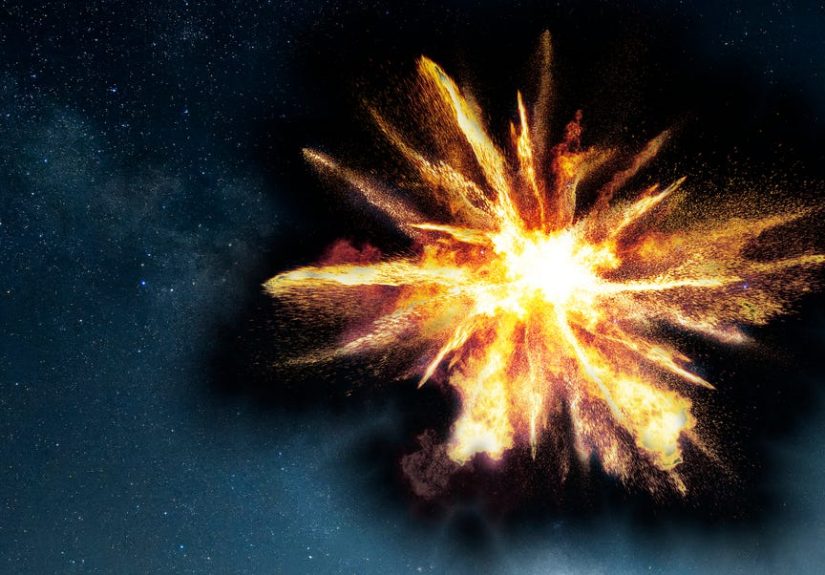
As it slammed into the atmosphere at tens of thousands of miles per hour, the asteroid compressed the air in front of it, heating the rock until it glowed, fragmented, and finally exploded as a bolide – a particularly bright meteor. Most of the incoming mass vaporized high in the atmosphere, but small, durable pieces survived the fall, slowed, and rained down over the countryside west of Berlin as meteorites.
How Scientists Knew It Was Coming
One of the most remarkable parts of the 2024 BX1 story isn’t just the fireball; it’s the warning. Only a few asteroids have ever been discovered and tracked before they hit Earth’s atmosphere. 2024 BX1 joined that elite list.
After Sárneczky’s discovery, observations were quickly shared worldwide. NASA’s Scout impact assessment system and similar tools used those measurements to calculate the asteroid’s trajectory and the probability of impact. The math pointed solidly toward a collision with Earth’s atmosphere over Germany within just a couple of hours – a textbook demonstration of how modern planetary defense systems are supposed to work.
To be clear, 2024 BX1 was never a threat to life on the ground. At around one meter across, it was too small to survive as a large object all the way down. But for scientists, it was a golden opportunity: a tiny test case that showed the global asteroid-surveillance network doing exactly what it was built to do.
It also gave researchers a rare chance to connect all the dots in real time from a faint point of light on a telescope image, to a predicted impact, to a fireball in the sky, to actual rocks on the ground that could be collected and analyzed in laboratories.
From Fireball to Treasure Map: The Strewn Field
Once the light show was over, the next big question was simple: Where did the pieces land? When a meteoroid breaks up in the atmosphere, the surviving fragments fall along an elongated zone called a strewn field. Predicting that zone is part physics, part detective work, and part muddy-boot endurance test.
Researchers started with the observed trajectory of the fireball – its speed, angle, and breakup altitude. Using atmospheric models and gravity, they ran simulations to estimate where different-sized fragments would have landed, accounting for winds that could push smaller pieces off the central path. This allowed scientists to draw narrow “search boxes” on maps of rural Brandenburg, west of Berlin.
Those search boxes turned out to overlap with farmland and fields near villages like Ribbeck in the Havelland region. It’s a quiet, picturesque area – more associated with orchards and country roads than cutting-edge planetary science. But almost overnight, those fields became ground zero for a space-rock treasure hunt.
Meet the Meteorite Hunters
Meteorite hunting is a surprisingly social sport. In the days after the 2024 BX1 explosion, professional scientists, local volunteers, and seasoned meteorite enthusiasts converged on the predicted strewn field. Some flew in from other countries; others were students from Berlin’s universities or staff from the Museum für Naturkunde.
Equipped with GPS coordinates, printed maps, and a heroic tolerance for cold, wet weather, teams spread out across the fields. They walked in tight lines, scanning the ground for anything that looked unusual. The problem? The 2024 BX1 meteorites didn’t look like the classic black, glassy stones people imagine.
These rocks blended annoyingly well with their surroundings. Many pieces were light gray or brownish and looked, at a distance, like ordinary bits of terrestrial stone or clods of soil. That made the hunt challenging but not impossible. Experienced hunters looked for subtle signs: a fresh chip in the soil, an oddly smooth surface, or small, pale crystals embedded in the rock.
Eventually, persistence paid off. Multiple small fragments were recovered, including some pieces around the size of a golf ball or baseball. There were hugs, photos, and a lot of very happy, very muddy people holding up what looked like unremarkable chunks of stone which, in scientific terms, were anything but ordinary.
Why These Meteorites Are So Rare
Once the first fragments were confirmed as meteorites, the next question was: What kind? Meteorites come in several major categories, each containing different minerals and histories. Early analysis of the Berlin-area specimens pointed to something exciting: they weren’t typical stony meteorites. They belonged to a rare class called aubrites.
Aubrites are bright, light-colored meteorites rich in minerals like enstatite. They’re thought to originate from a very specific kind of parent body in the asteroid belt – perhaps even from a differentiated asteroid that formed, melted, and partly evolved like a tiny proto-planet. Globally, only a small fraction of known meteorites are aubrites, making each new find scientifically valuable.
For researchers, these fragments are like pages torn from a 4.5-billion-year-old history book. Their composition can reveal how early solar system materials interacted, heated, cooled, and collided. High-precision lab techniques allow scientists to measure isotopes, trace elements, and shock features that record the rock’s journey from asteroid belt to atmosphere to Brandenburg field.
Some pieces quickly found their way into museum collections and research institutions, where they’re being cataloged, sliced into thin sections, and examined under microscopes. Others are held by the meteorite hunters who discovered them often on loan or in collaboration with scientists. While people like to talk about the “value” of meteorites in terms of dollars, the real treasure here is the data they contain.
Planetary Defense in Action
Beyond the thrill of the treasure hunt, the Berlin asteroid event was a quietly reassuring demonstration of planetary defense. 2024 BX1 was the kind of object you want to practice on: small, harmless, and still scientifically interesting.
Detecting and tracking a one-meter asteroid is challenging; these objects are faint, fast, and easy to miss. The fact that astronomers could spot it, calculate its trajectory, and issue a prediction hours before impact shows how far impact-monitoring systems have come in the last couple of decades.
More importantly, each well-documented impact sharpens our playbook. Every event teaches scientists how to better link telescopic observations to real-world outcomes: how the asteroid breaks up, how shock waves propagate, where fragments land, and what kinds of materials survive. Those lessons get folded back into models that might one day inform decisions about a much larger object that we don’t want anywhere near a major city.
While the Berlin fireball was spectacular, it was also normal in one sense: Earth is hit by small space rocks all the time. Most go unnoticed over oceans or remote areas. When one appears over a major metropolitan area, it reminds us that we live in a dynamic solar system and that keeping an eye on the sky is a smart long-term investment.
Could a Similar Event Happen Over Your City?
Short answer: yes, and it probably already has just not as visibly. Tiny meteoroids hit Earth’s atmosphere constantly. Most are grains of dust that burn up as “shooting stars.” A rock the size of 2024 BX1 creates a noticeable fireball, but the energy release is still relatively small compared to the larger impacts that worry planetary-defense experts.
Events like the Berlin fireball are a helpful reminder, not a reason to panic. The odds of a serious, city-damaging impact from a large asteroid are low on human timescales, and ongoing surveys are steadily mapping out the big near-Earth objects. Meanwhile, small fireballs can actually be an opportunity: they get people excited about science, bring communities and researchers together, and sometimes leave behind souvenirs from the dawn of the solar system.
If you ever see a bright fireball overhead, the smartest immediate reaction is not to race toward it, superhero-style. Instead, note the time and general direction, report it to an organization that collects fireball reports (in Europe or the American Meteor Society in the U.S.), and let the professionals and seasoned meteorite hunters do the risky work of searching near roads or in farm fields. If you do stumble on an odd rock that looks freshly broken and out of place, photograph it in situ before picking it up that context can be crucial for scientific analysis.
Experiences and Lessons from Berlin’s Meteorite Treasure Hunt
While the headlines focused on “rare space rocks” and “predicted impact,” the Berlin asteroid also became a very human story. Imagine being a student in Berlin, checking your phone and seeing an alert that a small asteroid is about to explode over your region. You bundle up, step outside, and watch the sky briefly erupt in light. A few days later, you’re out in a muddy field with your classmates, scanning the ground for space rocks in between tractor tracks. That’s not just a science lesson; that’s a core memory.
Many of the people who joined the treasure hunt west of Berlin described a strangely peaceful atmosphere. The fireball had already come and gone. There was no danger, just the sound of boots in wet grass, distant crows, and occasional car noise from nearby roads. Hunters walked in long, straight lines, often spaced a few meters apart, calling out when they found anything even remotely suspicious. Most of the time, it was just ordinary stone. But every “nope” made the eventual “I’ve got something!” moment that much sweeter.
Local farmers also played a role in the experience. Their land suddenly became the backdrop for international science. Some watched with curiosity as strangers with high-vis jackets and clipboards scoured their fields; others joined in or shared tips about where soil had recently been plowed or where rocks tended to collect. For many residents, the idea that a rock from outer space might be sitting quietly in their backyard was both surreal and oddly charming.
Meteorite hunters who have searched for falls in deserts or remote steppe regions say that the Berlin hunt was different. Instead of endless empty terrain, they walked through an everyday European landscape hedgerows, dirt roads, wind turbines, and villages with church spires in the distance. Finding a meteorite there feels like discovering a secret layer of the world you thought you already knew. You’re still on Earth, but the rock in your hand started its journey before Earth itself finished forming.
For scientists, the experience reinforced how powerful community-based science can be. No single lab could have covered that much ground so quickly. It took coordinated teams, volunteers, amateur astronomers, and experienced rockhounds, all sharing information through messaging apps, maps, and nightly briefings. Some people brought drones to scout terrain; others brought handheld magnets and sample bags. It was a mix of high-tech and low-tech, spreadsheets and intuition, satellite data and good old-fashioned walking.
The Berlin event also offered a kind of emotional reassurance. Planetary defense can be a sobering topic; it’s easy to jump mentally from “small training asteroid” to “extinction-level impact.” Yet standing in a field, holding a pebble-sized meteorite that was tracked from space to sky to soil, you’re reminded that humanity isn’t just a passive target. We can observe, predict, and respond. We can turn a cosmic surprise into shared discovery and even into a celebration of how far our science, technology, and cooperation have come.
For anyone who loves the idea of participating in something similar, the Berlin treasure hunt offers a blueprint. Pay attention to announcements from space agencies and meteor societies. Learn what meteorites really look like which, spoiler, is not always “shiny black rock from a movie.” Understand how to respect private property and local regulations if a fall occurs near you. And maybe most importantly, remember that you don’t need to be a professional scientist to join in. You just need curiosity, patience, and the willingness to walk a lot of kilometers while looking at the ground.
In the end, 2024 BX1 was a small asteroid with a big personality. It lit up the Berlin sky, tested our planetary-defense systems, scattered rare meteorites across quiet fields, and brought together a community of people who will never look at a shooting star quite the same way again. Not bad for a rock that, a few hours earlier, was just another anonymous speck drifting through space.






 Close
Close