
Table of Contents >> Show >> Hide
- What Is the Missing Square Puzzle?
- Why the Puzzle Feels So Convincing
- The Real Answer: It Is Not Actually a Triangle
- Where Does the “Missing” Square Come From?
- Step-by-Step Way to Explain the Missing Square Puzzle
- Why Teachers and Puzzle Fans Love This Problem
- What the Missing Square Puzzle Teaches About Visual Illusions
- Is There a Trick to Solving It Quickly?
- Common Mistakes People Make When Solving the Puzzle
- Related Puzzles and Why They Matter
- Conclusion: Can You Solve the Missing Square Puzzle?
- Real-World and Personal Experiences With the Missing Square Puzzle
At first glance, the missing square puzzle looks like the sort of thing that makes perfectly reasonable adults question both math and their eyesight. You start with a set of shapes that seem to fit snugly into a large triangle. Then the exact same pieces are rearranged, and suddenlyta-dathere’s an empty square where no empty square had any business showing up. Nobody added a piece. Nobody stole a piece. No tiny geometry goblin ran off with the area. So what on earth happened?
This classic brain teaser has been baffling students, teachers, puzzle lovers, and anyone who has ever trusted a diagram a little too quickly. It is often called the missing square puzzle or Curry’s paradox, and it is a brilliant reminder that pictures can be persuasive while still being sneaky. The puzzle does not break the laws of geometry. It breaks our confidence in casual eyeballing.
In this guide, we’ll walk through how the puzzle works, why the “missing” square is not really missing, and what this famous illusion teaches about slope, area, visual reasoning, and the dangerous charm of almost-straight lines. In other words, this is where geometry puts on a magician’s cape and then gets caught in the act.
What Is the Missing Square Puzzle?
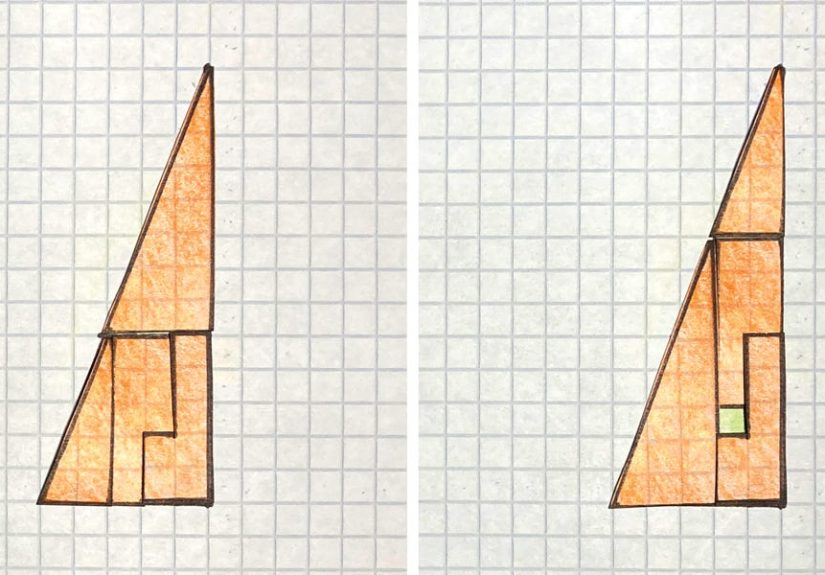
The missing square puzzle is a geometric dissection puzzle. You are given several piecesusually two right triangles and two polygon-like shapesthat can be arranged in two different ways. In one arrangement, the pieces seem to form a complete triangle. In the other, they seem to form the same triangle, but with a small 1-by-1 hole inside it.
That is the hook: if the pieces are identical in both arrangements, how can one version have an extra square of empty space?
It feels impossible because most people make a silent assumption: both big outlines must be the same triangle. The whole trick of the puzzle is that this assumption is false. The outer shapes look identical, but they are not.
Why the Puzzle Feels So Convincing
The puzzle works because your brain loves smooth, clean shapes. When two angled pieces line up almost perfectly, your mind generously rounds that “almost” into “absolutely.” It sees one long hypotenuse and labels the whole figure a triangle. Your eyes are basically trying to be helpful, but in this case they are the geometry equivalent of a friend who says, “I didn’t measure it, but it looked right.”
And that is exactly why this puzzle has lasted for decades. It exploits a common habit: we trust the picture before we test the math. In everyday life that usually works out fine. In a dissection paradox, it gets you ambushed by a missing square.
The Real Answer: It Is Not Actually a Triangle
Here is the secret sauce: the large figure in the puzzle is not a true triangle in either arrangement. The long diagonal edge only appears straight. In reality, it bends ever so slightly because the smaller component triangles do not have the same slope.
That tiny mismatch is enough to create the illusion of gained or lost area.
The slope problem
In the classic version of the puzzle, one small triangle has legs measuring 5 and 2, while the other has legs measuring 8 and 3. If these pieces were meant to lie on the same straight diagonal, their slopes would need to match perfectly.
But they do not. One slope is 2/5. The other is 3/8. Those values are close, but close is not the same as equal. In geometry, “close enough” is where trouble rents an apartment.
Because the slopes differ, the combined diagonal is not one straight line. It is slightly bent. In one arrangement, that bend bows inward. In the other, it bows outward. The total difference is tiny when spread across the length of the figure, but it adds up to exactly enough area to explain the missing square.
The area problem
Let’s look at the numbers that make this puzzle so deliciously annoying.
The apparent large triangle is often described as 13 units wide and 5 units tall. If it were a genuine triangle, its area would be:
(13 × 5) / 2 = 32.5 square units
But the pieces used in the puzzle add up to only 32 square units. That means something is already off before the rearrangement even happens. The figure can’t be a true 13-by-5 triangle, because the numbers refuse to cooperate. Geometry is not being mysterious here. It is being honest. We just ignored it for a minute.
So when the pieces are rearranged and a 1-by-1 gap appears, the puzzle is not creating extra space out of nowhere. It is merely redistributing a thin sliver of area that was hidden along the bent diagonal in the first arrangement.
Where Does the “Missing” Square Come From?
The missing square comes from a long, skinny region spread across the diagonal. In one arrangement, the shape bulges slightly outward and contains a little extra area. In the other, it bends inward and loses that same amount. Because the discrepancy is distributed like a narrow sliver rather than a neat block, the eye does not notice it immediately.
That is why the final hole feels so dramatic. A very thin mismatch, stretched over a long boundary, gets “collected” into one tidy square unit. It is the geometric equivalent of saving spare change in a jar for months and then suddenly having enough for pizza.
Step-by-Step Way to Explain the Missing Square Puzzle
1. Stop trusting the outline
The first move is psychological as much as mathematical: do not assume the big figure is a true triangle just because it looks like one. The puzzle depends on that assumption.
2. Compare the component triangles
Check whether the smaller triangles are similar. Similar triangles must have the same angle measures, which means their slopes must match. Here, they do not.
3. Calculate the total piece area
Add the areas of the smaller shapes. You get 32 square units, not 32.5. That tells you the outer figure cannot be the exact triangle it pretends to be.
4. Look for the hidden bend
Once you know the diagonal is not straight, the illusion collapses. The “missing” square is simply the visible version of a small area error that was previously disguised along the long edge.
Why Teachers and Puzzle Fans Love This Problem
The missing square puzzle is a classroom favorite because it teaches more than one lesson at a time. Yes, it is entertaining. Yes, it gives people that glorious “Wait… what?” moment. But it also teaches important mathematical habits.
- It shows why diagrams can mislead when not checked with measurements.
- It reinforces the importance of slope and similarity in geometry.
- It demonstrates that area is conserved, even when our intuition says otherwise.
- It encourages careful reasoning instead of visual guesswork.
That is a pretty efficient little puzzle. It entertains, embarrasses, and educatesall before lunch.
What the Missing Square Puzzle Teaches About Visual Illusions
This puzzle sits at the fun intersection of math puzzle, optical illusion, and geometric paradox. It reminds us that the human brain is wonderful at pattern recognition, but not always terrific at precision. We complete lines, smooth angles, and interpret near-matches as exact matches.
In design, architecture, engineering, and mathematics, that habit can be dangerous if it is left unchecked. The missing square puzzle is playful, but the principle behind it is serious: tiny errors in slope or alignment can create large misunderstandings.
So while the puzzle feels like a quirky party trick, it also carries a deeper point. Math is not anti-intuition, but it does insist that intuition be tested.
Is There a Trick to Solving It Quickly?
Yes: the fastest way to solve the missing square puzzle is to ask one question immediatelyare the two small triangles actually similar?
If the answer is no, the big diagonal cannot be a straight line formed by both of them. That means the whole apparent triangle is suspicious from the start. Once you spot that, the illusion goes from “mind blown” to “ah, you sneaky little fraud.”
Another quick shortcut is to compare total areas. If the assembled pieces do not match the area of the shape they supposedly form, then the drawing is only pretending to be exact.
Common Mistakes People Make When Solving the Puzzle
Assuming the picture is perfectly drawn
Many people assume a puzzle diagram is mathematically exact. In this puzzle, that assumption is the trapdoor.
Ignoring slope
People often focus on the rearrangement and forget to compare the angles of the smaller triangles. But the whole illusion depends on the slope mismatch.
Thinking the area really changes
Area is not magically created or destroyed here. The change is only apparent, not real. The pieces always contain the same total area.
Looking for a hidden overlap or missing piece
There is no secret flap, no invisible cardboard fold, and no geometry sorcery. The puzzle is just exploiting a nearly straight line that is not actually straight.
Related Puzzles and Why They Matter
The missing square puzzle belongs to a broader family of dissection paradoxes. These are puzzles where rearranged pieces seem to create or destroy area, length, or quantity. They are popular because they sharpen mathematical thinking in a memorable way.
Once you understand this puzzle, you start spotting the pattern in related illusions: when something seems to appear from nowhere, there is usually a hidden mismatch in shape, angle, thickness, or alignment. In short, the universe is not broken. The diagram is just flirting with chaos.
Conclusion: Can You Solve the Missing Square Puzzle?
Yesyou can solve the missing square puzzle once you stop treating the outer figure like a perfect triangle. The puzzle works because two smaller triangles with different slopes are arranged to create an edge that only looks straight. That tiny bend spreads a small area difference across the shape, and when the pieces are rearranged, the hidden discrepancy shows up as a visible square.
That is what makes this puzzle so satisfying. It does not rely on obscure formulas or advanced theorems. It rewards careful observation, logical reasoning, and a healthy suspicion of things that seem “obviously” correct. The missing square is not missing. Your certainty was.
And honestly, that may be the most lovable kind of math puzzle: one that tricks you just enough to make the lesson stick forever.
Real-World and Personal Experiences With the Missing Square Puzzle
If you have ever seen the missing square puzzle in a classroom, you already know the emotional timeline. First comes confidence. Someone says, “This is easy, it’s the same pieces.” Then comes the pause. Then the squint. Then the dramatic lean toward the page as if physical proximity will force geometry to confess. Eventually, someone blurts out, “That makes no sense,” which is exactly the moment the puzzle has done its job.
One of the reasons this puzzle sticks in people’s memory is that it creates a very human experience: the shock of realizing that your eyes and your logic have temporarily joined forces to mislead you. It is not just a math exercise. It feels personal. You were sure. The picture looked clean. The pieces matched. And yet the result still felt wrong. That moment of friction between appearance and truth is what makes the puzzle memorable years later.
Teachers often love using it because it wakes up a room instantly. A sleepy lesson on slope or area can become lively the moment students see a square apparently appear from nowhere. Suddenly everybody has an opinion. Some students insist the diagram is wrong. Others think the puzzle is a prank. A few become little detectives, tracing edges with pencils and checking ratios. In that sense, the missing square puzzle creates a better learning experience than a plain worksheet ever could. It gives students a reason to care about precision.
Outside the classroom, the puzzle has a similar effect. It shows up in puzzle books, online videos, social media posts, and casual conversations among people who enjoy brain teasers. It works beautifully at parties, during tutoring sessions, or in those oddly competitive family moments when somebody says, “Bet you can’t explain this.” The great thing is that the puzzle does not require advanced math to be fun. Even people who have not touched geometry in years can appreciate the surprise.
There is also something relatable about the deeper lesson. The puzzle mirrors real life more than we might like to admit. People often assume that if two situations look the same from a distance, they must be the same in substance. But small differences in angle, structure, or detail can change everything. That is true in design, planning, budgeting, engineering, and even arguments. The missing square puzzle is a tiny visual reminder that details matter.
Personally, many puzzle fans describe the experience the same way: frustration first, delight second. You feel mildly betrayed when you learn the diagonal is bent, and then oddly grateful. The trick is so simple and so elegant that it turns irritation into admiration. It also makes you more cautious in the best possible way. After meeting this puzzle, you never look at a “straight” line in a brain teaser quite the same way again.
And that is probably why the puzzle has such staying power. It is clever without being cruel, surprising without being random, and educational without sounding like a lecture. It gives you that rare combination of confusion, laughter, and insight. Not bad for one allegedly missing little square.






 Close
Close