
Table of Contents >> Show >> Hide
- A Tribute Big Enough to Get America’s Attention
- Who Margaret Hamilton Was Before the Internet Finally Noticed
- The Apollo 11 Moment That Proved Her Software Was Built for Reality
- Why Google’s Tribute Worked So Well
- Margaret Hamilton’s Legacy in Modern Software
- What the Giant Portrait Says About How We Remember Innovation
- The Human Experience of Hamilton’s Legacy
- Conclusion
Some tributes arrive as plaques. Some arrive as statues. And some arrive the way only Google could manage: by turning a chunk of the Mojave Desert into a moonlit portrait so enormous it out-sized Central Park. That was the company’s 2019 tribute to Margaret Hamilton, the computer scientist whose work on Apollo software helped make the moon landing possible. It was bold, nerdy, cinematic, and gloriously extra. In other words, it fit the moment perfectly.
But the real story is not just that Google made a giant portrait. It is why Hamilton deserved one. Long before “software engineer” became a job title printed on millions of LinkedIn profiles and coffee mugs, Hamilton was helping define what software even needed to be: rigorous, resilient, and ready for the exact moment when everything could go wrong. Apollo 11 did not simply need code that worked on a good day. It needed code that could survive a very bad minute on the way to the moon.
That is what makes Google’s tribute more than a clever publicity stunt. It was a public reminder that one of the most important heroes of the space age did not wear a spacesuit, plant a flag, or stare dramatically at the lunar horizon. She wrote logic, built safeguards, led teams, and helped create the kind of reliable software that could keep human beings alive in a machine hanging between Earth and the moon. Not bad for work that, in the 1960s, many people still treated like clerical magic with extra math.
A Tribute Big Enough to Get America’s Attention
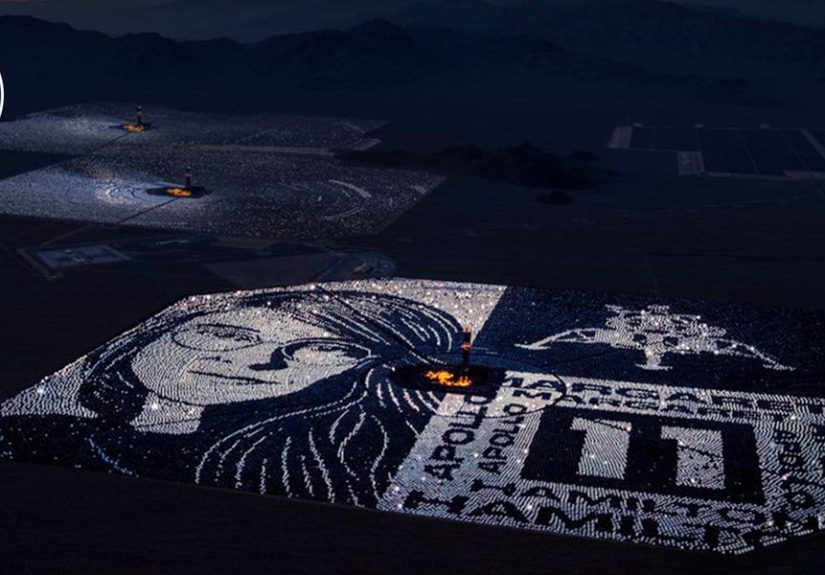
Let’s start with the headline-friendly part, because honestly, it deserves a slow clap. Google created a 1.4-square-mile portrait of Margaret Hamilton at the Ivanpah Solar Facility in California’s Mojave Desert. That is larger than Central Park, which covers a little more than 840 acres, or roughly 1.31 square miles. So yes, the comparison checks out. This was not “kind of large.” This was “someone please adjust the satellite” large.
The portrait was formed by repositioning more than 107,000 mirrors at Ivanpah to reflect moonlight rather than their usual sunlight. That detail matters because it transformed the installation from a renewable-energy site into a piece of night-sky theater. Google did not just create a giant image of Hamilton; it made a luminous tribute that echoed the spirit of Apollo itself. Moon mission. Moonlight portrait. You can practically hear the creative team high-fiving through history.
There was also something poetically appropriate about using a solar power facility for a tribute to a computing pioneer. Hamilton’s career was built on precision, systems thinking, and engineering discipline. Ivanpah is a monument to those same instincts at infrastructure scale. The setting made the tribute feel less like a billboard and more like a collaboration between code, light, land, and memory.
And that scale was the point. Google understood that Margaret Hamilton’s story had often been treated as niche, a footnote for programmers, NASA buffs, and people who get emotional around old code printouts. The giant portrait rejected that quiet treatment. It said, in effect, this is not a side story to Apollo. This is a main story. This is national-story, civilization-story, “put it where you can see it from way up there” territory.
Who Margaret Hamilton Was Before the Internet Finally Noticed
Margaret Hamilton was not a symbolic figure attached to Apollo after the fact. She was a central technical leader during the program itself. At MIT’s Instrumentation Laboratory, she led the Software Engineering Division responsible for the onboard flight software for Apollo’s command and lunar modules. That meant she was working in a field that barely had a name, on machines with absurdly limited computing power, while the United States was trying to do one of the most difficult things it had ever attempted.
Think about the timing. Today, if an app crashes, people grumble, reopen it, and move on with their lives. In Apollo, a software failure could cost a mission, a national goal, or human lives. Hamilton and her team were writing code for an environment with almost no margin for improvisation. The software had to be correct, efficient, and able to manage priorities under pressure. There was no luxury of “we’ll patch it after launch.” Space is not famous for forgiving version 1.0 problems.
Hamilton is also widely associated with helping legitimize the term “software engineering,” and for good reason. At a time when hardware was treated as the serious part of the operation, she argued that software demanded the same respect, rigor, and engineering discipline as any physical system. That sounds obvious now, but it sounded far less obvious when software was still fighting for status in a room full of rockets, guidance systems, and people who probably trusted metal more than code.
Her now-iconic photograph beside a towering stack of Apollo code helped cement her place in public memory decades later. The image is irresistible because it captures several truths at once: the scale of the effort, the physicality of software in the printout era, and the visual absurdity of one woman standing beside a paper monument to logic. It also serves as a reminder that the “hidden figures” of the space race included software pioneers whose work was every bit as mission-critical as the machinery around them.
The Apollo 11 Moment That Proved Her Software Was Built for Reality
If Hamilton’s legacy had rested only on leadership and vision, that would already be impressive. But Apollo 11 gave her software a live, unforgettable demonstration. During the lunar descent, the onboard computer began throwing the now-famous 1201 and 1202 program alarms. That is exactly the kind of moment that turns engineering from theory into destiny. Alarms during a moon landing are not mood-enhancers.
What happened next is the reason Hamilton’s name deserves to live beside the better-known astronauts of Apollo. The software was designed to prioritize critical tasks and discard less important ones when overloaded. In plain English, it knew how to stop fussing over the nonessential stuff and keep doing the things most necessary to land the spacecraft. That decision architecture helped Apollo 11 continue safely instead of spiraling into a catastrophic software meltdown.
This is where Hamilton’s brilliance becomes especially clear. She was not merely writing instructions for a predictable world. She was designing for the messy one, where humans make mistakes, hardware behaves unexpectedly, and impossible missions become even more impossible at the worst possible second. Her team built software that could recognize trouble, recover, and keep the essential functions alive. Modern engineers would call that fault tolerance. Apollo called it survival.
There is also a larger lesson buried inside those alarms. Great engineering is often invisible until the day it prevents disaster. Nobody throws a parade because a safeguard quietly worked exactly as intended. Yet those are the moments that separate flashy systems from trustworthy ones. Hamilton’s contribution was not just that she helped write the code. It was that she helped define what responsible software had to be under pressure.
Why Google’s Tribute Worked So Well
Google’s portrait succeeded because it understood the gap between Hamilton’s importance and her public fame. Astronauts have faces, missions, and mythology. Software pioneers often get documentation. Plenty of Americans recognized the Apollo 11 crew. Far fewer could name the woman whose software logic helped make the landing possible. The tribute corrected that imbalance in the loudest possible visual language.
It also spoke to a modern audience that processes history through images as much as text. A moonlit portrait larger than Central Park is the kind of fact that refuses to stay boring. It invites clicks, conversation, and curiosity. Once people arrive for the giant-desert-art angle, they stay for the Hamilton story. That is smart storytelling, not gimmickry. The spectacle opens the door; the history gives it weight.
There is another reason the tribute landed so well: it reframed a woman in computing not as a token inclusion, but as a central architect of a world-changing success. Hamilton was not important because she was “one of the women involved.” She was important because her work changed the trajectory of computing and helped deliver one of the most iconic achievements in modern history. The tribute made that hierarchy clear. First came the accomplishment. Then came the overdue recognition.
Google also chose its symbolism carefully. A portrait visible from above, formed by reflected light, connected the Earthbound world of infrastructure to the aspirational world of space exploration. It suggested that Hamilton’s work still reflects into the present: into modern software engineering, into fault-tolerant systems, into how we think about reliability, and into the continuing story of women whose technical labor held up major national achievements while history looked somewhere else.
Margaret Hamilton’s Legacy in Modern Software
It is tempting to freeze Hamilton in amber as a moon-landing legend, but that would undersell her. Her work matters because it still feels modern. She pushed for software that anticipated error rather than pretending perfect users and perfect systems would always exist. That mindset sits underneath everything from aerospace systems to medical devices to cloud computing. If your technology team talks about resilience, priority handling, or system reliability, it is already speaking a language Hamilton helped shape.
Her approach also challenged the old habit of treating software as secondary to hardware. Apollo showed, dramatically, that code could be the difference between a mission aborted and a mission completed. Today that idea seems obvious, because software now runs finance, infrastructure, communications, logistics, transportation, healthcare, and the device probably sitting in your pocket. But obvious things are often obvious only because someone fought to make them so.
Recognition followed, though slowly. NASA honored Hamilton with an Exceptional Space Act Award. In 2016, President Barack Obama awarded her the Presidential Medal of Freedom, describing her work as foundational to modern ultra-reliable software design and engineering. Those honors mattered, but they also underlined how long it took for the culture at large to fully appreciate what Apollo’s software leaders had accomplished.
That delay is part of what makes Google’s tribute emotionally satisfying. It was not replacing earlier honors; it was amplifying them for the internet age. Hamilton had already earned the medals, the archives, the interviews, and the technical respect. What Google added was mass visibility. It translated a deeply important computing legacy into a form impossible to shrug off.
What the Giant Portrait Says About How We Remember Innovation
Public memory loves dramatic images. A rocket launch. A bootprint. A grainy control room. But the history of innovation is also a history of quiet decisions made at desks, in labs, and inside stacks of logic that never become glamorous on their own. Hamilton’s story reveals the problem: our biggest achievements are often held together by work that is essential but visually uncooperative.
That is why the size of Google’s tribute matters beyond its novelty. Bigger than Central Park is a playful comparison, but it also functions like a correction. It tells us that Hamilton’s place in history is not small. It only looked small because we had not been measuring it properly. Once you account for the actual impact of her work, a giant portrait begins to seem less extravagant and more proportional.
It also says something encouraging about the present. There is growing interest in telling fuller stories about science, technology, and exploration, stories that include programmers, systems thinkers, and women whose labor was historically under-credited. The goal is not to rewrite Apollo into a different achievement. It is to tell the truth about how many kinds of excellence it required. Rockets needed fuel. Missions needed astronauts. And moon landings needed software that could think clearly when everything else got noisy.
The Human Experience of Hamilton’s Legacy
There is a particular feeling that comes with learning the full Margaret Hamilton story for the first time. It usually starts as surprise. You hear about a giant Google tribute in the desert and expect a quirky piece of corporate theater. Then you follow the thread back to Apollo, to MIT, to the alarms during lunar descent, and the whole thing changes shape. Suddenly the tribute feels less like a clever visual and more like a delayed standing ovation.
For many readers, the experience is deeply personal even if they never worked in aerospace or software. Hamilton represents a kind of intelligence that does not always get mythologized in popular culture: the patient, exacting, systems-level intelligence that prevents crises before anyone realizes there was a crisis to prevent. Her story resonates with engineers, certainly, but also with project managers, teachers, caregivers, researchers, and anyone whose best work often goes unnoticed precisely because it keeps things from falling apart.
Imagine seeing that portrait at Ivanpah in person or even just understanding its scale in your mind. The desert goes dark, the mirrors catch moonlight, and an image appears that is not of an astronaut stepping onto the lunar surface, but of the woman who helped make that step technically possible. That reversal is powerful. It rearranges the emotional furniture in the room. The hero is not in the spacesuit this time. The hero is the person who made sure the machine could keep thinking when the mission got messy.
There is also something moving about the contrast between Hamilton’s original era and ours. In the Apollo years, software was still fighting for respect. Women in technical leadership were rarer, more isolated, and too often treated as exceptions instead of trailblazers. Today, students can encounter Hamilton’s image in classrooms, museums, articles, documentaries, and social media feeds. The giant Google tribute added a new layer to that visibility. It told young programmers, especially young women, that technical brilliance belongs in the center of the story, not in the margins.
The experience of reading about Hamilton often leads to a second reaction after surprise: gratitude. Not vague gratitude, but the specific kind you feel when you realize history contained more competence, more foresight, and more courage than the short version ever told you. Apollo was not just about daring astronauts and national ambition. It was also about teams who had to imagine failure modes nobody wanted to think about and solve them anyway. Hamilton’s legacy reminds us that optimism is strongest when it is backed by preparation.
That may be why her story sticks. It does not flatter the fantasy of genius as effortless. It shows genius as disciplined, stubborn, collaborative, and willing to obsess over details that others might dismiss. There is comfort in that. It means world-changing work is not always a lightning bolt. Sometimes it is the result of asking better questions, demanding higher standards, and refusing to believe that software should get a pass just because it is hard.
And yes, there is joy here too. A giant moonlit portrait in the desert is fun. It is theatrical in the best possible way. It invites wonder, which is fitting, because wonder is part of the Apollo legacy. But the most lasting part of the experience is the mental reset Hamilton’s story creates. After you understand what she did, you start seeing technology history differently. You begin looking for the hidden architecture under every famous moment. You ask who built the reliability, who planned for the chaos, who made the glamorous outcome possible. That question does not just improve our understanding of Apollo. It improves our understanding of progress itself.
Conclusion
Google’s tribute to Margaret Hamilton was larger than Central Park, but its symbolic size mattered even more than its physical size. It was a giant, moonlit correction to the way innovation is often remembered. Hamilton was not a side note to Apollo 11. She was one of the people who made it work when working mattered most. Her leadership in software engineering, her insistence on reliability, and her team’s design decisions during the Apollo era helped define what modern trustworthy software looks like.
So yes, the desert portrait was enormous. Good. Some legacies need that kind of scale. Because when history is finally catching up to the people who helped build the future, subtlety can take the day off.







 Close
Close