
Table of Contents >> Show >> Hide
- What People Mean by “Lunar Supercollider”
- Why Bigger Colliders Reveal New Physics
- Why the Moon, Specifically?
- Engineering a Collider on the Moon: The “How” (and the “Yikes”)
- What Would We Learn? The Physics Payoff
- Biggest Obstacles (Besides “Everything”)
- Experiences: What “Lunar Collider Life” Might Actually Feel Like
- Conclusion
If you want to understand the universe, you can do one of two things: stare at the sky and hope it confesses,
or smash tiny particles together until nature accidentally tells you the truth. For the last half-century,
particle physicists have favored option #2 (with occasional breaks to drink coffee and argue about statistics).
And now there’s a deliciously sci-fi idea on the table: build the next mega-collider not under France and
Switzerland, not under Texas, but around the Moon.
The concept is sometimes nicknamed a “lunar supercollider.” In plain English: a particle accelerator so large
it could wrap around a lunar great circle, pushing proton collisions far beyond what Earth-based machines can
reasonably do. It’s ambitious, expensive, andyescurrently speculative. But it’s also grounded in real
accelerator physics, real lunar conditions, and real frustrations with the limits of building ever-bigger
machines on Earth.
What People Mean by “Lunar Supercollider”
A modern circular hadron collider is basically a super-precise racetrack for charged particles. Electric
fields push the particles faster; magnetic fields bend their paths into a loop; and at specific points, two
beams collide inside detectors the size of cathedrals. When it works, you get new particles, rare processes,
and measurements that sharpen (or shatter) our theories.
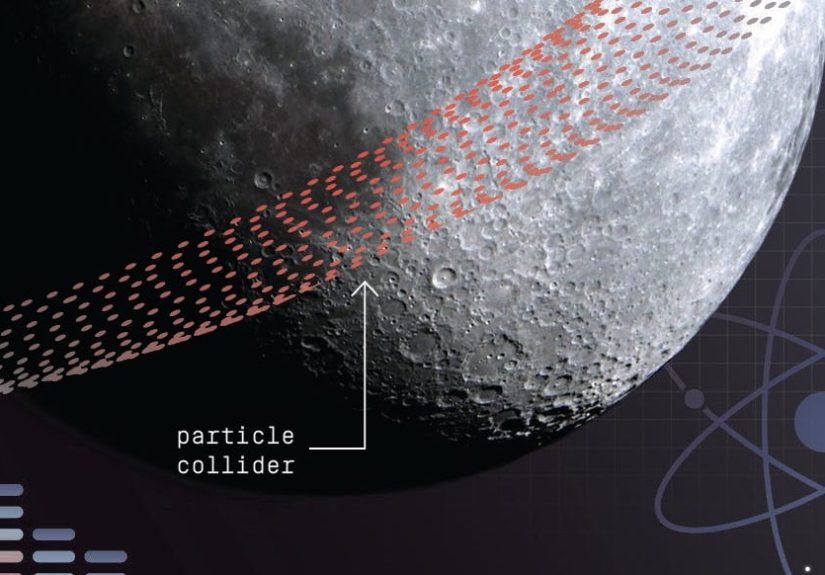
The Moon version scales the idea to a jaw-dropping size: one published proposal sketches a Circular Collider
on the Moon with a circumference of about 11,000 km, reaching a proton-proton center-of-mass energy of about
14 petaelectronvolts (PeV), assuming powerful 20-tesla bending magnets. That’s described as roughly a thousand
times higher than the Large Hadron Collider’s energy scale. In other words: “LHC, but make it lunar… and
also enormous.” (And yes, the budget meetings would be equally enormous.)
Why Bigger Colliders Reveal New Physics
Particle physics has a repeating plotline: whenever we push to a new energy frontier, the universe either
reveals something new or becomes increasingly smug about how well the Standard Model works. The Higgs boson,
discovered in 2012, is the signature example of an “energy frontier” success story. But there’s still a long
list of mysteries the Standard Model doesn’t solve: dark matter, the matter–antimatter imbalance, neutrino
masses, the nature of inflation, and whether new symmetries or hidden forces exist.
Energy is a flashlight (and sometimes a crowbar)
Higher collision energy is like turning up the brightness of your flashlight in a dark room. Some things were
always thereyou just couldn’t see them. In collider terms, that means heavier particles and rarer processes
that are inaccessible at lower energies. And even if brand-new particles don’t appear immediately, high-energy
collisions can magnify subtle deviations from Standard Model predictions.
But size matters because magnets have limits
For a circular collider, the achievable particle momentum depends on the magnetic field strength and the
radius of the ring. You can try to crank the magnetic field higher, but superconducting magnets are already
working near the edge of what materials, engineering, and cryogenics can support. If magnets can’t get
dramatically stronger overnight, the other lever is the ring sizebuild a bigger circle so the same magnetic
field bends much higher-energy beams.
Earth-based designs are constrained by geography, politics, environmental reviews, tunneling complexity, and
the awkward reality that our planet is already full of people who have opinions about giant underground
projects. The Moon is less crowded (unless you count craters).
Why the Moon, Specifically?
The Moon isn’t being proposed just because it looks cool in concept art. It has physical properties that are
legitimately attractive for certain parts of accelerator designespecially if you’re aiming for a collider so
large that Earth becomes a practical obstacle.
1) Space and siting: fewer “neighbors,” fewer constraints
A collider with thousands of kilometers of circumference would be a hard sell on Earth for purely physical
reasons: it would cross oceans, mountains, national borders, cities, and “that one protected wetland that
will ruin your entire route.” The lunar surface offers wide-open real estate and a consistent gravitational
environment, without property disputes in the usual sense.
2) The Moon’s “atmosphere” is basically a whisper
The Moon has an extremely tenuous exosphereso thin it doesn’t behave like the air we’re used to. That matters
because circular colliders require ultra-high vacuum in the beam pipe: stray gas molecules can scatter
particles out of the beam, creating losses and unwanted background in detectors. A lunar environment can
reduce some vacuum engineering burdens, though the collider still needs carefully maintained internal vacuum
systems. Think of it as starting a cleanliness project in a room that’s already pretty dust-freeexcept,
unfortunately, the Moon has dust in the other, more literal sense.
3) A natural incentive: lunar infrastructure is coming anyway
A lunar supercollider isn’t something you build with a pickup truck and optimism. It likely depends on a
broader lunar economy: power generation, robotics, mining and refining, construction systems, and transportation
routes between Earth, lunar orbit, and the surface. NASA’s Artemis campaign and related commercial efforts are
aimed at a sustained lunar presence, including missions designed to return astronauts to the lunar surface and
operate near the South Pole. In NASA’s current published planning, Artemis III is targeted for mid-2027 (with
timelines subject to change in real life, as space programs cheerfully demonstrate).
Engineering a Collider on the Moon: The “How” (and the “Yikes”)
To understand whether a lunar supercollider is even remotely plausible, it helps to break it into systems:
magnets, tunnel/structure, power, cooling, beam control, detectors, and maintenance. Each one is a serious
engineering fieldso, naturally, we’re proposing to do all of them… on the Moon.
Magnets: the make-or-break technology
High-energy circular colliders depend on superconducting dipole magnets, which produce strong magnetic fields
with minimal electrical resistancebecause otherwise your power bill would be visible from orbit. The LHC’s
magnets operate around the 8-tesla scale, and future colliders often target higher fields. Research programs
in the U.S. are actively developing next-generation superconducting magnet technology (including high
temperature superconductors) to reach higher fields and improved performance.
A lunar collider proposal that assumes 20-tesla dipoles is, in a sense, asking: “What if we combine huge
radius with very aggressive magnet tech?” That’s why magnet R&D is central to the conversation. Without
major progress in superconductors, conductor manufacturing, and cryogenic reliability, the whole “PeV on the
Moon” idea stays in the realm of fun thought experiments.
Structure: tunnel, trench, or something we haven’t invented yet
Earth colliders use tunnels for stability, safety, and shielding. On the Moon, tunneling is possible, but it’s
a different game: no groundwater (nice!), but abrasive regolith, extreme thermal cycling at the surface, and
the need to build and service equipment with heavy reliance on robotics.
One intriguing angle is using naturally sheltered environmentslike lunar pits or lava tubesas stable thermal
and radiation-protected spaces. NASA studies of lunar caves suggest subsurface environments can offer more
moderate temperatures than the surface’s brutal day/night extremes. A supercollider doesn’t have to live
entirely underground, but the more you can protect sensitive equipment, the easier long-term operations become.
Power: your biggest “utility bill” is 384,400 km away
A mega-collider is a power-hungry creature. Even today’s accelerators require enormous electrical systems, and
a lunar version adds inefficiencies: power generation, storage for lunar night (or careful siting near regions
with long-duration sunlight), and distribution along thousands of kilometers.
A plausible long-term approach might combine large solar arrays (especially attractive near certain polar
regions with favorable illumination) with nuclear power for steady baseload, plus industrial-scale energy
storage. The idea isn’t “plug it into the Moon.” The idea is “build a lunar grid,” which is a whole other
mega-projectand also something that would benefit many other lunar activities beyond particle physics.
Cooling and cryogenics: superconductors hate surprises
Superconducting magnets typically require cryogenic cooling. On Earth, that’s a mature (but still complex)
technology. On the Moon, you’d need cryoplants, insulation strategies, leak-proof systems, and a maintenance
philosophy that assumes you can’t just call a technician from two towns over. You also have to manage heat
from electronics, RF systems, and detector operationssometimes while the outside world swings between
blistering sunlight and deep cold.
Dust, radiation, and micrometeoroids: the Moon’s charming personality
Lunar regolith is not cute beach sand. NASA has repeatedly highlighted that lunar dust is sharp, abrasive, and
clingy, prone to coating equipment and causing mechanical and thermal issues. Apollo astronauts experienced
dust getting into mechanisms and degrading systemsfuture long-duration hardware will have to be engineered
around this reality.
Radiation is another non-negotiable. Earth’s magnetic field and atmosphere provide protection we rarely
appreciate until we leave them. A lunar collider’s electronics and detectors would need robust shielding and
careful operations planning, not only for long-term exposure to cosmic rays but also for episodic solar events.
What Would We Learn? The Physics Payoff
A lunar supercollider is not just “bigger LHC.” It potentially opens a fundamentally new regime. At energies
orders of magnitude above current machines, particle interactions probe distance scales and processes that
could connect to early-universe physics and to phenomena hinted at by astrophysical observations.
Dark matter: making the invisible show up on a detector
If dark matter consists of particles that can be produced in high-energy collisions, a much more powerful
collider improves the oddsespecially for heavier candidates. Even in scenarios where dark matter particles
don’t interact strongly, high-energy collisions can produce “missing energy” signatures coupled with other
telltale events. The bigger the energy reach, the wider the net.
New forces, hidden sectors, and “physics we didn’t know we needed”
Many beyond-Standard-Model ideas predict additional particles or interactions that are too heavy or too rare
to see with today’s machines. A collider in the PeV class could test wide classes of theories that currently
live mostly in equations and conference slides.
Connecting to cosmic rays: turning nature’s accidents into controlled experiments
The highest-energy cosmic rays hitting Earth carry staggering energiesfar above what human accelerators can
achieveyet they arrive randomly, rarely, and smash into the atmosphere with messy initial conditions. A
controlled collider at ultra-high energy would let physicists recreate aspects of those interactions with
precision, improving our understanding of particle showers, hadronic physics, and extreme-energy processes.
Biggest Obstacles (Besides “Everything”)
A lunar supercollider proposal is honest about the unknowns, and that honesty is part of what makes it useful:
it forces concrete thinking about what technologies must mature. Here are the sticking points that tend to
dominate serious discussions.
- Launch and logistics: moving mass to the Moon is still expensive and slow, even with improving commercial capabilities.
- Autonomous construction: thousands of kilometers of precision infrastructure demands robotics that can build, align, inspect, and repair at scale.
- Materials and manufacturing: in-situ resource utilization could help (e.g., construction materials from regolith), but superconductors and high-precision components likely still require Earth supply chains for a long time.
- Reliability: colliders are delicate. The Moon is not.
- Governance: who owns, operates, funds, and regulates a machine that wraps around a celestial body?
In other words: this isn’t just a physics project. It’s an entire civilization-scale infrastructure challenge
that happens to include particle physics as a major tenant. (Which, to be fair, is exactly how particle
physicists like their projects.)
Experiences: What “Lunar Collider Life” Might Actually Feel Like
No one has operated a supercollider on the Moonyet. But we do have real, hard-earned experience from three
places: (1) running complex accelerators on Earth, (2) living with lunar dust lessons from Apollo and decades
of lunar engineering studies, and (3) operating robots and instruments in harsh environments where repairs are
difficult. If you stitch those experiences together, you get a pretty vivid picture of what day-to-day life
around a lunar supercollider could be like.
Imagine the “morning shift” starting not with a commute, but with a systems dashboard that looks like mission
control and a power-plant control room had a baby. Accelerator operators already juggle beam stability,
magnet currents, vacuum quality, and the health of thousands of subsystems. On the Moon, the dashboard would
add lunar weather equivalents: radiation alerts, dust lofting risk near landing zones, thermal status of
surface components, and rover traffic reports (“Unit R-17 is stuck again; it has discovered a new crater it
strongly identifies with”).
The first time the collider completes a full “around-the-Moon” circulation test, the celebration would look
familiar to any lab veteran: cheering, screenshots, and someone immediately asking, “Okay but what’s the
background rate?” Physics is joy followed by debugging. Always followed by debugging.
Maintenance would be its own genre of adventure. On Earth, technicians can access a tunnel, swap a component,
and retest within hours or days. On the Moon, a “simple” repair might mean dispatching autonomous rovers to a
service hatch, running precision alignment routines, cleaning a connector that regolith has somehow adopted as
its forever home, and then validating the fix remotelypossibly while the site is entering lunar night.
NASA’s documented dust concerns are not abstract here: dust can clog mechanisms, degrade thermal surfaces, and
abrade materials. In a lunar collider, dust mitigation would be more than housekeeping; it would be mission
survival.
Crewed involvementif and when it becomes routinewould feel less like tinkering and more like aviation
maintenance crossed with deep-sea operations. You’d plan every EVA minute because the environment punishes
improvisation. The suits, tools, and procedures would reflect decades of learning from space operations:
modular parts, redundant seals, dust-resistant joints, quick-swap electronics, and strict “touch nothing you
don’t have to touch” rules.
For scientists, the emotional rhythm would be eerily familiar. Most days would be data quality checks and
incremental improvements: tuning beams, calibrating detectors, squashing systematic errors. Thenrarelyyou’d
see a strange bump in a distribution, a pattern in missing energy, or a deviation that won’t go away after
the 30th cross-check. That’s when the entire collaboration forgets what sleep is. The Moon might be quiet,
but the group chats would not be.
And there’s a humbling “overview effect” angle that’s hard to ignore. On Earth, a collider is a marvel of
engineering hidden underground, mostly invisible to everyone except the people running it. On the Moon, the
machine would be part of the landscapean artifact of intelligence stretched across a world. Every successful
run would be a reminder that curiosity can become infrastructure. Not a metaphorical oneliteral infrastructure.
The funniest part? After all that effort, the universe might still refuse to hand over a neat, cinematic
answer. It might give us a more precise Standard Model, tighter constraints, and a longer list of things we
now know we don’t know. Which is, honestly, the most realistic “experience” in physics: you build a bigger
question-asker, and nature responds with better questions.
Conclusion
A lunar supercollider is a bold idea balanced on real physics and very real engineering challenges. The Moon
offers space, an extremely thin exosphere, and a future infrastructure pathway that couldover decadesmake
ultra-large projects more plausible than they are on Earth. In return, the project demands breakthroughs in
high-field magnets, autonomous construction, power generation, dust mitigation, radiation shielding, and
reliable operations far from home.
If humanity ever builds a collider that circles the Moon, it won’t just be a machine for particle physics. It
will be a statement: that we’re willing to invest in understanding the universe at its deepest level, even
when the answer isn’t guaranteed, and even when the lab is a quarter-million miles away.






 Close
Close