
Table of Contents >> Show >> Hide
- The Big Idea: You’re Not “Plugging In a House”You’re Switching Power Sources
- Before You Buy Anything: Do a 10-Minute Load Plan
- Option A: Power Appliances Directly (No Panel Connection)
- Option B: Manual Transfer Switch + Power Inlet Box (The “Selected Circuits” Setup)
- Option C: Interlock Kit + Inlet Box (The “Power the Panel, Choose Your Breakers” Setup)
- Option D: Standby Generator + Automatic Transfer Switch (ATS)
- Safety Rules That Matter More Than Your Wi-Fi Password
- Neutral, Grounding, and “Why Is This Buzzing?” (A Friendly Reality Check)
- Code, Permits, and Inspections: The Unsexy Stuff That Protects You
- Common Mistakes (So You Don’t Become a Neighborhood Story)
- A Quick “Outage Drill” Checklist (Do This on a Nice Day)
- Conclusion: The Safest “Connection” Is a Safe Switch
- of Real-World Generator Hookup Experiences (So It Goes Smoothly When It Counts)
Power goes out. Your phone is at 12%. The fridge is making that “I’m warming up” sound.
And you suddenly remember you own a generator… somewhere… probably behind the holiday decorations.
Good news: backup power can be simple, safe, and surprisingly civilized. Bad news: the internet contains
some truly haunted “hacks” that can injure you, fry equipment, or backfeed power onto utility lines.
This guide breaks down the safe, code-aligned ways to connect a generator to your house,
with practical examples, a little humor, and a firm “no thanks” to the dangerous stuff.
(If you only read one sentence today, make it this one: Never plug a generator into a wall outlet.)
The Big Idea: You’re Not “Plugging In a House”You’re Switching Power Sources
Your home normally gets electricity from the utility grid. A generator is a second power source.
To connect a generator to your house safely, you need a way to ensure only one source feeds your panel at a time.
That’s what electricians mean by transfer equipment.
The safe connection options (from simplest to most “whole-house”)
- Extension cords only (no panel connection): power a few appliances directly.
- Manual transfer switch: powers selected circuits through a dedicated switch box.
- Panel interlock kit: lets you power your main panel (with strict load management).
- Standby generator + automatic transfer switch (ATS): the “it just works” option.
Before You Buy Anything: Do a 10-Minute Load Plan
Generator sizing is where most people either overspend… or discover the hard way that
a space heater and a microwave can’t be “best friends” on a small portable generator.
You want to plan for running watts and starting (surge) watts.
Motors (fridges, sump pumps, well pumps, some HVAC) often surge when they start.
A realistic “keep life normal-ish” example
| Item | Typical Running Watts | Typical Starting Watts |
|---|---|---|
| Refrigerator | 150–400 | 600–1,200 |
| Sump pump | 800–1,200 | 1,500–3,000 |
| Wi-Fi router + modem | 20–60 | Same |
| LED lights (several rooms) | 50–150 | Same |
| Microwave | 900–1,500 | Same |
If your must-haves are a fridge, some lights, Wi-Fi, and maybe a sump pump,
many homeowners do fine with a 5,000–7,500-watt portable generator (varies by what you run and how you manage loads).
If you’re eyeing a well pump, larger HVAC, or more circuits, the strategy matters as much as the wattage.
Option A: Power Appliances Directly (No Panel Connection)
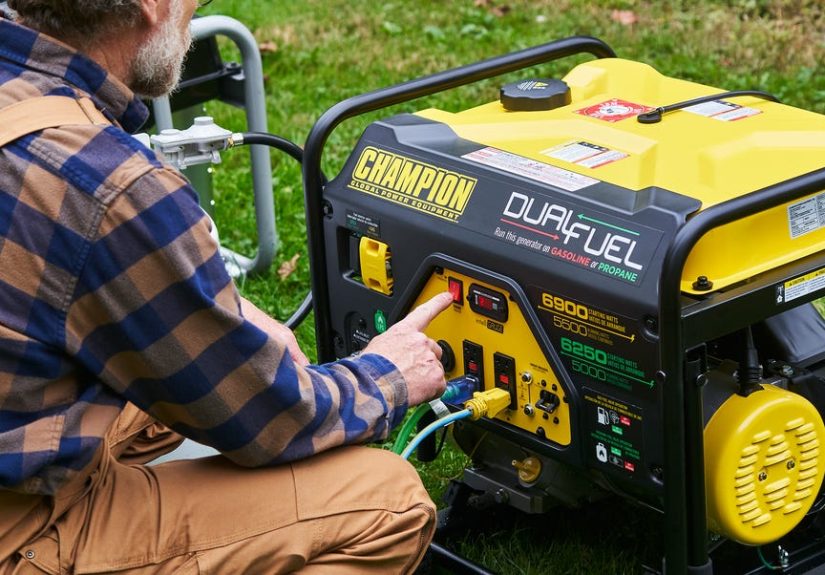
This is the simplest and often the safest entry point: run the generator outdoors and plug appliances into it
using heavy-duty, outdoor-rated extension cords.
You are not “connecting the generator to the house wiring” hereyou’re just powering devices.
Best for
- Renters or apartments (where panel modifications aren’t possible)
- Short outages
- Minimal loads (fridge, phone charging, fans, a few lights)
How to do it without turning your living room into a spaghetti-cord museum
- Place the generator outside on a dry surface, well away from doors/windows.
- Use the right cords: thick gauge, outdoor-rated, no cuts, no missing ground pin.
- Start the generator first, let it stabilize, then plug loads in one at a time.
- Don’t overload it. If the generator bogs down, trips, or the lights flicker like a horror movie, reduce load.
The downside is convenience: you may be routing cords through a cracked window or door.
If you want a cleaner setup (and the ability to energize selected circuits), move to a transfer switch or interlock.
Option B: Manual Transfer Switch + Power Inlet Box (The “Selected Circuits” Setup)
A manual transfer switch is a separate box (often mounted near your main panel) that lets you feed
specific circuits from the generator. It’s designed to prevent backfeeding by mechanically and electrically
separating generator power from utility power.
Best for
- Homeowners who want a safer, cleaner setup than extension cords
- People who only need a handful of critical circuits (fridge, furnace blower, sump, kitchen outlets, etc.)
- Anyone who wants simpler operation and clearer “on/off” control per circuit
What gets installed (usually by a licensed electrician)
- Outdoor inlet box (where the generator cord plugs into the house)
- Manual transfer switch (select circuits are moved/connected through this switch)
- Proper breakers, wiring, labeling, and (often) permits/inspection depending on location
How you operate it during an outage (typical workflow)
- Turn off or unplug sensitive loads (computers, TVs) if possible.
- Plug generator cord into the inlet (generator still off).
- Start the generator outdoors and let it warm up briefly.
- Flip transfer switch circuits from “Line” (utility) to “Gen” (generator) one at a time.
- Add loads gradually: start with essentials, then “nice-to-haves.”
- When utility power returns, flip circuits back to “Line,” shut down and cool the generator, then disconnect.
Why people like this option: it’s straightforward, it limits what can run (helpful for avoiding overload),
and it’s easier for other family members to use correctlyespecially at 2:00 a.m. during a storm.
Option C: Interlock Kit + Inlet Box (The “Power the Panel, Choose Your Breakers” Setup)
An interlock kit is a mechanical device installed on your main electrical panel
that prevents the main breaker and a dedicated generator backfeed breaker
from being on at the same time. That physical “can’t do both” is the entire pointbecause humans are great,
but also occasionally distracted by things like “no coffee” and “a tree fell on the fence.”
Best for
- Homeowners who want flexibility to power different circuits as needed
- People comfortable managing loads by turning breakers on/off
- Those who want a cost-effective alternative to moving circuits into a transfer switch box
What gets installed (again: typically electrician territory)
- Outdoor inlet box
- Generator power cord (proper rating/connector)
- Generator breaker in the main panel (proper sizing and placement)
- Panel-specific interlock hardware and required labeling
How you use an interlock during an outage (high-level, safety-first)
- Turn off big loads (HVAC, range, dryer) at the breakers to prevent overload.
- Turn off the main breaker (utility feed).
- Engage the interlock so the generator breaker can be turned on (and the main cannot).
- Start the generator outdoors.
- Turn on the generator breaker, then energize needed circuits one at a time.
- Manage loads actively: if you start the microwave, maybe pause the toaster oven’s “career.”
- When power returns, reverse the process: turn off generator breaker, shut down generator, then restore main breaker.
Pros and cons in plain English
- Pro: Flexibleyou can power different circuits depending on the season and needs.
- Pro: Often less expensive than a full circuit transfer switch setup.
- Con: You must manage loads carefully to avoid overloading the generator.
- Con: Installation must match your specific panel model and local code requirements.
Option D: Standby Generator + Automatic Transfer Switch (ATS)
A standby generator is permanently installed outside (like an HVAC condenser),
usually runs on natural gas or propane, and uses an automatic transfer switch
to detect outages and power your home without you doing anything beyond enjoying the sudden quiet confidence.
Best for
- Frequent outages, medically necessary equipment, or work-from-home dependence
- Homeowners who want automatic backup power (even when they’re away)
- Those who prefer a long-term solution with professional maintenance options
What to know before you commit
- Cost: Highest upfront, but also the most seamless.
- Permits: Often involves electrical and fuel-gas permits, plus clearances and placement rules.
- Maintenance: Like a carignore it forever and it will choose the worst moment to be dramatic.
- Load planning still matters: “Whole-house” can mean different things depending on generator size and your home’s loads.
Safety Rules That Matter More Than Your Wi-Fi Password
1) Carbon monoxide (CO): the invisible, odorless risk
- Run generators outside onlynot in garages, basements, sheds, or “but the door is open.”
- Keep it well away from the house and aim exhaust away from doors, windows, and vents.
- Use CO alarms on every level and near sleeping areas, ideally with battery backup.
2) Backfeeding: how people get hurt and equipment gets wrecked
Backfeeding happens when generator power flows backward through your home’s wiring into utility lines.
It can endanger lineworkers, neighbors, and your own electronics when grid power returns.
The fix is simple in concept: use approved transfer equipment (transfer switch, interlock, or ATS).
The non-fix is “I’ll just be careful.” The grid does not accept pinky promises.
3) Wet weather, cords, and fire risk
- Keep the generator dry (operate on a dry surface; use a canopy-like cover designed for ventilation).
- Let it cool before refueling to reduce fire risk.
- Use properly rated cordsundersized cords can overheat.
- Never daisy-chain power strips like you’re building a holiday-light exhibit.
Neutral, Grounding, and “Why Is This Buzzing?” (A Friendly Reality Check)
Once you start connecting a generator to a home electrical system, details like
neutral bonding, GFCI behavior, and whether equipment switches the neutral
become importantand these are exactly the details that vary by generator design and installation method.
That’s why most reputable guidance boils down to: have a qualified electrician install transfer equipment
and follow your generator and transfer device instructions.
Translation: your goal is a system that’s safe, compliant, and predictablenot a science fair project
that only works when the moon is in a certain phase.
Code, Permits, and Inspections: The Unsexy Stuff That Protects You
Many U.S. jurisdictions treat generator connections as electrical work that may require a permit and inspection,
especially when you’re adding an inlet box, transfer switch, interlock kit, or standby system.
Local requirements can vary, so your best move is to check with your local building department (your AHJAuthority Having Jurisdiction)
or hire an electrician who does this routinely.
Bonus: a permitted, inspected installation can also help with insurance questions later.
Nobody wants to explain “my cousin’s friend wired it” in a claims call.
Common Mistakes (So You Don’t Become a Neighborhood Story)
- Trying to power the panel without transfer equipment (the classic backfeed hazard).
- Running the generator too close to the house (CO risk climbs fast).
- Overloading (tripped breakers, damaged generator, or both).
- Using the wrong cords (heat, voltage drop, melted insulation).
- Forgetting a plan (in a storm, nobody wants to guess which breaker is the fridge).
A Quick “Outage Drill” Checklist (Do This on a Nice Day)
- Label your critical circuits (fridge, furnace blower, sump, well, kitchen outlets).
- Test your generator for 10–15 minutes under load (not just “it starts”).
- Stage your gear: generator cord, fuel, oil, funnel, flashlight, spare batteries.
- Check CO alarms and replace batteries if needed.
- Practice the steps so nobody is learning during thunder.
Conclusion: The Safest “Connection” Is a Safe Switch
If you want the safest way to connect a generator to your house, think “transfer,” not “trick.”
Extension cords are fine for simple needs. A manual transfer switch is great for a set list of circuits.
An interlock kit offers flexibility if you’re comfortable managing breakers. And a standby generator with an ATS is the
hands-off premium option.
Whatever you choose, treat carbon monoxide safety and backfeed prevention as non-negotiable.
Your goal isn’t just to keep the lights onit’s to do it in a way that’s safe for your family, your home,
and the people working to restore the grid.
of Real-World Generator Hookup Experiences (So It Goes Smoothly When It Counts)
Homeowners who use generators regularly tend to report the same “wish I’d known that earlier” lessonsand they’re
surprisingly consistent across regions, house sizes, and generator brands.
First: the practice run is everything. People often buy a generator, stash it, and assume the rest will be intuitive.
Then an outage hits, it’s raining sideways, and the generator cord is… somewhere. Or the oil level is low. Or the battery is dead.
The folks who have the best experiences usually do one calm, daylight test where they run the generator under load,
verify the inlet connection, and confirm which circuits matter. It’s not exciting, but it turns chaos into a routine.
Second: labels save relationships. In interlock setups, the most common “oops” isn’t the interlock itselfit’s load management.
People flip on the fridge, then the microwave, then the coffee maker (because priorities), and suddenly the generator bogs down.
The smoother approach is to label “big hitters” in the panel (range, dryer, water heater, HVAC compressor) and keep them off
unless you’re sure the generator can handle it. Some homeowners even make a tiny “power menu” on the inside of the panel door:
“Always on: fridge, Wi-Fi, lights. Rotate: microwave OR toaster OR hair dryer (choose one, champion).”
Third: CO safety is easy to underestimate because the danger is invisible. Many “close call” stories start with someone
placing the generator near a garage door, under a covered patio, or too close to a window because it’s convenient or sheltered
from weather. The experiences that end well usually include two habits: placing the generator well away from openings and
keeping CO alarms (with fresh batteries) in the house. People who do both don’t have to rely on luck.
Fourth: the little accessories matter. A good funnel, a spare quart of oil, nitrile gloves, a headlamp,
and a weather-appropriate cover (that still allows safe ventilation) are the difference between “this is fine” and “why is my
flashlight in the kitchen drawer I can’t open because it’s dark?” Many homeowners eventually build a small “outage tote”
that lives next to the generator: cord, fuel stabilizer, basic tools, and a printed checklist.
Finally: the best generator setup is the one your household can operate correctly.
If multiple people may need to run it, the simplest operating steps win. That’s why transfer switches and clearly labeled interlocks
tend to produce the calmest outcomesbecause the system itself nudges everyone toward the safe process.





 Close
Close