
Table of Contents >> Show >> Hide
- What Makes an Accent Wall “Impressive” (And Not “Oops”)
- The $70 Strategy: A Painted Geometric Accent Wall That Looks Custom
- Materials and Budget Breakdown (Realistic, Not Fairy-Tale)
- Step-by-Step: Paint a Geometric Dining Room Accent Wall (The Clean Way)
- Step 1: Measure the Wall (So Your Budget Doesn’t Cry)
- Step 2: Choose a Pattern That Matches Your Personality
- Step 3: Prep the Wall Like a Pro (This Is Where the Magic Lives)
- Step 4: Mark Your Layout (Lightly, Like a Polite Ghost)
- Step 5: Tape the Design (Sharp Lines = “High-End”)
- Step 6: The Secret to Crisp Lines: Seal the Tape
- Step 7: Paint in Two Thin Coats (Patience Pays Off)
- Step 8: Remove Tape at the Right Time
- Step 9: Touch Up Like You Meant It
- Color Ideas That Look Expensive (Even If Your Budget Isn’t)
- If Paint Isn’t Your Thing: Two Backup Accent Wall Options Under $70-ish
- Styling the Accent Wall So It Looks Intentional (Not Accidental)
- Common Mistakes That Make a $70 Accent Wall Look Like $7
- of Real-World “Experience” (AKA: What DIYers Learn Fast)
- Conclusion: Your $70 Dining Room Glow-Up Plan
Your dining room has one job: make Tuesday night leftovers feel like a candlelit event.
Unfortunately, blank walls tend to say, “Welcome to my hallway… but with chairs.”
The good news? You don’t need a contractor, a fancy wallpaper budget, or a degree in geometry
to pull off a stunning dining room accent wall for about $70.
This guide shows you the smartest way to get a high-end look with a low-end spendusing
paint, tape, and a little planning. You’ll also get a couple of backup options (still budget-friendly)
if your wall texture, rental rules, or patience level demands it.
What Makes an Accent Wall “Impressive” (And Not “Oops”)
An accent wall is simply one wall that stands out through color, pattern, texture, or material.
It creates a focal point and helps your room feel intentionalnot like you paused decorating
right after buying the table. The trick is choosing one strong move and executing it cleanly.
Pick the Right Wall: The “Yes, Obviously” Wall
In dining rooms, the best accent wall is usually the one you naturally look at when you enter
the spaceor the wall behind a buffet/sideboard, bar cart, or large art piece. Avoid the wall
that’s chopped up by too many doors or tiny windows (unless you enjoy taping around trim
like it’s an Olympic sport).
Choose Contrast That Fits the Room
Contrast doesn’t have to mean “neon coral in a beige house.” It can be darker, lighter, warmer,
cooler, or simply more patterned than the surrounding walls. A good rule of thumb is to go a
couple shades lighter or darker than the rest of the room for noticeable impact without chaos.
Finish Matters (Yes, the Boring Part Is Important)
Dining rooms see fingerprints, chair bumps, and the occasional “Who brought the red wine?”
moment. Eggshell and satin finishes are popular for living areas because they balance looks
and cleanability. Satin is typically more durable and stain-resistant than eggshell, but eggshell
can be plenty practical depending on the paint line you choose.
The $70 Strategy: A Painted Geometric Accent Wall That Looks Custom
If you want “designer feature wall” energy on a “two grocery bags and a latte” budget,
paint + painter’s tape is the MVP. It’s dramatic, forgiving, and scalable. You can go bold
(large diagonal blocks) or subtle (tone-on-tone pattern) without spending more.
Why this method hits the $70 target
- Paint goes farespecially if you’re painting a pattern (not a full wall).
- Tape is cheap and creates crisp lines that read “professional.”
- Most supplies are multipurpose and reusable for future DIY wins.
Materials and Budget Breakdown (Realistic, Not Fairy-Tale)
Your total depends on what you already own (roller tray? drop cloth? that mysterious half-used
roll of tape in the junk drawer?). Here’s a typical under-$70 shopping list if you’re starting light.
| Item | Why You Need It | Budget Range |
|---|---|---|
| 1 quart interior paint (accent color) | Enough for many accent wall patterns (often ~100 sq. ft. per quart) | $18–$30 |
| Painter’s tape (1–2 rolls) | Creates clean lines for geometric shapes | $6–$14 |
| Mini roller + tray (or roller cover) | Smoother finish than brush marks for large areas | $8–$15 |
| Angled brush (2-inch is a workhorse) | For cutting in edges and painting near tape lines | $6–$12 |
| Light spackle + sanding sponge | Fills nail holes so the wall looks polished | $6–$10 |
| Drop cloth or plastic sheeting | Protects floors and makes cleanup less tragic | $4–$10 |
Estimated total: $48–$91 depending on brand choices and what you already have.
To reliably land near $70, use a paint pattern (less paint), grab a basic roller kit,
and skip “premium specialty tape” unless your walls are textured like popcorn ceilings’ cousin.
Step-by-Step: Paint a Geometric Dining Room Accent Wall (The Clean Way)
Step 1: Measure the Wall (So Your Budget Doesn’t Cry)
Measure width and height, then multiply for square footage. Example: an 8 ft by 10 ft wall is 80 sq. ft.
A quart of paint is commonly enough for about 100 sq. ft. per coatgreat for patterns and many single-wall
projects. If your plan is to paint the entire wall in a dark color over a light wall, you may need a second coat,
which could require more paint. The hack: do a pattern so the existing wall color becomes your “base coat.”
Step 2: Choose a Pattern That Matches Your Personality
Here are three geometric options that look expensive but behave nicely for beginners:
- Diagonal color blocks: bold, modern, forgiving if you’re slightly off.
- Oversized diamond grid: graphic and artsy (great behind a buffet).
- Checkerboard rectangles: playful but sophisticated when done tone-on-tone.
Dining-room tip: If you host often (or just like pretending you do), choose a pattern that won’t visually
fight with a chandelier, large mirror, or gallery wall. One “hero” feature is the goal, not a design cage match.
Step 3: Prep the Wall Like a Pro (This Is Where the Magic Lives)
Prep is the difference between “Wow, you did that?” and “So… is it supposed to look textured?”
Clean the wall to remove grime, fill nail holes with spackle, sand smooth, and wipe away dust.
Tape off baseboards and adjacent edges. It’s not glamorous, but neither is repainting next weekend.
Step 4: Mark Your Layout (Lightly, Like a Polite Ghost)
Use a pencil and level to mark reference points. For diagonal designs, mark corner-to-corner guide points.
For grids, lightly mark intervals (for example, every 18–24 inches for larger shapes). Step back and look.
If it feels too busy from across the room, it will feel even busier when you’re seated at the table.
Step 5: Tape the Design (Sharp Lines = “High-End”)
Apply painter’s tape along your pencil lines. Press down edges firmly with a plastic card or a clean putty knife
to prevent paint bleed. Keep tape lines continuous where possiblelots of tiny tape pieces can create tiny gaps,
and tiny gaps create big regrets.
Step 6: The Secret to Crisp Lines: Seal the Tape
Want that razor-sharp look? Paint a thin layer of the wall’s base color along the tape edges first (or use a clear
sealing method if you have it). Once dry, paint your accent color. This seals small gaps so the accent paint
can’t sneak under the tape like it pays rent.
Step 7: Paint in Two Thin Coats (Patience Pays Off)
Use a brush to cut in near tape edges, then fill larger areas with a roller for an even finish.
Thin coats dry better, look smoother, and reduce bleed. Wait the recommended time between coats.
Most paint lines suggest one or two coats depending on surface and color change.
Step 8: Remove Tape at the Right Time
Remove tape while the final coat is still slightly tacky (not dripping wet, not fully cured).
Pull it back at a 45-degree angle. If any spot looks like it wants to peel, use a utility knife to score the edge lightly
before removing more tape.
Step 9: Touch Up Like You Meant It
Use a small angled brush for touch-ups. Keep a damp cloth handy for tiny mistakes if you catch them quickly.
Once everything dries, clean up pencil marks (a gentle eraser works; avoid scrubbing fresh paint like it insulted you).
Color Ideas That Look Expensive (Even If Your Budget Isn’t)
1) Moody and Modern
Try deep navy, inky charcoal, or a soft black for a dining room that feels intimate and dramatic.
Pair with warm metals (brass or gold tones) and creamy whites for balance.
2) Warm and Welcoming
Terracotta, cinnamon, and clay tones make a dining room feel cozyespecially with wood furniture and woven textures.
These shades also hide scuffs better than super-light neutrals. (Your chairs will thank you.)
3) Earthy and Fresh
Olive and muted greens work beautifully in dining rooms because they feel grounded, natural, and timeless.
They also pair well with both modern and traditional decorkind of like a blazer for your walls.
If Paint Isn’t Your Thing: Two Backup Accent Wall Options Under $70-ish
Option A: Peel-and-Stick Wallpaper Panel (Fast, Stylish, Low Commitment)
Peel-and-stick wallpaper can deliver instant “designer moment” energy. The key is careful alignment:
measure the wall, mark a plumb vertical line for your first strip, and smooth as you go to avoid bubbles.
Add extra length for trimming because ceilings and floors are rarely perfectly level.
- Best for: renters, pattern lovers, commitment-phobes.
- Budget trick: do a single centered panel (like a mural) instead of covering the whole wall.
- Pro tip: start slowpeel a bit of backing at a time and smooth downward.
Option B: Stenciled “Wallpaper” Look (Paint-Only Pattern, Big Visual Payoff)
Stencils are back because they’re a smart shortcut: you get pattern without the price of premium wallpaper.
Use a stencil brush or sponge, apply light coats, and let it dry briefly before shifting the stencil to repeat the design.
Tone-on-tone (same color, slightly different sheen) looks particularly elevated in dining rooms.
- Best for: traditional homes, farmhouse styles, and anyone who loves a “classic but custom” look.
- Budget trick: stencil only the upper half of the wall or inside large taped shapes.
Styling the Accent Wall So It Looks Intentional (Not Accidental)
Use Scale Like a Designer
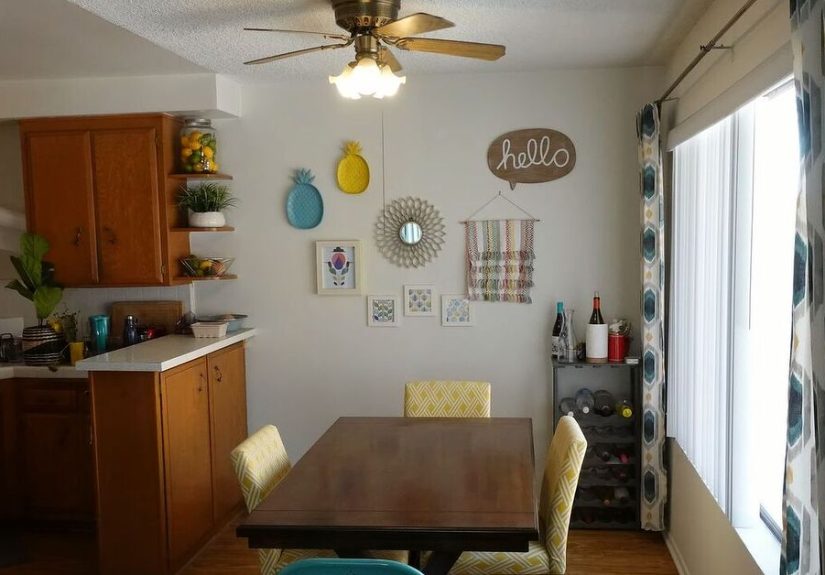
One large piece of art or a big mirror often looks more high-end than lots of small pieces.
If you do a gallery wall, keep frames consistent and plan spacing before hanging.
Light It Well
Accent walls love light. If your dining room feels dim, consider a brighter bulb in the fixture
(warm white, not operating-room white), or add a plug-in sconce to highlight the feature wall.
Repeat the Color Twice
An accent wall looks more “designed” when the accent color appears elsewhere in the roomthink napkins,
a vase, chair cushions, or a runner. Two repeats is enough. Three is confident. Four is a theme party.
Common Mistakes That Make a $70 Accent Wall Look Like $7
- Skipping prep: bumps and holes show up more on feature walls, not less.
- Rushing tape: most “paint disasters” begin with tape slapped on in a hurry.
- Going too tiny: small busy patterns can look jittery from across the room.
- Ignoring sheen: too flat can scuff; too glossy can highlight imperfections.
- Not testing color: lighting changes everythingespecially at dinner time.
of Real-World “Experience” (AKA: What DIYers Learn Fast)
If you’ve ever watched a 20-second “before and after” video and thought, “I can do that after work,”
welcome to the club. The club has paint in its hair. The most common experience people report with an
accent wall isn’t that the steps are hardit’s that the order matters. When you prep first, tape carefully,
and paint in thin coats, the project feels almost suspiciously doable. When you skip steps, the wall becomes
a very large, very public reminder that shortcuts are rarely short.
A big lesson is that walls are basically mirrors for imperfections. That tiny nail hole you ignored for years?
Suddenly it’s a craterbecause the accent wall is the “star” of the room and the spotlight is on.
People who take ten minutes to fill holes and sand smooth almost always say it was the best time they spent.
It’s not glamorous, but neither is staring at a bumpy wall while you eat spaghetti.
Tape is another “experience teacher.” Most first-timers learn that painter’s tape isn’t magic on its own;
it’s more like a helpful assistant who still needs direction. Pressing down the edges matters.
Sealing the tape edges matters even more. DIYers who try the “seal with the base color” trick often
describe it as the moment their wall stopped looking homemade and started looking custom. It’s the difference
between crisp lines and that fuzzy edge that whispers, “This was done at 11:47 p.m.”
Color choice is where expectations meet lighting. Dining rooms change personalities depending on the hour:
bright midday light makes colors look cleaner and cooler, while evening light makes them warmer and moodier.
Many people end up loving deeper colors at night (they feel cozy and restaurant-like) but prefer softer colors
during the day. That’s why sample swatchesor at least painting a test patchtends to be a crowd favorite move.
It helps avoid that classic experience of choosing “warm taupe” and ending up with “mysterious mushroom.”
Finally, there’s the “reveal moment.” Almost everyone says the same thing: the wall looks messy until it suddenly
doesn’t. Mid-project, tape lines, patchy first coats, and pencil marks can make you question every life choice.
Then you pull the tape, touch up a few spots, and step backboom. The room looks finished. The dining room feels
like it has a point of view. And the best part? You did it with a budget that’s closer to a nice dinner out than
a renovation. That’s the kind of experience that turns “I’m not handy” into “Okay, what wall is next?”
Conclusion: Your $70 Dining Room Glow-Up Plan
To create an impressive dining room accent wall for about $70, choose the right focal wall, pick a paint-based
design that minimizes material cost, prep thoroughly, and use painter’s tape like you mean it. Geometric paint
patterns are the sweet spot: high visual impact, low spend, and totally customizable. If paint isn’t your vibe,
a peel-and-stick panel or stencil pattern can still deliver a big transformation without blowing your budget.





 Close
Close