
Table of Contents >> Show >> Hide
Some people boot up Overwatch to win ranked matches, chase highlight intros, or blame their tank with Olympic-level confidence. I get it. But for me, one of the biggest thrills of the game has always been the characters themselves. Overwatch heroes are not just playable avatars with guns and cooldowns. They are walking, glowing, dashing, wall-riding design lessons. They have strong silhouettes, instantly readable personalities, memorable color palettes, and just enough lore to make an artist whisper, “Yep, I need to draw that immediately.”
That is why Overwatch characters have stayed so popular with fan artists for years. Whether you love D.Va’s gamer-to-mech-pilot energy, Lúcio’s rhythm-powered optimism, Widowmaker’s icy elegance, or Reaper’s dramatic “I entered through the smoke machine” menace, the roster gives artists a buffet of visual styles. You can sketch armor, robes, streetwear, sci-fi tech, sleek weapons, floating forms, impossible hair, and expressions that scream personality before a single line of dialogue appears.
If you love drawing Overwatch characters, you are not alone. The game practically invites fan art. Every hero feels designed to be recognized in a heartbeat and remembered for much longer. That makes Overwatch a gold mine for illustrators, hobby doodlers, digital painters, comic artists, and anyone who has ever filled a notebook margin with a suspicious number of Tracer poses instead of taking proper notes.
In this article, I want to dig into why these heroes are so fun to draw, what makes them work from a character design standpoint, which heroes are especially rewarding for artists, and how drawing them can sharpen your skills in pose, costume logic, color, and storytelling. Then I will end with a longer personal reflection on the experience of loving Overwatch characters and putting that love onto the page.
Why Overwatch Characters Are So Good for Artists
They are readable in a split second
One of the smartest things about Overwatch hero design is visual clarity. You can usually identify a hero fast, even at a distance, because each one has a distinct shape language. Reinhardt looks like a moving fortress. Widowmaker feels long, sleek, and predatory. D.Va reads as a compact pilot wrapped in big mech energy. Lúcio carries motion in his whole frame. Zenyatta looks calm even when chaos is exploding around him.
For artists, that clarity is a dream. It means you do not have to drown a drawing in tiny details to make the character recognizable. A strong pose, a few key costume elements, and the right silhouette can do most of the heavy lifting. That is how great game character art works: it stays clear at a glance but rewards attention up close.
They mix style with story
Overwatch does not rely on cool costumes alone. The best heroes feel like their visual design and their backstory are shaking hands. Lúcio’s movement, music gear, and bright colors reflect a hero built around energy, community, and action. Widowmaker’s cold palette and sleek form fit a patient assassin. D.Va’s look blends esports celebrity, military purpose, and pop-icon flair. That kind of visual storytelling gives artists something richer than “person with weapon.” It gives them character.
They are fun to exaggerate
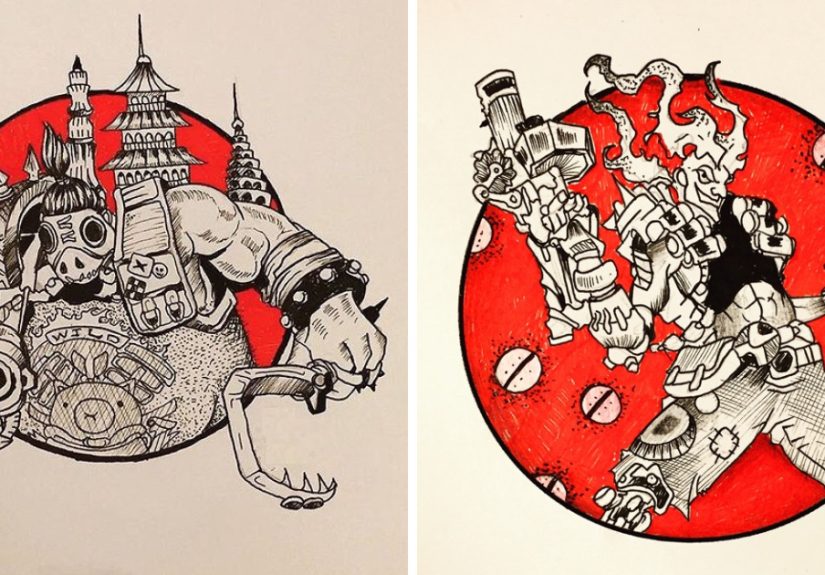
Another reason Overwatch fan art thrives is flexibility. The heroes support realism, stylization, comics, chibi versions, painterly portraits, and dramatic action scenes. You can push Reaper toward gothic horror, make Ashe look like a fashion illustration with a shotgun, or turn Sigma into a beautiful floating geometry puzzle with feet that somehow still start arguments. The designs are solid enough to survive artistic interpretation, which is a huge reason fans keep returning to them.
The Heroes I Love Drawing Most
D.Va: chaos, charm, and giant mech drama
D.Va is one of the best heroes for artists because she gives you two visual toys at once: Hana Song herself and the mech. She blends gamer culture, military sci-fi, and celebrity confidence in a way that feels unmistakably Overwatch. If you want to practice contrast, she is perfect. The pilot can be expressive, playful, and human, while the mech is heavy, angular, and intimidating. Draw them together and you get scale, story, and motion in one composition.
She also works in almost any mood. Cute selfie? D.Va has you covered. Mid-battle launch sequence? Also D.Va. Tired but stubborn hero after a rough fight? Still D.Va. That range makes her one of the most rewarding Overwatch heroes to sketch over and over again.
Lúcio: movement you can almost hear
Lúcio is pure rhythm on paper. Everything about him suggests flow: the skates, the curves in his gear, the bounce in his posture, the music-based effects. He is the kind of character who teaches artists how to draw motion without making a piece look messy. If your drawing feels stiff, Lúcio can fix that problem fast. You cannot draw him like a statue unless you are actively trying to lose the assignment.
What I love most is how upbeat he feels without becoming visually boring. He is bright, energetic, and idealistic, but he still has depth. That balance makes him a great choice for artists who want to practice emotional tone as much as anatomy and costume.
Widowmaker: elegance with an edge
Widowmaker is a favorite for artists who enjoy sleek lines, sharp shapes, and controlled menace. She looks precise. Even her stillness feels intentional. That is powerful in illustration because not every dramatic piece needs explosions and motion blur. Sometimes the strongest image is a character who looks like she already knows how this ends.
Drawing Widowmaker is a master class in restraint. You do not need a crowded background. You do not need ten effects layers screaming for attention. You need strong posture, cool confidence, and a sense of danger that feels quiet instead of loud. When that works, it really works.
Reaper: theatrical darkness done right
Reaper is one of those characters who could have become pure edge and nonsense, yet somehow lands as iconic. The hood, the mask, the dual shotguns, the smoke, the attitude that says “I absolutely practiced this entrance,” it all clicks. He is enormously fun to draw because he lets artists play with shadow, negative space, and dramatic staging.
He is also a great reminder that design appeal matters. Fans love characters who feel emotionally intense, visually bold, and mechanically distinctive. Reaper checks all three boxes, which is why he shows up constantly in fan art, stylized posters, and moody illustrations.
Zenyatta and Sigma: calm complexity
Zenyatta and Sigma scratch a different artistic itch. Zenyatta offers balance, serenity, and beautiful circular design motifs. He is ideal for compositions built around calm power. Sigma, meanwhile, is wonderfully strange. Floating posture, asymmetry, gravity themes, and a face that can shift from gentle genius to terrifying instability? That is catnip for illustrators.
Both heroes prove that Overwatch does not just succeed with cool action archetypes. It succeeds with characters whose visual identities are rooted in ideas. Zenyatta feels like harmony. Sigma feels like science cracking open into obsession. Drawing them is not just drawing outfits. It is drawing concepts.
How I Approach Drawing Overwatch Characters
I start with the pose, not the costume
When artists tackle drawing Overwatch characters, it is tempting to jump straight into armor plates, weapons, hair, and costume details. I try not to. First, I ask: what is the hero doing, and what emotional vibe should the drawing carry? Tracer should feel quick. Reinhardt should feel massive. Mercy should feel composed even in action. Kiriko can feel nimble and clever. If the pose is right, the drawing has a heartbeat before the details arrive.
I pick the three things that make the hero unmistakable
Every hero has signature visual anchors. D.Va has the cheek marks, headset, and mech silhouette. Lúcio has the skates, locks, and audio-tech vibe. Widowmaker has her shape, rifle, and cool, surgical body language. If I lock in those anchors early, the piece stays recognizable even when I simplify other parts.
I think about costume logic
Great fan art usually respects how a costume works, even when the style changes. Why is this armor bulky in one area and flexible in another? Which materials are rigid, and which ones stretch? What accessories tell us about the hero’s life? Overwatch is excellent at layering function into style, and artists can learn a lot by paying attention to that. A costume should not just look cool. It should feel like it belongs to that person.
I use color to support personality
Color is not decoration. It is storytelling. Warm highlights can make a hero feel hopeful or high-energy. Cold palettes can create distance, danger, or mystery. Overwatch has always leaned hard into strong color identities, and that helps artists immensely. Even a simple portrait becomes stronger when the palette echoes the hero’s mood and role.
What Overwatch Taught Me About Character Design
The biggest lesson Overwatch characters teach is that memorable design comes from unity. Silhouette, personality, role, color, motion, and lore all need to point in the same direction. When they do, fans remember the character. Artists want to draw the character. Cosplayers want to build the character. Players want to learn the character. That is not accidental. That is smart design doing its job.
Another lesson is that variety matters. The roster includes robots, scientists, assassins, healers, rebels, athletes, musicians, outlaws, and walking science incidents. That variety broadens the artistic playground. Some days you want mechanical detail. Some days you want expressive faces. Some days you want clean hero-poster energy. Overwatch keeps offering all of it.
And finally, I have learned that strong characters survive change. New skins, fresh seasonal looks, gameplay updates, and expanding story arcs all work because the core identity of each hero remains readable. That is why the fandom keeps returning. The designs feel stable enough to love and flexible enough to reinvent.
Why Overwatch Fan Art Still Matters
Fan art is more than decoration for a fandom. It is conversation. It is how players say, “This hero meant something to me.” It is how artists interpret a world and leave fingerprints on it. Overwatch especially encourages that because the heroes are built around distinct themes and emotional hooks. People do not just like the abilities. They connect with the identities.
Some artists draw heroes because they love the mechanics. Some draw them for the lore. Some want to redesign skins, imagine alternate universes, or push characters into comic, painterly, or anime styles. That flexibility keeps the community alive. And honestly, it is part of the fun. The official designs open the door, but fan artists throw the party.
My Experience Loving Overwatch Characters and Drawing Them
I did not start drawing Overwatch characters because I thought it would make me a better artist. I started because I liked them too much to leave them inside the screen. That is the simplest truth. I would finish a match, still buzzing from a great play or laughing at some wonderfully dramatic voice line, and then I would feel that itch. I needed to draw somebody. Maybe it was D.Va after a clutch self-destruct. Maybe it was Lúcio mid-wall ride, looking like gravity had filed a complaint and been ignored. Maybe it was Widowmaker staring through the viewer like she already knew my sketch lines were crooked.
At first, I was mostly chasing likeness. I wanted the hero to look right. I obsessed over hair shapes, armor curves, and whether a pose felt close enough to the official art. But after a while, something shifted. I stopped asking, “Did I copy the design correctly?” and started asking, “Did I capture why this character is cool?” That question changed everything. Suddenly my drawings had more energy. My Tracer sketches leaned harder into motion. My Reaper pieces got moodier. My Zenyatta drawings became calmer and more centered. I was not just drawing costumes anymore. I was drawing character.
One of my favorite things about drawing Overwatch heroes is how each one teaches a different lesson. D.Va teaches contrast between playful personality and battlefield intensity. Lúcio teaches flow. Sigma teaches controlled weirdness, which is a phrase I never expected to write, yet here we are. Ashe teaches attitude. Mercy teaches elegance without losing strength. Reaper teaches shadow and drama. Every hero feels like a mini art class wearing boots and carrying a weapon.
I also love that drawing these characters never feels exactly the same twice. On one day, I might do a fast sketch that focuses on gesture and silhouette. On another, I will spend forever rendering metal, glow effects, and fabric textures because apparently I enjoy making life difficult for myself. Sometimes I want something polished enough to frame. Other times I just want a rough page full of poses and expressions. Both count. Both are part of the relationship between artist and character.
There is also a weirdly personal comfort in drawing heroes you already know well. You do not start from zero. You already understand their rhythm, their attitude, their visual language. That familiarity frees you up to experiment. You can push style, exaggerate shape, swap moods, or imagine new scenes, and the character still holds together. That is a gift. Not every game cast gives artists that kind of sturdy creative foundation.
And honestly, drawing Overwatch characters is just fun. Not “good for discipline” fun. Not “I am technically improving my anatomy” fun. I mean actual, silly, satisfying fun. The kind where you look up after an hour and realize you were supposed to be doing something responsible. The kind where one sketch becomes five because you thought, “Well, maybe just one more version with a better pose,” and then suddenly your desk is covered in heroic nonsense.
That is why I keep coming back. I love Overwatch characters because they are expressive, stylish, and full of visual personality. I draw them because drawing is one of the best ways I know to spend more time with the things I love. And if a character can make you want to play, read, imagine, and create all at once, that character is doing something special.
Final Thoughts
If you love Overwatch characters and draw them, you are tapping into one of the best parts of the franchise: its talent for making heroes feel instantly iconic and endlessly interpretable. These designs are not memorable by accident. They are built with care, clarity, and personality, which is exactly why artists keep sketching them, repainting them, redesigning them, and falling in love with them all over again.
So draw the hero you main. Draw the hero you fear. Draw the hero whose outfit makes you question your life choices as an artist. Draw messy pages, dramatic posters, soft portraits, comic panels, and silly doodles. Overwatch characters are made to move, but they are also made to be remembered. And sometimes the best way to remember them is to put pencil to paper and let the fandom take over.





 Close
Close