
Table of Contents >> Show >> Hide
- The Short Answer: When Did James Webb Space Telescope Launch?
- Why People Kept Asking “When Will It Launch?” for Years
- From Liftoff to First Science: The Timeline After Launch
- Why Webb Had to Launch This Way
- What Webb Has Delivered Since Launch
- So… Why Keep the Old Question in the Title?
- Is Webb Still Operating? What About Mission Lifetime?
- Experience Section (Extended): What the Webb Launch Era Felt Like
- Final Takeaway
Let’s answer the big question in one clean sentence before we go full cosmic detective:
the James Webb Space Telescope (JWST) already launched on December 25, 2021.
Yes, Christmas Day. Yes, while many people were still hunting for batteries and leftover pie.
So why does the question “When will James Webb Space Telescope launch?” keep showing up?
Because Webb had one of the longest, twistiest pre-launch stories in modern space science: schedule shifts,
technical challenges, budget stress, weather delays, and enough nail-biting to power a thriller series.
Add old articles still floating around search results, and it is easy to see why people still ask it in the future tense.
In this in-depth guide, we will cover the exact launch answer, the delay timeline, what happened after liftoff,
why launch architecture mattered so much, and how Webb has changed astronomy since then. We will also end with
a long-form experience section that captures what this mission felt like for scientists, students, and everyday
sky nerds watching history in real time.
The Short Answer: When Did James Webb Space Telescope Launch?
Exact launch date, time, place, and rocket
- Launch date: December 25, 2021
- Launch time: 7:20 a.m. Eastern Time (12:20 UTC)
- Launch site: Guiana Space Centre, Kourou, French Guiana
- Launch vehicle: Ariane 5
If you searched this in 2018, 2019, or 2020, the answer was always “soon.” If you searched in late 2021, the answer
changed by days and windows because of final technical and weather adjustments. But from a historical and SEO standpoint,
the canonical answer is now fixed: JWST launched on December 25, 2021.
Why this launch mattered immediately
Webb is not just another telescope. It is an infrared observatory designed to study the early universe, galaxy formation,
star birth, and exoplanet atmospheres. In plain English: it helps us look deep into time by observing light stretched
into infrared wavelengths over billions of years.
Think of Hubble as a legendary camera and Webb as a time machine with a giant cold mirror and a precision chemistry lab.
Different tools, different strengths, same big human curiosity: Where did we come from, and are we alone?
Why People Kept Asking “When Will It Launch?” for Years
A mission with a long runway
Webb started as an ambitious successor concept to Hubble and grew into one of the most complex science observatories ever built.
That complexity was not cosmetic; it was structural. Webb had to launch folded, survive deep-space transit, and deploy itself
robotically far from Earth, where no astronaut repair mission was realistically available in the same way Hubble once enjoyed.
Technical challenges and schedule shifts
Multiple reviews over the years flagged integration and testing challenges, and those challenges translated into delays.
In the final pre-launch stretch, even after major technical progress, the mission still experienced short-term schedule updates
before settling on the December 25 window.
In other words, people were not confused because they were not paying attention.
They were confused because the mission timeline was genuinely moving while engineers were protecting mission success.
Why the final days were extra tense
Spaceflight has no “undo” button. Final launch processing includes thousands of checks and dependencies.
Even a small anomaly can trigger a hold, especially for a flagship observatory with a global science impact.
Webb’s final days reflected exactly that mindset: no bravado, just disciplined risk management.
From Liftoff to First Science: The Timeline After Launch
Phase 1: Launch and early activation
Webb lifted off cleanly and began a carefully choreographed cruise. Early post-launch steps included separation from the rocket,
power and communications setup, and trajectory correction activities. Nothing about this phase was routine in spirit:
every successful step reduced mission risk and increased global confidence.
Phase 2: The high-stakes deployment sequence
Webb’s deployment was one of the most complicated robotic unfolds ever attempted in space. The observatory had to
transform from launch configuration to full observing geometry: sunshield deployment and tensioning, mirror structures,
and other hardware activations.
This is where Webb earned its dramatic reputation. The deployment sequence included over 50 major deployments and
over 300 single points of failure. That phrase sounds scary because it is scary: each single-point element had to work.
Fortunately, the team executed with extraordinary precision.
Phase 3: Arrival at L2 and commissioning
About one month after launch, Webb reached the Sun–Earth L2 region, roughly 1.5 million kilometers from Earth.
Then came commissioning: mirror alignment, instrument checks, thermal stabilization, and calibration.
This phase was the difference between “it launched” and “it can do world-class science.”
Phase 4: First images and science operations
In July 2022, NASA revealed Webb’s first images, including the deep field that instantly became iconic.
Soon after, science operations moved into steady output mode. In internet terms: the telescope did not just “go live,”
it dropped a season finale in episode one.
Why Webb Had to Launch This Way
Infrared astronomy needs cold, stable conditions
Webb observes primarily in infrared wavelengths. To detect extremely faint infrared signals, the observatory and instruments
must stay very cold and thermally stable. Heat is noise, and noise is the enemy of faint cosmic truth.
That is why Webb uses a large multi-layer sunshield and an orbit geometry near L2 that keeps the telescope in a favorable
thermal and communication environment.
A giant mirror that had to fold for launch
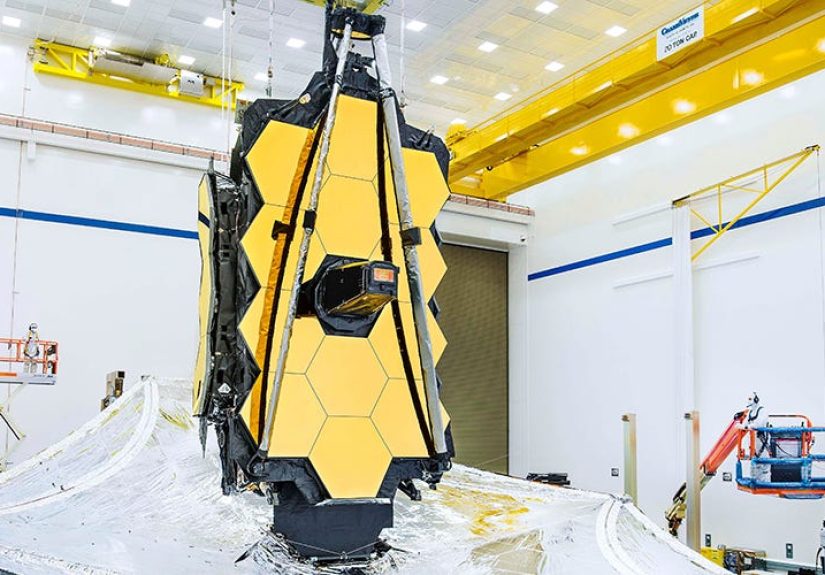
Webb’s primary mirror is 6.5 meters across and built from 18 hexagonal segments. It had to fit inside a rocket fairing,
launch folded, then unfold and align in space with extreme precision. If that sounds like shipping a grand piano in a suitcase
and then tuning it on a moving elevator, you are getting the idea.
Four instruments, one big scientific leap
Webb’s instrument suite includes NIRCam, NIRSpec, MIRI, and FGS/NIRISS. Together, these tools support high-sensitivity imaging,
spectroscopy, and detailed atmospheric and galaxy studies across near- and mid-infrared ranges.
Translation: Webb does not just take pretty pictures. It reads chemical fingerprints, time-stamps cosmic history, and helps test
models of how stars, planets, and galaxies form and evolve.
What Webb Has Delivered Since Launch
1) Early universe records and surprises
Webb has pushed the boundary on observing very early galaxies, including record-setting detections such as JADES-GS-z14-0.
These findings suggest the early universe may have built bright, massive systems faster than many models predicted.
In science, surprise is not failure. Surprise is usually the beginning of a better theory.
Webb has delivered plenty of that kind of productive discomfort.
2) Exoplanet atmospheres are now chemistry classrooms
Webb detected clear carbon dioxide signatures in the atmosphere of exoplanet WASP-39 b, a major early demonstration
of its atmospheric spectroscopy strength. Later studies, including observations of K2-18 b, reported methane and carbon dioxide,
fueling important discussions about habitability frameworks and atmospheric interpretation.
Important nuance: atmospheric detection is not the same as “life confirmed.” Webb gives us better evidence, not instant certainty.
Good science moves from exciting hints to repeated verification.
3) A stronger bridge between images and physics
Webb has reinforced a powerful shift in public understanding: astronomy is not only visual wonder.
It is also measurement-heavy physics, chemistry, and statistics. The spectacular imagery may draw attention,
but the spectra and time-series data are where many headline conclusions are built.
So… Why Keep the Old Question in the Title?
Because search behavior is human behavior. People still type “When will James Webb Space Telescope launch?” even now,
either because they are revisiting the mission story or because they land on older pages first.
A good article answers the literal query and then upgrades the reader from a date lookup to real understanding.
If your only takeaway is one line, make it this:
JWST launched on December 25, 2021, and the post-launch science has already reshaped modern astronomy.
Is Webb Still Operating? What About Mission Lifetime?
Current mission status in practical terms
Webb is in active science operations. Proposal cycles continue, data keeps coming, and fresh analyses regularly refine or challenge
previous assumptions. This is normal and healthy in frontier science.
How long can it keep going?
Baseline expectations historically included a minimum mission threshold and a longer design-driven operational target.
After launch and trajectory performance, NASA indicated propellant margins could support significantly more than a 10-year
science lifetime, often discussed publicly around the 20-year range under favorable conditions.
Space hardware always carries uncertainty, but Webb’s early operations gave the mission a strong runway.
Experience Section (Extended): What the Webb Launch Era Felt Like
If you want the emotional version of this story, imagine waking up early on a holiday morning while the world is split between
family brunch and mission control adrenaline. Your phone is full of countdown screenshots. Group chats are weirdly quiet because
everyone is pretending to be calm while actually refreshing live feeds every thirty seconds.
Then liftoff. A rocket rises from tropical humidity carrying decades of engineering, argument, paperwork, and hope.
For a minute, the event feels straightforward: flame, smoke, ascent, applause. But everyone who follows space missions knows
that launch is only chapter one. Webb is not like putting a telescope on a shelf. Webb is like sending a folded orchestra
into deep space and asking it to assemble itself perfectly before the concert.
The days that follow are emotionally peculiar. Each successful deployment update gives relief, but relief only lasts until the
next critical step. Sunshield updates become appointment viewing. Mirror updates become global mood indicators.
You start learning vocabulary you never planned to learn: tensioning, thermal equilibrium, wavefront sensing, trajectory correction.
Suddenly your casual interest in astronomy has a spreadsheet.
Families discuss engineering at dinner. Students in classrooms pull up diagrams and debate why infrared matters.
People who never cared about orbital mechanics can now explain why L2 is useful without looking it up.
It is one of those rare science moments where the public does not just consume a result; they experience the process.
Weeks later, when Webb reaches its operating region, celebration feels quieter and deeper.
Not fireworks quiet, but marathon quiet. The kind where people exhale and realize they have been clenching their shoulders
since launch day. Engineers talk about handoffs. Scientists talk about calibration. Fans talk about “first light” like
it is a holiday of its own.
Then the first images arrive, and the tone changes again. Even people who expected something extraordinary are still stunned.
The deep-field view, especially, creates that rare cognitive snap where scale becomes personal:
you are staring at tiny points that are not tiny at all, but vast systems from a very old universe whose light traveled
absurd distances to land on your screen while you sit in sweatpants.
What makes this experience special is not just beauty. It is shared perspective. In a noisy era, Webb offered a multi-year arc
where precision, patience, and collaboration visibly mattered. The mission included setbacks, reviews, delays, and skepticism.
It also included perseverance, correction, and eventual delivery. That combination is relatable beyond astronomy.
For many people, Webb became a reminder that complex projects can still work when teams prioritize rigor over speed theater.
For students, it became proof that STEM careers are not abstractthey are the human machinery behind moments the whole planet sees.
For researchers, it opened new data horizons. For the public, it revived a simple but powerful feeling:
curiosity is not childish; it is civilizational infrastructure.
So if you ask, “When will James Webb launch?” and someone answers, “It already did,” that is truebut incomplete.
The fuller answer is that Webb launched once, and then it launched again in culture:
into classrooms, conversations, memes, papers, and midnight sky apps.
It changed how people imagine astronomynot as distant genius work done by strangers, but as a collective human project
where each successful deployment, each calibrated instrument, and each analyzed spectrum widens the story we can tell about existence.
That may be the most durable outcome of all. Long after individual headlines fade, Webb’s launch era will remain a case study
in how ambitious science can be difficult, delayed, debated, and still absolutely worth it.
Final Takeaway
The question in the title is historically important and practically answerable:
James Webb launched on December 25, 2021.
But the more useful question now is, “What did that launch unlock?”
The answer: a high-performing infrared observatory that is already reshaping our understanding of early galaxies,
exoplanet atmospheres, and cosmic historywhile reminding the public that science can still deliver jaw-dropping results
when engineering discipline meets long-term vision.




 Close
Close