
Table of Contents >> Show >> Hide
- What exactly is a Lisfranc fracture?
- Causes of a Lisfranc fracture
- Symptoms: how a Lisfranc fracture feels (and looks)
- Diagnosis: why Lisfranc fractures are sometimes missed
- Treatment: from boot to surgery (and why “stable vs. unstable” matters)
- Recovery timeline: what healing usually looks like
- Possible complications (and how to lower the risk)
- Prevention: can you avoid a Lisfranc fracture?
- When to seek urgent care
- Real-world experiences: what people often say about Lisfranc fractures (about )
- Conclusion
A Lisfranc fracture is one of those injuries that sounds like a fancy French dessert but feels like a
personal betrayal from your own foot. It involves the midfootspecifically the joints and ligaments where
your long metatarsal bones meet the tarsal bones (the “tarsometatarsal” joints). When that area fractures,
dislocates, or the key stabilizing ligament tears, the result can be a deceptively serious injury that’s
sometimes mistaken for a “bad sprain.”
And that’s the problem: a Lisfranc injury can look like a routine twist at first, but if it’s unstable and
not treated correctly, it can lead to long-term pain, arthritis, loss of arch height, and the kind of
“why does my foot hate stairs?” frustration that lingers for years. The good news: with early recognition,
proper imaging, and the right treatment plan, many people recover well and get back to work, sports, and
normal life (yes, including chasing toddlers, which is basically a sport).
Quick note: This article is for education and does not replace medical care. If you can’t
bear weight after a foot injuryor you have significant swelling or bruisingget evaluated promptly.
What exactly is a Lisfranc fracture?
“Lisfranc” refers to the tarsometatarsal (TMT) joint complex in the midfoot. This area acts like
a bridge between your heel/arch and your toes. It has a big job: keeping the arch stable while you walk,
run, jump, pivot, and do that awkward sideways shuffle to avoid stepping on a LEGO.
A “Lisfranc fracture” often means there’s a fracture in the midfoot bones and/or a ligament injury that
destabilizes the joint. In many cases, it’s really a fracture-dislocation or a fracture plus ligament
disruption. One important structure is the Lisfranc ligament, which helps lock the midfoot together.
When it fails, the bones can shift out of alignmentsometimes subtly, sometimes dramatically.
Causes of a Lisfranc fracture
Lisfranc injuries happen in two main ways: direct force (something hits or crushes the foot) or
indirect force (the foot twists or bends under load). Both can cause fractures, ligament tears, or both.
1) Direct trauma (crush-type injuries)
This can occur when something heavy lands on the midfoot (workplace injuries, dropping a weight, a car tire,
etc.). Direct trauma may cause multiple fractures and significant swelling. These injuries can be obvious,
but they can also hide behind swelling and pain that seems “normal” for a bad accident.
2) Indirect trauma (twist + load)
Indirect injuries are common in sports. A classic scenario is the foot being pointed downward (plantarflexed)
while the body rotates or loads onto itthink football, soccer, basketball, rugby, trail running, or stepping
off a curb wrong while carrying groceries like a hero with poor judgment.
3) Falls and motor vehicle accidents
Higher-energy forcesfalls from height or vehicle collisionscan cause more severe fracture-dislocations and
may involve other injuries. These typically require urgent evaluation and often surgical management.
Symptoms: how a Lisfranc fracture feels (and looks)
The midfoot is not subtle when it’s mad. The symptoms can range from moderate pain to “I can see my life
choices.” But several clues should raise suspicion for a Lisfranc injury.
Common symptoms
- Midfoot pain (often on the top of the foot), especially over the arch/TMT joints
- Swelling in the midfoot
- Difficulty bearing weight or inability to walk normally
- Bruising on the top of the foot
- Bruising on the bottom (plantar) side of the foot, which is a major red flag
- Pain with push-off (walking feels worse when you try to step forward)
The “plantar bruising” clue
Bruising on the bottom of the foot (plantar ecchymosis) is often highlighted as a particularly suspicious sign.
Not everyone gets it, but when it shows up after a midfoot injury, clinicians take notice.
Specific example
Imagine a weekend basketball player who lands on a foot that’s slightly pointed down and rotated. They feel a
sharp pain in the midfoot, hobble off, and assume it’s a sprain. Two days later, the swelling is persistent,
walking is miserable, and there’s bruising under the arch. That pattern should prompt evaluation for a Lisfranc injury.
Diagnosis: why Lisfranc fractures are sometimes missed
Lisfranc injuries can be missed because the midfoot bones are small, swelling can obscure deformity, and
some injuries are subtle on standard (non-weight-bearing) X-rays. Yet early diagnosis matters, because
unstable Lisfranc injuries tend to do poorly if they heal in a misaligned position.
What a clinician looks for
- Tenderness over the tarsometatarsal joints (midfoot)
- Swelling pattern and bruising (especially plantar bruising)
- Pain with forefoot twisting or stress maneuvers
- Instability or widening between bones (sometimes subtle)
Imaging tests used
-
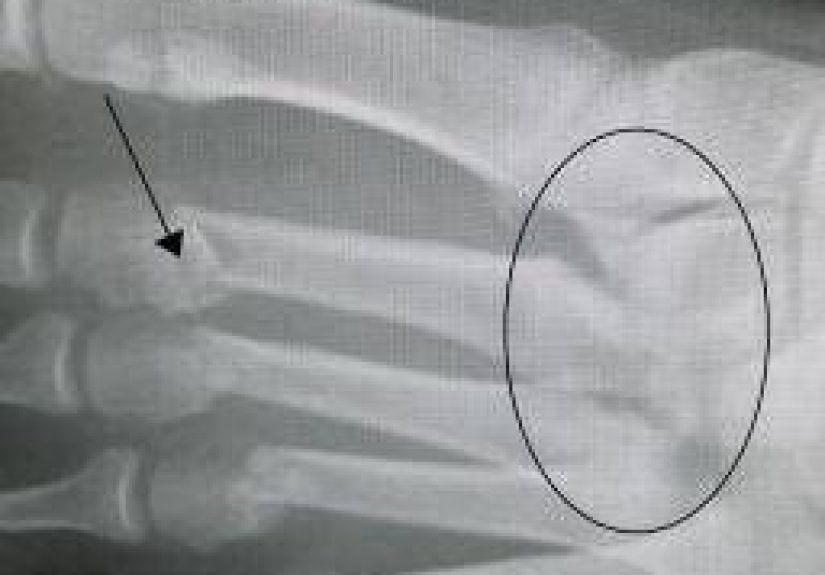
Weight-bearing X-rays: These can reveal joint widening or misalignment that doesn’t show up
when you’re lying down. Sometimes comparison views are used. - CT scan: Useful for detecting small fractures and understanding the exact fracture pattern.
- MRI: Helpful for evaluating ligament damageespecially if X-rays don’t show much but symptoms and exam raise suspicion.
If your clinician suspects a Lisfranc injury and you can’t comfortably bear weight, they may treat it as a
potentially serious injury while imaging is being arrangedmeaning immobilization and avoiding weight-bearing.
Treatment: from boot to surgery (and why “stable vs. unstable” matters)
Treatment depends heavily on whether the midfoot joints are stable and well-aligned or
unstable/displaced. A stable injury can sometimes heal with conservative management. An unstable
injury often needs surgery to restore alignment and protect the arch.
First aid right after injury
- Stop weight-bearing if walking is very painful
- Immobilize the foot (boot/splint if available)
- Ice and elevate to reduce swelling
-
Consider over-the-counter pain relief if safe for you (some people should avoid NSAIDs due to kidney,
stomach, bleeding, or medication interactionsask your clinician/pharmacist if unsure) - Get evaluated the same day or within 24–48 hours if you can’t bear weight or bruising/swelling is significant
Non-surgical treatment (conservative care)
Nonoperative treatment is typically considered when imaging shows a stable, nondisplaced injury
meaning the bones are not shifted and the joint alignment is maintained.
Typical conservative plan may include:
- Strict non-weight-bearing with a cast or walking boot for several weeks (often 6–8 weeks)
- Follow-up visits and sometimes repeat imaging to ensure the joints stay aligned
- Gradual progression to partial then full weight-bearing as guided by your clinician
- Physical therapy to restore strength, mobility, balance, and gait mechanics
Conservative care can work well for the right injury pattern. The key is not treating an unstable injury
like a mild sprain. If the joint is unstable and shifts, the arch can lose its normal structure and the risk
of post-traumatic arthritis rises.
Surgical treatment
Surgery is often recommended when there is displacement, fracture-dislocation, or clear instability of the midfoot joints.
The main goals are to restore alignment and keep the midfoot stable while it heals.
Common surgical approaches
-
ORIF (Open Reduction and Internal Fixation): The surgeon re-aligns the bones and stabilizes
them with hardware (often screws/plates). Hardware may sometimes be removed later, depending on symptoms,
surgeon preference, and fixation method. -
Primary arthrodesis (fusion): In selected casesespecially severe ligament disruption or certain
injury patternssurgeons may fuse specific midfoot joints. The goal is pain relief and long-term stability,
though it trades some joint motion for stability. (Many patients don’t notice major motion loss because those
joints have limited motion to begin with, but individual results vary.)
There’s active medical discussion and research comparing ORIF versus primary fusion for certain Lisfranc injuries.
The right choice depends on factors like displacement, ligament involvement, patient activity level, and surgeon experience.
Recovery timeline: what healing usually looks like
Lisfranc injuries don’t do “overnight shipping.” Even with perfect treatment, recovery often takes months.
Many people feel significantly better before they’re truly ready for impact activitiesso the timeline matters.
Typical recovery phases
- Protection phase: Immobilization and non-weight-bearing (often weeks)
- Transition phase: Gradual weight-bearing in a boot, continued swelling management
- Rehab phase: Physical therapy for mobility, calf/foot strength, balance, and gait training
- Return-to-activity phase: Sport- or job-specific progression; impact comes last
What “full recovery” can mean
For many people, “full recovery” means walking normally without pain and returning to desired activities.
For othersespecially after severe injuriesthere may be lingering stiffness, occasional swelling, or limits on
high-impact activity. It’s not a failure; it’s biology plus physics.
Possible complications (and how to lower the risk)
A Lisfranc fracture is a joint injury, and joints can be picky. Complications are more likely when diagnosis
is delayed, alignment isn’t restored, or the injury is severe.
Potential complications
- Post-traumatic arthritis in the midfoot joints
- Chronic pain or persistent swelling
- Arch collapse or long-term instability if the injury heals malaligned
- Hardware irritation (in surgical cases)
- Stiffness and weakness without thorough rehabilitation
What helps
- Getting evaluated early when symptoms are suspicious
- Following non-weight-bearing instructions (yes, even when you “feel fine”)
- Doing structured rehab and not skipping the boring strengthening work
- Using supportive footwear and orthotics if recommended
Prevention: can you avoid a Lisfranc fracture?
Not every injury is preventable (gravity has a solid track record), but you can reduce riskespecially in sports and active jobs.
Practical prevention tips
- Wear activity-appropriate footwear with good midfoot support and traction
- Train ankle and foot stability (balance work, calf strength, foot intrinsic strengthening)
- Progress training gradually to avoid sloppy mechanics under fatigue
- Take falls seriously if you land awkwardly on the foot and can’t bear weight afterward
When to seek urgent care
Get same-day evaluation (urgent care/ER/orthopedic clinic) if you have any of the following after a foot injury:
- Inability to bear weight for more than a few steps
- Significant midfoot swelling or deformity
- Bruising on the bottom of the foot
- Numbness, tingling, cold foot, or color changes
- Open wounds or severe pain out of proportion
Real-world experiences: what people often say about Lisfranc fractures (about )
I can’t share personal medical experiences (I’m not a person with bones), but I can share the kinds of
stories clinicians hear again and againpatterns that help you recognize what a Lisfranc injury looks like in real life.
Experience #1: “It’s just a sprain… right?”
A lot of Lisfranc injuries start with a twist that doesn’t seem dramatic. Someone steps wrong off a curb, or
lands funny during a pickup game. They can limp, the foot swells, and they assume it will settle down in a few
days. What makes the story “Lisfranc flavored” is the location and the stubbornness: the pain sits in the midfoot,
push-off feels awful, and walking down stairs is weirdly brutal. A few people mention bruising under the arch,
which feels like the foot’s way of waving a red flag while shouting, “This is not fine.” When imaging finally
shows instability, the biggest emotion is often surprisebecause the injury didn’t feel “big enough” to be serious.
Experience #2: The non-weight-bearing lifestyle shock
If you’ve never been non-weight-bearing, it’s… an adjustment. People often say the hardest part isn’t the pain;
it’s the logistics. Showering becomes an extreme sport. Carrying coffee turns into an engineering problem. One
common tip from patients: set up a “base camp” (charging cable, water bottle, snacks, meds if prescribed, and
something to do) wherever you spend the most time. Another surprisingly helpful trick is planning your routes
through the house like you’re plotting a heistbecause crutches plus clutter equals instant regret.
Experience #3: The slow return to “normal”
Whether treatment is conservative or surgical, many people report a turning point when the boot comes off.
They expect instant freedomand instead discover stiffness, calf weakness, and a foot that gets puffy after a
short walk. This is normal for many recoveries: the foot is healing, but the entire leg has been on vacation.
Rehab often feels unglamorous: tiny toe exercises, balance drills, slow strengthening, and gradually retraining
the walking pattern. People who do best usually describe a mindset shift: “I stopped trying to win recovery
in a week and started playing the long game.”
Experience #4: Confidence comes back in layers
Even after pain improves, confidence can lag. Athletes may feel nervous cutting or pivoting. Workers may worry
about long shifts on concrete. Many people say the first time they jog, jump, or work a full day again feels
like a victoryand also like a reminder to respect the process. The midfoot is the arch’s guardian; it wants
stability before it signs off on your next adventure.
If you suspect a Lisfranc fracture, the “best experience” is the one where you get checked early, protect the
foot, and follow a treatment plan that matches the injury’s stability. Your future self (and your arch) will
thank you.
Conclusion
A Lisfranc fracture is a midfoot injury that can range from subtle to severebut it’s rarely something you
want to “walk off.” The key themes are simple: recognize the red flags (midfoot pain, swelling, difficulty
bearing weight, and especially plantar bruising), get proper imaging when suspicion is high, and treat based
on stability. Stable injuries may heal with strict immobilization and non-weight-bearing. Unstable injuries
often do best with surgical alignment and stabilization. With timely care and rehab, many people return to
their usual activitieseven if it takes patience, a good boot, and the emotional resilience to conquer stairs again.





 Close
Close