
Table of Contents >> Show >> Hide
- Who Is Marina Umaschi Bers?
- What Does “Coding as Literacy” Mean?
- From Coding as Playground to Coding as Another Language
- ScratchJr: Coding Through Stories and Games
- KIBO: Making Code Tangible and Screen-Free
- Beyond Jobs: Coding for Voice, Values, and Citizenship
- How Coding Supports Reading and Writing
- What Educators Can Learn From Bers’s Approach
- Why Parents Should Care About Coding Literacy
- The Bigger Debate: Is Coding Really Essential?
- Experiences Related to Marina Umaschi Bers’s Vision of Coding Literacy
- Conclusion: Coding Is a New Pencil, Not Just a New Career Path
- SEO Tags
Note: This article is written for web publication and synthesizes real public information about Marina Umaschi Bers, ScratchJr, KIBO, Coding as Another Language, and early childhood computer science education. No direct source links are included per the publishing requirement.
For a long time, “coding” sounded like something that happened in a dim room full of glowing monitors, half-empty coffee cups, and people who say things like “just push it to production” without blinking. Marina Umaschi Bers has spent much of her career challenging that image. To her, coding is not simply a technical skill reserved for future software engineers. It is a new form of literacya way for children to express ideas, solve problems, tell stories, build relationships, and understand the world around them.
That shift matters. When educators talk about literacy, they usually mean reading and writing. But Bers invites schools, parents, and policymakers to think bigger. In a digital society, children do not only need to read words on a page; they also need to understand the logic, symbols, systems, and creative possibilities behind the technologies shaping daily life. In other words, coding is not just about making a robot move forward. It is about helping a child say, “I have an idea, and I can bring it to life.”
Who Is Marina Umaschi Bers?
Marina Umaschi Bers is a leading scholar in early childhood computer science education and developmental technologies. She is the Augustus Long Professor of Education at Boston College’s Lynch School of Education and Human Development, with connections to computer science and interdisciplinary research. Before joining Boston College, she built a major body of work at Tufts University, where she founded the DevTech Research Group, a research community focused on how new technologies can support children’s learning, creativity, and positive development.
Bers is widely known for her work on tools and frameworks that make coding developmentally appropriate for young children. She co-developed ScratchJr, a free introductory programming language that allows children ages five to seven to create interactive stories and games. She also created KIBO, a screen-free robotics kit that lets children build and program robots using tangible wooden blocks. Both projects reflect one of her core beliefs: children should not be passive consumers of technology. They should be creators, designers, storytellers, and thoughtful participants in a digital world.
Her books, including Coding as a Playground and Beyond Coding, expand this idea beyond technical instruction. Bers argues that coding can support computational thinking, communication, collaboration, creativity, and even character development. That last part is important. In her view, teaching coding well is not about producing tiny Silicon Valley interns in Velcro sneakers. It is about helping children become more capable, expressive, reflective, and responsible human beings.
What Does “Coding as Literacy” Mean?
When Bers describes coding as literacy, she is not saying that Python should replace picture books or that kindergarteners should debug JavaScript before snack time. Her point is more powerful and more humane: coding is a symbolic language. Like written language, it allows people to represent ideas, communicate meaning, and create something that others can experience.
Traditional literacy helps children read stories, write messages, interpret information, and participate in society. Coding literacy does something similar in a world filled with apps, algorithms, robots, smart devices, games, and digital media. It gives children a way to understand how technology works and how they might shape it rather than simply tap, swipe, and hope for the best.
Coding Is a Language of Expression
In ScratchJr, a child can choose a character, create a background, record a voice, arrange coding blocks, and make a story unfold. The child is not just learning sequence, loops, or events. The child is composing. A character moves because the child decided it should move. A scene changes because the child imagined a new setting. A recorded voice plays because the child wanted to add personality, humor, or emotion.
That is literacy in action. The child is using symbols to create meaning. The symbols happen to be programming blocks instead of alphabet letters, but the deeper learning process is familiar: plan, express, revise, share, and reflect.
Coding Is a Tool for Thinking
Coding also strengthens computational thinkingthe ability to break down problems, recognize patterns, create step-by-step instructions, test ideas, and fix mistakes. These are not only computer science skills. They are life skills. A child who learns that a robot did not turn because the program needs a different instruction is also learning persistence, logic, and the gentle art of not blaming the robot for everything.
Bers’s approach makes computational thinking concrete. Instead of beginning with abstract syntax, she emphasizes playful tools that match children’s developmental stages. Young learners can physically arrange KIBO blocks, scan them, and watch their robot act out the program. The code becomes visible, touchable, and social. It is not trapped behind a wall of punctuation marks.
From Coding as Playground to Coding as Another Language
One of Bers’s most influential ideas is “coding as a playground.” A playground is not random chaos, although anyone who has watched children near a slide may respectfully disagree. A good playground has structure, boundaries, opportunities, imagination, movement, risk-taking, cooperation, and discovery. Children try things, negotiate with peers, invent rules, test limits, and learn through active experience.
Bers uses that metaphor to argue that coding environments for young children should be playful, creative, and meaningful. They should not feel like digital worksheets wearing a fake mustache. Instead, they should invite children to build projects that matter to them: a dancing animal, a family story, a robot parade, a weather report, a game, or a scene from a favorite book.
Her “Coding as Another Language” framework extends this idea by connecting computer science to literacy development. Just as children learn natural languages through communication, stories, songs, gestures, and social interaction, they can learn coding through projects that involve expression and purpose. Coding becomes another language for thinking and communicating, not just a set of commands.
Why This Matters in Early Childhood
Early childhood is a period of intense curiosity. Young children ask questions that can humble even the most confident adult: Why is the moon following us? Where does the internet live? Why can’t the dog talk if it clearly has opinions? Bers’s work treats that curiosity as the perfect starting point for computer science education.
Instead of waiting until middle school or high school, she argues that young children can engage with foundational coding concepts when the tools are designed for them. That means colorful blocks, tangible materials, stories, movement, collaboration, and room for imagination. It also means teachers do not need to turn preschool into a miniature software boot camp. The goal is not speed. The goal is meaning.
ScratchJr: Coding Through Stories and Games
ScratchJr is one of the clearest examples of Bers’s coding-as-literacy philosophy. Designed for young children, ScratchJr lets learners snap together graphical programming blocks to make characters move, jump, dance, speak, and interact. Children can create stories and games while using early math, sequencing, problem-solving, and language skills in a motivating context.
What makes ScratchJr powerful is that it does not begin by asking children to memorize technical vocabulary. It begins with creation. A child can make a cat walk across the screen, add a beach background, record a sentence, and turn the whole thing into a tiny animated story. Suddenly, coding is not a mysterious adult activity. It is a storytelling tool.
For teachers, ScratchJr opens a bridge between computer science and familiar classroom practices. A lesson might connect coding with a book students have read. Children can retell a scene, animate a character’s journey, or create an alternate ending. They practice sequencing in both narrative and programming: first this happens, then that happens, and finally the dragon learns basic manners. One can dream.
KIBO: Making Code Tangible and Screen-Free
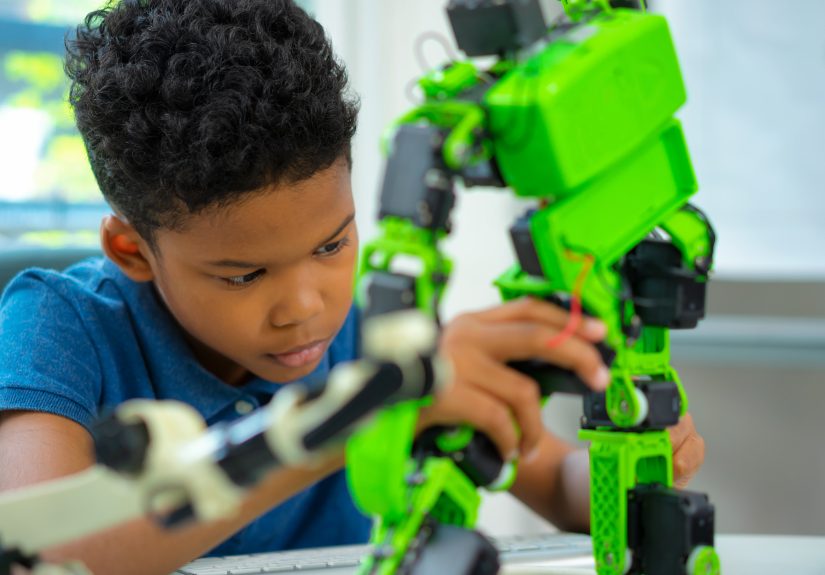
KIBO, another major contribution from Bers, takes a different route. It introduces coding through robotics without requiring screens or keyboards. Children build a robot, decorate it, arrange wooden programming blocks, scan the blocks, and watch the robot follow the program. The result is a hands-on experience that combines engineering, art, movement, sequencing, and problem-solving.
This design matters because young children often learn best through physical exploration. They want to touch, build, move, test, and proudly announce, “Look what I made!” approximately 47 times in a row. KIBO respects that developmental reality. It turns code into something children can hold in their hands and see in action across the classroom floor.
KIBO also makes collaboration natural. One child may build the robot’s body, another may decorate it, another may arrange the program, and another may predict what the robot will do. When the robot does something unexpected, the group can investigate together. The error becomes part of the learning, not a failure stamped in red ink.
Beyond Jobs: Coding for Voice, Values, and Citizenship
One of Bers’s most refreshing arguments is that coding should not be justified only by future employment. Yes, computer science skills can support careers. Yes, the economy needs people who understand technology. But Bers makes a deeper case: we do not teach children to read only because future jobs require reading. We teach reading because literacy gives people voice, agency, access, and participation in society.
The same logic applies to coding. Children who understand technology are better prepared to ask questions about the digital systems around them. Who made this app? What does it ask from users? What problem does it solve? Who benefits? What could be improved? Those questions turn coding education into civic education.
In Beyond Coding, Bers connects computer science learning with human values. A coding classroom can cultivate patience, generosity, curiosity, honesty, perseverance, and responsibility. For example, when students share a project, they learn to give and receive feedback. When they debug, they practice resilience. When they design for a classmate or community need, they practice empathy. The code may run on a tablet or robot, but the bigger lesson runs through character.
How Coding Supports Reading and Writing
At first glance, coding and reading may seem like separate subjects. One belongs with books, the other with devices. Bers’s work shows that the connection is much closer. Coding projects often require children to plan narratives, organize events, use vocabulary, explain choices, and revise based on feedback. Those are core literacy behaviors.
Consider a first-grade classroom using ScratchJr to retell The Three Little Pigs. Students must identify characters, sequence events, choose settings, and decide which actions should happen on screen. If the wolf appears before the house is built, the story logic breaks. If a character moves without explanation, the audience may be confused. In fixing the program, students also refine the story.
Coding also makes abstract literacy concepts visible. Sequence becomes a row of blocks. Cause and effect becomes a character moving after a command. Revision becomes debugging. Audience awareness becomes sharing the project with classmates. Suddenly, writing is not only pencil on paper; it is design, performance, timing, and interaction.
What Educators Can Learn From Bers’s Approach
Bers’s work offers practical guidance for schools that want to teach coding without turning classrooms into stress factories. The first lesson is simple: start with purpose. Children should code something meaningful, not just complete isolated puzzles. A puzzle can teach logic, but a personally meaningful project teaches logic plus ownership.
1. Connect Coding to Stories
Ask students to animate a scene from a book, create a digital greeting card, or program a robot to act out a poem. Story gives coding a reason to exist. It also helps children understand that programs communicate ideas.
2. Make Debugging Normal
Debugging should not be treated as a disaster. It is part of the creative process. Teachers can say, “The program is giving us information,” instead of “Something is wrong.” That small shift helps students see mistakes as clues.
3. Use Collaboration Intentionally
Pair programming, group robot projects, and peer feedback help children practice communication. One student may be the “driver,” another the “navigator,” and both can learn that teamwork is easier when everyone gets a turn and nobody grabs the mouse like it contains the last cookie on Earth.
4. Balance Screens With Physical Play
Tools like ScratchJr and KIBO show that coding does not have to mean sitting silently in front of a screen. Children can plan on paper, act out algorithms with their bodies, build robots, draw characters, and discuss ideas before programming them.
Why Parents Should Care About Coding Literacy
Parents sometimes worry that early coding will add more screen time or pressure to childhood. That concern is understandable. Childhood should not become a race to build a portfolio before losing the first baby tooth. Bers’s perspective offers a healthier frame. Coding, when designed well, is not about rushing children into adult technical culture. It is about giving them another expressive tool.
Parents can support coding literacy by asking children open-ended questions: What did you make? What did you want your character to do? What happened when you changed the blocks? How did you fix it? These questions value process over perfection.
Families can also connect coding to everyday life. A recipe is an algorithm. Morning routines involve sequence. Board games use rules and conditions. Giving directions to a friend involves step-by-step thinking. Once children see that computational thinking exists beyond computers, coding becomes less intimidating and more connected to the real world.
The Bigger Debate: Is Coding Really Essential?
Some critics argue that not every child needs to code. Bers’s response, in spirit, is that not every child will become a novelist either, but every child benefits from literacy. The goal is not to make everyone a professional programmer. The goal is to help everyone understand a major language of modern life.
Digital systems influence education, healthcare, entertainment, transportation, communication, finance, and civic participation. Children who grow up without any understanding of how these systems are designed may become dependent users. Children with coding literacy are more likely to become informed creators and critical thinkers.
That does not mean coding should replace art, music, outdoor play, reading, or human conversation. In fact, Bers’s work argues the opposite. Coding becomes most powerful when it connects with the arts, storytelling, ethics, and social interaction. The best coding classroom is not a silent room of isolated children clicking blocks. It is a lively studio where ideas move between screens, robots, paper, voices, hands, and hearts.
Experiences Related to Marina Umaschi Bers’s Vision of Coding Literacy
One of the most memorable experiences connected to coding as literacy happens when a child realizes that the computer is not “magic.” At first, many young learners assume digital things simply happen. A character moves because the tablet wants it to move. A robot turns because robots are mysterious little creatures with plastic opinions. But when children build a program themselves, that illusion changes. They begin to see technology as designed, instructed, and shaped by human choices.
Imagine a small group of kindergarten students working with a screen-free robot. Their mission is to make the robot travel from a cardboard “home” to a paper “park.” The first program sends the robot forward, but not far enough. The second program sends it too far, where it crashes gently into a block tower and creates what the students immediately describe as “a robot accident.” Instead of giving up, they count steps, rearrange blocks, test again, and cheer when the robot finally arrives. In that moment, they are not memorizing a definition of sequencing. They are living it.
Another common experience appears in storytelling projects. A child using ScratchJr may create a scene where a butterfly visits the moon, a dog becomes a superhero, or a family goes on a picnic. The project may look simple to an adult, but inside it are layers of literacy. The child chooses characters, plans events, records narration, adjusts timing, and decides how the audience will understand the story. When something does not work, the child revises. That is the same creative cycle writers use, only with motion, sound, and code blocks added to the toolbox.
Teachers often notice that coding can bring forward students who may not always shine during traditional assignments. A quiet child might become the expert at predicting what a robot will do. A student who struggles with handwriting might tell a rich story through animation. A child still developing spoken English might use movement, images, and recorded sounds to communicate meaning. This is why Bers’s framing matters so much: coding as literacy expands the ways children can show what they know.
There is also a powerful social experience in debugging. In many classrooms, mistakes feel private and embarrassing. In a coding project, especially a playful one, mistakes become shared puzzles. The robot spun in a circle? Interesting. The character disappeared? Let’s investigate. The program played the sound at the wrong time? Time to check the sequence. Children learn that confusion is not the end of thinking; it is often the beginning of better thinking.
Parents can see the same pattern at home. When children explain their projects, they practice language, confidence, and reflection. A simple question like “How did you make that happen?” can lead to a surprisingly detailed explanation of order, cause, and intention. The child becomes both programmer and teacher. For families, that conversation may be more valuable than the finished project itself.
These experiences show why Marina Umaschi Bers’s work continues to resonate. Coding literacy is not about pushing childhood into adulthood. It is about honoring children as capable creators. It gives them a new way to play with ideas, communicate with others, and understand the designed world around them. And when a child proudly announces, “I made it do that,” the sentence carries more than technical success. It carries agency, joy, and the beginning of a lifelong relationship with learning.
Conclusion: Coding Is a New Pencil, Not Just a New Career Path
Marina Umaschi Bers’s vision of coding as an essential form of literacy asks educators and parents to rethink what computer science can be. It is not merely preparation for jobs, though it can certainly support future careers. It is not just a technical subject, though it teaches technical ideas. At its best, coding is a language of expression, a tool for thinking, a playground for creativity, and a pathway toward ethical participation in a digital society.
ScratchJr and KIBO show what this philosophy looks like in practice. Children can code stories, build robots, collaborate with classmates, debug problems, and express ideas in ways that feel playful and meaningful. They can learn sequence, logic, design, and problem-solving without losing the wonder of childhood. In fact, that wonder is the fuel.
The most important lesson from Bers’s work may be this: children deserve more than technology they can consume. They deserve technology they can question, shape, create, and use to make their voices heard. Coding, taught with care and imagination, is one more language children can use to say, “Here is what I see. Here is what I imagine. Here is what I can build.”







 Close
Close