
Table of Contents >> Show >> Hide
- Who Is Yulia Brodskaya?
- What Makes Yulia Brodskaya’s Paper Art So Mesmerizing?
- The Technique Behind the Beauty
- Paper Quilling, Reinvented for the Modern Eye
- Major Themes in Yulia Brodskaya’s Art
- Why Her Work Connects With So Many People
- Yulia Brodskaya’s Book: Learning to Paint With Paper
- How Beginners Can Appreciate and Learn From Her Style
- Paper Art in the Digital Age
- The Lasting Influence of Yulia Brodskaya’s Colored Paper Art
- Personal Experience: What It Feels Like to Explore Paper Art Inspired by Yulia Brodskaya
Some artists paint with oils. Some sculpt with clay. Yulia Brodskaya looked at a strip of colored paper and apparently thought, “Yes, this tiny rectangle is about to have a dramatic career.” The result is a body of work so rich, tactile, and luminous that it makes ordinary paper seem like it has been seriously underachieving.
Yulia Brodskaya is widely known for transforming colored paper strips into breathtaking portraits, floral compositions, typography, and nature-inspired scenes. Her technique is often connected to paper quilling, the centuries-old craft of curling, shaping, and arranging narrow strips of paper. Yet Brodskaya’s work does more than repeat tradition. She pushes paper quilling into the territory of fine art, using paper not simply as decoration but as a medium for depth, emotion, movement, and visual storytelling.
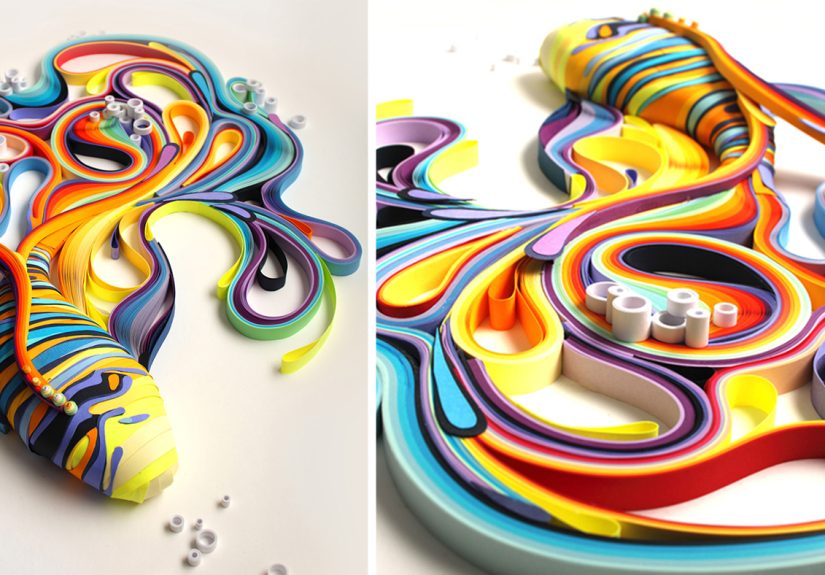
Her artworks are mesmerizing because they live somewhere between painting and sculpture. From a distance, they may resemble bold brushstrokes or mosaic-like color fields. Up close, the viewer sees hundreds of carefully placed paper strips standing on edge, curled into coils, folded into waves, packed into dense textures, and glued with almost surgical patience. It is paper art with personality, and yes, it probably has better posture than most of us.
Who Is Yulia Brodskaya?
Yulia Brodskaya is a Russian-born, UK-based paper artist and illustrator. Originally trained in graphic design and illustration, she did not begin her career by planning to become one of the most recognizable contemporary paper quilling artists. Her first major step into paper art reportedly began as a self-promotional design project. She wanted to create an eye-catching version of her name, “Yulia,” and began experimenting with strips of paper glued on edge.
That experiment became a turning point. What started as a clever lettering idea grew into a distinctive artistic language. Instead of treating paper as a flat surface to draw on, Brodskaya began using the paper itself as the line, the texture, the shadow, and the color. Her work soon attracted attention from design lovers, craft communities, art publications, and collectors because it felt both ancient and refreshingly modern.
Today, her name is closely associated with the phrase “painting with paper.” That phrase captures the magic of her technique perfectly. She does not simply make paper decorations; she builds images using colored strips as if they were strokes of paint. The difference is that her strokes rise from the surface, creating a tactile three-dimensional quality that digital screens can only politely attempt to imitate.
What Makes Yulia Brodskaya’s Paper Art So Mesmerizing?
The charm of Brodskaya’s colored paper art comes from a combination of precision, color intelligence, patience, and emotional depth. Many artists can make something pretty from paper. Brodskaya makes paper appear alive. Her strips twist, curl, cluster, and flow like hair, feathers, flower petals, ocean waves, or wrinkles on a human face.
1. She Turns Paper Strips Into Brushstrokes
Traditional quilling often involves rolling thin paper strips into coils, teardrops, scrolls, and decorative patterns. Brodskaya respects that heritage but expands it. In many of her works, especially her portraits, she uses tightly packed colored paper strips to mimic the look of brushstrokes. The paper does not merely outline a subject; it becomes the skin tone, shadow, highlight, texture, and mood.
This approach is especially powerful in her human portraits. A cheek may be built from warm peach, rose, orange, cream, and burgundy strips. A shadow may be deepened with blue or purple. A wrinkle may become a raised line of paper that catches actual light. The result is not flat illustration. It is a visual conversation between color and structure.
2. Her Work Has Real Physical Depth
One of the most exciting things about paper quilling art is that it changes depending on the viewing angle. Because Brodskaya glues paper strips on edge, the artwork casts small shadows. Light moves across the raised surfaces, making the piece feel different from one moment to the next. A photograph can show the design, but seeing the texture up close is another experience entirely.
That depth gives her art a sculptural quality. The paper is not just color; it is form. Each curl and fold adds volume. Each edge creates rhythm. Each tightly packed strip contributes to the illusion of movement. Her pieces may look delicate, but they carry the visual weight of serious craftsmanship.
3. Her Color Choices Feel Bold but Controlled
Brodskaya’s colored paper strips often appear in vivid palettes: turquoise, coral, lemon yellow, emerald green, magenta, violet, deep blue, and warm neutrals. Yet the colors rarely feel random. They are energetic without becoming chaotic. This is where her graphic design background quietly enters the room wearing sensible shoes and holding a ruler.
Her compositions often balance bright areas with calmer tones. A portrait might include electric blues and hot pinks, but the face remains readable. A floral scene may burst with rainbow-like color, but the curves and spacing guide the eye naturally. This control helps her paper illustrations feel rich rather than noisy.
The Technique Behind the Beauty
At first glance, Brodskaya’s technique seems simple: paper, glue, and patience. That is technically true in the same way that cooking a perfect soufflé is “just eggs and heat.” The materials may be humble, but the execution is demanding.
Her process often begins with a sketch or planned composition. The drawing acts like a map, but the final artwork evolves as paper is placed. She cuts or prepares strips of heavy paper or card, bends and shapes them, then attaches them edge-down to the background. Some strips are curled into coils. Others are folded into waves, packed into tight lines, or layered to create a dense, painterly surface.
Tweezers, toothpicks, cocktail straws, scissors, and PVA glue may sound like supplies from a very ambitious school project, but in Brodskaya’s hands, they become precision tools. The work requires steady hands, strong design instincts, and the ability to see color as both surface and structure.
Paper Quilling, Reinvented for the Modern Eye
Paper quilling has a long history, often associated with decorative craft, religious ornamentation, greeting cards, and delicate handmade designs. Brodskaya’s contribution is not that she invented quilling, but that she helped reframe it for contemporary audiences. Her work shows that quilling can be expressive, emotional, large-scale, and gallery-worthy.
In her hands, quilling becomes less about repeating standard shapes and more about using paper strips as a flexible visual language. Coils become highlights. Curves become hair. Dense stacks become shadows. Loose spirals become energy. This is why her paper art is often described as standing between painting and sculpture.
For viewers who associate paper crafts with small hobby projects, her work can be a delightful shock. It says, very politely but firmly, “Please stop underestimating stationery.”
Major Themes in Yulia Brodskaya’s Art
Portraits With Emotional Texture
One of the most compelling areas of Brodskaya’s practice is portraiture. Her faces are not smooth, airbrushed, or emotionally empty. They are layered, expressive, and deeply human. She has explored faces of different ages, often using paper strips to create wrinkles, contours, and subtle emotional expressions.
This matters because paper can easily become decorative. Brodskaya pushes it toward feeling. Her portraits can suggest dignity, memory, mystery, confidence, or quiet reflection. The strips do not hide the complexity of the face; they celebrate it.
Nature-Inspired Paper Art
Nature is another major influence in Brodskaya’s work. Flowers, leaves, shells, birds, organic curves, and flowing patterns appear throughout her portfolio. These subjects are a natural fit for paper quilling because the medium loves curves. A strip of paper wants to become a vine, a petal, a feather, or a wave. It practically raises its little paper hand and volunteers.
Her nature-inspired works often feel joyful and abundant. They show how paper can suggest growth, motion, and softness even though the material itself is cut, folded, and fixed in place. This contrast is part of the magic.
Typography and Lettering
Because Brodskaya came from graphic design and illustration, typography has remained an important part of her practice. Her early paper experiments began with lettering, and her typographic paper art continues to show how words can become objects. Letters made from curled and shaped paper feel playful, dimensional, and full of character.
In a world crowded with flat digital fonts, handmade paper typography has a special warmth. It reminds us that letters are not only symbols; they can also be sculptures, patterns, and little architectural events.
Why Her Work Connects With So Many People
Yulia Brodskaya’s paper art connects with viewers because it is easy to understand at first glance but rewarding to study closely. You do not need an art history degree to appreciate it. The reaction is immediate: “Wow, that is paper?” Then comes the second reaction: “Wait, how long did that take?” Then the third: “Could I do this at home?” Then, after trying one tiny coil: “Respectfully, no.”
Her work also arrives at a perfect cultural moment. In an age of fast images, instant filters, and AI-generated visuals, handmade art has a renewed emotional power. Brodskaya’s pieces visibly contain time. Every strip represents a decision. Every curve shows human touch. Every composition says that slowness can be beautiful, not just inconvenient.
Yulia Brodskaya’s Book: Learning to Paint With Paper
Brodskaya is also the author of Painting with Paper: Paper on the Edge, a book that explores her approach to creating three-dimensional paper artworks. Rather than functioning only as a simple project manual, the book focuses on her process, creative thinking, use of color, composition, and practical methods for working with paper and glue.
For artists, crafters, teachers, and curious beginners, the book is valuable because it encourages experimentation. It does not frame creativity as a checklist where every petal must behave. Instead, it invites readers to develop their own visual voice. That lesson may be even more useful than a perfect coil.
How Beginners Can Appreciate and Learn From Her Style
You do not need to become Yulia Brodskaya overnight to learn from her work. In fact, please do not attempt to become an internationally recognized paper artist by Thursday. Start smaller. Her art offers practical lessons for anyone interested in paper crafts, mixed media, illustration, or design.
Study the Direction of the Strips
Look closely at how the strips move. They rarely sit randomly. In portraits, they follow the structure of the face. In flowers, they follow the curve of petals. In abstract sections, they create rhythm and flow. Direction is what turns paper from decoration into visual movement.
Use Color Like a Painter
Instead of choosing one color for one area, observe how Brodskaya layers related colors. A shadow may contain blue, violet, brown, and red. A highlight may include cream, yellow, and pale pink. This approach gives paper art more depth and sophistication.
Respect Negative Space
Her compositions often use empty space wisely. The blank background allows the raised paper forms to breathe. Beginners sometimes want to fill every inch, possibly because blank space feels like it is judging them. But restraint can make the paper details more powerful.
Paper Art in the Digital Age
Part of Brodskaya’s appeal is that her work photographs beautifully, making it popular online. Bright colors, strong textures, and intricate details are extremely shareable. However, the true value of her work is not just that it looks good on a screen. It reminds digital audiences of the pleasure of physical materials.
Paper has edges. Glue has drying time. Curves must be shaped by hand. Mistakes cannot always be undone with a keyboard shortcut. That physical reality gives her art a refreshing honesty. It is precise but not sterile, polished but not lifeless.
The Lasting Influence of Yulia Brodskaya’s Colored Paper Art
Yulia Brodskaya has helped elevate paper quilling from a decorative craft into a contemporary art form with emotional and visual range. Her influence can be seen in the growing popularity of modern quilling, paper illustration, dimensional typography, and mixed-media paper design. Many artists and hobbyists now look at paper strips not as scraps, but as serious creative material.
Her work proves that innovation does not always require expensive tools or futuristic technology. Sometimes it begins with a sheet of card, a sharp blade, glue, and the courage to follow an idea that seems almost too simple. The result can be extraordinary.
Personal Experience: What It Feels Like to Explore Paper Art Inspired by Yulia Brodskaya
Spending time with Yulia Brodskaya’s paper art changes the way you look at ordinary materials. After studying her work, a plain sheet of colored paper no longer seems flat or boring. It begins to look like potential. A strip of red paper could become a lip, a petal, a ribbon, or a shadow. A coil of blue could become water, an eye, or a tiny storm with excellent manners.
The first experience many people have with quilling-inspired paper art is surprise. The materials are familiar, almost too familiar. We have all used paper for homework, grocery lists, birthday cards, printer jams, and the occasional desperate napkin substitute. But Brodskaya’s work reveals that paper can hold emotion. It can create depth, texture, and drama without pretending to be anything else.
Trying a small paper strip project also teaches patience very quickly. At the beginning, it looks easy. You cut a few strips, curl them around a tool, add glue, and place them on a background. Then reality enters wearing tap shoes. The strip refuses to curve exactly where you want it. The glue appears in places it was not invited. A tiny coil escapes across the table like it has urgent business elsewhere. Suddenly, Brodskaya’s precision feels even more impressive.
But that challenge is part of the pleasure. Paper art slows you down. It asks you to pay attention to pressure, direction, color, and spacing. You begin noticing how one curve changes the mood of a design. You learn that a lighter shade can lift an area, while a darker strip can create instant depth. You discover that small decisions matter, and that beauty often comes from repeating careful actions until the surface begins to come alive.
For creative people, Brodskaya’s work is especially inspiring because it removes excuses. The materials are accessible. Paper and glue are not exotic treasures guarded by dragons. Yet the results can be astonishing when imagination and discipline meet. Her art encourages beginners to experiment while also reminding them that mastery takes time. That is a healthy creative lesson: start playfully, practice seriously, and do not panic when your first flower looks more like a confused cabbage.
There is also a calming quality to working with paper strips. The repetitive motion of cutting, curling, bending, and placing can feel meditative. Unlike fast digital creation, paper art makes the artist stay present. You cannot rush every step. You have to wait for glue to set, adjust shapes by hand, and respond to what is happening on the surface. In that way, paper art becomes not only a visual project but also an experience in focus.
The biggest lesson from exploring this topic is that humble materials can produce powerful art. Yulia Brodskaya’s mesmerizing paper art is not impressive because it hides the paper. It is impressive because it celebrates paper completely. Every strip remains visible. Every edge matters. Every color contributes. Her work invites viewers and makers to look closer, appreciate craftsmanship, and remember that creativity often begins with the simplest question: what else could this become?
Note: This article is based on publicly available information from Yulia Brodskaya’s official portfolio, interviews, publisher descriptions, and art features. It has been rewritten in an original editorial style for web publishing.





 Close
Close