
Table of Contents >> Show >> Hide
- The Beach Find That Turned Into a Major Archaeology Story
- Why This Dagger Looks So Special
- What the Hallstatt Connection Would Mean
- The Big Plot Twist: The Age May Not Be Settled
- Why Beaches and Storms Keep Spilling History Into the Present
- What the Detectorists Did Right
- Why the Story Resonates So Strongly Online
- Experiences Related to a Discovery Like This
- Conclusion
Some beach walks end with wet shoes, a pocket full of shells, and maybe a mildly disappointing sandwich. This one ended with a dagger.
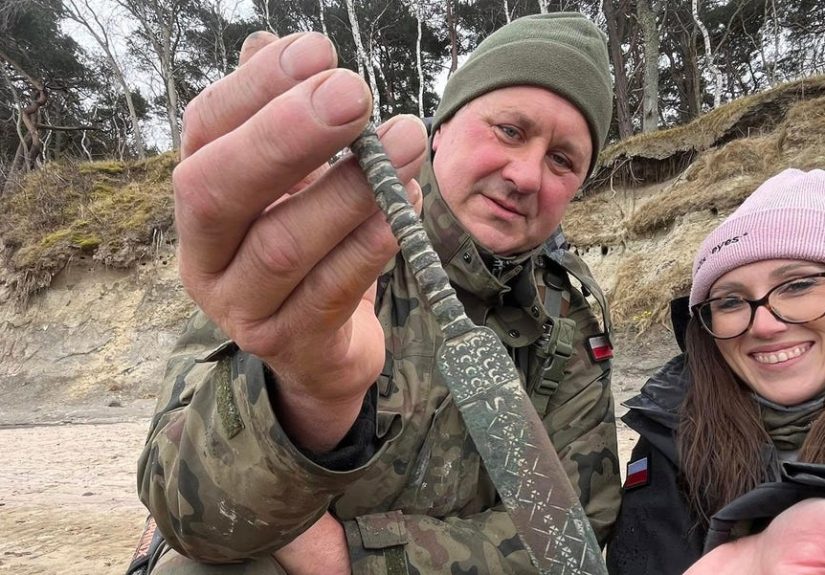
That is why the discovery of an ornate ancient blade on a Baltic beach in Poland has traveled so fast across history sites, archaeology desks, and social media feeds. Two metal detectorists were scanning a storm-battered stretch of shoreline when they came across an object lodged in a fallen chunk of clay. What emerged was no rusty scrap and no ordinary knife. It was a beautifully decorated dagger, complete with crescent-like motifs, star-shaped markings, and the kind of craftsmanship that makes experts stop, squint, and start speaking in very careful museum language.
Early reports described the weapon as around 2,800 years old and linked it to the early Iron Age, possibly the Hallstatt world of Central Europe. That alone would make it a headline-worthy archaeological moment. But the story gets even more interesting from there. The blade was found after storms and coastal erosion appear to have exposed it. It may have been ceremonial rather than practical. It may have been imported from farther south. And in a twist worthy of any good artifact mystery, not everyone agrees on the original dating.
So yes, this is a story about an ancient dagger on a beach. But it is also a story about erosion, craftsmanship, responsible metal detecting, and the strange, thrilling way the past sometimes decides to wash ashore when nobody is expecting it.
The Beach Find That Turned Into a Major Archaeology Story
The basic facts are irresistible. Two detectorists, Jacek Ukowski and Katarzyna Herdzik, were exploring a beach on Poland’s Baltic coast after rough weather had damaged the shoreline. In a mass of clay that had fallen from the cliff, they found an ornate dagger in remarkably good condition. The object was quickly reported to museum authorities rather than pocketed, sold, or turned into somebody’s “cool shelf thing,” which was exactly the right move.
That fast handoff matters. In archaeology, context is everything. Where an object is found, what it is found beside, the kind of sediment that preserved it, and whether it came from a stable layer or a collapsed one can all affect how experts interpret it. Even when an artifact has already been moved by nature, as appears to be the case here, prompt reporting can preserve critical information about its location and condition.
The dagger itself immediately drew attention because it did not look crude or utilitarian. It looked intentional. Elegant, even. The blade was said to be around 24 centimeters long, narrow and pointed, with rich decoration running across much of its surface. Instead of being a plain tool, it looked like an object meant to signal meaning, status, or both.
That is one reason the story exploded beyond archaeology circles. People do not just love old things. They love old things with drama. Put a decorated weapon in a chunk of coastal clay after a storm, add a possible ritual backstory, and suddenly you have history with cinematic lighting.
Why This Dagger Looks So Special
It was not made to be visually boring
The most striking part of the find is the ornamentation. Reports describe crescent moons, star-like crosses, barbed or geometric lines, and a central decorative band running down the blade. The handle also appears carefully finished, with repeated patterns and a pointed end. In other words, this was not a quick forge-and-go situation.
Decorated weapons often raise immediate questions about status and symbolism. A blade can be a weapon, yes, but it can also be a marker of rank, identity, wealth, religious belief, or elite connections. In ancient Europe, finely worked metal objects were often social signals as much as practical objects. A richly decorated blade says something, even if modern researchers still debate exactly what.
That high level of workmanship is also why some experts and museum officials described the object as a metallurgical masterpiece. Fine ornamentation on a metal blade requires planning, skill, and access to techniques that were not casually available to everyone. A piece like this suggests a maker who knew exactly what they were doing and a user who could afford something more than everyday gear.
It may have been ceremonial, not just functional
One of the most intriguing interpretations is that the dagger may have had ritual significance. Some observers have suggested that the surface decoration, especially the crescent and star-like imagery, could point toward symbolic or cosmological meaning. That has led to speculation about a connection to a solar cult or ceremonial practice.
Now, archaeology is not a field that rewards wild guessing. A few decorative motifs do not automatically give us a full religious biography of an artifact. But symbols matter, and experts are right to take them seriously. Across prehistoric and early historic Europe, weapons were sometimes deposited in special places, bent, buried, or otherwise removed from ordinary use in ways that suggest ritual behavior rather than simple loss.
That means the dagger could have been a weapon with symbolic value, a prestige object carried by an elite warrior, or an item made primarily for display or ceremony. All three possibilities remain compelling, which is historian-speak for “we need more evidence, but wow, look at this thing.”
What the Hallstatt Connection Would Mean
If the original dating holds up, the dagger belongs to a fascinating slice of European prehistory. The Hallstatt culture is generally associated with the early Iron Age in Central Europe and is often dated broadly to the first half of the first millennium B.C. It is a period tied to expanding trade, elite display, metalworking skill, and the rise of warrior identities that later fed into the wider story of ancient Celtic Europe.
That context helps explain why researchers were quick to wonder whether the dagger was locally made or imported. Hallstatt-era networks were not isolated village bubbles. Goods, styles, materials, and ideas traveled. A finely decorated blade found on the Baltic coast could reflect long-distance exchange, elite gifting, or the movement of prestige objects across regions.
If it was imported from southern Europe, that would make the find even more exciting because it would hint at broader trade or cultural contact. If it was made locally but influenced by southern styles, that would still show how ideas traveled and were adapted. Either way, the dagger becomes more than a sharp object. It becomes evidence of connection.
That bigger historical frame is what turns a beach discovery into a meaningful archaeological story. The dagger is interesting not only because it is old, but because it may help illuminate the world that produced it: a world of metalworkers, coastlines, belief systems, travel routes, and people who clearly understood that objects could carry power far beyond their practical use.
The Big Plot Twist: The Age May Not Be Settled
Here is where the story earns a raised eyebrow from careful readers. While early coverage described the dagger as around 2,800 years old and linked it to the early Iron Age, later archaeologists publicly challenged that interpretation. Some argued that the object may be much younger, possibly dating to only a few centuries ago rather than nearly three millennia.
That does not make the discovery less interesting. It makes it more honest.
Archaeological dating is not magic, and it is not always immediate. When an object surfaces outside a controlled excavation, especially after being shifted by coastal collapse or storm action, the first interpretation is often provisional. Experts look at style, manufacturing details, corrosion patterns, context, and eventually metallurgical testing. Early judgments can change once specialists weigh in.
For web readers, that means the most responsible version of this story is not “mystery solved.” It is “remarkable object found, initial dating suggests the early Iron Age, later experts dispute the age, more study is needed.” That may not sound as punchy as a viral headline, but it is much closer to how real archaeology works.
And honestly, there is something refreshing about that. The dagger is not just an artifact. It is a reminder that history is an argument built from evidence. Sometimes the first headline is the beginning of the investigation, not the end.
Why Beaches and Storms Keep Spilling History Into the Present
Another reason this story caught on is that it taps into a larger pattern: coasts are constantly revealing and destroying the past at the same time. Storms, wave action, changing shorelines, thawing ground, and erosion can expose artifacts that were hidden for centuries. That sounds romantic until you remember the second half of the equation. The same forces that reveal sites can also tear them apart.
Archaeologists working in coastal zones have been warning about this for years. Shoreline erosion can uncover tools, bones, buildings, burials, and everyday objects, but once those materials are exposed, they often begin to deteriorate fast. A dramatic storm can act like both curator and wrecking ball. It opens a window, then starts breaking the frame.
That makes rapid reporting especially important in places where the coast is unstable. A detectorist or beachcomber who finds something unusual is not just stumbling onto a curiosity. They may be encountering a fragile piece of the past in the brief interval before salt, oxygen, human interference, or weather erase more of the story.
In that sense, this dagger is part of a bigger modern archaeology theme. Nature is exposing buried histories in unexpected places, and researchers are racing to document them before they vanish. The beach is not only a setting here. It is an active participant in the discovery.
What the Detectorists Did Right
The internet loves a finder story, but this one is especially worth celebrating because the response was responsible. The discovery was promptly reported to the local museum. That decision preserved the object for study, protected its legal and historical value, and created the chance for real scholarship instead of rumor and resale.
Responsible metal detecting is a bigger issue than many casual readers realize. In the best cases, detectorists work within local laws, report finds, cooperate with archaeologists, and help identify threatened heritage. In the worst cases, unreported digging destroys context, feeds black-market trade, and turns history into stripped-down collectibles.
This discovery landed on the good side of that divide. The detectorists recognized that the dagger was potentially significant and acted accordingly. That is one reason the story has been framed not just as a lucky find, but as a model of good heritage practice.
And that is a useful message for readers. Finding something old is exciting. Reporting it properly is what turns excitement into knowledge.
Why the Story Resonates So Strongly Online
There is also a very modern reason people cannot stop clicking on stories like this one: it compresses deep time into a single vivid scene. A storm hits. A cliff falls. Two people walk a beach. Suddenly, the ancient world is in somebody’s hand.
That kind of narrative feels almost unfairly perfect. It mixes luck, mystery, craftsmanship, danger, and a hint of cosmic symbolism. It invites us to imagine what else might be sitting just below the surface in places we treat as ordinary. It flatters our sense that the world is still full of surprises, which, to be fair, it is.
But the deeper reason it works is emotional. This dagger is a bridge between strangers separated by centuries. Someone forged it. Someone carried it. Someone valued it enough to decorate it. Then, after an enormous stretch of silence, two modern people found it by the sea. That is the kind of timeline that makes history feel less like a textbook and more like a live wire.
Experiences Related to a Discovery Like This
To understand why this story has such staying power, it helps to think about the human experience wrapped around a find like this. For the detectorists, the moment probably did not begin with certainty. It began with a signal, a patch of disturbed ground, maybe a bit of skepticism, and the routine hope that the next sweep might turn up something mildly interesting. People who search beaches with detectors learn to live in the gap between anticipation and disappointment. Most signals are forgettable. That is exactly why the unforgettable ones hit so hard.
Imagine the feeling of brushing away wet grit and clay and seeing a worked edge, then decoration, then realizing this is no modern object. There is usually a flash of adrenaline first, then disbelief, then a very practical fear of doing something wrong. That combination is common in real find stories. The thrill is immediate, but so is the pressure. Do not scratch it. Do not clean it too aggressively. Do not separate it from the material around it if that material matters. Do not become the cautionary tale in a museum lecture.
Then comes the second experience: restraint. That may not sound dramatic, but it is one of the most important emotional shifts in archaeology-related finds. The right reaction is not “I found treasure, now it is mine.” The right reaction is “I may have found evidence, and now I have a responsibility.” That mindset changes everything. It turns a lucky beach walk into a moment of stewardship.
There is also the museum side of the experience, which is its own kind of excitement. Curators and archaeologists are trained not to overreact in public, but that does not mean they do not feel the charge of discovery. When a reported object arrives with unusual workmanship and plausible antiquity, the room changes. People start comparing forms, looking at corrosion, studying decoration, checking dimensions, and asking where exactly it was found. Even before answers exist, the artifact begins pulling specialists into a shared act of interpretation.
For local communities, finds like this can create another layer of experience: pride mixed with curiosity. A beach that yesterday was just a windy stretch of coast becomes a place with a headline and a story. Residents start imagining the deeper history of their landscape. They pay attention to the cliffs differently. The past suddenly feels local, not abstract.
And for readers, the emotional experience is strangely personal too. Stories like this trigger a universal thought: what if history is closer than I think? What if one storm, one walk, one glance downward is all it takes for the ordinary world to crack open? That sense of possibility is part of the magic. It reminds us that discovery is not always made by a giant expedition under dramatic music. Sometimes it happens in coastal wind, with tired legs, damp sleeves, and a detector that will not stop beeping.
That is why the dagger matters beyond the artifact itself. It captures the full chain of wonder: the search, the shock, the care, the expertise, and the widening circle of people who get pulled into the story. Even if future analysis revises the date or changes the interpretation, that human experience remains real. The beach gave up a mystery, and for a moment the distance between then and now became wonderfully, almost absurdly, small.
Conclusion
The dagger found on the Baltic beach is the kind of discovery that reminds us why archaeology still has the power to stop people mid-scroll. It combines beauty, mystery, craftsmanship, and just enough uncertainty to keep the story alive.
Whether the blade proves to be a true 2,800-year-old early Iron Age relic or a younger object that fooled first impressions, it already offers something valuable: a vivid lesson in how the past surfaces, how evidence is tested, and how responsible finders can help protect cultural heritage instead of accidentally damaging it.
In other words, this was not just a cool thing on a beach. It was a moment when weather, chance, history, and human curiosity all collided in one patch of coastal clay. Not bad for a day by the water.







 Close
Close