
Table of Contents >> Show >> Hide
- What Record Did NASA Set, Exactly?
- Why NASA Is Betting on Lasers for Space Communications
- How Space-to-Ground Laser Communication Works
- Meet TBIRD: The “Tissue Box” That Thinks It’s a Data Center
- Zooming Out: NASA’s Lasercom Momentum Beyond TBIRD
- Real-World Impacts: What Faster Space Downlinks Unlock
- Challenges NASA Still Has to Solve (Because Space Never Lets You Have Nice Things)
- FAQ: Space-to-Ground Laser Communications
- Conclusion
If you’ve ever tried to upload a 4K video on hotel Wi-Fi, you already understand the emotional core of space communications:
a whole lot of amazing data… stuck behind a very tiny pipe. Now imagine that pipe is the size of a drinking straw, the
“router” is orbiting Earth at thousands of miles per hour, and the “dead zone” is… clouds.
That’s why NASA’s recent space-to-ground laser communication record is such a big deal. Using an optical (laser-based)
downlink, NASA and its partners pushed data from space to Earth at 200 gigabits per seconda speed that makes
traditional radio links look like they’re trying to stream in dial-up cosplay. Even better, this wasn’t a “one lucky second”
headline. The team demonstrated sustained, repeatable high-rate performanceexactly what you need if you want future missions
to send home more science, more imagery, and more “wow” without waiting until next Tuesday.
What Record Did NASA Set, Exactly?
The milestone: a record-breaking 200 Gbps space-to-ground laser communications link, demonstrated by NASA and
partners using the TeraByte InfraRed Delivery (TBIRD) payload aboard a small satellite mission. The headline
number matters because it represents how much information can be delivered during short “passes” over a ground station
the limited window when a spacecraft is in view and able to transmit.
In plain English: TBIRD showed that a compact optical terminal in low Earth orbit can dump terabytes of data to Earth in
just minutes. NASA reported the demonstration peak as 4.8 terabytes of error-free data in five minutes at
200 Gbps during a single pass. That’s enough bandwidth to fundamentally change how we design space instruments, Earth-observing
satellites, and future exploration missionsbecause suddenly, getting the data home isn’t the slowest part of the job.
Why NASA Is Betting on Lasers for Space Communications
Radio is reliablebut it’s getting crowded
Radio-frequency (RF) communications have been spaceflight’s dependable workhorse for decades. RF is robust, mature, and can
punch through clouds and weather more easily than light. But it’s also constrained by spectrum availability and bandwidth.
As sensors improvethink higher-resolution cameras, hyperspectral imagers, and advanced radarspacecraft can generate data
faster than they can transmit it. The result is an awkward reality: some missions “see” more than they can share.
Lasers pack more data into the same “conversation”
Optical communications (often called “lasercom”) uses near-infrared light instead of radio waves. Because optical frequencies
are vastly higher than RF, they can carry much more informationsimilar to how fiber-optic internet can move mountains of data.
In space, a laser link also creates a narrow beam, which helps with security and reduces interference compared with wide RF
broadcast patterns.
Small satellites are hungry for big downlinks
The space industry has shifted toward smaller, cheaper satellites that can be built and launched faster. But small spacecraft
don’t automatically mean small data needsespecially for Earth observation and research. TBIRD’s success hints at a future where
even compact satellites can return enormous datasets quickly, enabling better climate monitoring, disaster response imagery,
agricultural analysis, and more frequent “fresh” data for decision-makers.
How Space-to-Ground Laser Communication Works
1) The spacecraft “points” a laser like a superhero with perfect aim
A laser link isn’t like Wi-Fi. It’s more like shining a laser pointer onto a dime from miles awayexcept the dime is moving,
you’re moving, and the atmosphere is doing interpretive dance in between.
Optical terminals need extremely precise pointing, acquisition, and tracking. The spacecraft must lock onto a ground station,
keep the beam aligned, and compensate for vibration and motion. That’s why engineering a stable pointing system is just as
important as raw transmission power.
2) The ground station uses a telescope to “catch” the light
On the ground, telescopes and specialized receivers collect the incoming photons and convert them into digital bits. Because
the beam is narrow, the ground station is not casually “listening” to the whole skyit’s actively tracking a precise target
and pulling data from that tight optical link.
3) Adaptive optics helps fight the atmosphere’s bad attitude
Earth’s atmosphere can distort optical signals via turbulencesimilar to how distant objects shimmer over a hot road.
Advanced ground stations may use adaptive optics systems to correct distortions and improve the reliability of high-rate
downlinks. This is one reason high-performance optical ground stations can look more like observatories than traditional
satellite dishes.
4) Weather is the boss battle
Lasercom typically can’t punch through thick clouds. That means operational planning matters: you need clear skies, smart scheduling,
and often multiple geographically separated ground stations to improve your odds. In other words, lasercom doesn’t replace RF
it complements it. RF can be your all-weather fallback, while lasercom becomes your express lane when the sky cooperates.
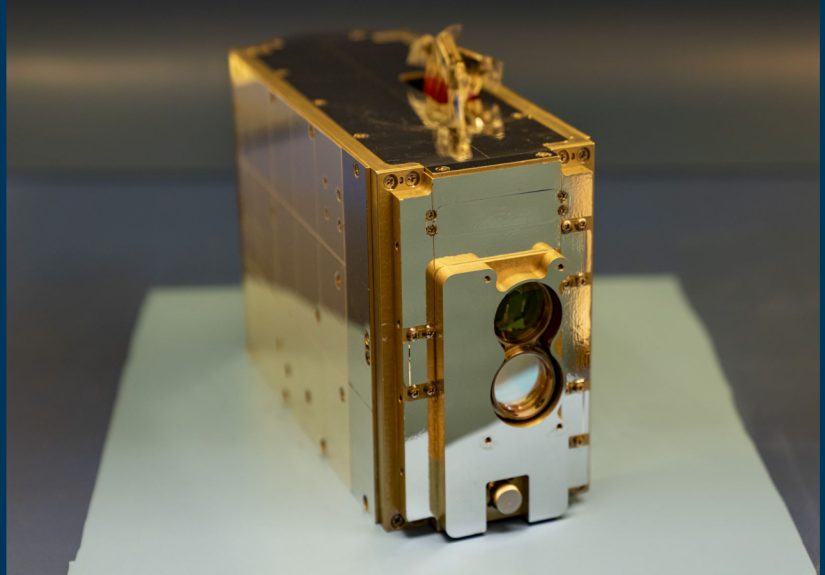
Meet TBIRD: The “Tissue Box” That Thinks It’s a Data Center
TBIRD was designed to prove that very high data rates are possible from a compact payload on a small satellite.
It rides on NASA’s Pathfinder Technology Demonstrator program and demonstrates direct-to-Earth optical downlinks from low Earth orbit.
The record matters for another reason: it suggests we can scale optical communications without requiring massive, power-hungry,
custom spacecraft buses. If a small platform can deliver 200 Gbps under real conditions, then future missionscommercial and
governmentcan design around that capability.
Why 200 Gbps changes the design conversation
Space mission architects obsess over “link budget” like chefs obsess over salt. If the downlink is slow, you either:
(a) reduce the amount of data you collect, (b) compress aggressively and risk losing valuable detail, or (c) store data on-board
and dribble it home over days.
High-rate lasercom offers a fourth option: collect more, keep more detail, and downlink in short bursts when conditions are good.
For science and Earth observation, that can mean richer datasets, faster delivery, and more flexibility in what instruments can do.
Zooming Out: NASA’s Lasercom Momentum Beyond TBIRD
TBIRD is one headline-worthy milestone, but it’s part of a wider NASA effort to mature optical communications across multiple
mission typesnear Earth, the Moon, and deep space.
Deep space: proving lasers work far beyond Earth orbit
Separate from TBIRD, NASA’s Deep Space Optical Communications (DSOC) technology demonstrationflying with the
Psyche missionhas been pushing distance and performance milestones for laser links across millions of miles.
DSOC has demonstrated that deep-space laser communication can deliver meaningful rates at vast distances, including historic
demonstrations of high-definition video and long-distance links comparable to (or beyond) Earth-to-Mars separations. While DSOC’s
data rates are nowhere near 200 Gbpsdeep space is a different beastthe strategic point is the same: optical links can deliver
more data than comparable RF systems at long distances, enabling richer future exploration.
Lunar and relay architectures: building an “optical network,” not just a single link
NASA is also developing relay-style laser communications concepts, where spacecraft can route data through an optical relay
in space down to Earthsimilar to how a cell tower network works, but with fewer snack runs and more orbital mechanics.
Over time, these pieces add up: direct-to-Earth high-rate links from LEO (TBIRD), operational relay demonstrations, and deep-space
optical experiments (DSOC). The long-term goal is an infrastructure where the bottleneck is no longer “getting the bits home.”
Real-World Impacts: What Faster Space Downlinks Unlock
Earth observation that’s actually timely
Many Earth-observing missions already collect enormous volumes of imagery. The challenge is delivering it quickly enough to matter.
With higher downlink rates, satellites can transmit more data per pass, reducing latency between observation and delivery.
That’s crucial for disaster response (wildfires, floods, hurricanes), maritime monitoring, and rapid infrastructure assessments.
More ambitious instruments
If mission teams can count on higher bandwidth, they can fly sensors that generate larger datasetshigher resolution, more spectral
channels, faster sampling. That means a better scientific payoff without forcing teams into harsh trade-offs.
Future human exploration
Human missions create not just scientific data but operational needs: high-definition video, telemetry, medical monitoring,
surface mapping, and robust communications infrastructure. Optical communications could become a critical part of how we support
astronauts farther from Earth, especially as missions expand toward Mars and beyond.
Challenges NASA Still Has to Solve (Because Space Never Lets You Have Nice Things)
Clouds and atmospheric turbulence
The atmosphere can be uncooperativecloud cover can block optical links entirely, and turbulence can degrade performance.
Mitigation strategies include multiple ground stations, choosing sites with favorable weather, and using advanced receivers
and adaptive optics.
Pointing precision at scale
Demonstrating a record is one thing. Building a fleet of missions that can reliably acquire, track, and maintain laser links
under varied conditions is another. Future operational systems must be resilient, easier to integrate, and less “custom art project”
and more “repeatable product.”
Hybrid operations with RF
Optical communications won’t fully replace radio in the near term. The likely future is hybrid: RF for command and control
plus backup coverage, optical for high-volume science and imagery when conditions are favorable.
Standards, interoperability, and scaling ground infrastructure
A world with many laser-equipped spacecraft needs coordination: standards, compatible terminals, scalable ground networks, and
scheduling systems that can match links to weather windows. The tech is impressive; the operations will be the real endurance sport.
FAQ: Space-to-Ground Laser Communications
Is this the same as the lasers used between satellites?
Not quite. Inter-satellite laser links (crosslinks) connect satellites to each other in space. Space-to-ground lasercom has to
deal with the atmosphere and weather, which makes it uniquely challenging. Both are optical, but they’re different operational problems.
Is it “secure”?
A narrow laser beam is harder to intercept than a broad RF signal, which can offer security advantages. But “secure” also depends
on encryption, key management, and mission designso the beam shape alone isn’t the whole story.
Will this give us “internet from Mars”?
Laser communications can dramatically boost the data capacity of deep-space links, but Mars communications still face big constraints:
distance, power, pointing, and network architecture. Think of lasercom as upgrading the highway, not teleporting the cars.
Conclusion
NASA’s space-to-ground laser communication record isn’t just a brag-worthy speed testit’s a preview of how space missions will
operate when bandwidth stops being the villain of the story. With TBIRD demonstrating 200 Gbps from low Earth orbit and NASA’s
broader optical communications portfolio proving that lasers can work at lunar and deep-space distances, the trajectory is clear:
future missions will return richer science, faster imagery, and more capability than today’s RF-limited links can realistically support.
The punchline is simple: when you can move more data, you can do more discovery. And that’s the kind of record worth chasing.
Experience Notes: What It “Feels Like” to Run a Lasercom Pass
Imagine you’re on a laser communications operations team on the day of a high-rate demo. The vibe is part mission control, part
weather channel, and part “please don’t let the telescope sneeze.” A lasercom pass is shortoften measured in minutesso everything
around it becomes a choreography of preparation and precision.
First comes the planning, which is less glamorous than it sounds and more like doing advanced math while negotiating with clouds.
You start with orbital predictions: when does the spacecraft come into view, how long is the geometry good, and what elevation
angles maximize link performance? Then you add the atmosphere, which turns the schedule into a probability game. Clear skies?
Great. High cirrus clouds? Maybe. Marine layer rolling in? Suddenly your “high-rate pass” becomes a motivational speech about resilience.
On the ground side, teams often run checks that feel like prepping a race car: receiver readiness, telescope tracking calibration,
and verifying that timing systems are synchronized down to fractions of a second. Optical links are allergic to sloppiness. If a
radio dish can be forgiving, a laser terminal is the oppositeit wants a crisp lock, stable pointing, and a clean optical path.
Operators will monitor everything from tracking performance to signal quality metrics, watching for that satisfying moment when the
link transitions from “searching” to “locked.” It’s the communications version of hearing the engine catch on the first turn of the key.
When the downlink starts, the data doesn’t arrive as a single dramatic burst that makes everyone cheer (although cheering is allowed).
Instead, it shows up as steady performance graphs, error-rate counters that you want to stay boringly low, and throughput numbers
that either make you smile or make you quietly re-check the alignment. High-rate lasercom is a discipline in watching dashboards
without blinkingbecause the moment you look away is the moment the atmosphere decides to improvise.
A particularly memorable operational lesson in lasercom is how physical the environment feels. With RF, you can forget the air exists.
With lasers, you can’t. Turbulence can cause fading. Slight pointing drift can bite throughput. Even tiny vibrations matter. That’s why
teams treat pointing and tracking like a first-class subsystem, not an afterthought. It’s also why ground sites are chosen for conditions
that sound like a vacation brochure: high elevation, low humidity, and “most weather below the summit.” (If you’re sensing a theme, it’s
that lasercom really prefers its sky like its coffee: clear.)
After the pass, teams do what engineers always do: they turn success into homework. They review logs, compare predicted performance to
actual results, and look for the subtle signs that a system is ready to move from “demo mode” to “operational reliability.” Because the
long-term win isn’t one record-setting downlinkit’s a future where optical communications becomes routine. The best kind of futuristic
technology is the kind that eventually becomes boring. When a 200 Gbps pass feels as normal as a standard RF downlink, that’s when you’ll
know the real milestone has been reached.






 Close
Close