
Table of Contents >> Show >> Hide
- What Optical Resonance Actually Means
- Why NIST Cares So Much About Tiny Atomic Signals
- How NIST Uses Optical Resonance To Interrogate Atoms
- Real NIST Examples of Optical Resonance in Action
- Why This Matters Outside the Physics Department
- The Main Challenges: Because Atoms Are Tiny and Also Dramatic
- Research Experience: What Working Around Optical Resonance Really Feels Like
- Conclusion
At NIST, “probing atoms” does not mean poking them with a microscopic stick and hoping for the best. It means aiming exquisitely controlled light at atoms, tuning that light to just the right frequency, and watching how the atoms respond. That response is called optical resonance, and it is one of the most powerful tricks in modern measurement science.
If that sounds fancy, it is. But the core idea is surprisingly simple: atoms absorb and emit light only at specific frequencies tied to the spacing between their energy levels. Hit the right frequency, and the atom reacts strongly. Miss it, and the light might as well be trying to start a conversation with a brick. NIST has turned that simple principle into a serious scientific superpower, using optical resonance to build better atomic clocks, create new sensors, study quantum behavior, and push measurement science into territory that would have sounded like science fiction a generation ago.
The result is a field where lasers, resonators, optical lattices, frequency combs, and chilled-out atoms all work together like a very nerdy orchestra. And when the tuning is right, the payoff is enormous: cleaner signals, sharper measurements, smaller uncertainties, and new ways to test the laws of physics themselves.
What Optical Resonance Actually Means
Optical resonance happens when the frequency of light matches a natural transition inside an atom. Electrons in atoms can occupy only certain allowed energy states. To move from one state to another, an atom must absorb exactly the right amount of energy. Since light comes in packets of energy that depend on frequency, that means the laser has to be tuned with extraordinary precision.
This is why optical resonance is such a big deal. At resonance, even a tiny cloud of atoms can produce a measurable change in absorption, fluorescence, phase, or transmission. That gives scientists a way to read atomic behavior with astonishing sensitivity. Instead of guessing what atoms are doing, researchers can interrogate them directly and let the atoms answer in the most honest way possible: by obeying quantum mechanics.
In practice, NIST researchers often use highly stable lasers, optical cavities, and frequency combs to find and stay locked to these resonances. Once that happens, atoms become natural reference standards. They do not care about branding, office politics, or whether the lab coffee is terrible. They care about physics, and physics makes them wonderfully reliable.
Why NIST Cares So Much About Tiny Atomic Signals
NIST is the United States’ measurement agency, so its mission is not just to admire precise numbers but to create them, verify them, and make them useful. Optical resonance fits that mission perfectly because atomic transitions are fundamentally reproducible. When a laser is locked to a well-chosen atomic resonance, researchers get a reference signal that is rooted in nature rather than in an arbitrary manufactured object.
That is why optical resonance sits at the heart of next-generation metrology. It supports better timekeeping, more accurate field measurements, improved navigation, quantum sensing, and laboratory techniques that can be miniaturized and deployed outside specialized physics labs. NIST’s work spans everything from room-sized optical clocks to photonic chips designed to shrink cold-atom tools into realistic instruments.
Put differently, optical resonance lets NIST turn atoms into standards, sensors, and scientific witnesses. And those witnesses are annoyingly consistent, which is exactly what metrologists want.
How NIST Uses Optical Resonance To Interrogate Atoms
Tuning Lasers to Atomic Transitions
The first step is always frequency control. A laser used to probe atoms cannot wander around like a distracted tourist. It must be stabilized so that its light stays on or near a selected transition. NIST researchers use optical cavities, resonators, and advanced stabilization methods to push laser frequency noise lower and lower. The goal is to make the laser quiet enough that the atom, not the equipment, sets the scale.
Once that laser is properly tamed, researchers can sweep it across an atomic line and watch the signal change. A dip in transmission, a burst of fluorescence, a phase shift, or a split resonance peak can reveal what is happening inside the atomic system. In classic laser-cooled atom experiments, NIST has used optical probing of rubidium and cesium to record Doppler-free spectra and observe effects such as Autler-Townes splitting, where the interaction of light with atoms reshapes the resonance structure itself.
Cooling and Trapping the Atoms
Atoms at room temperature move quickly, and moving atoms are messy measurement partners. Their motion broadens spectral lines and smears out precision. So NIST often cools atoms with laser light and traps them in carefully engineered environments. These may include magneto-optical traps, ion traps, or optical lattices made from standing waves of light.
Cooling atoms is one of those ideas that still sounds like a prank until you see the physics. By tuning light slightly below resonance, researchers can arrange things so atoms moving toward a beam absorb more photons and get nudged back. Repeating this from multiple directions slows the atoms dramatically. It is less “freezing” in the everyday sense and more “strategically persuading atoms to stop showing off.”
When the atoms are colder, their resonances become narrower and easier to measure. Longer interrogation times become possible, and systematic effects become easier to study. That is one reason cold atoms are so central to NIST’s work in clocks and sensors.
Using Optical Lattices and Magic Wavelengths
One of NIST’s most important tools is the optical lattice clock. In these systems, overlapping laser beams create a periodic landscape of light that traps neutral atoms, often strontium or ytterbium, in a grid. The beauty of the method is that thousands of atoms can be measured at once, improving signal quality and stability.
There is, however, a catch with the size of a small mountain: trapping light can shift the atomic transition being measured. That would be terrible for a clock. The solution is the magic wavelength, a carefully chosen trapping wavelength at which the relevant clock states are perturbed equally, leaving the transition frequency nearly unchanged. It is one of those delightfully elegant ideas that makes quantum physics seem less like chaos and more like a very strict but fair puzzle.
NIST and JILA researchers have pushed this approach into record-setting territory with strontium and ytterbium lattice clocks. These clocks use optical transitions, which oscillate much faster than microwave transitions in cesium standards. Faster oscillations mean finer “ticks,” and finer ticks mean better precision.
Frequency Combs: The Optical Rulers
Optical resonance would be immensely useful even without frequency combs, but with combs it becomes downright formidable. A frequency comb is a light source containing a series of evenly spaced spectral lines, like the teeth of a ruler for optical frequencies. NIST and JILA researchers helped establish combs as essential tools for connecting optical measurements to usable clock signals.
In direct frequency-comb spectroscopy, comb light can interrogate atomic transitions directly and even track quantum coherence in real time. This matters because atoms often do not just jump from state to state in a neat little diagram. They interfere, accumulate phase, and evolve coherently. Frequency combs give researchers a way to study that behavior with extraordinary precision and bandwidth.
That makes combs useful not only for clocks but also for spectroscopy more broadly, including studies of atomic structure, transition frequencies, and dynamic quantum effects. They are called combs, but in the lab they behave more like laser Swiss Army knives.
Real NIST Examples of Optical Resonance in Action
Optical Atomic Clocks
Perhaps the clearest example is the optical atomic clock. NIST’s ion and lattice clocks use lasers tuned to extremely narrow resonances in trapped ions or neutral atoms. When the laser drifts away from resonance, the system detects the offset and corrects it. The laser then inherits the atomic transition’s consistency, and that stabilized light becomes a timekeeping reference.
This is not academic nitpicking. Better clocks improve synchronization in telecommunications, support power-grid timing, strengthen navigation, and enable precision tests of relativity and fundamental constants. NIST’s recent clock advances continue to support the broader effort to redefine the second using optical, rather than microwave, standards.
Rydberg Atom Sensors
NIST has also used optical resonance in Rydberg-atom sensing. Rydberg atoms are atoms excited to very high-energy states, where their outer electrons are far from the nucleus and extremely sensitive to electric fields. NIST researchers use lasers to prepare these atoms and optical spectroscopy techniques such as electromagnetically induced transparency to read out how radio-frequency fields alter the atomic spectrum.
This approach is clever because the atoms themselves become the calibrated sensing element. Instead of relying on a conventional probe that must be calibrated by another standard, the measurement links directly to atomic structure and SI-traceable constants. It is a wonderfully elegant move: make the atom both the witness and the measuring stick.
Chip-Scale and Integrated Optical Devices
NIST is also working to shrink atomic measurement systems. Its integrated optical atomic devices and cold-core technology efforts combine photonics, waveguides, gratings, metasurfaces, and vapor cells to create more compact atomic sensors and clocks. That work aims to reduce the number of bulky optics required to cool, trap, and probe atoms.
Meanwhile, related work involving microring resonators and integrated photonics points toward smaller optical “clockwork” for future atomic clocks. The vision is clear: take the kind of metrology that once filled rooms and compress it into packages that can survive outside the lab.
Optical Resonators Beyond Atomic Clocks
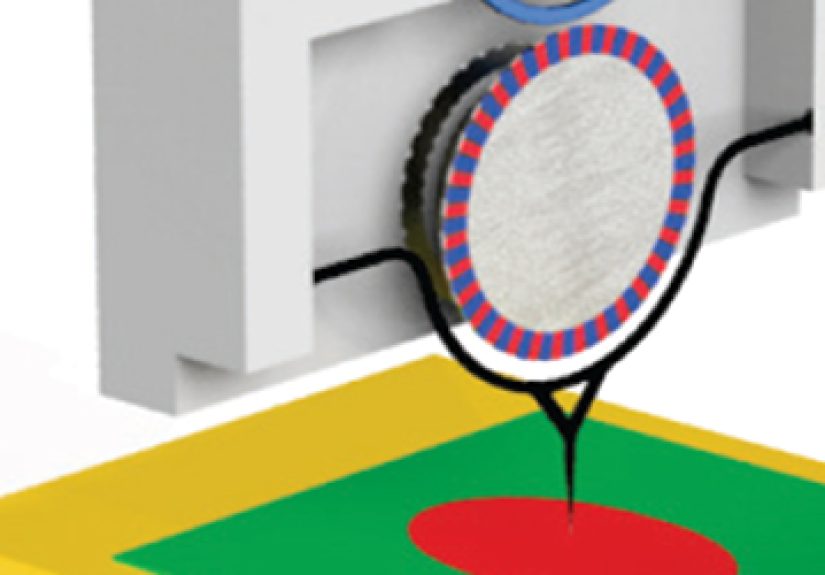
Even in nanoscale instrumentation that is not directly an atomic clock, NIST has used optical resonators to detect tiny motions with extreme sensitivity. One example is a miniature disk resonator acting like an optical whispering gallery, where certain light frequencies circulate strongly. When a nearby mechanical probe moves, it shifts the optical resonance, translating minute motion into a measurable optical signal.
That work highlights a broader truth: resonance is a metrology amplifier. Whether NIST is probing atoms, measuring electric fields, or improving nanoscale probes, resonance makes weak signals louder and cleaner.
Why This Matters Outside the Physics Department
Optical resonance research can sound like it belongs in a laser bunker guarded by graduate students and caution signs. But the impact reaches much further. Better atomic clocks help support navigation, distributed networks, finance systems, communications, geodesy, and scientific infrastructure. Atom-based sensors could improve field calibration, compact navigation systems, and environmental measurements. Compact optical clocks may eventually move from rare laboratory instruments to deployable devices.
There is also a deeper payoff. By probing atoms more precisely, NIST and its collaborators can search for tiny deviations from expected physics. Are fundamental constants truly constant? Can clocks detect minuscule gravitational differences between locations? Can atom-based measurements reveal new quantum effects or improve standards across entire industries? These are not side quests. They are central reasons this work matters.
The Main Challenges: Because Atoms Are Tiny and Also Dramatic
For all their virtues, atoms are not easy laboratory citizens. External electric and magnetic fields can shift resonances. Temperature can produce blackbody radiation shifts. Collisions between atoms can alter the ticking frequency in ensemble clocks. Laser noise, vibration, dead time, and optical path fluctuations can all damage measurement quality. That is why so much of NIST’s progress comes not from a single dramatic invention but from relentless suppression of noise and uncertainty.
In optical lattice clocks, scientists must manage collisional shifts and lattice-induced effects. In Rydberg sensors, they must interpret how external fields reshape EIT spectra. In miniaturized devices, they must preserve atomic performance while stripping away the large, forgiving laboratory hardware that traditionally made such measurements possible.
That challenge is what makes the field exciting. Optical resonance is simple in principle and fiendish in execution. It rewards patience, engineering discipline, and the kind of optimism required to spend hours aligning a laser only to discover that the real problem was a thermal drift hiding two tables away.
Research Experience: What Working Around Optical Resonance Really Feels Like
One of the most interesting parts of this topic is the human experience behind it. From the outside, optical resonance research can look sterile: vacuum chambers, mirrors, fiber couplers, control electronics, and enough black metal hardware to make the lab resemble a science-fiction stage set. But anyone who has followed this field closely knows that the real experience is more dynamic, more frustrating, and more rewarding than the diagrams suggest.
First, there is the strange emotional power of finally seeing a resonance appear. Scientists may spend days or weeks preparing an apparatus, aligning beams, stabilizing temperature, reducing vibration, cleaning optical signals, and debugging software. Most of that work produces no dramatic visual payoff. Then, suddenly, a signal shows up exactly where physics says it should. A narrow dip. A split line. A stable fringe. A fluorescence burst. It is a small feature on a screen, but it represents the moment when a hidden atomic process becomes measurable. In experimental physics, that can feel like hearing a whisper from nature and realizing it is speaking in complete sentences.
Second, working with resonance teaches humility. At these precision levels, tiny effects matter. A slight drift in laser frequency, an unnoticed magnetic field, imperfect polarization, a little extra atomic density, or heat leaking into the system can nudge the result. Researchers learn quickly that the atoms are honest, but the environment is a skilled prankster. This is why so much of NIST’s progress comes from mastering control rather than merely collecting data. Precision is rarely a gift. It is usually the result of eliminating one annoyance after another until the underlying physics is finally allowed to sit still.
Third, there is a very practical joy in turning abstract quantum ideas into tools. Optical resonance is not just about proving that a transition exists. It is about using that transition. A narrow resonance can become a clock. A sensitive Rydberg response can become an electric-field probe. A photonic chip can simplify what used to require racks of equipment. That translation from deep theory to reliable instrument is where NIST’s style of research really shines. It is one thing to admire atoms. It is another to make them useful on purpose.
There is also a collaborative side to the experience that often gets overlooked. Progress usually comes from teams that mix theorists, experimental physicists, engineers, materials specialists, and metrologists. One group may understand the quantum transition. Another may design the resonator. Another may model the noise. Another may build the photonics. Optical resonance research works best when precision is shared across specialties, which is fitting because the measurements themselves depend on everything working in sync.
And finally, there is the long view. The field advances step by step. A better cavity. A quieter laser. A shallower lattice at the right condition. A compact comb. A better way to read a resonance. Those increments may look modest in isolation, but together they reshape what is possible. That is the lived experience of this topic: lots of patience, occasional panic, moments of beauty, and the steady realization that when light is tuned just right, atoms become some of the best storytellers in science.
Conclusion
NIST’s use of optical resonance to probe atoms is a perfect example of how elegant physics becomes powerful technology. By tuning light to match atomic transitions, researchers can study matter with extraordinary precision, transform atoms into time standards and sensors, and build tools that push the boundaries of measurement science. From laser-cooled atoms and optical lattices to Rydberg sensors and chip-scale photonics, the same core principle keeps reappearing: resonance turns faint atomic behavior into clear information.
That matters because the future of precision measurement will not be built on rough estimates or noisy guesses. It will be built on signals that are stable, reproducible, and rooted in the structure of nature itself. NIST’s work shows that when you learn to listen carefully to atoms with light, they can tell you the time, measure a field, reveal a quantum interaction, and maybe even point the way to the next definition of precision.







 Close
Close