
Table of Contents >> Show >> Hide
- The mystery was never just that LSD was powerful
- The big discovery: LSD gets trapped in a receptor pocket
- Why the trip outlasts the drug in the bloodstream
- It is not only about sticking around; it is also about signaling
- How LSD compares with other psychedelics
- Why scientists care so much about this finding
- The risks that tend to get edited out of the folklore
- Reported experiences related to why LSD trips feel so long
- Bottom line
Note: Body-only HTML, ready for copying and web publishing.
For decades, LSD had one very annoying habit from a scientific point of view: it refused to behave like a normal drug. A tiny dose could trigger an experience that lasted 8 to 12 hours, sometimes with a long mental afterglow, even though the chemical itself was clearing from the bloodstream much sooner. In plain English, LSD was the party guest who said, “I’m heading out,” and then somehow kept talking in the doorway for another six hours.
Now scientists have a much clearer answer for why an LSD acid trip lasts so long. The short version is this: LSD does not just touch a serotonin receptor and leave. It wedges itself into the receptor in a way that makes escape unusually slow. Researchers discovered that part of the receptor folds over the drug like a tiny molecular lid, helping trap it in place. Later studies strengthened the case by showing similar structural features in closely related serotonin receptors and by confirming in humans that blocking the key receptor can sharply shorten the experience.
That discovery matters for more than curiosity. It helps explain LSD’s legendary duration, sheds light on how psychedelic drugs affect perception and mood, and gives drug developers a road map for designing future medicines that may keep helpful brain effects while reducing hallucinations or marathon-length trips.
The mystery was never just that LSD was powerful
LSD is famous for being potent, but potency was only half the puzzle. The bigger question was duration. In controlled human studies, oral LSD has produced effects lasting an average of about 8.5 hours, with peak effects often arriving around 2.5 hours after dosing. Yet pharmacokinetic research shows the drug’s plasma half-life is much shorter, around 3.6 hours. That mismatch pushed scientists to ask a simple but important question: if LSD is fading in the blood, why is it still throwing a rave in the brain?
The answer turns out to involve receptor residence time. A drug’s impact is not determined only by how much of it is floating around in the bloodstream. What matters is also how tightly and how long it stays attached to its target. In LSD’s case, that target is primarily the brain’s serotonin system, especially the 5-HT2A receptor, which is strongly linked to psychedelic effects such as visual distortions, altered time perception, intensified emotions, and changes in the sense of self.
So the modern explanation for why acid trips last so long is not, “Because LSD is weird.” Scientific translation: yes, it is weird, but weird in a very specific, measurable, molecular way.
The big discovery: LSD gets trapped in a receptor pocket
A tiny lid with a big consequence
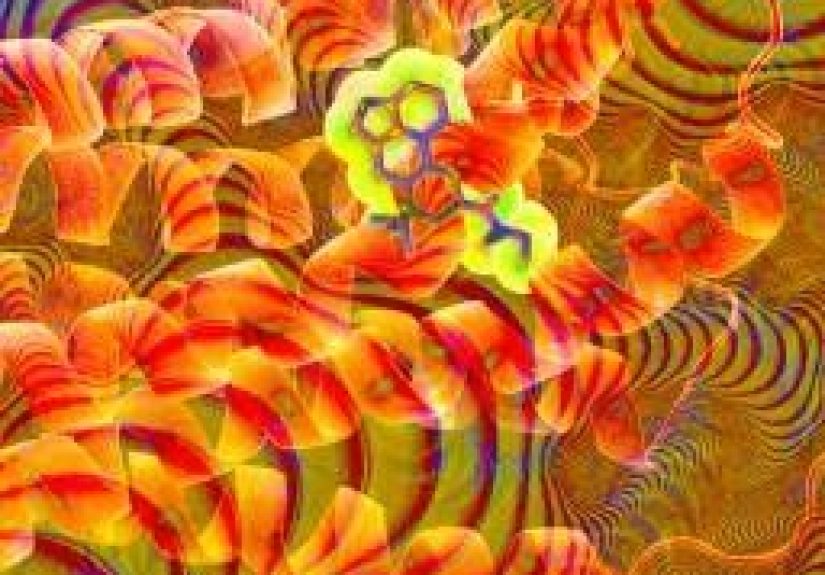
The breakthrough came when researchers captured high-resolution images of LSD bound to a human serotonin receptor. They found that LSD sits in the receptor’s binding pocket at an unexpected angle. Then comes the clever part: a flexible piece of the receptor folds over the molecule like a lid, partially sealing it inside.
That means LSD is not just docking. It is getting tucked in.
This structural trick helps explain why LSD has such a long-lasting effect even at very small doses. Once the drug is inside the receptor pocket, it does not simply drift away when the bloodstream starts clearing it. It remains engaged long enough to keep activating brain signaling linked to the psychedelic experience.
Researchers later showed that if the receptor is altered so that this lid becomes looser and more mobile, LSD leaves much faster. In other words, the long trip is not just about the drug being strong. It is about the drug being stubborn.
Why the receptor detail matters
This is where the science gets especially interesting. The first landmark structural work focused on a serotonin receptor called 5-HT2B, which is closely related to 5-HT2A. That was useful because it gave researchers a clean molecular snapshot of the trapping mechanism. Later structural studies on 5-HT2A, the receptor more directly tied to hallucinogenic effects, found a very similar arrangement. That helped move the explanation from “promising clue” to “strong mechanistic story.”
So when headlines say scientists discovered why LSD lasts so long, the careful version is this: structural biology revealed that LSD can be physically occluded by a receptor lid, and later work on related receptors and human studies backed up the idea that this lingering receptor engagement is central to the long duration of the acid trip.
Why the trip outlasts the drug in the bloodstream
This is the part that makes non-chemists squint at the ceiling for a moment. Many people assume a drug’s effects should fade as soon as blood levels fall. That is often directionally true, but it is not the whole story.
LSD illustrates why. In controlled trials, the compound reaches peak blood concentrations long before the full experience is over. Researchers have measured average subjective effects lasting roughly 8 to 12 hours, while the drug’s plasma half-life is only a few hours. That means the brain experience is not explained by blood chemistry alone.
Instead, LSD acts like a molecule with a VIP pass and no interest in leaving the venue. Even as overall circulating levels decline, the drug’s slow exit from serotonin receptors can keep the signaling going. Add to that the fact that psychedelics can disrupt communication across major brain networks involved in self-processing, perception, and emotion, and you have a recipe for a long, immersive altered state that feels much longer than the clock suggests.
And yes, altered time perception makes the whole thing even stranger. A six-minute stretch can feel like an emotional trilogy. A hallway can seem philosophical. A lamp can become, for reasons nobody requested, the main character.
It is not only about sticking around; it is also about signaling
The receptor-lid model explains a lot, but not everything. Scientists also found that LSD appears to favor certain signaling pathways inside cells. In particular, structural and biochemical work has linked LSD to strong beta-arrestin-related signaling, alongside classic G-protein signaling. That matters because different signaling patterns can produce different biological and psychological effects.
When researchers weakened the receptor lid, LSD not only detached faster, but its signaling behavior changed as well. That suggests the long residence time and the way the receptor changes shape may both contribute to the character of the trip, not just the duration.
Human studies add another layer of evidence. In one randomized study, the serotonin 5-HT2A blocker ketanserin reduced the duration of LSD’s subjective effects from about 8.5 hours to about 3.5 hours when given after LSD. That is a big clue. It tells us that continued activation of this receptor is not just related to the experience; it is a major driver of how long it lasts.
How LSD compares with other psychedelics
LSD is not the only psychedelic with long effects, but it stands out. In a comparative study, mescaline lasted even longer on average, while psilocybin was substantially shorter. LSD landed in the middle of that comparison at roughly 8.2 hours, compared with about 4.9 hours for psilocybin and about 11.1 hours for mescaline.
That comparison helps show why LSD has always occupied a special corner of psychedelic culture and research. It combines high potency, relatively long duration, and a receptor-binding style that looks unusually sticky. It is not just “strong mushrooms.” Pharmacologically, it is doing its own elaborate molecular dance.
Why scientists care so much about this finding
The practical importance goes far beyond explaining the classic acid trip. Researchers are trying to understand whether psychedelics can be turned into safer, more targeted psychiatric treatments. If scientists know which structural features make LSD long-lasting or hallucinogenic, they can try to redesign those features.
That work is already happening. Newer studies have described non-hallucinogenic LSD analogs and therapeutic LSD-inspired compounds with reduced hallucinogenic potential. The goal is not to recreate Woodstock in a prescription bottle. The goal is to keep potentially useful brain effects, such as rapid changes in mood-related circuits or neuroplasticity, while reducing the intense perceptual distortions and all-day time commitment.
In other words, understanding why LSD lasts so long gives scientists leverage. Once you know which molecular door is getting stuck, you can start designing a better hinge.
The risks that tend to get edited out of the folklore
LSD’s mystique can make it sound like a purely cerebral adventure, but the real-world risks are not imaginary. The effects can be unpredictable and vary based on dose, potency, mood, setting, expectations, and individual biology. People can experience fear, panic, confusion, or risky behavior while intoxicated. Physical effects can include increased heart rate, higher blood pressure, dilated pupils, nausea, trembling, and difficulty sleeping long after the most intense phase seems over.
There is another modern problem too: products sold as LSD are not always LSD. U.S. drug agencies have warned that other synthetic compounds, including NBOMes, are sometimes sold as acid and may carry higher risks of severe adverse effects. So even the phrase “one tab of LSD” can be scientifically sloppy in the wild.
That is one reason the new receptor research is so useful. It moves the conversation out of rumor, mythology, and movie scenes and back into measurable biology.
Reported experiences related to why LSD trips feel so long
One of the most fascinating parts of this topic is how the molecular explanation lines up with reported human experience. People do not describe LSD as merely “lasting a long time.” They often describe it as unfolding in layers, almost like several different experiences stacked inside one long day.
Early on, people commonly report a sense of anticipation: colors sharpening, sounds becoming textured, ordinary objects suddenly looking as if they have opinions. Then comes the stronger phase, when time may feel elastic, emotions can become dramatically amplified, and visual changes can range from subtle shimmering to fully immersive distortions. Some people describe patterns moving on walls, music feeling three-dimensional, or thoughts arriving with unusual intensity and speed. In research settings, participants have also reported experiences that score highly on measures of altered consciousness, ego dissolution, and mystical-type effects.
What is striking is how often people say the trip does not end all at once. Instead, it tapers. The visuals may soften while the mind remains unusually open, restless, analytical, emotional, or unable to sleep. That subjective “long tail” makes sense in light of the receptor story. If LSD is leaving its target slowly, the brain is not getting a clean off-switch. It is getting a gradual dimmer.
Many reported experiences also include intense changes in the perception of time itself. Minutes can feel stretched, repetitive, or strangely enormous. Someone may feel as if they have been thinking about the same idea for an hour, only to discover that seven minutes have passed. This can make the trip feel even longer than its already long biological duration. A chemically long experience becomes a psychologically massive one.
Another common theme is looping. Thoughts, images, and emotions can circle back on themselves, creating the feeling of being inside a repeating mental hallway. That can be beautiful for some people and terrifying for others. Either way, it helps explain why LSD has such a reputation for feeling endless. A trip does not have to last 24 hours to feel enormous. It just has to keep the same receptor systems engaged while also bending the user’s internal clock.
There is also a major difference between controlled research settings and uncontrolled real-life use. In studies, participants are screened, monitored, and supported. In uncontrolled situations, the same long duration can become exhausting. A person who expected a colorful evening may instead find themselves emotionally raw at 3 a.m., still unable to sleep, still processing intense perceptions, and still waiting for the experience to fade. From a molecular standpoint, the explanation is elegant. From a human standpoint, it can be deeply inconvenient.
Some participants in longer-term follow-up research have described a single LSD session as meaningful, insightful, or personally important months later. Others outside formal studies report difficult experiences marked by anxiety, paranoia, or confusion. Both outcomes fit the larger scientific picture: LSD is acting on systems involved in perception, emotion, and meaning-making, and it stays active long enough to make those effects feel immersive rather than fleeting.
So when people say acid feels like it lasts forever, that is not just dramatic storytelling. It is partly chemistry, partly brain network disruption, and partly the fact that LSD seems able to stretch the very sense of duration through which humans judge experience in the first place. Science did not remove the mystery entirely. It just showed that the mystery has a molecular blueprint.
Bottom line
Scientists now have a compelling explanation for why LSD acid trips last so long. The drug binds to serotonin receptors in a way that lets part of the receptor fold over it like a lid, slowing its escape. Later research showed this trapping mechanism is relevant to the receptor systems most tied to psychedelic effects, while human studies confirmed that blocking the key serotonin receptor can dramatically shorten the trip.
That makes LSD a perfect example of how small molecules can produce outsized experiences. A microscopic structural detail can turn a brief chemical encounter into an all-day alteration of perception, mood, and time itself. It is one of the clearest reminders in neuroscience that in the brain, tiny mechanisms can have very loud consequences.







 Close
Close