
Table of Contents >> Show >> Hide
- Who Were Glen And Bessie Hyde?
- The Honeymoon Voyage Begins
- The Last Confirmed Sightings
- The Empty Boat And The Search
- The Leading Theories About What Happened
- Why The Hyde Mystery Still Captivates Us
- Modern Lessons For Grand Canyon Adventurers
- Experiences And Modern Echoes Of The Hyde Honeymoon
- Conclusion: Love, Risk, And A Canyon That Keeps Its Secrets
- SEO Summary
Some couples celebrate their honeymoon with sandy beaches and fruity drinks. Glen and Bessie Hyde chose something a bit more… intense:
running the wild Colorado River through the Grand Canyon in a homemade boat, chasing speed records and history. They pushed off in 1928
as starry-eyed newlyweds and never came back. What they left behind is one of the Grand Canyon’s most enduring mysteriesand a cautionary
tale for every would-be adventurer.
Who Were Glen And Bessie Hyde?
A whirlwind romance with a daring twist
Glen Rollin Hyde was a bean farmer from Twin Falls, Idaho, practical and hardworking but fascinated by fast water and big canyons.
Bessie Louise Haley was a young woman from West Virginia who had already broken one social rule by divorcing her first husband before
the age of 23. The two met on a passenger ship headed to Los Angeles in 1927, fell in love quickly, and married on April 10, 1928
just one day after Bessie’s divorce became final.
Glen wasn’t just a dreamer; he already had serious whitewater ambitions. In 1926 he had run Idaho’s Salmon and Snake Rivers with veteran
river runner “Cap” Guleke, learning how to maneuver heavy wooden scows through brutal currents. Bessie, on the other hand, had very little
river experience. She brought enthusiasm and courage more than technical skillplus a willingness to sign up for a honeymoon that most
people today would only attempt with a helmet, satellite phone, and a full waiver packet.
Big dreams in a big canyon
The couple wanted more than a romantic float. Glen planned to set a speed record for running the Colorado River through the Grand Canyon,
and he hoped Bessie would become the first documented woman to boat the entire canyon. Fame, sponsorships, and maybe even a book deal
beckoned. In 1928, river-running the Grand Canyon was still rare and dangerous, and commercial outfitters were decades away. Tackling it
in a homemade boat made their journey even more audacious.
The Honeymoon Voyage Begins
A homemade sweep scow and a grand plan
In October 1928, the Hydes traveled to Green River, Utah, where Glen built a 20-foot wooden sweep scowa flat-bottomed river boat commonly
used in Idaho at the time. It was big, boxy, and not exactly designed for the tight, technical rapids of the Grand Canyon, but Glen believed
its stability and capacity made it the perfect expedition vessel. They christened it and launched on October 20, heading down the Green River
toward its confluence with the Colorado and ultimately into the Grand Canyon.
The Hydes weren’t just drifting. They kept a detailed diary, took photographs, and moved steadily downstream, lining or running rapids
that would scare even modern boaters. Their route took them through towering sandstone walls and icy November winds. Yet, by all accounts,
they were making good time and seemed to be handling the challenges as well as anyone could in a big, heavy scow.
The Last Confirmed Sightings
A hike to the rim and a famous photographer
As they entered the Grand Canyon proper, the couple pulled ashore and hiked up the Bright Angel Trail to the South Rim to resupplya brutal
climb that honeymoon brochures rarely mention. At the top, they visited the home and studio of photographer and river runner Emery Kolb,
perched dramatically on the rim. Kolb snapped their now-iconic photograph and hosted them overnight.
Kolb later reported that Glen mentioned tightening up their schedule. Some accounts say that Glen brushed off suggestions that they should
carry life jackets or hire a guide. The couple seemed determined, perhaps even a little overconfident. On November 18, 1928, they hiked back
down into the canyon, rejoined their boat, and pushed off downstream below Hermit Rapid. That’s the last time anyone is known to have seen
them alive.
The Empty Boat And The Search
A promising journey suddenly goes silent
When weeks passed with no word, Glen’s father became worried and alerted authorities. A large search effort formed, including river runners,
park rangers, and the Kolb brothers. In early December, searchers finally spotted the Hydes’ scow in the river near Diamond Creek, roughly
137 miles downstream from Lees Ferry and more than 200 miles from the trip’s starting point.
The scene was eerie. The boat was upright, lightly tied off in an eddy, with no visible damage. Their gear, food, and Bessie’s diary were
still on board. There were no signs of a violent capsize, no torn clothing, and no footprints leading away from the riverbank that anyone
could confidently identify. It looked like the Hydes had simply stepped off the boat and vanished into thin desert air.
Bessie’s diary showed that they had safely run difficult stretches of the river and had made it as far as Diamond Creek. That suggests they
successfully navigated many of the most notorious rapids before they disappeared. But diaries don’t write endings, and the final pages stopped
short of any explanation.
The Leading Theories About What Happened
1. A tragic accident in the rapids
The most straightforward theory is also the least dramatic: somewhere below their last documented camp, the Hydes fell into the river and
drowned. River historian Otis “Dock” Marston argued that they may have been swept out when their scow struck submerged rocks near mile 232,
a rapid notorious for catching even experienced boaters. Strong currents and cold water could easily have overwhelmed them, especially without
modern flotation gear. Bodies lost in the Colorado River are not always recovered, particularly in remote, rugged sections of the canyon.
Supporters of this theory point out that while the boat was found intact, that doesn’t rule out an accident. A heavy scow could conceivably
right itself after a partial swamping or scrape through rapids that swimmers could not survive, especially in November conditions. In other
words, the river may have spared the boat and taken the people.
2. The “Bessie escaped” story
Over time, more sensational stories have surfaced. One campfire favorite suggests that Glen was controlling and sometimes abusive, and that
Bessie finally snapped, killed him, and hiked out of the canyon to start a new life under a different name. This theory got a boost in 1971,
when an elderly woman on a commercial rafting trip supposedly announced that she was Bessie Hyde and had stabbed her husband to death. She
later recanted, and no solid evidence ever backed up her claim.
Another variation ties the Hydes to famed Grand Canyon river runner Georgie Clark. After Clark’s death in 1992, friends sorting through her
belongings found a pistol and documents that sparked speculation she was secretly Bessie. However, Clark’s early life is well documented, and
researchers have found no credible link between her and the missing honeymooner beyond rumor and coincidence.
3. The Kolb skeleton and the conspiracy theories
Things took an extra creepy turn in 1976 when skeletal remains were found on property once owned by Emery Kolb at the canyon rim. Because
Kolb was among the last people to see the Hydes, speculation exploded that the bones might belong to Glenand that Kolb might have known
more than he ever admitted.
Forensic analysis eventually spoiled the mystery. Experts concluded the skeleton belonged to a man no older than 22 who had died decades
after the Hyde disappearance; later work tied the remains to an unidentified suicide victim found in the early 1930s. The Kolb conspiracy
made for good ghost stories, but the science essentially ruled it out.
4. We may simply never know
With no bodies, no confession, and no definitive physical evidence, every explanation remains partly guesswork. That uncertainty is exactly
what keeps the story alive. Books, documentaries, podcasts, and rafting-trip campfire tales return to the Hydes again and again, revisiting
the same clues and reaching slightly different “maybe” conclusions.
Why The Hyde Mystery Still Captivates Us
The disappearance of Glen and Bessie Hyde hits a rare storytelling sweet spot: romance, adventure, danger, and a perfect cliffhanger ending.
They weren’t hardened explorers funded by governments; they were a young couple with big dreams and a boat that probably smelled like fresh
lumber. That makes them relatable. You can picture them laughing in the boat, arguing about how to pack the gear, or posing awkwardly for
Emery Kolb’s camera on the rim.
Their story also highlights how wild the Grand Canyon really is. Even today, with modern gear, satellite communication, and professional guides,
the Colorado River is not a tame amusement-park ride. The Hydes remind us that nature doesn’t care about your honeymoon plans, your Instagram
goals, or your speed records.
Modern Lessons For Grand Canyon Adventurers
If you’re planning a Grand Canyon rafting trip or even just a rim-to-river hike, the Hyde case quietly underlines several safety basics that
still apply almost a century later:
- Respect the river. Rapids rated as “fun” on a brochure can still be cold, powerful, and unforgiving.
- Use proper equipment. Modern life jackets, helmets, communication devices, and professionally designed rafts exist for a reason.
- Listen to experience. Veteran guides and rangers know which rapids and side canyons cause problems, especially in shoulder seasons.
- Time of year matters. The Hydes traveled in late fall; low temperatures, shorter days, and icy water make mistakes more costly.
- Have a realistic plan. Record-setting schedules and homemade boats make for dramatic stories, but they also shrink your margin for error.
Today, commercial rafting trips on the Colorado emphasize risk management, training, and layered backup plans. Guests still hear the Hyde story,
but usually as a reminder that the canyon deserves humility, not just admiration.
Experiences And Modern Echoes Of The Hyde Honeymoon
Visit the Grand Canyon today, and you’ll find that Glen and Bessie’s names linger like canyon echoes. Many Colorado River guides weave their tale
into evening talks, right after dinner and just before everyone crawls into sleeping bags under a sky packed with stars. The guide points downstream
into the darkness, the river a low roar in the background, and says something like, “Somewhere down there, almost a century ago, two newlyweds
vanished.” You can feel the group lean in.
On some trips, the boatmen stop near the stretch where the Hydes’ scow was found. Passengers look up at the sheer cliffs and down at the brown
current and realize how small a wooden boator any boatreally is in that scale of landscape. The campsite chatter turns from gear and snacks to
questions: “Could they have climbed out?” “Did anyone ever find their camera?” “Would searchers today do better with helicopters and drones?”
The canyon, stubborn as ever, refuses to answer.
Hikers on the Bright Angel Trail also find themselves walking in the Hydes’ footsteps without realizing it. That same trail carried them from the
river to Emery Kolb’s studio and back again. If you pause on a switchback and look up toward the rim, it is easy to imagine Bessie in a wool
coat and sturdy boots, maybe relieved to be on solid ground for a night, maybe eager to get back to the river and to the record waiting below.
The Grand Canyon’s air is thin but surprisingly crowded with ghosts like that.
For history buffs, museum exhibits and archival photos add another layer of experience. Northern Arizona University’s collections include images
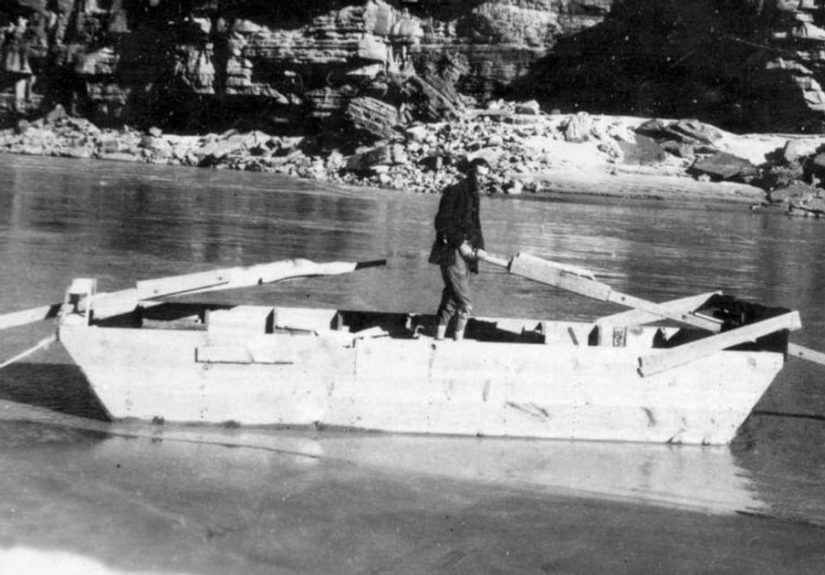
of the Hydes, their boat, and the search that followed. Seeing the scow at rest in the water, fully loaded and oddly peaceful, is unsettling. It
looks more like a boat waiting for passengers than the last frame of a tragedy. That visual disconnectboat present, people missingis part of
why the case still clings to the imagination.
Modern adventurers often process the Hyde mystery by contrast. They sign waivers, are handed a U.S. Coast Guard–approved life jacket, and listen
to a safety talk that mentions hand signals, rescue procedures, and what to do if they “go for a swim.” Then someone quietly notes that in 1928,
the Hydes launched without most of that safety netno satellite beacons, no emergency radios, no river permits requiring training and backup plans.
The canyon hasn’t changed much; what changed is how we prepare for it.
For many visitors, the story becomes part of their own memory of the Grand Canyon. They might not remember the technical name of every rapid, but
they remember the honeymooners who chased a record and slipped into legend. Back home, when they flip through photos or tell friends about the
trip, they often mention Glen and Bessie Hyde in the same breath as sunsets, side canyons, and sore muscles. The unsolved disappearance adds a
thread of mystery to an already overwhelming landscape, reminding everyone that wild places still hold secrets, even in the age of GPS and
social media.
Conclusion: Love, Risk, And A Canyon That Keeps Its Secrets
The disappearance of Glen and Bessie Hyde sits at the crossroads of love story, adventure tale, and true-crime mystery. Two newlyweds pushed off
into one of the world’s most dramatic landscapes with big dreams and limited safety gearand the canyon never gave them back. Whether they were
lost to an unseen rapid, a hidden cliff, or something more human and complicated, we simply don’t know.
What we do know is that their story still echoes from campfires, museum exhibits, and trail signs. It warns modern adventurers to respect the
river, to prepare carefully, and to remember that even the most beautiful places demand humility. And it leaves us with a haunting image: a sturdy
wooden boat, floating quietly in a bend of the Colorado, waiting for two passengers who never return.
SEO Summary
meta_title: Grand Canyon Mystery: Glen and Bessie Hyde
meta_description: Discover the unsolved Grand Canyon disappearance of honeymooners Glen and Bessie Hyde, their daring river trip, and the lasting mystery.
sapo: On a chilly November day in 1928, newlyweds Glen and Bessie Hyde pushed their homemade boat into the Colorado River, hoping to set a Grand Canyon speed record and make Bessie the first woman to run the entire canyon. Weeks later, searchers found their scow floating upright with their supplies still on boardbut the couple had vanished without a trace. Nearly a century later, their story remains one of the canyon’s most compelling mysteries, inspiring books, podcasts, and late-night campfire debates about what really happened on their adventurous honeymoon.
keywords: Glen and Bessie Hyde, Grand Canyon disappearance, Colorado River mystery, honeymoon river trip, unsolved Grand Canyon case, Glen Hyde boat, Bessie Hyde story






 Close
Close