
Table of Contents >> Show >> Hide
- Why Paradoxes Hit So Hard
- The 26 Famous Paradoxes
- 1) The Liar Paradox
- 2) Russell’s Paradox
- 3) The Barber Paradox
- 4) The Grelling–Nelson (Heterological) Paradox
- 5) The Berry Paradox
- 6) Curry’s Paradox
- 7) The Knower Paradox
- 8) The Sorites (Heap) Paradox
- 9) The Ship of Theseus
- 10) The Ravens Paradox (Paradox of Confirmation)
- 11) The Unexpected Hanging (Surprise Exam) Paradox
- 12) Newcomb’s Paradox
- 13) The Prisoner’s Dilemma
- 14) The Monty Hall Problem
- 15) The Birthday Paradox
- 16) Simpson’s Paradox
- 17) The Allais Paradox
- 18) The Ellsberg Paradox
- 19) Braess’s Paradox
- 20) Hilbert’s Hotel (Infinity Hotel) Paradox
- 21) The Banach–Tarski Paradox
- 22) The Twin Paradox
- 23) The Grandfather Paradox
- 24) The Bootstrap Paradox
- 25) The Fermi Paradox
- 26) Olbers’ Paradox
- So… Are Paradoxes “Problems,” or Are We the Problem?
- Paradox Encounters: 7 Real-Life “Wait…What?” Experiences (About )
- 1) The Party Trick That Humiliates Everyone: Monty Hall
- 2) The Office Dashboard That Lies With Honesty: Simpson’s Paradox
- 3) “How Is That Already 50%?”: The Birthday Paradox in the Wild
- 4) The “Heap” Argument You Accidentally Have Online
- 5) The Identity Crisis You Get From Upgrades
- 6) The “Why Would Anyone Do That?” Experience of Rational Choice Paradoxes
- 7) The Cosmic Version of “Seen, Left on Read”
- Conclusion
Paradoxes are the intellectual equivalent of stepping onto what looks like solid ground and discovering it’s actually a trapdoor.
One second you’re nodding along“Sure, that makes sense”and the next your brain is filing a formal complaint with management.
The best paradoxes don’t just confuse people; they expose a hidden assumption you didn’t even realize you were using.
In this guide, we’ll tour 26 famous paradoxes across logic, philosophy, math, probability, economics, and physicseach one a tiny mind-bender
that has made students, professors, and very confident people on the internet suddenly get a lot quieter.
Why Paradoxes Hit So Hard
A paradox usually starts with premises that feel reasonable. That’s the bait. Then it uses perfectly normal steps of reasoning (the switch),
and ends somewhere that seems impossible (the goat).
- Logical paradoxes can create contradictions (like “true” and “false” colliding at high speed).
- Probability paradoxes feel wrong because our intuition is terrible at counting invisible combinations.
- Philosophical paradoxes highlight fuzzy concepts like identity, knowledge, or “what counts as a heap.”
- Physics paradoxes often come from mixing everyday intuition with a universe that refuses to behave politely.
The 26 Famous Paradoxes
1) The Liar Paradox
“This sentence is false.” If it’s true, then it’s false. If it’s false, then it’s true. Congratulations: language just tied itself into a knot
and handed you the rope.
2) Russell’s Paradox
Consider the set of all sets that do not contain themselves. Does it contain itself? Either answer breaks the rules.
This paradox helped force modern mathematics to get serious about foundations.
3) The Barber Paradox
A barber shaves all and only those men who do not shave themselves. So… does the barber shave himself?
It’s a “real-life costume” version of Russell’s paradoxfunny until you realize the barber can’t exist as described.
4) The Grelling–Nelson (Heterological) Paradox
Some adjectives describe themselves (“English” is English). Others don’t (“long” isn’t long).
Now ask: is the word “heterological” heterological? Whichever answer you pick, it flips on you like a prank chair.
5) The Berry Paradox
“The smallest positive integer not definable in under eleven words.” That phrase defines it… in under eleven words (depending how you count),
which creates a paradox about definition, language, and sneaky self-reference.
6) Curry’s Paradox
A sentence says: “If this sentence is true, then unicorns exist.” Some logical systems let that snowball into proving almost anything.
It’s a warning label for certain styles of “if-then” reasoning.
7) The Knower Paradox
“This sentence is not known.” If you know it, it’s false. If you don’t know it, it might be true.
It’s the Liar Paradox wearing a trench coat and sneaking into epistemology.
8) The Sorites (Heap) Paradox
One grain of sand isn’t a heap. Adding one grain doesn’t seem like it could magically create a heap.
Yet keep adding grains andsurpriseyou clearly have a heap. So where’s the boundary, and why is it so slippery?
9) The Ship of Theseus
Replace one plank at a time until every plank is new. Is it still the same ship?
Now rebuild the original planks into a shipwhich one is the real Ship of Theseus? Identity starts sweating.
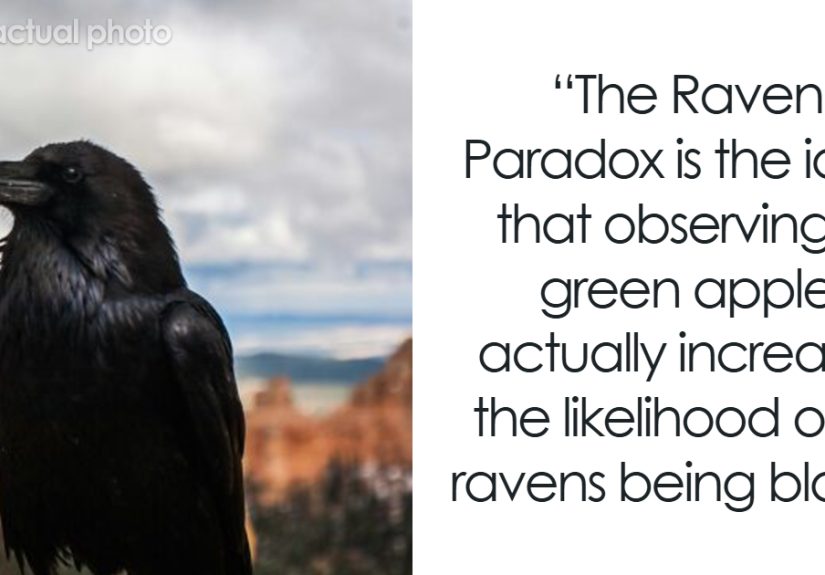
10) The Ravens Paradox (Paradox of Confirmation)
“All ravens are black” is logically equivalent to “All non-black things are non-ravens.”
So does observing a green apple (a non-black non-raven) somehow confirm something about ravens? Your common sense says no; logic says “kind of.”
11) The Unexpected Hanging (Surprise Exam) Paradox
A judge says you’ll be executed next week on a day you won’t expect. You reason it can’t be the last day… then the second-to-last… until you conclude
it can’t happen at all. Then it happens, and your logic sits in the corner rethinking its life choices.
12) Newcomb’s Paradox
Two boxes, one predictor, and a choice that pits “dominance reasoning” against “expected value reasoning.”
People split almost evenly on what a rational person should dobecause it forces you to decide what “rational” even means.
13) The Prisoner’s Dilemma
Two rational prisoners, two choices, and a result that punishes trust. If both “do the smart thing,” both can end up worse off than if they cooperated.
It’s a paradox of individual rationality versus group outcomes.
14) The Monty Hall Problem
Pick one of three doors. The host reveals a goat behind another door. Do you switch?
Intuition screams “it’s 50/50!” but the math says switching doubles your oddsmaking this one of the most famous probability faceplants ever.
15) The Birthday Paradox
In a group of just 23 people, the chance that two share a birthday is over 50%.
It feels impossible until you realize the number of pairs grows fastyour brain counts people; probability counts pairings.
16) Simpson’s Paradox
A trend appears in multiple groups, but reverses when you combine them.
It’s not magicit’s confounding variablesbut it can make honest data look like it’s running a con.
17) The Allais Paradox
Many people violate expected utility theory in consistent, predictable ways when certainty is involved.
In other words: your preferences can be stable, reasonable, and still “break” a tidy mathematical model of rational choice.
18) The Ellsberg Paradox
Given a choice between a known probability and an unknown one, people usually prefer the known optioneven when the expected payoff could match.
It highlights ambiguity aversion: we dislike not knowing what we don’t know.
19) Braess’s Paradox
Adding a new road can make traffic worse. Yes, worse.
When drivers selfishly optimize their own commute, the network can settle into a slower equilibriumlike a group project where everyone “helps” at once.
20) Hilbert’s Hotel (Infinity Hotel) Paradox
A hotel with infinitely many occupied rooms can still take more guests: move the guest in room 1 to room 2, room 2 to room 3, and so on.
Infinity doesn’t behave like a big number; it behaves like a different species.
21) The Banach–Tarski Paradox
In a certain mathematical sense, you can “cut” a solid sphere into a handful of bizarre pieces and reassemble them into two spheres the same size as the original.
It’s a theorem about sets and the axiom of choicenot a DIY craft project, unless your scissors are made of pure abstraction.
22) The Twin Paradox
One twin travels near light speed and returns younger than the twin who stayed home.
The “paradox” comes from mixing frames of reference; relativity’s time dilation is real, but your intuition keeps trying to file it under “illegal.”
23) The Grandfather Paradox
If you travel back in time and prevent your grandfather from having children, you erase your own existenceso who did the time traveling?
It’s the classic time-travel contradiction that makes writers reach for multiverses and physicists reach for aspirin.
24) The Bootstrap Paradox
You bring a book back in time and give it to its authorwho then publishes it. Where did the information originate?
It’s a causal loop with no clear starting point, like a mystery novel written by the plot twist itself.
25) The Fermi Paradox
The universe is huge, old, and packed with starsso where is everybody?
The tension between “aliens should be common” and “we see no evidence” fuels endless scientific and philosophical debate.
26) Olbers’ Paradox
If the universe were infinite, eternal, and filled uniformly with stars, the night sky should be bright everywhere.
The fact that it’s dark helped push us toward modern cosmology: an evolving universe with a finite age and expansion.
So… Are Paradoxes “Problems,” or Are We the Problem?
A good paradox is less like a trick question and more like an X-ray. It reveals the bones of your assumptions:
how you define truth, how you handle infinity, how you interpret probability, how you decide what “same” even means.
Sometimes the resolution is technical. Sometimes it’s philosophical. Sometimes it’s realizing you smuggled in a vague word like “heap” and expected logic not to notice.
Paradox Encounters: 7 Real-Life “Wait…What?” Experiences (About )
Paradoxes aren’t confined to dusty philosophy books or chalkboards that smell like panic. They show up in ordinary lifeoften disguised as
“common sense,” which is exactly how they get you. Here are a few experiences people routinely run into that feel paradoxical, even when the underlying
logic is perfectly real.
1) The Party Trick That Humiliates Everyone: Monty Hall
Someone brings up the Monty Hall problem at a dinner party. Two minutes later, half the table is loudly defending “it’s 50/50,” while the other half is
doing napkin math like they’re trying to defuse a bomb. The funny part is that even after you show the correct reasoning, many people still feel it’s wrong.
That’s the experience of a veridical paradox: the answer is true, but your intuition refuses to sign the paperwork.
2) The Office Dashboard That Lies With Honesty: Simpson’s Paradox
A team looks at performance metrics. Department A improved. Department B improved. Then the combined company metric drops.
Cue confusion, blame, and a sudden interest in “data literacy.” Simpson’s paradox appears in marketing funnels, medical stats, admissions data,
and anywhere grouping choices matter. The experience is unsettling: you didn’t miscalculateyour aggregation did.
3) “How Is That Already 50%?”: The Birthday Paradox in the Wild
In classrooms (and surprisingly often at weddings), someone asks how many people it takes for a shared birthday to become likely.
When “23” hits the room, you can almost hear the gears grind. The lived experience is realizing probability isn’t counting people; it’s counting pairings.
Your brain wants a neat, linear story. Combinatorics shows up with a forklift.
4) The “Heap” Argument You Accidentally Have Online
Someone posts, “At what point is it cheating?” or “When is someone officially rich?” or “What counts as bald?”
Hundreds of comments later, you’ve built the Sorites paradox out of pure opinions. The experience here is discovering that vague boundaries aren’t just
annoyingthey can break certain forms of reasoning. We rely on fuzzy categories daily, then act surprised when they behave… fuzzy.
5) The Identity Crisis You Get From Upgrades
You replace your phone’s battery, screen, and case over time. You swap parts on a car. You renovate a house room by room.
Eventually you look around and think, “Is this still the same thing?” That’s the Ship of Theseus experience, except with receipts and warranty paperwork.
We treat identity as obvious until gradual change forces us to explain what we mean by “same.”
6) The “Why Would Anyone Do That?” Experience of Rational Choice Paradoxes
People buy insurance for tiny risks, ignore huge ones, and prefer a sure $50 over a risky $100 even when the expected value favors risk.
The Allais and Ellsberg paradoxes show up whenever certainty and ambiguity enter the chat. In real life, it feels like people are inconsistent
but often they’re expressing stable human priorities that don’t fit a single elegant formula.
7) The Cosmic Version of “Seen, Left on Read”
The Fermi paradox is the late-night, staring-at-the-sky experience: with so many stars, shouldn’t there be signs of other civilizations?
The unsettling feeling isn’t just scientific; it’s emotional. Either life is rarer than we hope, or the universe is stranger than we can currently detect,
or something about “civilizations” and “signals” doesn’t work the way our imagination assumes.
The common thread in these experiences is that paradoxes don’t merely confuse youthey spotlight the gap between the world and the shortcuts your brain
uses to navigate it. And honestly, that’s kind of the point. Paradoxes are not here to make you feel dumb; they’re here to remind you that “obvious”
is not the same thing as “true.”
Conclusion
If you’ve felt confused while reading this list, welcome to the clubmembership is open to everyone, especially smart people.
Famous paradoxes endure because they reveal something deep: the limits of language, the quirks of probability, the traps of self-reference,
and the ways our intuition gets bullied by infinity. The win isn’t “never being confused.” The win is learning to enjoy the moment your assumptions get caught.







 Close
Close