
Table of Contents >> Show >> Hide
- What Is the Volume of a Pyramid?
- Way 1: Use the Standard Pyramid Volume Formula
- Way 2: Find the Base Area First, Then Apply the Formula
- Way 3: Use Comparison, Decomposition, or Slicing to Understand the Formula
- Common Mistakes When Finding the Volume of a Pyramid
- Why This Formula Matters in Real Life
- Final Thoughts on the 3 Ways to Calculate the Volume of a Pyramid
- Experiences Related to Calculating the Volume of a Pyramid
If the phrase volume of a pyramid makes you want to fake a Wi-Fi outage, take a breath. This topic is much friendlier than it looks. A pyramid may seem dramaticvery pointy, very mysterious, very “ancient civilization energy”but the math behind it is surprisingly tidy. Once you understand the relationship between the base, the height, and that famous one-third factor, the whole thing stops feeling like geometry and starts feeling like a well-organized recipe.
In this guide, we’ll walk through three ways to calculate the volume of a pyramid. The first is the standard shortcut everybody learns. The second is the practical method you use when the base area is not handed to you on a silver platter. The third is the deeper, smarter approach that explains why the formula works in the first place. Along the way, we’ll cover examples, common mistakes, and a few real-world situations where pyramid volume actually matters.
By the end, you won’t just know the formula. You’ll know how to use it confidently, explain it clearly, and avoid the classic blunders that turn a simple problem into mathematical soup.
What Is the Volume of a Pyramid?
The volume of a pyramid is the amount of three-dimensional space inside it. Think of how much sand, water, packing material, or imaginary treasure could fit inside the solid. Because volume measures space, the answer is always written in cubic units, such as cubic inches, cubic feet, or cubic centimeters.
A pyramid has one base and triangular faces that meet at a single point called the apex. The base can be a square, rectangle, triangle, or another polygon. That matters because the base shape affects how you find the base area, and the base area is the star of the show in the volume formula.
Way 1: Use the Standard Pyramid Volume Formula
The fastest and most common method is the standard formula:
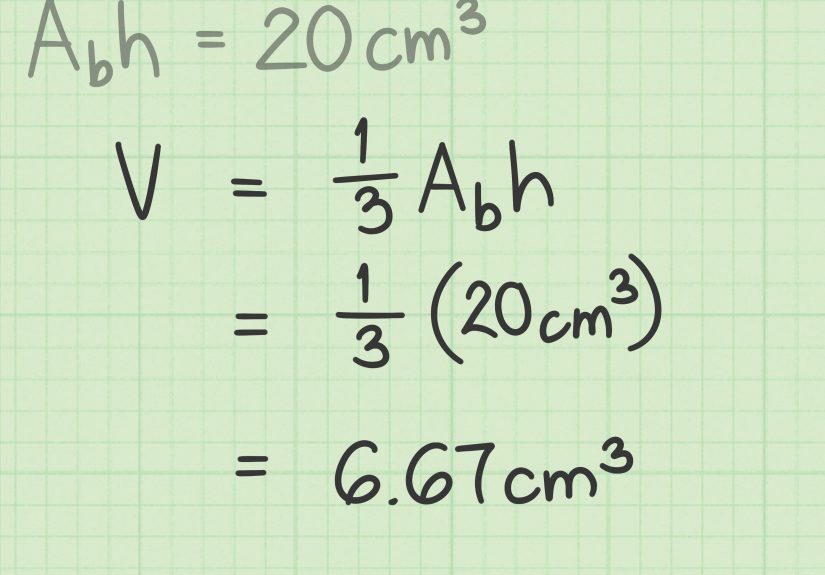
Volume = (1/3) × base area × height
Or, written more compactly:
V = (1/3)Bh
Here’s what the symbols mean:
- V = volume
- B = area of the base
- h = perpendicular height from the base to the apex
This method is perfect when the problem already gives you the base area. No extra detective work. No side quests. Just plug in the numbers and simplify.
Example 1: Square Pyramid with Base Area Given
Suppose a pyramid has a base area of 64 square feet and a height of 12 feet.
Use the formula:
V = (1/3)Bh
V = (1/3)(64)(12)
V = (1/3)(768)
V = 256 cubic feet
That’s it. Clean, quick, and painless. Geometry occasionally behaves itself.
Why the One-Third Matters
The biggest surprise for many learners is the 1/3. Without it, you’d be calculating the volume of a prism, not a pyramid. A prism with the same base area and height holds three times as much as the pyramid. That one-third factor is not decoration. It is the whole personality of the formula.
Way 2: Find the Base Area First, Then Apply the Formula
This is the method you’ll use most often in real homework and test problems. Usually, the problem does not give you the base area directly. Instead, it gives the dimensions of the base, and you have to calculate the area before using the pyramid formula.
So this method has two steps:
- Find the area of the base.
- Plug that area into V = (1/3)Bh.
The trick is knowing which area formula matches the base shape.
Example 2: Square Base Pyramid
Let’s say a pyramid has a square base with side length 9 inches and a height of 14 inches.
First, find the base area:
B = s² = 9² = 81 square inches
Now use the volume formula:
V = (1/3)(81)(14)
V = (1/3)(1134)
V = 378 cubic inches
Simple enough. Square base? Square the side. Then let the formula do the heavy lifting.
Example 3: Rectangular Base Pyramid
Now suppose the pyramid has a rectangular base that is 10 feet long and 6 feet wide, with a height of 15 feet.
First, find the base area:
B = l × w = 10 × 6 = 60 square feet
Then calculate the volume:
V = (1/3)(60)(15)
V = (1/3)(900)
V = 300 cubic feet
Notice the pattern? The base formula changes, but the overall volume formula stays exactly the same.
Example 4: Triangular Base Pyramid
Things get a little more interesting with a triangular base. Suppose the base triangle has a base of 12 centimeters and a triangle height of 8 centimeters. The pyramid’s height is 10 centimeters.
First, find the area of the triangular base:
B = (1/2)bh = (1/2)(12)(8) = 48 square centimeters
Now use the pyramid volume formula:
V = (1/3)(48)(10)
V = (1/3)(480)
V = 160 cubic centimeters
This is a great reminder that the pyramid formula never asks what shape the base is. It only cares about one thing: the area of that base.
When This Method Is Best
Use this approach when the problem gives side lengths instead of base area. It’s especially useful for square pyramids, rectangular pyramids, and triangular pyramids, which show up all the time in geometry classes.
Way 3: Use Comparison, Decomposition, or Slicing to Understand the Formula
This third method is less about speed and more about understanding. It helps answer the question many students quietly ask: Why is the formula one-third of the base area times height?
There are a few smart ways to see it.
A. Compare a Pyramid to a Prism
If you build a prism and a pyramid with the same base area and the same height, the pyramid has exactly one-third the volume of the prism.
For example, if the base area is 90 square units and the height is 12 units, then the prism volume would be:
Prism volume = Bh = 90 × 12 = 1080 cubic units
The pyramid volume is one-third of that:
Pyramid volume = 1080 ÷ 3 = 360 cubic units
This comparison is one of the easiest ways to build intuition. A pyramid is like the “diet version” of a prism: same footprint, same height, less filling.
B. Decompose a Solid into Pyramids
Sometimes you can break a larger solid into congruent pyramids and use symmetry to prove the formula. One classic example uses a cube. If you connect the center of a cube to each face, the cube can be partitioned into six congruent pyramids.
Imagine a cube with side length 6 units. Its volume is:
Cube volume = 6³ = 216 cubic units
If the cube is split into six equal pyramids, each pyramid has:
216 ÷ 6 = 36 cubic units
Now check with the pyramid formula. One face of the cube is the base, so the base area is 6 × 6 = 36 square units. The height from the center of the cube to a face is 3 units.
V = (1/3)(36)(3) = 36 cubic units
Boom. Same answer. Geometry just showed its work.
C. Use Slicing or an Integral for Advanced Math
In more advanced classes, the volume of a pyramid can be derived by slicing it into many thin cross-sections. As you move from the apex down to the base, each slice gets wider. Because the side lengths change linearly, the slice areas change in a squared pattern. Adding infinitely many thin slices leads to the familiar result:
V = (1/3)Bh
This approach is especially helpful if you are studying calculus, Cavalieri’s principle, or geometric reasoning. It also explains why the formula works for both right pyramids and oblique pyramids, as long as you use the perpendicular height.
So while this third method may not be the fastest for a basic worksheet, it is the most powerful for true understanding.
Common Mistakes When Finding the Volume of a Pyramid
Let’s save you from the greatest hits of pyramid-related confusion.
1. Using Slant Height Instead of Height
The formula uses the perpendicular height, which is the straight-line distance from the apex to the base measured at a right angle. The slant height runs along a face and is usually used for surface area, not volume. Mixing them up is like using your shoe size to measure your refrigerator. Wrong tool, wrong day.
2. Using Perimeter Instead of Base Area
The formula is base area, not base perimeter. If you multiply the sides around the base incorrectly or add them together instead of finding area, the final answer will be nonsense wearing a math hat.
3. Forgetting the One-Third
This is the classic. Students correctly find the base area, correctly multiply by height, and then completely ghost the one-third factor. The result is always three times too large.
4. Forgetting Cubic Units
Area uses square units. Volume uses cubic units. Always. A pyramid with a volume of “160 cm” is not finished. It needs to be 160 cm³.
Why This Formula Matters in Real Life
You may not wake up every morning desperate to calculate pyramid volume, but the skill appears in more places than you’d think. Architects, engineers, builders, designers, and students all use volume reasoning to estimate materials, compare shapes, and model real objects.
Maybe it’s a pyramid-shaped skylight, a roof feature, a sculpture base, a decorative stone cap, a package design, or even a game-development model. In each case, volume helps answer practical questions: How much space is inside? How much material is needed? How heavy might it be? How does it compare with a prism of similar size?
So yes, this is math class. But it is also problem-solving with a pointy hat.
Final Thoughts on the 3 Ways to Calculate the Volume of a Pyramid
If you remember just one thing from this article, make it this: the volume of a pyramid is one-third of the product of its base area and perpendicular height. Everything else is just strategy.
Way 1 is your fastest option when the base area is already given. Way 2 is your practical everyday method when you need to calculate the base area first. Way 3 gives you the deeper understanding by comparing pyramids to prisms or by using slicing and geometric reasoning.
Once you see how these methods connect, pyramid problems become much less intimidating. The shape may look dramatic, but the math is surprisingly calm. And honestly, that feels like a fair trade.
Experiences Related to Calculating the Volume of a Pyramid
Anyone who spends time learning or teaching geometry starts noticing that pyramid volume problems create a very specific kind of confusion. At first, many students think the topic is harder than it really is because the shape looks complicated. A rectangular prism feels familiar. A cube feels safe. A pyramid looks like it belongs in a tomb full of traps and ancient warnings. The dramatic shape makes people assume the formula must be dramatic too. Then they discover it is just one-third of base area times height, and the room collectively relaxes.
One of the most common classroom experiences is watching someone calculate everything correctly and then forget to divide by three. It happens constantly. You can almost see the moment: confidence rises, numbers are multiplied, the answer is boxed, and then a teacher gently says, “You built a prism, not a pyramid.” It is such a classic mistake that many students never make it again after the first time. Apparently embarrassment is a memorable teaching assistant.
Another common experience shows up when learners work with diagrams. If the drawing includes a slanted edge, many people instinctively grab that number and use it as the height. It feels reasonable because it is right there, staring at you like it wants to help. But volume only cares about the perpendicular height. That realization becomes a turning point. Students begin to see that geometry is not just about plugging in numbers; it is about understanding what each measurement actually means.
Outside the classroom, pyramid volume pops up in surprisingly practical ways. Art students building display pieces, hobbyists making dice towers or terrain models, and designers sketching decorative tops for posts or columns all run into the same issue: they need to estimate material. A pyramid shape may look small, but volume calculations quickly reveal whether it needs a little resin, a lot of foam, or way more concrete than expected. That is usually when math stops feeling theoretical and starts saving money.
There is also a test-prep experience that many people share. Pyramid volume problems are often easier than they look, which means they can become confidence-builders during an exam. A student who learns to slow down, find the base area, use the true height, and divide by three suddenly has a reliable win on the page. In a subject where confidence matters, that kind of problem can change the mood of the whole test.
Perhaps the best experience related to this topic is the moment the formula finally makes sense. Not just memorizedunderstood. When someone sees that a pyramid is one-third of a matching prism, the rule stops feeling random. It becomes logical. And once math feels logical, it becomes much easier to trust, remember, and use again.





 Close
Close