
Table of Contents >> Show >> Hide
- Why Mirrors Make an Entryway Look Bigger
- Before You Hang Anything: A Quick Mirror Game Plan
- Mirror Size & Proportion: A Simple Cheat Sheet
- 51 Entryway Mirror Ideas That Visually Expand Space
- Common Mistakes That Shrink an Entryway
- Real-World Lessons: 500+ Words of Experience From Actual Entryways
- Conclusion
Your entryway has two jobs: welcome people in and send you out the door looking semi-organized. Mirrors are the cheat codethey bounce light, add depth, and make even a skinny hallway feel like it took a deep breath.
Below are 51 practical ideas (from “one big statement mirror” to “mirror wall, but make it classy”), plus placement rules that keep the look bright instead of chaotic.
Why Mirrors Make an Entryway Look Bigger
They boost brightness: Mirrors reflect windows, sidelights, and lamps, spreading light into corners that would otherwise feel cave-like.
They add depth: Reflections extend sightlines, so walls feel farther apart and hallways feel longer.
They fake architecture: Oversized mirrors can read like extra windows; mirrored panels can visually push boundaries outward.
They’re functional décor: A mirror is one of the few wall pieces that’s useful every single day.
Before You Hang Anything: A Quick Mirror Game Plan
Pick what you want the mirror to reflect
A mirror will faithfully reflect anythingincluding clutter. Aim it at a window, a light fixture, artwork, greenery, or a tidy console setup. If it reflects the coat pile, your entryway will feel “bigger”… and messier.
Hang it at human height
On an open wall, start with the center around eye level (often cited near 57–60 inches from the floor). Over furniture, keep the bottom edge roughly 7–10 inches above the surface so it feels connected, not floating. In entryways where you’re mostly standing (not lounging), you can nudge things slightly higherbut don’t send your mirror into the stratosphere.
Secure it like you mean it
Big mirrors need proper hardware (studs when possible, heavy-duty anchors when not). Avoid adhesive hooks for mirrors, and strap leaning floor mirrors so they can’t tip. If you’re renting, you can still go bigjust lean and secure.
Mirror Size & Proportion: A Simple Cheat Sheet
If mirrors are magic, proportion is the spell book. Here are guidelines designers use because they look balanced and help the space feel larger:
- Over a console: Aim for a mirror about two-thirds to three-quarters the width of the furniture. Too small looks lost; too wide can feel top-heavy.
- For narrow entryways: Tall, slim mirrors (or a vertical stack of two mirrors) emphasize height and keep the walkway visually open.
- For dark foyers: Go larger than you think you need. A bigger reflective surface captures more lightespecially when paired with a lamp or sconces.
- For high ceilings: Consider a taller mirror or a mirror plus an accessory above (like a small art piece) so the wall feels intentionally “filled,” not empty.
One more rule that’s surprisingly helpful: stand where guests will stand (right inside the door), then check what the mirror reflects. If it highlights a pretty view, great. If it spotlights the recycling bin, rotate the plan.
51 Entryway Mirror Ideas That Visually Expand Space
A. Big Mirrors, Big Illusions
- Lean an oversized floor mirror. Tuck it behind a slim bench so it reads intentional and adds instant depth.
- Mount a full-length mirror near the door. Practical for outfit checks and it visually “stretches” the wall.
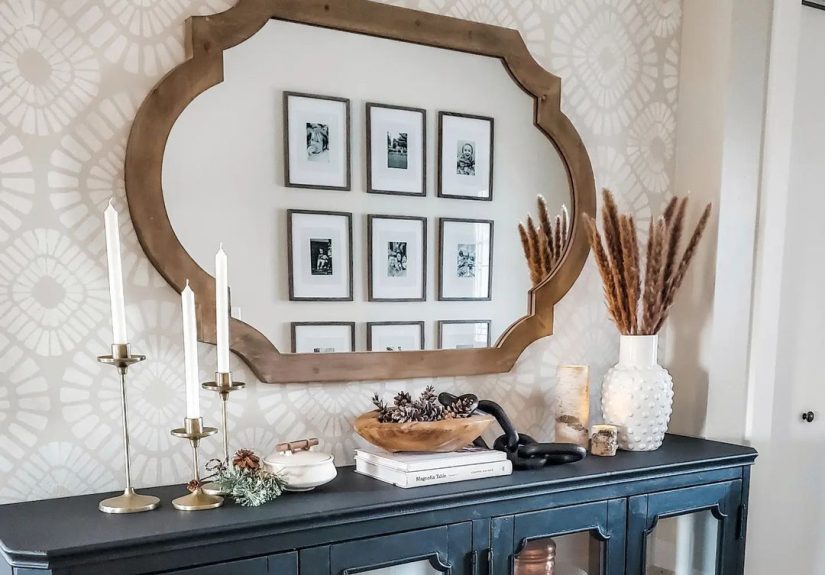
- Choose an extra-wide mirror above a console. Wide reflections make narrow foyers feel broader.
- Go tall with an arched mirror. The curve softens sharp angles while the height lifts the space.
- Try a narrow vertical mirror. Perfect for tight corners where a chunky frame would crowd the path.
- Use a “fake window” grid mirror. It mimics another light source and makes walls feel lighter.
- Install one large mirrored panel. A single clean plane can make a compact entry feel twice as deep.
- Flank the door with two tall mirrors. Symmetry calms the eye, and calm reads as “spacious.”
- Hang a mirror at the end of a hallway. The corridor reads longer (a classic small-space trick).
- Use mirrored closet or sliding doors nearby. If the entry shares a closet wall, reflective doors multiply light.
B. Shape Shifters
- Round mirror above a slim console. Circles break up boxy entries and feel welcoming.
- Oval mirror for vertical lift. It elongates subtly while staying traditional and soft.
- Sunburst mirror as a focal point. Great when the entry needs energy, not another rectangle.
- Organic wavy mirror. Adds movement and personality without visually “weighing down” the wall.
- Hexagon mirror. Modern geometry that reads crisp but still light.
- Convex mirror. Captures a wider viewhelpful when the entry is tiny.
- Three-panel (triptych) mirror. The angles bounce light around more dynamically than one flat pane.
- Pivot mirror. Adjust the angle so it reflects light (and not the messy corner).
- Frameless beveled mirror. Minimal edges keep tight entries from feeling busy.
- Antiqued mirror. Patina adds warmth and hides everyday smudges better.
C. Multiply the Effect (Without One Giant Mirror)
- Mini mirror gallery wall. Multiple small mirrors add sparkle and depth like functional art.
- Same frame finish, mixed shapes. You get variety while keeping the wall cohesive.
- Grid of identical mirrors. Repetition visually widens the wall (and looks very tailored).
- Mix mirrors and framed art. Mirrors brighten; art adds colortogether they feel curated.
- Stack two mirrors vertically. A quick height boost for short walls or low ceilings.
- Hang three mirrors in a row. Great above a long runner; it visually “pushes” side walls outward.
- Match mirror shapes for symmetry. Symmetry reduces visual noise, which helps small entries feel open.
- Reflect another mirror slightly. A little layered reflection adds depth without turning into a funhouse.
- Create a vintage “mirror wall.” Thrifted frames add texture while still increasing light.
- Add mirrored tiles as an accent strip. Use sparingly for shimmerthink “glow,” not “disco.”
D. Mirrors That Also Solve Drop-Zone Problems
- Mirror with a built-in shelf ledge. A tiny landing strip keeps essentials off the floor.
- Storage mirror cabinet. Hidden storage for sunglasses, keys, mail, and all the small chaos.
- Mirror over a floating shelf. Keeps the floor visiblean easy way to make space feel larger.
- Mirror above a slim console with drawers. Drawers hide clutter so the reflection stays “clean.”
- Mirrored console table. Reflective furniture visually disappears, making the entry feel lighter.
- Mirror as a backsplash behind décor. Doubles candlelight, flowers, and whatever you use as “welcome.”
- Bench + baskets under a mirror. A shoe solution that doesn’t look like a shoe problem.
- Mirror above a shoe cabinet. Slim storage plus wall depthgreat for tight foyers.
- Mirror integrated into a hall tree. Hooks + storage + reflection in one footprint.
- Key rail under the mirror. Stops the “where are my keys?” spiral before it starts.
E. Light-Boosting Pairings
- Flank the mirror with sconces. Even light reduces shadows and makes the wall glow.
- Backlit LED mirror. Adds soft brightnessespecially good in windowless entries.
- Console lamp beside the mirror. The reflection doubles the lamp’s cozy impact at night.
- Mirror opposite natural light. Bounce daylight from windows or sidelights deeper inside.
- Angle the mirror toward a dim corner. Small shifts can redirect light where you need it.
- Pair with reflective accents. Glass, polished metal, and glossy paint amplify the mirror effect.
F. DIY, Rental-Friendly, and Budget Wins
- Paint the frame to match trim. It looks built-in and makes the wall feel more “finished.”
- DIY an arched frame on a rectangle mirror. Instant architectural charm without custom millwork.
- Wrap a frame in rope or rattan. Adds texture while the mirror keeps the entry airy.
- Lean (don’t hang) and strap. Rental-friendly, moveable, and safer for busy households.
- Thrift, then group. A budget mirror wall can look designer with consistent spacing.
Common Mistakes That Shrink an Entryway
- A tiny mirror on a huge wall. Size up or group mirrors so the wall feels intentional.
- Reflecting clutter. Decide what you’re doubling before you hang anything.
- Hanging too high. Keep the reflection at eye level for standing (entryways aren’t sofa zones).
- Sketchy hardware. Heavy mirrors need anchors or studsno shortcuts.
- Overcrowding. One strong mirror + one smart landing zone beats five random pieces.
Real-World Lessons: 500+ Words of Experience From Actual Entryways
In theory, any mirror can “make a space feel bigger.” In real life, the mirror becomes the unofficial command center: the place where you realize you’re late, your dog looks betrayed, and your sunglasses have once again vanished into an alternate dimension. After watching how people actually live with entryway mirrors, a few patterns show up again and again.
Smudges are inevitable, so plan for them. The most-touched mirrors (full-length near the door, or anything hung low enough for kids) collect fingerprints, nose boops, and tiny mystery streaks. Antiqued mirrors and darker frames tend to hide day-to-day grime better than crisp frameless styles. If you love that sleek look, stash a microfiber cloth in the nearest drawer so you can do a 20-second “reset” before company arrivesand consider a small runner to reduce dust that loves to land on glass.
The best mirror reflects a routine, not just a room. People love entryway mirrors most when there’s a simple landing setup beneath: a slim console or shelf for keys, a tray that corrals pocket junk, and a spot for shoes. Without that, the mirror becomes a spotlight for clutter, and the “bigger” feeling disappears fast. Even a tiny floating shelf under a mirror can change the daily flow: drop keys, check hair, exit like a functional adult. Add one hook nearby and you’ve basically created a tiny transportation hub.
Think about who’s using the mirrorand from what height. In family homes, a single mirror hung purely for adult eye level can be frustrating for kids (or shorter adults) who only see foreheads. Two fixes show up often: a tall mirror that serves everyone, or a second smaller mirror mounted lower on the side wall. In pet homes, a low mirror can become a “nose art” gallery. If that’s your reality, choose a textured/antiqued finish or keep the bottom edge just a bit higher. Bonus: a tall mirror also makes it easier to spot shoe-lace issues before you step outside.
Glare can ruin the vibe. A mirror facing a strong light source can bounce harsh reflections into eyesespecially at night when porch lights and overhead fixtures are bright. That’s why many homeowners end up preferring side lighting (sconces) or a console lamp: it softens shadows, brightens faces, and keeps the entryway from feeling like a dental office. Warm bulbs and diffused shades help the mirror amplify light without the “spotlight interrogation” effect.
Leaning mirrors feel casual, but they still need rules. Floor mirrors are popular because they’re easy to move and look relaxed. But in everyday life, they can shift when bumped by a bag, vacuum, stroller, or an enthusiastic golden retriever. A simple anti-tip strap keeps the setup feeling effortlesswhile making it far safer. The same goes for mirrors near doors that swing wide; leaving a little clearance prevents accidental knocks.
The “best” placement changes with seasons. In winter, people crave brightnessmirrors that bounce lamp light are a lifesaver. In summer, mirrors that catch daylight (or reflect greenery outside) make the space feel fresh and airy. If you like to refresh your entryway without buying new furniture, keep one mirror as the permanent workhorse and rotate smaller accessories around it.
Conclusion
The fastest way to make an entryway feel larger is a mirror that’s sized well, hung at the right height, and aimed at something worth reflecting. Start with function (a last-look spot and a landing zone), then pick a style that fits your homearched, round, vintage, frameless, or full-on mirror wall. Bigger, brighter, and fewer last-minute sock crises.





 Close
Close