
Table of Contents >> Show >> Hide
If you want to understand a quieter, smarter, more soulfully Texan version of Dallas architecture, start with Max Levy. Not the Dallas of oversized gestures, shiny towers, and buildings that seem designed mainly to impress passing drones. The other Dallas. The one with filtered light, carefully framed trees, courtyards that cool the air, and rooms that make you exhale a little slower the moment you walk in.
Levy’s work has long occupied a special place in North Texas design culture. He is a modernist, yes, but not the chilly, look-how-expensive-my-rectangle kind. His architecture tends to be precise without being uptight, inventive without needing to yell about it, and rooted in climate, craft, and everyday life. In a city that can sometimes confuse “big” with “important,” Max Levy has built a career proving that restraint can be thrilling and that modest materials, used brilliantly, can feel positively luxurious.
An architect visit centered on Max Levy in Dallas is really a visit into a design philosophy. It is about how buildings can notice the weather instead of fighting it. It is about how light can become a construction material. It is about how a house on an ordinary suburban lot can suddenly feel observant, calm, and unexpectedly poetic. And yes, it is also about how a metal roof, a gravel court, and a few beautifully disciplined moves can outperform a truckload of decorative nonsense.
Who Is Max Levy?
Max Levy grew up in Fort Worth, studied architecture at the University of California, Berkeley, and USC, worked at Skidmore, Owings & Merrill in Chicago, then returned to Texas to work with the Oglesby Group before opening his own Dallas practice in 1984. That trajectory matters because it helps explain the unusual balance in his work: part formal discipline, part regional sensitivity, part artistic curiosity, and part practical Texas common sense.
Over the years, Levy has been celebrated as one of the leading residential architects in Dallas, earning honors that include the Texas Society of Architects’ O’Neil Ford Medal. Critics and peers consistently describe his buildings as profoundly crafted, deceptively simple, and capable of making places of distinction from humble circumstances. That last phrase may be the key to his entire career. Levy does not wait for a heroic site or a billionaire-sized commission to make good architecture happen. He can take the “normal” conditions of Dallas lifea narrow lot, five existing trees, a quiet church corner, a suburban streetand turn them into design opportunities.
Why Dallas Is the Right Place to Read His Work
Dallas is an ideal setting for Levy’s architecture because the city is full of contradictions. It is sprawling yet intensely image-conscious. It has a strong modernist legacy but also a habit of replacing good buildings with larger ones that have all the charm of a luxury spreadsheet. Within that landscape, Levy’s work reads almost like a counterargument. His buildings do not ignore Dallas conditions; they answer them.
North Texas climate is no joke. Heat, glare, sudden storms, bright skies, and long warm seasons all demand real architectural intelligence. Levy’s work has often been praised for relying on traditional formal responses to Texas weather. That means shade is not an afterthought. Breezes matter. Roofs, trellises, porches, courtyards, monitors, and carefully controlled glazing are not decorative tricks. They are part of the building’s actual intelligence.
This is one reason his work feels so grounded in place. He is not importing a generic international style and plopping it onto a Dallas lot like a design souvenir. He is making modern architecture that behaves like it belongs here.
The Signature Max Levy Vocabulary
1. Light as a living material
One of the most repeated observations about Levy’s work is his fascination with light. The Texas Society of Architects once described light as first among his tools, noting how he channels it, shapes it, and gives it mystery. That sounds lofty, but in practice it means his buildings are rarely flat experiences. They shift over the course of the day. Walls catch moving shadows. Skylit spaces become softer or sharper depending on the hour. Openings do more than provide illumination; they choreograph awareness.
That interest shows up across different project types. In the Saint Michael and All Angels Columbarium in Dallas, Levy organized three courts around the atmosphere itself: wind, rain, and light. Mirrors pull the sky into the walls, a bronze sail acts as a wind vane, and the entire structure turns natural phenomena into part of the emotional experience of the place. In other words, he makes weather feel almost ceremonial. That is a rare talent.
2. Modest materials, elevated by detail
Levy has also been admired for his inventive use of plainspoken materials: metal, masonry, glass, framing, and industrial components deployed with uncommon care. Remodelista once highlighted his innovative use of low-cost, industrial elements such as MDF cladding, battleship linoleum, and even hardware-store-style pendant lighting. In lesser hands, that mix could turn into a bargain-bin design experiment. In Levy’s hands, it becomes elegant because the composition is so disciplined.
The lesson here is not “cheap materials are cool.” The lesson is that materials become beautiful when proportion, alignment, and restraint are doing the heavy lifting. Levy’s buildings often look expensive because they are carefully thought through, not because they are overstuffed with luxury finishes trying to compensate for weak design.
3. Nature brought close, not merely admired from indoors
Levy has said that architecture can reframe our awareness of nature in ways that bring relief to hectic lives. That sentence may sound like something you would find embroidered on a tasteful pillow, but his buildings actually back it up. Trees, sky, rain, shadows, breeze, and planted courts are not scenery in his work. They are participants.
Look at his Greenway Parks house in Dallas. The design was organized around preserving five mature oak trees, and Levy described how respecting them also meant arranging the floor plan so interior views could enjoy each one. The result was not just tree protection in a technical sense; it was a house composed around the experience of living with those trees. That is a meaningful difference. One approach checks a box. The other changes the architecture.
Projects That Help Explain Max Levy in Dallas
Color Clock House at Urban Reserve
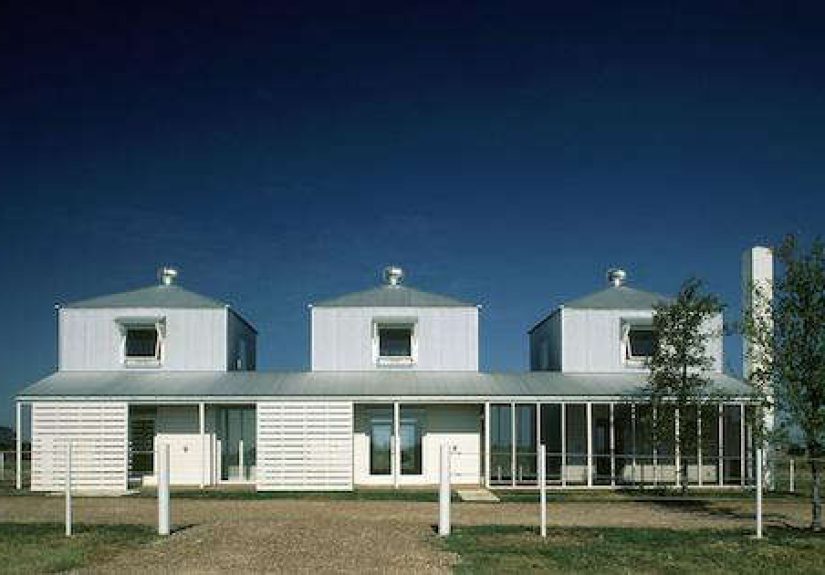
Dallas architecture watchers still point to Color Clock House as one of those Max Levy moments you cannot quite forget. In Architectural Record’s coverage of Urban Reserve, the house is described as being topped by five colorful light monitors oriented in different directions. That one move tells you a lot about Levy. It is playful, yes, but it is also climatic and spatial. It turns the roofline into a device for capturing light and distinguishing time, almost like a tiny observatory hiding in a neighborhood.
Urban Reserve itself was conceived as a community for people passionate about modern architecture, and Levy’s contribution fit perfectly. The house was contemporary without being cold, expressive without being chaotic. It showed how a speculative modern neighborhood could still contain buildings with genuine personality.
Merrilee Lane
If you want a master class in how to make a tight suburban lot feel spacious and alive, Merrilee Lane deserves your attention. Texas Architect described the project as two parallel whitewashed brick forms with simple shed roofs feeding a delicately detailed system of gutter, downspout, and runnel. Rainwater is directed into a gravel courtyard that separates the two wings, where crape myrtles and a transparent corridor turn the gap into the emotional center of the house.
That is classic Levy. He does not merely place rooms on a lot. He composes voids. The courtyard is not leftover space; it is the point. It organizes movement, brings light into the interiors, and transforms a typical residential parcel into something much more attentive and memorable.
The Greenway Parks House
The Greenway Parks residence is another excellent example of Levy’s nature-first planning. Built around existing oak trees, it pairs large windows and natural materials with a rooftop screen porch tucked into the canopy. That porch detail is particularly telling. Many architects would stop at “great view.” Levy added a room-like outdoor retreat that lets residents actually inhabit the treetops rather than simply admire them from climate-controlled safety.
The home’s palette of white oak floors and honed limestone also shows his preference for materials that age with dignity. Nothing screams for attention, yet the whole composition feels deeply considered. It is modern architecture with manners.
Saint Michael and All Angels Columbarium
This project may be the clearest statement of Levy’s poetic side. Set beside a Dallas church, the open-air brick columbarium turns mourning into a sequence of elemental experiences. Wind becomes visible. Rain is collected and given ritual presence. Mirrors bring the sky into the niches. The structure is calm, modest, and deeply affecting.
Importantly, it is not solemn in the heavy-handed way memorial architecture can sometimes become. Instead, it is tender and observant. Even the benches are positioned so visitors sit with a niche rather than confront it. Levy’s architecture here does something difficult and generous: it creates stillness without turning stiff.
House at Wind Point
Although outside Dallas proper, House at Wind Point helps decode Levy’s thinking for anyone studying his Dallas work. Architectural Record described how he broke the home into a series of smaller buildings to avoid harming a wooded site and minimized disturbance by using concrete piers with virtually no site grading. Only one tree had to be cut down.
That strategy reveals the practical backbone behind the poetry. Levy is not romantic about landscape in an abstract way. He is willing to let ecological sensitivity reorganize the entire plan. That is why his houses often feel so settled in their sites. They are not imposing order from above; they are negotiating with what is already there.
The “Martini Deck” House and the Art Lovers’ Home
Dwell has featured Levy homes in Dallas that showcase another side of his work: the ability to make domestic life feel both artful and relaxed. One residence became famous for a cylindrical entry clad in raw galvanized sheet metal and a tiny “martini deck” perched on top. Another, designed for art lovers in Turtle Creek, featured Venetian plaster walls, a custom art-display system, and a courtyard-centered plan.
What connects these houses is not a repeated look but a repeated attitude. Levy gives every project a distinctive twist, yet the underlying concerns stay consistent: choreographed movement, natural light, careful detailing, and a refusal to let daily life become visually dull. His houses are not trying to be magazine spreads twenty-four hours a day. They are trying to make living feel richer.
What Makes a Visit to Max Levy’s Dallas So Memorable?
An architect visit focused on Max Levy is memorable because his work rewards slow looking. At first glance, you may notice the clean lines, the brick, the metal, the glass, the beautiful restraint. But stay a little longer and the real pleasures begin to appear. A shadow lands exactly where it should. A corridor frames a tree trunk like a painting. A roof edge performs several jobs at once. A courtyard cools the mood of an entire house. The building starts acting less like an object and more like a conversation between climate, geometry, and everyday life.
That is why Levy matters in Dallas. He offers a model of architecture that is contemporary without being disposable, regional without being nostalgic, and refined without becoming precious. In a city that often celebrates the loudest thing in the room, his buildings keep proving the power of the well-composed pause.
Extended Reflections: The Experience of Max Levy’s Architecture in Dallas
To experience Max Levy’s work in and around Dallas is to discover that good architecture can alter your pace before you even realize it. You may approach one of his houses from a street lined with familiar North Texas scenerybroad lawns, parked cars, hard sun, a hint of suburban samenessand then something subtle happens. The façade does not showboat. It edits. It filters. It gives you just enough information to be curious. Suddenly you are paying attention.
That first impression is part of the experience. Levy’s work often resists the instant-gratification logic of so much contemporary residential design. There is no giant architectural drumroll. No desperate need to announce that something “iconic” is occurring. Instead, the building earns your attention through proportion, placement, and sequence. It is a little like meeting the smartest person at the party and realizing, after ten minutes, that they are also the funniest. The charm sneaks up on you.
As you move closer, details begin to surface. A trellis throws shadows that shift by the minute. A simple sheet of metal reveals a softness because of the way it catches sky color. Brick feels less like a heavy wall and more like a textured instrument for light. Levy seems unusually aware that materials are never static in Texas. They heat up, cool down, glow, darken, reflect, and weather. His buildings do not deny that drama; they quietly collaborate with it.
Then comes the part that lingers: the transition from outside to inside. Levy is especially good at thresholds. Entries are not merely doors attached to walls. They are moments of adjustment. A passage may narrow and then open. A court may appear before the living room does. A glimpse of sky may arrive before the full space reveals itself. You do not simply enter; you are prepared to enter. That sounds like a small distinction, but it changes how a building is felt in the body.
Inside, the experience often becomes less about square footage and more about awareness. This is one reason his houses can feel generous without being bloated. Rooms are not trying to overwhelm you with size. They are calibrated to draw your attention outward, upward, or across. A corridor becomes interesting because of where it lands your eye. A window matters because it frames an oak branch instead of treating the outdoors like a generic green blur. A courtyard becomes memorable because it is not ornamental filler but a genuine outdoor room with atmospheric weight.
There is also something distinctly Dallas about the emotional effect of Levy’s work. The city can be fast, image-driven, and relentlessly developmental. Against that backdrop, his architecture feels almost corrective. It suggests that success in design is not about excess but about intelligence. Not about bigger gestures, but better ones. Not about stuffing a project with features until it surrenders, but about making a few clear moves so well that the whole place hums.
That may be the deepest pleasure of an architect visit focused on Max Levy in Dallas. You leave with more than admiration for a talented designer. You leave with recalibrated expectations. You start to notice how many buildings ignore sun, trees, breeze, and human feelingand how much better architecture becomes when it does not. Levy’s work reminds visitors that modern design does not have to be cold, luxury does not have to be loud, and poetry does not have to float above practical life. In the best Max Levy projects, practicality is exactly what allows the poetry to land.
Conclusion
Max Levy’s Dallas is not the city of empty spectacle. It is the Dallas of disciplined beauty, climatic intelligence, and buildings that make ordinary life feel a little more awake. His work shows that Texas modernism can be warm, witty, and rooted in actual place. It also shows that architecture does not need a circus budget to be unforgettable. Sometimes all it needs is light, proportion, a few honest materials, respect for the site, and an architect who knows when to stop before the design starts showing off.
If you are planning an architect visit in Dallas, Max Levy is essential not because he is the loudest voice in the city, but because he may be one of the clearest. His buildings speak fluent Texas, fluent modernism, andbest of allfluent human life.







 Close
Close