
Table of Contents >> Show >> Hide
- Who Is MOS?
- The MOS Design Philosophy: Ordinary Forms, Unordinary Results
- Floating House: A Familiar House in an Unfamiliar Situation
- Afterparty at MoMA PS1: Cooling Down the Crowd
- House No. 10: The Courtyard as a Social Device
- Petite École: Small Scale, Big Lessons
- Element House and the Art of the Prototype
- Why MOS Matters in Contemporary Architecture
- Lessons Designers Can Learn from MOS
- Architect Visit Experience: What It Feels Like to Enter the MOS Mindset
- Conclusion: MOS and the Architecture of Becoming
- SEO Tags
Some architecture offices announce themselves with marble lobbies, monogrammed stationery, and conference rooms so quiet you can hear a mechanical pencil reconsider its life choices. MOS is not that kind of office. A visit to the world of MOS Architects feels less like entering a polished showroom and more like stepping into a living index of models, drawings, prototypes, furniture experiments, books, jokes, diagrams, and buildings that politely refuse to behave like ordinary buildings.
Led by Michael Meredith and Hilary Sample, MOS is a New York-based architecture and design studio known for making architecture that is playful without being unserious, intellectual without being allergic to everyday life, and experimental without floating away into academic fog. Their work moves across houses, schools, pavilions, exhibitions, objects, books, installations, and research. In other words, MOS treats architecture not only as a finished building but also as a way of thinking, drawing, testing, laughing, failing, revising, and occasionally asking, “What if a house could act like a diagram wearing a raincoat?”
This “Architect Visit: MOS” is a close look at what makes the studio influential: its small-office intelligence, its affection for ordinary forms, its interest in construction logic, and its ability to make architecture feel both strange and familiar. If traditional architecture often tries to look timeless, MOS seems more interested in the moment right before something becomes fixed. That moment is where the good mischief happens.
Who Is MOS?
MOS is the architecture practice of Michael Meredith and Hilary Sample, two architects whose work connects professional practice with teaching, publishing, and research. Meredith is closely associated with Princeton University, while Sample has taught at Columbia GSAPP and is known for her work on housing, maintenance, and the everyday responsibilities of architecture. Their academic lives are not separate from their buildings; they feed the studio’s design method like espresso feeds a deadline.
The office has received major recognition, including the Cooper Hewitt National Design Award in Architecture, the American Academy of Arts and Letters Architecture Award, and the Architectural League’s Emerging Voices honor. Those awards matter, but they do not fully explain MOS. The better explanation is found in the work itself: modest shapes made complicated, familiar types made unfamiliar, and practical projects that sneak in a theory seminar while still remembering where the door goes.
The MOS Design Philosophy: Ordinary Forms, Unordinary Results
One of the most interesting things about MOS Architects is their comfort with recognizable forms. Many of their houses look, at first glance, like children’s drawings of houses: pitched roofs, simple volumes, repeated silhouettes, clean outlines. But the simplicity is deceptive. MOS often begins with common architectural types, then stretches, multiplies, cuts, folds, aggregates, or relocates them until they begin to operate differently.
This is not minimalism in the “please do not touch the white sofa” sense. MOS’s architecture is more curious, more open-ended, and more materially alert. A pitched roof may become a structural idea. A courtyard may become the social engine of a house. A small pavilion may become a climate device. A school may become a kit of aluminum parts. A book may become a building’s cousin. In MOS’s hands, the ordinary is not boring; it is raw material.
Architecture as Research, Not Just Real Estate
MOS’s work frequently treats each project as a research question. How can a building be prefabricated and still feel specific to its site? How can a house create privacy without becoming a bunker? How can a temporary pavilion cool a crowd without pretending to be a permanent monument? How can architecture communicate through models, software, drawings, books, and objects as much as through walls?
This research-driven attitude makes MOS especially valuable for architects, students, and design lovers who want more than glossy images. Their projects invite close reading. They ask visitors to notice assembly, repetition, scale, climate, social use, and the humor hidden in architectural seriousness. MOS buildings do not simply say, “Look at me.” They say, “Look again.”
Floating House: A Familiar House in an Unfamiliar Situation
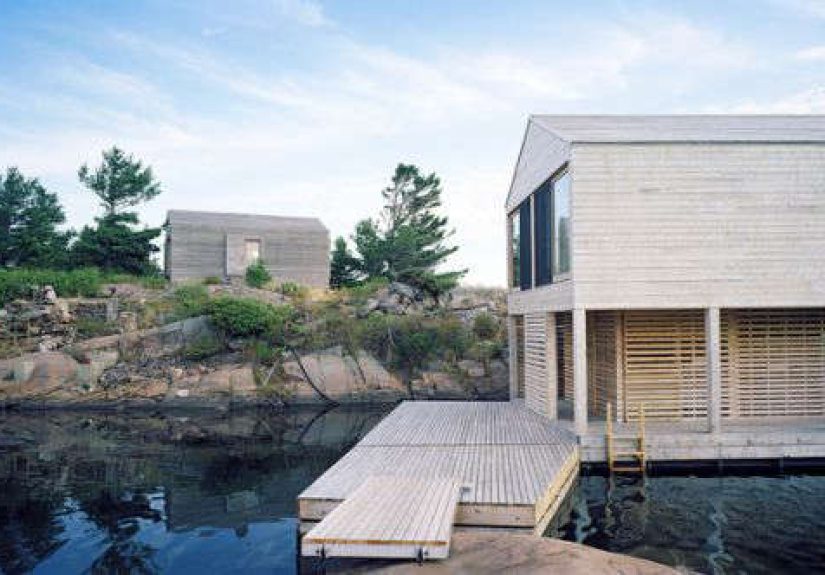
The Floating House on Lake Huron remains one of MOS’s most widely discussed projects, and for good reason. It takes a familiar house shape and places it in a condition where normal architectural assumptions start to wobble. Built for a remote island site, the house responds to the logistical challenges of construction, transportation, water, weather, and changing lake conditions.
Rather than forcing a conventional house onto a difficult site, MOS worked with the problem. The project used a floating steel pontoon structure, allowing the building to be fabricated in a more controlled setting and moved into position. The result is not a luxury object shouting at the lake. It is a compact, intelligent, slightly surreal house that seems to understand that nature is not a backdrop; it is the boss.
What makes Floating House memorable is the balance between archetype and adaptation. The pitched-roof form says “house” immediately. The floating base says, “Yes, but this house has read the site report.” It is practical and poetic at the same time, like a rain boot with a philosophy degree.
Afterparty at MoMA PS1: Cooling Down the Crowd
MOS’s 2009 MoMA PS1 Young Architects Program installation, Afterparty, shows another side of the studio’s thinking. Designed for the museum’s summer courtyard events, the pavilion was not merely a sculptural object. It was an atmosphere machine: a temporary environment shaped around shade, gathering, cooling, and social behavior.
The project used tall, chimney-like forms and rough materiality to create a setting that felt primitive, theatrical, and oddly intimate. Instead of chasing the slick futurism that often haunts temporary pavilions, MOS leaned into arches, domes, texture, and environmental effect. The project’s name also mattered. An afterparty is where the main event loosens its tie. MOS turned that idea into architecture, creating spaces for people to pause, talk, sit, and escape the heat.
For anyone studying temporary architecture, Afterparty is a useful example because it did not confuse spectacle with success. A pavilion has to do something. In this case, it cooled, gathered, framed, and changed the social tempo of a courtyard.
House No. 10: The Courtyard as a Social Device
House No. 10, often described as a house with a courtyard, demonstrates MOS’s fascination with aggregation. Instead of treating a house as a single clean box, the design gathers multiple house-like volumes around a central void. Each piece carries part of the domestic program, while the courtyard becomes the organizing force.
This approach makes the house feel both simple and complex. The repeated pitched forms are easy to understand, but their arrangement creates privacy, movement, outdoor connection, and changing views. It is the architectural equivalent of a small family reunion: everyone is related, everyone has a slightly different personality, and the courtyard is where the conversation happens.
House No. 10 also shows how MOS avoids the trap of form for form’s sake. The geometry is not merely visual branding. It shapes how people move, gather, retreat, and look outward. The design makes domestic life feel spatially loose rather than over-scripted.
Petite École: Small Scale, Big Lessons
Petite École, an open-air design school for young children in Versailles, France, reveals MOS’s interest in construction, pedagogy, and reassembly. The project is made from hundreds of aluminum pieces that were modeled, flattened, cut, folded, prefabricated, shipped, and assembled on site. It looks simple, but that simplicity hides a carefully choreographed fabrication process.
What makes the project especially compelling is its relationship to learning. A school for children should not feel like a sealed administrative container. Petite École suggests that education can happen in a light, open, adaptable structure where making and looking are part of the same experience. It is architecture as classroom, toy, kit, and lesson plan.
The project also captures one of MOS’s recurring strengths: making high-tech and low-tech feel like friends. Parametric files and hand-built models both matter. Digital precision and physical assembly both matter. The building does not worship technology; it uses it, then lets the final result feel approachable.
Element House and the Art of the Prototype
Element House, connected to the Museum of Outdoor Arts and the Star Axis land-art context in New Mexico, reflects another MOS theme: the prototype. The project has circulated through models, publications, and architectural discussion as a compact building system that explores sustainability, repetition, and modular assembly.
The idea of the prototype is central to understanding MOS. A prototype is not just an unfinished product. It is a way to think. It allows architecture to remain open, testable, and adjustable. In MOS’s universe, models are not miniature trophies; they are arguments. Drawings are not decorative paperwork; they are tools for thinking. Books are not afterthoughts; they are architectural sites of their own.
Why MOS Matters in Contemporary Architecture
MOS matters because the studio offers an alternative to two common extremes in architecture. On one side, there is corporate smoothness: buildings that look expensive, competent, and emotionally unavailable. On the other side, there is over-theoretical design: projects so concept-heavy they need a 40-page essay before anyone can find the bathroom. MOS sits in a more interesting middle ground.
The studio’s work is smart, but it is not afraid of use. It is experimental, but it pays attention to materials. It is playful, but it is not careless. It is theoretical, but it often begins with ordinary things: houses, courtyards, benches, classrooms, roofs, porches, sheds, pavilions. This gives MOS’s architecture a rare combination of depth and accessibility.
A Practice of Smallness
Another reason MOS feels relevant today is its interest in smallness. In a culture that often celebrates bigger buildings, bigger budgets, bigger renderings, and bigger egos, MOS shows the architectural power of smaller gestures. A small house can become a serious spatial study. A temporary pavilion can test environmental ideas. A book can challenge how architects represent people. A bench can rethink public space.
This does not mean MOS avoids ambition. It means ambition does not always need to arrive wearing a skyscraper costume. Sometimes the most influential architectural ideas are modest enough to fit on a table, in a courtyard, or under a large eave.
Lessons Designers Can Learn from MOS
1. Start With the Familiar, Then Complicate It
MOS often begins with recognizable forms. This is a powerful lesson for designers: originality does not require rejecting everything familiar. Sometimes the best move is to take a known type and ask better questions of it.
2. Let Constraints Become the Concept
The remote site of Floating House, the heat of the MoMA PS1 courtyard, the assembly logic of Petite École, and the domestic needs of House No. 10 all show how constraints can generate design intelligence. A constraint is not the enemy of creativity. It is creativity’s slightly annoying personal trainer.
3. Make Representation Part of the Work
MOS treats models, books, drawings, software, exhibitions, and installations as central parts of architecture. For students and young architects, this is a reminder that how a project is represented can shape how it is understood. A good model is not a decoration. It is a form of thinking with glue on its fingers.
4. Keep Humor in the Room
Architecture can be serious without becoming stiff. MOS’s project names, descriptions, and formal experiments often contain a dry wit. That humor does not weaken the work. It makes the work more human. Buildings, after all, are used by people, and people are wonderfully strange.
Architect Visit Experience: What It Feels Like to Enter the MOS Mindset
The most useful way to experience MOS is not to expect a single grand manifesto. Instead, imagine walking through a studio where every table holds a different kind of evidence: a paper model, a small object, a book proof, a structural idea, a housing study, a strange roof, a drawing of a person, a photograph of a courtyard, a rejected prototype that still looks suspiciously alive.
A visitor quickly notices that MOS does not separate “serious architecture” from the small acts that make architecture possible. The office’s world includes finished buildings, but also fragments, mockups, diagrams, and speculative work. This can be refreshing for anyone tired of architecture presented only as perfect final photography. In the MOS mindset, architecture is not born glossy. It is assembled, tested, doubted, revised, and occasionally rescued from a pile of foam, paper, and caffeine.
One experience related to studying MOS is the feeling that the projects are approachable at first, then more layered the longer you look. Floating House seems simple until you consider fabrication, transport, water levels, and site specificity. House No. 10 seems like a group of small houses until you understand how the courtyard reorganizes domestic life. Petite École seems like a lightweight pavilion until you see the intelligence of its prefabricated aluminum system. Afterparty seems like a fun pavilion until you realize it is also about climate, crowd behavior, temporary public space, and the social life of shade.
Another strong experience is discovering how much MOS values the “in-between.” Their best work often happens between categories: between building and object, research and practice, seriousness and humor, high-tech modeling and hand-built experimentation, ordinary form and strange outcome. That in-between quality makes the work feel alive. It resists being pinned down too quickly, which is inconvenient for lazy criticism but excellent for architecture.
For homeowners, MOS offers a lesson in how houses can be imaginative without becoming unlivable. Their residential projects suggest that a home does not need to rely on luxury clichés to feel special. A courtyard, an eave, a roofline, a repeated volume, or a careful relationship to the landscape can create richness. The drama comes from spatial intelligence, not from shouting materials across the room.
For students, MOS offers an even sharper lesson: do not treat design as a straight line from concept to rendering. Make models. Study ordinary buildings. Read. Write. Test assemblies. Think about maintenance. Pay attention to people. Let drawings be messy before they become precise. Most importantly, allow a project to be both intelligent and a little weird. The world has enough buildings that look like they were designed by a committee trapped in a glass elevator.
For practicing architects, MOS is a reminder that small offices can have large cultural influence. A studio does not need to become a corporate machine to produce important work. By connecting teaching, making, publishing, and building, MOS shows how architectural practice can remain nimble and critical. The office becomes not just a service provider but a laboratory for how architecture can be produced and discussed.
For general design lovers, visiting MOS through its projects is enjoyable because the work rewards curiosity. You do not need to know every architectural theory reference to appreciate a floating house, a courtyard house, a school for children, or a cooling pavilion. But if you do know the references, the projects give you more to chew on. MOS architecture works like a good meal with a strange ingredient: satisfying at first bite, more interesting after the second, and suddenly you are asking why your own porch is not doing more with its life.
The lasting experience of “Architect Visit: MOS” is that architecture can be disciplined without being dull. It can be funny without being frivolous. It can be small without being minor. It can use ordinary forms without producing ordinary results. MOS reminds us that the best architecture does not always arrive as a heroic object. Sometimes it arrives as a question, a model, a courtyard, a roof, a bench, a book, or a little school that can be taken apart and assembled somewhere else.
Conclusion: MOS and the Architecture of Becoming
MOS Architects occupies a distinctive place in contemporary design because the studio makes architecture feel like an active process rather than a frozen product. Its work is built from research, repetition, humor, constraint, and a deep interest in how ordinary forms can become extraordinary when handled with care. From Floating House to Afterparty, from House No. 10 to Petite École, MOS shows that design intelligence does not have to scream. Sometimes it whispers through a roofline, cools a courtyard, floats on pontoons, or gathers a family around an open center.
To visit MOS, even through its buildings and publications, is to encounter architecture in the act of thinking. The studio’s work asks us to look closely at the familiar and to notice what happens when a basic house shape, a simple schoolroom, or a temporary pavilion is pushed just far enough to become new. That is the charm of MOS: it makes architecture feel unfinished in the best possible way, always becoming something else.





 Close
Close