
Table of Contents >> Show >> Hide
- Why a Brushless Motor Thrust Stand Matters
- What the Stand Actually Measures
- How a Brushless Motor Thrust Stand Works
- Why the Data Is So Useful
- How to Read the Numbers Without Fooling Yourself
- The Big Catch: Static Thrust Is Not the Same as Flight
- Safety: Because Props Are Not Friendly Little Ceiling Fans
- What Makes a Great Thrust Stand Instead of a Fancy Guessing Machine
- Example Use Cases
- Brushless Motor Thrust Stands Turn Curiosity Into Engineering
- Experience and Lessons from the Bench
There are two kinds of RC builders in the world. The first group says, “This motor should be fine.” The second group says, “Let’s test it and see whether ‘fine’ means smooth flight or a dramatic smoke-based weather event.” A brushless motor thrust stand is made for the second group, which is another way of saying it is made for people who enjoy facts, repeatable numbers, and keeping expensive components from turning into cautionary tales.
At first glance, a thrust stand looks almost suspiciously simple: mount the motor, attach the propeller, add a way to measure force, and run the setup through a controlled throttle sweep. But that simple rig can tell you a lot. It can reveal how much thrust a motor-and-prop combination actually makes, how much current it draws, whether the battery sags under load, and whether a setup is efficient or just loud and overconfident. For model aircraft builders, drone hobbyists, makers, and anyone experimenting with electric propulsion, that is gold. Not pirate gold. Better. Spreadsheet gold.
Why a Brushless Motor Thrust Stand Matters
Brushless motors are wonderfully powerful and wonderfully easy to misunderstand. Product listings might tell you the motor’s Kv rating, recommended cell count, and maybe a few propeller suggestions. That helps, but it does not answer the real question: what happens when your motor, your prop, your ESC, and your battery all meet on the bench and decide whether they like each other?
That is where a thrust stand earns its keep. It replaces guesswork with measured performance. Instead of assuming a 5-inch tri-blade prop is “probably okay” on a particular setup, you can see whether it produces useful thrust efficiently or simply drags current out of the battery like a teenager emptying the refrigerator after school.
For aircraft design, this matters because propulsion is not just about making the prop spin. It is about matching the motor, propeller, voltage, and airframe goals. A setup for a lightweight trainer, a freestyle quad, and a heavy-lift experimental build will not want the same behavior. One might prioritize efficiency. Another might prioritize punch. A third might prioritize “please take off without sounding offended.” A thrust stand helps you sort all that out before the maiden flight becomes the final flight.
What the Stand Actually Measures
Thrust
The headline number is thrust, usually shown in grams, ounces, or newtons. This tells you the pushing force produced by the motor and propeller combination at a given throttle level. It is the number most people want first because it answers the classic question: how hard is this little angry fan actually pulling?
Current Draw
Current draw is the reality check. A setup that produces a lot of thrust but demands too many amps may overheat the motor, strain the ESC, or punish the battery. Peak thrust is fun, but surviving long enough to use it is also nice.
Voltage and Power
Good test data also tracks voltage under load and total power in watts. This lets you see battery sag, which is a sneaky villain in propulsion testing. A combo may look impressive at the first burst of throttle, then fade once the voltage dips and the party lights go out.
RPM
RPM adds context. Since Kv describes theoretical no-load revolutions per volt, actual loaded RPM helps show how the prop is really loading the motor. If the RPM is much lower than expected, that prop may be asking for more torque than the setup can deliver efficiently.
Efficiency
The smartest users do not stop at “more thrust equals better.” They look at efficiency, often in terms like thrust per watt. This is where the thrust stand becomes truly useful. A setup that makes slightly less peak thrust but does it with much better efficiency can be the better real-world choice, especially when flight time matters more than showing off on the bench.
How a Brushless Motor Thrust Stand Works
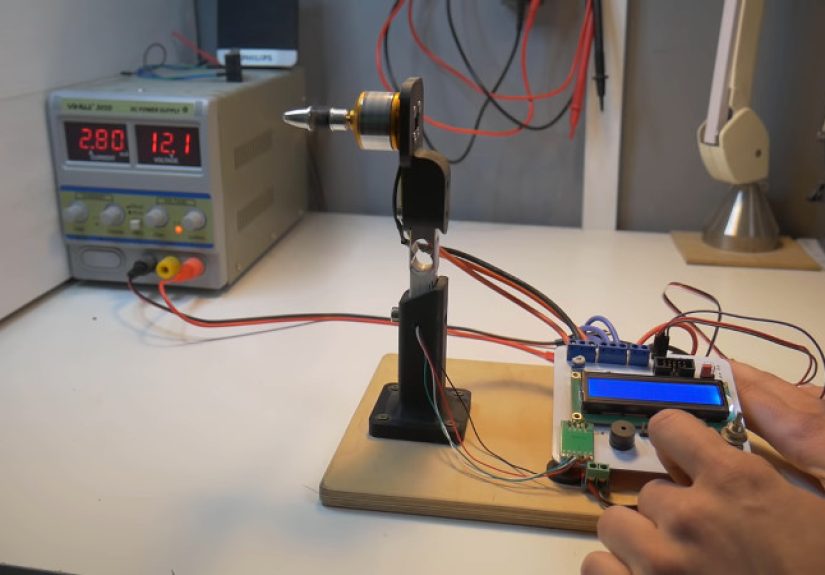
A typical DIY stand uses a rigid frame, a motor mount, a force sensor such as a load cell or strain gauge, and a controller that ramps throttle in controlled steps. Many hobby builds also add a small microcontroller, a display, data logging, and an ADC module such as an HX711 to turn tiny strain signals into readable numbers.
The principle is simple. When the motor spins the propeller, the prop pushes air backward and creates forward thrust. Since the motor is bolted to the stand, that force is transferred into the frame and measured by the sensor. The result is a direct reading of static thrust. Pair that with electrical measurements from a watt meter, ESC telemetry, or logging system, and you suddenly have a respectable little test lab instead of a pile of hope and LiPo batteries.
The better the stand, the better the data. Rigidity matters. Sensor calibration matters. Repeatability matters. If the frame flexes, the sensor drifts, or the battery state changes wildly between tests, the results become less “engineering” and more “performance art.”
Why the Data Is So Useful
A brushless motor thrust stand is useful because it helps answer practical decisions quickly and clearly.
- Choosing the right propeller: You can compare diameter, pitch, and blade count instead of relying on internet folklore.
- Protecting electronics: You can spot combinations that pull too much current before the ESC does the detecting for you in the loudest possible way.
- Comparing batteries: You can see how different packs behave under load and whether one sags more than another.
- Improving efficiency: You can find the setup that offers the best thrust-per-watt instead of just the most dramatic bench numbers.
- Validating manufacturer claims: Published specs are helpful, but measured results on your own system are better.
That last point deserves extra attention. Test data is especially valuable because real-world setups vary. Wire length, connector quality, battery condition, prop balance, and cooling can all influence results. A thrust stand does not eliminate every variable, but it helps you see the ones that actually matter.
How to Read the Numbers Without Fooling Yourself
The most common mistake is falling in love with the highest thrust number and ignoring everything else. That is like choosing a car entirely because the speedometer has ambitious dreams.
Instead, look at the whole curve. What happens at 25%, 50%, 75%, and 100% throttle? Does thrust rise smoothly? Does current spike early? Does voltage sag hard near the top end? Is the extra thrust at full throttle worth the huge jump in power draw?
Suppose one propeller delivers a bit more peak thrust but demands much more current to get there. Another propeller may produce slightly less top-end force but run cooler and more efficiently across the usable throttle range. For many aircraft, the second setup is the real winner. Bench testing gives you permission to stop worshiping peak numbers and start paying attention to performance that actually helps in flight.
Repeatability is another key clue. Run the same test more than once. If the numbers bounce around like a squirrel on espresso, something in the setup needs work. Good data should be boring in the best possible way.
The Big Catch: Static Thrust Is Not the Same as Flight
This part matters a lot. A thrust stand usually measures static thrust, meaning the propeller is working in still air rather than advancing through the air the way it does in flight. Static data is useful, but it is not the whole story.
In real flight, airflow changes the propeller’s operating conditions. The relationship between thrust, drag, RPM, torque, and efficiency shifts once the aircraft is moving. That means a setup that looks amazing on a stand may behave differently in the air. Static testing is excellent for comparison and screening, but it is not a substitute for flight testing or wind-tunnel-style dynamic analysis.
Think of static thrust data as a strong first draft. It tells you which combinations deserve attention and which ones deserve a polite “absolutely not.” It does not tell you everything about cruise efficiency, unload behavior, or full in-flight aerodynamic performance. But it gives you a far smarter starting point than blind trial and error.
Safety: Because Props Are Not Friendly Little Ceiling Fans
A brushless motor thrust stand is only useful if it does not try to launch a propeller across the workshop. Spinning propellers store energy, and high-RPM tests deserve respect.
Use a sturdy mount. Keep clear of the propeller plane. Inspect props before testing. Secure wires so nothing can wander into the blades. Use eye protection. Consider shields or remote operation for higher-power setups. And do not ignore recommended RPM limits for the propeller you are using. A perfectly good experiment can become a terrible idea very quickly when a prop is oversped, damaged, or badly balanced.
Also, never treat “it held together last time” as a safety protocol. That is not engineering. That is flirting with statistics.
What Makes a Great Thrust Stand Instead of a Fancy Guessing Machine
Calibration
If the sensor is not calibrated, the results are decorative. A proper stand should be zeroed and checked with known weights or forces before serious testing begins.
Consistent Test Conditions
Battery charge level, ambient temperature, prop condition, and throttle ramp timing should be kept as consistent as possible. Otherwise you are comparing one test against a different universe.
Clean Data Logging
Logging thrust, current, voltage, and RPM together is ideal. One number in isolation is interesting. Four synchronized numbers are useful.
Rigid Construction
A flexing stand can corrupt readings. If the structure moves in odd ways under load, your sensor may be measuring some combination of thrust and mechanical drama.
Example Use Cases
Imagine you are choosing between two propellers for a mid-size brushless setup. One prop gives higher peak thrust, but the current draw rises sharply near the top of the throttle range. The second prop makes slightly less thrust, but its current curve is smoother and the battery voltage stays healthier. If the aircraft is meant for longer flights, smoother handling, and lower heat, the second option may be the smarter pick.
Or imagine you are comparing 4S and 6S operation on similar motors with adjusted Kv. The stand may show that one setup reaches the desired thrust with lower current, while the other hits the target with more heat and more battery sag. Suddenly the choice is not about internet bragging rights. It is about measurable behavior.
That is why this kind of data matters so much. It helps builders make decisions based on evidence instead of tradition, marketing, or a forum comment from 2017 written by someone named TurboGoat42.
Brushless Motor Thrust Stands Turn Curiosity Into Engineering
At its best, a thrust stand is not just a test jig. It is a truth machine for propulsion setups. It shows whether a motor and propeller combination is efficient, excessive, underpowered, or simply mismatched. It helps prevent overheated electronics, disappointing performance, and wasted money. It also teaches a valuable lesson that applies far beyond RC aircraft: measuring something beats guessing almost every single time.
So yes, a brushless motor thrust stand provides useful data. Very useful data. The kind of useful data that can save a build, improve a design, and make a hobbyist feel like a backyard aerospace engineer with a healthy respect for spreadsheets and spinning blades. That is a pretty good combo.
Experience and Lessons from the Bench
Anyone who spends time around propulsion testing eventually learns that the stand tells two stories at once. The first story is numerical: thrust, watts, amps, RPM, efficiency. The second story is emotional: optimism, surprise, denial, then acceptance. The usual testing journey begins with confidence. You bolt a motor to the stand, install a prop that looked perfect on paper, and expect greatness. Then the numbers arrive and politely inform you that paper was being a little dramatic.
One of the most common experiences is discovering how much the propeller changes everything. A motor that feels lively with one prop can become sluggish and hot with another. Swap blade count, diameter, or pitch and the personality of the system changes instantly. That is why thrust stand sessions are so eye-opening. They remind you that the motor is not working alone. It is part of a relationship, and sometimes that relationship is healthy, while other times it is the electrical equivalent of two people who should absolutely not text each other anymore.
Another common lesson is that peak throttle often gets too much attention. During bench sessions, builders naturally stare at full power numbers because they are dramatic and easy to compare. But the more experience you gain, the more you begin to appreciate mid-throttle behavior. Many aircraft spend most of their useful life away from 100% throttle. If the system is smooth, efficient, and cool in the middle of the range, that often matters more than squeezing out one last heroic burst at the top. The stand helps reveal this by turning “feels good” into a pattern you can actually see.
Battery behavior is another teacher with a dry sense of humor. A pack that seemed strong on the charger can look far less confident under load. Bench testing makes voltage sag impossible to ignore. It also exposes the difference between a fresh, healthy pack and one that has lived a long, adventurous life. That experience alone can save a lot of confusion later, because a weak battery can make a good motor-and-prop combo look worse than it really is.
Then there is the issue of repeatability. Early tests often teach humility. Maybe the first run looks fantastic, the second looks odd, and the third looks like the stand has developed opinions. That usually sends you back to the basics: recheck calibration, confirm prop balance, tighten the mount, repeat the run with the same battery state, and verify that nothing is rubbing or shifting. In other words, the thrust stand does more than evaluate parts. It also improves your habits. It trains you to think like a tester instead of a guesser.
Perhaps the best experience of all is the moment when the data finally lines up with reality. A setup that looked efficient on the stand flies the way you hoped. The aircraft lifts cleanly, temperatures stay reasonable, throttle response feels crisp, and the landing does not include a mysterious smell. That is the reward. Not just bigger numbers, but better decisions. Over time, the stand becomes less of a gadget and more of a trusted advisor. It does not flatter you. It does not care about marketing hype. It simply tells you what the system is doing. In a hobby full of variables, that kind of honesty is incredibly valuable.





 Close
Close