
Table of Contents >> Show >> Hide
- What the 43.6% figure actually means
- Why the Bay Area is winning again
- The Bay Area is not the only game in town, but it is still the main stadium
- What this means for founders
- What this means for investors
- The hidden catch in the headline
- Experiences from the market: what this trend feels like on the ground
- Conclusion
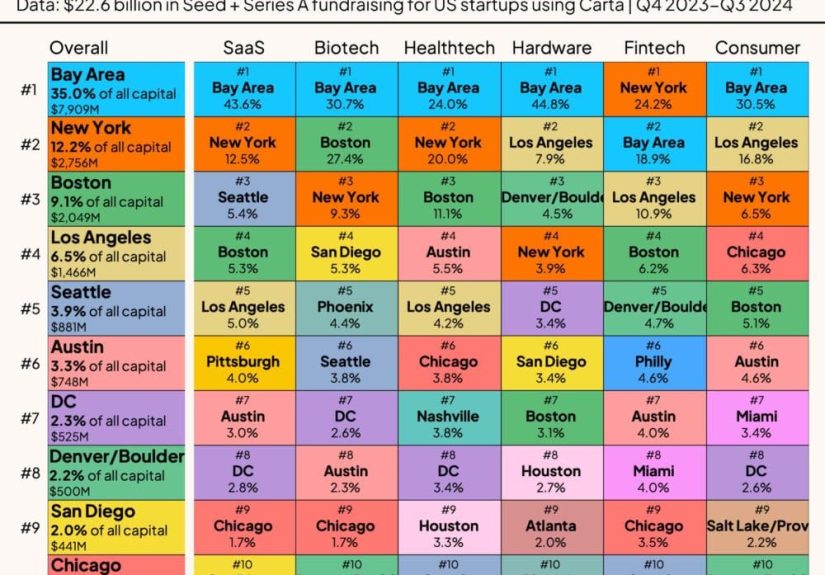
If venture capital had a favorite coffee shop, it would probably be in San Francisco, have terrible parking, and charge $8 for something with oat milk. That is the vibe behind one of the more eyebrow-raising startup stats in recent memory: according to Carta data cited by SaaStr and GeekWire, the Bay Area captured 43.6% of all SaaS funding over the four quarters from Q4 2023 through Q3 2024.
That number is big enough to make founders in every other U.S. city stare into the middle distance and whisper, “Cool, cool, cool.” But the headline matters because it says something bigger than “San Francisco is loud again.” It points to a real shift in how venture capital is being deployed, how AI is reshaping software, and why geography still matters in an industry that spent years telling everyone location no longer mattered.
To be precise, the 43.6% figure is not a timeless law of the universe. It reflects a specific Carta dataset from a specific period. Still, later reports suggest the same broad story held up: the Bay Area remained the country’s dominant venture hub, software stayed the biggest funding category, and AI intensified the concentration of capital into a smaller number of companies and ecosystems. In other words, this is not just a flashy stat. It is a map of where investors believe the next wave of software value will be created.
What the 43.6% figure actually means
The first thing to understand is that this headline is about share, not just size. It is not merely saying the Bay Area raised a lot of SaaS money. Of course it did. It is saying that nearly half of all SaaS venture funding in the measured period went to one metro region. That is a very different kind of dominance.
GeekWire’s coverage of the Carta ranking showed the Bay Area far ahead of every other major market, with New York at 12.5%, Seattle at 5.4%, Boston at 5.3%, and Los Angeles at 5.0%. That means the Bay Area was not just leading. It was lapping the field in software funding.
Even Carta’s broader geography work points in the same direction. In its regional and industry analysis, Carta noted that the West has historically captured a larger share of SaaS funding than its share of venture funding overall. That is not random. The Bay Area has long served as the most established U.S. software cluster, and it keeps benefiting from a flywheel of founders, operators, investors, customers, and talent who all keep running into each other at the same events, offices, and apparently very expensive dinner reservations.
So when people say the Bay Area is “back,” what they really mean is that software capital is concentrating there again in a way that looks less like a blip and more like a structural advantage.
Why the Bay Area is winning again
1. AI has poured rocket fuel into software investing
You cannot explain Bay Area SaaS funding without talking about AI. Not anymore. The old SaaS playbook was already evolving, but AI sped up the shift. Silicon Valley Bank reported that 48% of venture investment went to AI-powered companies in 2024. Carta later showed software remained the largest funding sector, and newer reporting tied a record share of venture dollars to AI startups.
This matters because many of the most heavily funded AI companies are effectively redefining the software stack. Some are model builders. Some are infrastructure plays. Some are enterprise application companies wrapped in AI language. But whatever label they use, they are pulling huge amounts of capital into the same ecosystem where software investors, cloud veterans, research talent, and platform partners are already concentrated.
That has made the Bay Area more than a geography. It has become a gravity well. Founders go there for talent density. Investors go there because the best companies are there. More companies move there because the investors are there. And around and around the carousel goes, except the carousel is powered by GPUs and term sheets.
2. Venture capital likes clusters, especially in a tighter market
When money is easy, investors can afford to be geographically adventurous. When the market gets more selective, pattern matching comes roaring back. Carta’s 2024 and 2025 market reports showed fewer rounds, more concentration, and a market that increasingly rewarded stronger companies with larger checks while leaving weaker ones behind. In short: quantity came down, but conviction did not disappear. It just got choosier.
That selectivity helps places with thick startup infrastructure. In a market where Series A deal counts can fall while valuations for the winners stay high, investors become more likely to fund teams that are easier to diligence, easier to reference-check, and easier to help after the deal closes. The Bay Area is built for exactly that kind of investing.
It is the ecosystem equivalent of buying from the aisle where you already know the brands. Is it always fair? No. Is it predictable? Very much so.
3. The best software founders still want speed, not just capital
Money is only part of the appeal. Strong SaaS founders often want fast hiring, warm intros to design partners, easier executive recruiting, and a faster route to enterprise credibility. The Bay Area still offers all of that at unusual scale.
That is why newer Carta reporting still showed San Francisco metro fundraising at remarkable levels in 2025. In Q3 2025, startups on Carta based in the San Francisco metro area brought in $8.1 billion in new venture funding, and Carta said the region out-raised New York, Boston, and Los Angeles combined in that quarter. Software was also still the largest funded sector on Carta in Q3 2025.
In plain English: the cluster effect did not fade. It got sharper.
The Bay Area is not the only game in town, but it is still the main stadium
None of this means brilliant software companies cannot be built elsewhere. They can. They are. And they will continue to be. New York remains powerful, especially where SaaS overlaps with fintech, media, and enterprise buying centers. Seattle benefits from cloud and infrastructure depth. Boston keeps punching above its weight in technical talent and enterprise software. Austin and Miami still matter. Los Angeles brings a different mix of consumer, commerce, and applied technology strengths.
But there is a difference between “strong ecosystem” and “dominant capital magnet.” The Bay Area is still the latter. Carta’s Q3 2024 report said Bay Area startups in SaaS raised about $11.8 billion over the previous 12 months, or roughly 40% of the region’s total venture funding. That is a staggering amount of software money concentrated in one place.
Even more telling, PitchBook and NVCA reported that in Q2 2025, the Bay Area, New York, Boston, and Los Angeles together accounted for 72.3% of venture deal value. The U.S. market is not evenly spread. It is hub-driven, and software investing is even more hub-driven than venture overall.
What this means for founders
If you are building a SaaS company outside the Bay Area, the takeaway is not “move immediately and lease a tiny apartment for the price of a medieval castle elsewhere.” The smarter lesson is more tactical.
First, founders should understand that access still compounds. If capital is concentrating geographically, then relationship-building matters more, not less. That could mean spending more time in the Bay Area even if you do not move there. It could mean building a customer advisory network that includes Bay Area operators. It could mean recruiting one senior leader with deep Silicon Valley credibility. Sometimes the shortest bridge to capital is not a relocation. It is a better network map.
Second, companies need to be clearer about whether they are traditional SaaS, AI-native software, or a hybrid. That distinction is increasingly important. Investors are rewarding software companies that can explain why AI makes their product more valuable, more defensible, or more efficient, rather than just more buzzword-compliant.
Third, the market is rewarding stronger proof earlier. Silicon Valley Bank’s enterprise software work highlighted rising investor focus on AI, while Carta’s fundraising data showed a market that still funds great businesses but does not spread money around as casually as it once did. Founders need sharper traction stories, tighter execution, and better capital efficiency. The old “we’ll figure out monetization after the Series A” energy is not exactly dead, but it is no longer getting invited to every meeting.
What this means for investors
For VCs, the 43.6% stat is both a comfort blanket and a warning label.
It is comforting because concentration can feel rational. The Bay Area still produces an outsized share of elite startup talent, technical breakthroughs, and enterprise software ambition. If you want exposure to the most competitive deals, that is where many of them are.
But it is also a warning because concentration can distort judgment. If every investor piles into the same ecosystem and the same themes, prices rise fast, competition intensifies, and the margin for error gets thinner. We have already seen that dynamic in AI-heavy funding markets, where megadeals and giant valuation step-ups can reshape the venture landscape almost overnight.
That means investors have to separate ecosystem strength from valuation discipline. The Bay Area can be the right hunting ground and still be the place where you overpay.
The hidden catch in the headline
There is one important caveat here: mega-rounds can make concentration look even bigger. Crunchbase reported that Bay Area-based companies alone reached $55 billion in Q1 2025, accounting for 69% of U.S. venture funding that quarter, largely because AI megadeals were doing what AI megadeals do: showing up with flamethrowers and rewriting every chart in sight.
That does not make the Bay Area story false. It just means founders and readers should be careful not to confuse capital concentration with universal opportunity concentration. Plenty of exceptional startups are still being built outside Northern California. Early formation is also more geographically dispersed than later-stage funding. Carta’s pre-seed data has shown that while California remains the top state, smaller ecosystems continue to capture meaningful shares of very early startup creation.
So yes, the Bay Area is dominating SaaS funding. But no, that does not mean every future winner must start on a block with three AI billboards and six founder dinners happening at the same time.
Experiences from the market: what this trend feels like on the ground
If you talk to founders, operators, angel investors, and startup recruiters right now, the experience behind this statistic feels surprisingly human. It often starts with a subtle change in behavior. A founder based outside California begins taking more meetings in San Francisco. An enterprise software startup that used to be fully remote starts hiring one or two executives in the Bay Area because that is where the product talent, design partners, or investor connections happen to be densest. A seed investor in another city starts saying some version of, “We can lead here, but for the next round you’ll probably want more Bay Area exposure.”
That is how concentration shows up in real life. Not as a giant banner over the Golden Gate Bridge, but as dozens of small decisions that nudge money and momentum in the same direction.
For SaaS founders, one common experience is the feeling that the market has become split in two. If your company has a credible AI angle, strong early customer love, and a team investors instantly recognize as capable of moving fast, you may find real enthusiasm. If your story sounds like solid but conventional B2B software, the reception can be much colder. Many operators describe the current market as one where “good” is not bad, but “good” is no longer especially fundable. The Bay Area amplifies that dynamic because investors there see so many ambitious AI-and-software pitches that the bar rises for everyone.
Recruiters and early employees are feeling it too. In concentrated ecosystems, talent moves faster because information moves faster. People hear about the promising startup before the job post is even live. A machine learning engineer leaves a big tech company on Tuesday, has four intros by Thursday, and is comparing startup offers by next week. That speed is hard to replicate in smaller markets, even if those markets have excellent talent. In software, timing matters, and the Bay Area still behaves like the fastest moving airport terminal in the country: crowded, stressful, expensive, and somehow still where the most flights connect.
Investors have their own version of this experience. Many say the Bay Area remains the easiest place to build conviction quickly. They can meet a founder, talk to three customers, check references, and compare the company to five similar startups in a matter of days. That speed reduces friction. In a cautious market, lower-friction investing wins.
At the same time, there is also a quiet pushback happening. Plenty of founders outside the Bay Area are intentionally choosing to stay put, build capital-efficient companies, and use the concentration trend to their advantage. They visit the Bay when needed, raise selectively, and keep teams where operating costs are lower. Their experience is less glamorous but often more durable. They know they may not win the “hottest startup dinner conversation” award, but they might win on retention, burn, and focus.
That is why the smartest reading of this trend is not “everyone must move.” It is “everyone must understand where the center of gravity is.” Once you know that, you can choose whether to lean into it, orbit around it, or deliberately build away from it. But pretending it does not exist is not a strategy. It is just very expensive optimism.
Conclusion
Carta’s 43.6% Bay Area SaaS funding figure landed like a thunderclap because it confirmed what many founders and investors were already sensing: software capital is clustering again, and the Bay Area is the biggest magnet. Newer market data only strengthens that interpretation. Software remains the largest venture category, AI keeps pulling more dollars into the sector, and investors continue to favor dense ecosystems where speed, talent, and trust travel fast.
The Bay Area does not have a monopoly on great SaaS companies. But it still has the deepest stack of advantages for getting them funded. For founders, that means being intentional about access. For investors, it means balancing ecosystem reality with valuation discipline. And for everyone else, it means admitting that geography never really died in venture capital. It just muted itself for a while, then came back with better branding and more GPUs.
Note: This article is based on current U.S. venture market reporting and industry data. Time-bound percentages and regional rankings may shift as additional funding rounds are reported and logged.






 Close
Close