
Table of Contents >> Show >> Hide
- From Sidewalk Trash to Energy Storage Material
- Why Cigarette Butts Are Such a Big Waste Problem
- How Can Cigarette Butts Become Battery Materials?
- The Battery Basics: Where the Carbon Fits
- Not Just Batteries: Supercapacitors Love Porous Carbon Too
- Why Cigarette Filters Are a Surprisingly Useful Starting Material
- The Real Processing Steps Behind the Magic
- Potential Benefits of Converting Cigarette Butts Into Batteries
- The Challenges Nobody Should Ignore
- Could This Replace Graphite in Electric Vehicle Batteries?
- Real-World Example: From Filter Fiber to Carbon Electrode
- Why This Topic Matters for the Circular Economy
- Experience Section: What Working Around This Topic Teaches You
- Conclusion: A Dirty Waste Stream With a Clean-Energy Possibility
Note: This article discusses cigarette butts as hazardous waste and as a research feedstock for advanced carbon materials. It does not encourage smoking or unsafe handling of littered cigarette waste. Any real collection or processing should be done only through proper waste-management systems, protective equipment, and laboratory-grade procedures.
From Sidewalk Trash to Energy Storage Material
Cigarette butts are tiny, ugly, and weirdly confident. They sit in gutters like they own the place. They show up on beaches, outside restaurants, near bus stops, in storm drains, and occasionally in places where no human can explain how they got there. For years, the usual story about cigarette butts has been simple: they are litter, they are toxic, and they are a massive environmental headache.
But a new question is giving this old problem a surprising twist: what if cigarette butts could become part of batteries?
That does not mean someone is stuffing a phone charger with old filters from a parking lot. The real science is more elegant and, thankfully, much cleaner. Researchers are studying how discarded cigarette filters can be transformed into carbon-rich materials used in energy storage devices such as lithium-ion batteries, zinc-ion batteries, lithium-oxygen batteries, and high-performance supercapacitors. In plain English: yesterday’s sidewalk nuisance may become tomorrow’s electrode material.
The idea sounds like science fiction with a recycling bin, but it is based on chemistry. Most cigarette filters are made from cellulose acetate, a plastic-like material derived from cellulose. Cellulose acetate contains carbon, and carbon is a superstar in battery technology. Graphite, one of the most common anode materials in lithium-ion batteries, is also a form of carbon. So researchers looked at cigarette filters and thought, “Disgusting, yes. Useless, maybe not.”
Why Cigarette Butts Are Such a Big Waste Problem
Before we turn trash into treasure, we need to admit the trash part is huge. Cigarette butts are consistently ranked among the most common types of litter found in cleanups. They are not harmless paper scraps. The filter is usually cellulose acetate, which breaks apart slowly and can shed microplastic-like fibers. Add nicotine, heavy metals, and other toxic residues from smoke, and the humble cigarette butt becomes less “small piece of litter” and more “tiny chemical burrito nobody ordered.”
Stormwater can carry cigarette butts from sidewalks into drains, rivers, lakes, beaches, and oceans. Once there, filters can fragment into smaller fibers rather than simply vanishing. Wildlife may mistake them for food, while water and soil can be exposed to leached chemicals. That is why cigarette butt recycling is not just a cute environmental side project. It is a serious waste-management challenge with public health, pollution, and cleanup-cost implications.
Traditional disposal methods do not solve the problem gracefully. Landfilling cigarette waste stores it rather than recovering value. Incineration may reduce volume but can create emissions-control concerns. Litter cleanup is expensive and reactive. Recycling, if done properly, offers a more interesting path: remove hazardous waste from the environment and convert part of it into useful material.
How Can Cigarette Butts Become Battery Materials?
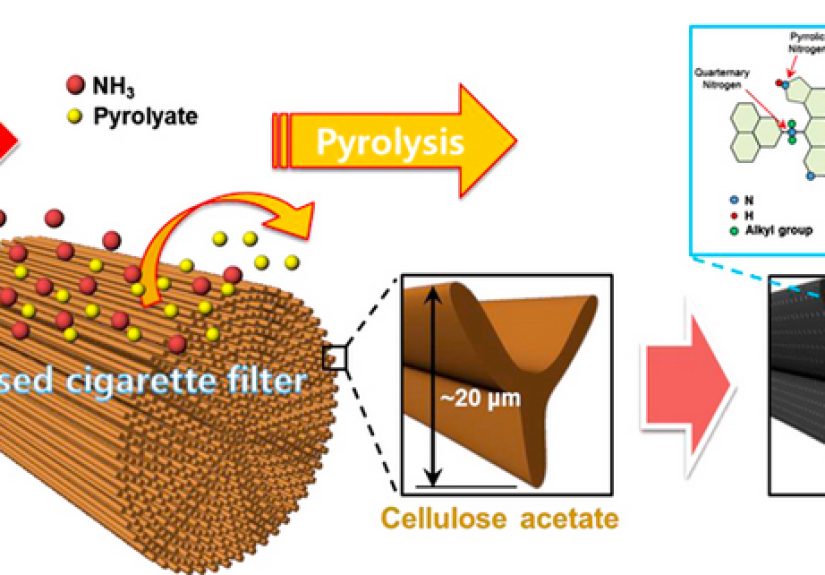
The basic concept is carbon conversion. Cigarette filters are collected, cleaned, dried, cut or shredded, and then thermally processed in controlled environments. One common method is carbonization, where the material is heated at high temperature with little or no oxygen. Instead of burning into ash, the organic structure transforms into carbon powder or porous carbon.
Some studies have carbonized waste cigarette butts at around 800°C under nitrogen gas. The result can be nitrogen-doped carbon. “Doped” does not mean the carbon took a suspicious gym supplement. It means atoms such as nitrogen, oxygen, or sulfur are introduced into the carbon structure. These heteroatoms can improve electrical conductivity, create active sites, and help ions move or attach more effectively during charging and discharging.
Researchers may also use activation steps, such as chemical activation with potassium hydroxide, to create pores. Porous carbon is valuable because batteries and supercapacitors benefit from high surface area. Imagine a sponge versus a marble. The sponge has more internal surface where ions can interact. In energy storage, that extra surface can improve capacity, power output, and charge-transfer behavior.
The Battery Basics: Where the Carbon Fits
A typical lithium-ion battery includes an anode, cathode, separator, electrolyte, and current collectors. The anode and cathode store lithium. During charging and discharging, lithium ions move through the electrolyte while electrons move through the external circuit. That movement is what powers your phone, laptop, power tools, and electric vehicles.
Carbon materials are especially important at the anode side. Graphite has long been the standard anode material because it is stable, conductive, relatively affordable, and good at hosting lithium ions. Cigarette-butt-derived carbon is not automatically a drop-in replacement for commercial graphite, but it can act as a promising experimental carbon material, especially when engineered with pores, defects, and nitrogen doping.
In lithium-ion battery research, waste-cigarette-butt-derived nitrogen-doped carbon has shown encouraging cycling stability and capacity in laboratory tests. In zinc-ion battery research, cigarette-filter-derived nitrogen-doped carbon nanoparticles have been used as a coating on zinc anodes to help suppress dendrites and side reactions. That matters because dendrites are tiny metal growths that can reduce battery life and safety. Think of them as battery whiskers with bad intentions.
Not Just Batteries: Supercapacitors Love Porous Carbon Too
The phrase “converting cigarette butts into batteries” is catchy, but the broader opportunity includes supercapacitors. Supercapacitors store energy differently from batteries. They usually charge faster, deliver high power quickly, and survive many cycles. They are useful for applications such as regenerative braking, grid support, backup systems, and electronics that need fast bursts of energy.
Porous carbon is a key supercapacitor material because ions can gather on its huge internal surface. Recent research has explored converting cigarette butts into nitrogen- and oxygen-doped nanoporous biochar for supercapacitor electrodes. The process can involve hydrothermal carbonization, pyrolysis, and chemical activation to build a hierarchical pore network. In simpler terms: researchers cook, transform, and sculpt the waste into a carbon structure with lots of tiny pathways.
Those tiny pathways matter. Micropores can increase storage sites, mesopores can improve ion transport, and larger connected pores can help electrolyte move more easily. A well-designed porous carbon electrode is like a city with alleys, roads, and highways. If all the roads are clogged, ions get annoyed. And nobody wants annoyed ions.
Why Cigarette Filters Are a Surprisingly Useful Starting Material
Cigarette filters are not valuable because they are clean. They are valuable because they are abundant, carbon-rich, and structurally fibrous. The cellulose acetate fibers can act as a scaffold that becomes porous carbon after thermal treatment. Their shape and chemistry give researchers something to engineer.
The nitrogen-containing compounds associated with used cigarette waste may also contribute to nitrogen doping during processing. Nitrogen doping can create defects and functional groups in carbon, which may improve electrochemical performance. Defects sound bad in everyday life, but in battery materials, controlled defects can be useful. A perfect wall gives ions nowhere to sit; a carefully textured wall gives them places to interact.
Another advantage is cost. Cigarette butts are a waste stream, not a premium raw material. If collection and preprocessing can be managed safely and economically, the feedstock itself could be inexpensive. That is one reason this idea attracts attention in circular economy discussions: it turns a pollution liability into a possible resource.
The Real Processing Steps Behind the Magic
1. Collection and Sorting
The first step is collecting cigarette butts from controlled streams, such as public receptacles, cleanup programs, or dedicated recycling systems. Random street litter can contain dirt, water, biological contamination, and other debris, so industrial-scale recycling would need careful sorting and sanitation.
2. Cleaning and Drying
Researchers often wash or treat the filters to remove loose contaminants, ash, paper, and inorganic residues. Drying is important because moisture can affect carbonization and energy use. Nobody wants a high-temperature furnace fighting a soggy filter army.
3. Carbonization
In carbonization, the cleaned filter material is heated under an inert atmosphere such as nitrogen. This converts the cellulose acetate into carbon. The temperature, heating rate, and hold time influence the final structure, conductivity, and surface chemistry.
4. Activation
Activation creates more pores. Chemical activation may use agents such as potassium hydroxide, while physical activation may use steam or carbon dioxide. The goal is to increase surface area and tune pore size for better electrochemical performance.
5. Electrode Fabrication
The carbon material is then mixed, coated, pressed, or formed into an electrode, depending on the device. Battery electrodes may include binders and conductive additives. Supercapacitor electrodes may use activated carbon powders or freestanding carbon membranes.
6. Testing
Laboratories test the material with charge-discharge cycling, cyclic voltammetry, impedance analysis, and full-cell demonstrations. These tests reveal capacity, stability, resistance, efficiency, and how the material behaves over hundreds or thousands of cycles.
Potential Benefits of Converting Cigarette Butts Into Batteries
The environmental benefit is obvious: fewer cigarette butts left to pollute streets, waterways, beaches, and soil. Even if only a portion of the waste stream could be captured, that would still reduce litter and microplastic contamination.
The material benefit is also compelling. Carbon materials are central to modern energy storage. If waste-derived carbon can perform well enough in specific applications, it could reduce dependence on virgin carbon sources and support more sustainable battery supply chains. This is especially relevant as demand for energy storage grows with electric vehicles, renewable energy, portable electronics, and grid modernization.
The economic benefit depends on scale. Waste collection, cleaning, transportation, thermal processing, activation chemicals, emissions controls, and quality testing all cost money. But if the final carbon material has high value, the economics may become attractive. The best-case scenario is a circular system where cities, recyclers, laboratories, and manufacturers cooperate to turn a messy waste stream into a consistent industrial input.
The Challenges Nobody Should Ignore
Turning cigarette butts into batteries is promising, but it is not a magic wand. The first major challenge is contamination. Used filters can contain toxic chemicals, biological residues, soil, rainwater, and random street debris. Safe preprocessing is essential.
The second challenge is consistency. Battery manufacturers need materials with predictable structure, purity, particle size, and performance. A bag of random cigarette butts from a beach cleanup is not the same thing as battery-grade carbon. The waste stream must be standardized before it can become a reliable product.
The third challenge is energy use. Carbonization and activation require heat, chemicals, and equipment. If the process consumes too much energy or creates unmanaged emissions, the environmental benefit shrinks. A responsible system needs life-cycle analysis, emissions control, wastewater treatment, and chemical recovery.
The fourth challenge is scale. Laboratory results are exciting, but commercial production is a different beast. A material that performs beautifully in a coin cell may behave differently in large-format cells, harsh conditions, or mass manufacturing. Scaling from “cool paper” to “factory line” is where many technologies discover their villain origin story.
Could This Replace Graphite in Electric Vehicle Batteries?
Not immediately. Commercial lithium-ion batteries require extremely reliable, high-purity materials. Graphite has decades of industrial experience behind it. Cigarette-butt-derived carbon is still mostly in the research and development stage.
However, replacement is not the only goal. Waste-derived carbon may find niche uses first: supercapacitors, coatings for zinc anodes, conductive additives, lithium-oxygen battery catalysts, or lower-cost stationary storage components. These applications may tolerate different material properties than premium electric-vehicle battery anodes.
In the future, the most realistic path may be hybrid use. Cigarette-butt-derived carbon could be blended with other carbons, used as a coating, or engineered into specialized electrode structures. Instead of asking, “Can cigarette butts replace all graphite?” the better question is, “Where can this waste-derived carbon perform well enough to create environmental and economic value?”
Real-World Example: From Filter Fiber to Carbon Electrode
Imagine a city installing cigarette butt collection bins in downtown areas, parks, and beaches. The collected waste goes to a specialized recycling facility. There, the filters are separated from paper and ash, washed, dried, and processed in sealed reactors. The material is carbonized under nitrogen and activated to create a porous structure.
The resulting carbon is tested for surface area, pore size, conductivity, and impurities. If it meets specifications, it becomes an electrode material for supercapacitors used in industrial backup systems or transportation applications. The city reduces litter. The recycler sells a higher-value carbon product. The manufacturer gains a lower-cost sustainable feedstock. Everybody wins, except the cigarette butts, and frankly, they had it coming.
Why This Topic Matters for the Circular Economy
The circular economy is about designing waste out of the system. Instead of extracting raw materials, manufacturing products, using them once, and throwing them away, circular systems try to reuse, recover, and regenerate value. Converting cigarette butts into energy storage materials fits that idea because it upgrades a hazardous, low-value waste stream into a functional material.
This does not make cigarette waste “good.” Pollution is still pollution. The best cigarette butt is the one that never becomes litter in the first place. But once the waste exists, recycling it into carbon materials is smarter than pretending it will politely disappear.
The same thinking applies to many other waste streams. Researchers are exploring carbon materials from biomass, food waste, paper waste, textiles, and plastics. Cigarette butts are especially interesting because they combine abundance, environmental harm, and carbon-rich chemistry. In the grand recycling talent show, they are the contestant everyone underestimated.
Experience Section: What Working Around This Topic Teaches You
Anyone who has joined a community cleanup knows cigarette butts are everywhere. You may start the morning expecting plastic bottles and snack wrappers, but after ten minutes you realize the true boss battle is the cigarette filter. They hide in sidewalk cracks. They gather around storm drains. They wedge themselves into beach sand like they signed a long-term lease. Picking them up is not glamorous, but it quickly teaches an important lesson: small waste becomes massive when multiplied by billions.
That experience makes the idea of converting cigarette butts into batteries feel less like a quirky laboratory headline and more like a practical challenge worth exploring. When you see hundreds of filters collected from one block or one park entrance, the feedstock question becomes real. There is material out there. The problem is collecting it safely, keeping it separate, and making sure it does not contaminate soil and water before it can be reused.
From a writer’s perspective, this topic is also a great example of how sustainability stories should be told. The headline is fun: “Cigarette Butts Into Batteries.” It has the energy of a science fair project wearing sunglasses. But the deeper story is more serious. It involves hazardous waste, microfibers, carbon chemistry, electrode engineering, and the difficult economics of recycling. A good article should not oversell the technology as if tomorrow’s electric cars will run on yesterday’s ashtray. It should explain both the promise and the limits.
From a consumer’s perspective, the biggest takeaway is behavior. Even if scientists can turn filters into carbon electrodes, that does not excuse littering. Recycling systems work best when waste is collected intentionally. A cigarette butt tossed into a storm drain is pollution. A cigarette butt placed in a proper collection container may become recoverable material. The difference is not glamorous, but it matters.
From a business perspective, cigarette butt recycling shows how future materials may come from strange places. Companies already think about supply chains for lithium, nickel, graphite, copper, and rare materials. Waste-derived carbon adds another question: can cities and industries create cleaner, traceable waste streams that become reliable raw materials? If yes, the winners may be the companies that master collection logistics and material quality, not just the companies with the flashiest lab results.
From an education perspective, this topic is gold. It connects chemistry, environmental science, engineering, public policy, and economics in one tiny object. Students can learn why cellulose acetate behaves like plastic, why carbon matters in batteries, why porous structures improve electrodes, and why pollution prevention is still better than cleanup. It is the rare science topic where the classroom example might literally be lying outside the classroom door.
The most useful experience, however, is humility. Waste conversion is difficult. Batteries are difficult. Environmental cleanup is difficult. Combining all three is not a weekend craft project. But progress often starts with someone asking an odd question: “What else can this become?” In the case of cigarette butts, the answer may be advanced carbon materials for energy storage. That is not just recycling. That is a plot twist with a lab coat.
Conclusion: A Dirty Waste Stream With a Clean-Energy Possibility
Converting cigarette butts into batteries is not a gimmick. It is a serious research direction built on the chemistry of cellulose acetate, carbonization, doping, and porous electrode design. Cigarette filters are a pollution problem because they are abundant, persistent, and toxic. Yet those same carbon-rich filters may become useful feedstock for advanced energy storage materials.
The technology still faces real hurdles: contamination, processing cost, emissions control, material consistency, and commercial scale. But the concept is powerful. It shows how waste management and clean energy can overlap. The future may not be powered entirely by recycled cigarette butts, but some energy storage devices could one day include carbon that started life as discarded filter waste.
That is the kind of circular economy story worth paying attention to: less litter in waterways, more value from waste, and a reminder that innovation sometimes begins by looking at the ugliest thing on the sidewalk and asking, “Can we do better than this?”





 Close
Close