
Table of Contents >> Show >> Hide
- What Exactly Are deVOL Aged Brass 'Mayan' Taps?
- Why Aged Brass Feels So Right Right Now
- The Design Language: Traditional, But Not Stuffy
- Function Matters, Too
- What to Know About the Living Finish
- How to Style deVOL Aged Brass 'Mayan' Taps Successfully
- Are deVOL Aged Brass 'Mayan' Taps Worth It?
- Living With deVOL Aged Brass 'Mayan' Taps: An Experience-Led Perspective
- Final Thoughts
If you have ever looked at a kitchen and thought, “Wow, this room seems to have a trust fund and excellent taste in aprons,” there is a good chance the faucet had something to do with it. Fixtures matter. They are the jewelry of the sink area, the handshake of the kitchen, the detail that quietly tells you whether the room is aiming for “builder basic” or “I own several beautiful wooden spoons on purpose.”
That is exactly why deVOL Aged Brass ‘Mayan’ Taps get so much attention. They are not flashy in a loud, look-at-me way. They are handsome in the way old English kitchens are handsome: collected, practical, warm, and a little bit romantic. Instead of trying to look factory-fresh forever, these taps lean into age, texture, and character. In other words, they are the opposite of a faucet that looks like it was designed by a spaceship.
What makes them compelling is not only the silhouette, but the philosophy behind them. deVOL created the finish to feel like a properly aged vintage brass fixture, but with the reliability of a new one. That combination is catnip for homeowners and designers who want authenticity without the plumbing drama that can come with actual antique fittings. The result is a pair of traditional-style taps that feel rooted in history while still functioning beautifully in a hard-working modern kitchen.
What Exactly Are deVOL Aged Brass ‘Mayan’ Taps?
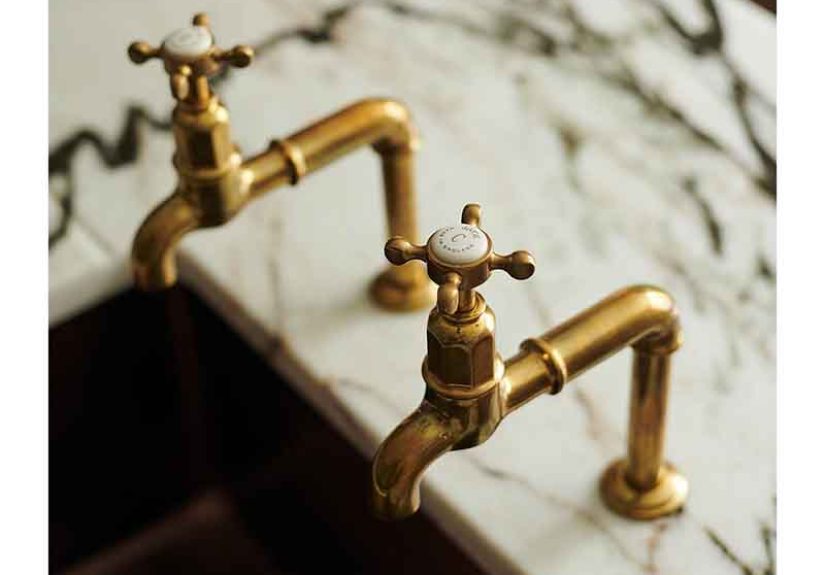
The deVOL Aged Brass ‘Mayan’ Taps are a pair of separate hot and cold taps with classic crosshead handles, made in deVOL’s exclusive aged brass finish. They have a traditional, old-world look and are designed to sit comfortably in kitchens that favor handcrafted details, painted cabinetry, natural stone, and a sink with a bit of presence. They are not a pull-down, not a touchless wonder, and definitely not trying to impersonate a commercial restaurant sprayer. They are about elegance, restraint, and timeless form.
One of the most appealing details is the finish itself. These taps use unlacquered brass with an aged living finish, which means the surface is meant to change over time. That evolving patina is not a defect. It is the point. You do not buy Mayan taps because you want a finish that never changes. You buy them because you want a fixture that becomes more believable, more settled, and more beautiful the longer it lives in your kitchen.
There is also craftsmanship behind the charm. The taps were developed with Perrin & Rowe, a name long associated with premium traditional tapware. That matters because high-end traditional design can go very wrong when the proportions are clumsy or the finish feels fake. deVOL avoids that trap. The Mayan taps look intentional, balanced, and deeply considered, which is exactly what you want when your faucet is sitting front and center above a sink every single day.
Why Aged Brass Feels So Right Right Now
Brass has made a huge comeback in American interiors, but not all brass is created equal. The glossy, yellow-toned brass that once dominated certain decades can feel overly polished and a little too eager. Aged brass taps, by contrast, bring warmth without shouting. They have depth. They soften a kitchen. They add soul to a room that might otherwise feel too crisp, too white, or too “I have no idea where to put the fruit bowl, but at least the quartz is immaculate.”
The appeal of unlacquered brass faucets is that they feel human. They respond to touch, air, water, and use. The finish deepens in areas, lightens in others, and slowly develops the kind of irregularity that makes a kitchen feel lived in rather than staged. That is why so many designers pair living finishes with materials like marble, soapstone, painted wood, terracotta, or handmade tile. Those materials all get better when they are allowed to relax a little.
deVOL understands this instinctively. The Mayan taps are especially effective because their finish is not trying to mimic age with a flat, artificial coating. Instead, the surface has movement and softness. It reads as authentic. In a world full of surfaces pretending to be something else, authenticity is a luxury.
The Design Language: Traditional, But Not Stuffy
The word “traditional” sometimes scares people because they assume it means fussy, formal, or trapped in a time capsule with too many tassels. The Mayan taps prove otherwise. Yes, they are rooted in classic design. Yes, they have crosshead handles and a distinctly old-world shape. But they also have a clean, disciplined simplicity that keeps them from tipping into costume-drama territory.
That is why these taps work in more than one style of kitchen. They are an obvious match for an English-style kitchen with a Belfast sink, painted cabinets, and open shelving. But they also look right at home in a California transitional space with creamy cabinetry and a slab backsplash, a farmhouse kitchen with beadboard and vintage finds, or even a minimalist room that needs one warm, soulful note to keep it from feeling too stern.
In fact, the Mayan taps often work best when the rest of the kitchen is not trying too hard. Give them a marble sink, a deep ceramic apron front, or a quietly dramatic stone countertop and they do the rest. They do not need a lot of cheering from other elements. They just need good company.
Where They Really Shine
These taps look especially strong in kitchens with:
Painted cabinetry in soft neutrals, mossy greens, deep blues, charcoal, mushroom, or warm white.
Natural countertops such as Carrara marble, soapstone, honed quartzite, or dark wood.
Traditional or farmhouse sinks, especially fireclay, marble, copper, or brass options.
Handmade-looking surfaces such as zellige tile, plaster walls, or beadboard paneling.
Mixed metals, where the aged brass is supported by iron, nickel, or even stainless in a restrained way.
That last point matters. You do not have to match every metal in a kitchen anymore. In fact, a perfectly matched room can feel a little too rehearsed. The Mayan taps pair beautifully with mixed-metal kitchens because their finish has enough complexity to bridge warmer and cooler elements.
Function Matters, Too
Let’s address the practical question: are separate pillar-style taps as universally convenient as a modern pull-down faucet? No, not for everyone. If your dream kitchen involves filling stockpots like a speed-run contestant and spraying peanut butter off every surface in sight, a different faucet style may fit your habits better.
But that is not really the point of the Mayan taps. These are taps for people who care as much about the atmosphere of a room as the mechanics of a fixture. They are a choice for homeowners who want the sink area to look thoughtful and permanent, not merely efficient. That does not make them impractical. It just means their form and function are balanced differently.
And to be fair, traditional taps are often easier to love over the long term than trend-driven statement pieces. Their proportions age well. Their styling is flexible. Their visual language is already proven. In ten years, they are unlikely to make you wonder what possessed you to buy the faucet equivalent of a concept sneaker.
What to Know About the Living Finish
This is the part buyers should understand before falling in love with the photos. Living finish brass changes. It darkens, mellows, and marks more visibly than lacquered or plated alternatives. Water spots may show. Areas around the handles may evolve differently depending on how often they are touched. If you want a faucet that looks identical every morning for the next decade, you are shopping in the wrong aisle.
But if you appreciate materials that record life rather than hide it, the Mayan taps become far more interesting over time. They gain variation. They settle into the kitchen. They stop looking like a recent purchase and start looking like they belong there. That sense of belonging is hard to fake.
Maintenance is fairly straightforward: treat the finish gently. Avoid harsh abrasives and aggressive polishing unless you are intentionally trying to alter the patina. A soft cloth and mild care usually make the most sense. Think preservation, not overcorrection. These taps are not asking to be buffed into a mirror. They want to age gracefully, not attend a pageant.
How to Style deVOL Aged Brass ‘Mayan’ Taps Successfully
If you are building a kitchen around these taps, the easiest mistake is trying to compete with them. The smartest approach is to let them lead a quieter cast.
For a classic look, pair them with an apron-front fireclay sink, painted cabinets, unlacquered brass or antique brass hardware, and a honed marble or soapstone countertop. For something moodier, set them against dark wood, slate, or a veiny stone and let the brass catch the light. For a softer, more collected kitchen, combine them with open shelves, vintage art, woven textures, and a muted paint color that gives the room a little hush.
They also work beautifully with blue cabinets, which is a combination designers return to again and again for good reason. Blue adds depth, brass adds warmth, and the result feels elegant without becoming precious. Creamy whites, putty tones, and dusty greens also make excellent partners.
And yes, a marble sink with these taps is ridiculously gorgeous. It is also the kind of combination that makes people linger by the sink and suddenly pretend they are very interested in washing one more glass.
Are deVOL Aged Brass ‘Mayan’ Taps Worth It?
For the right kitchen, absolutely. These taps are not about mass-market convenience or bargain pricing. They are about design integrity. They offer a specific mood: old-world, grounded, warm, tactile, and quietly luxurious. They do not just complete a sink area. They establish its personality.
What you are really paying for is a combination of quality, proportion, finish, and emotional effect. Plenty of faucets can deliver water. Far fewer can make a kitchen feel layered, believable, and beautifully settled. That is the real value of the Mayan taps. They help a room feel like it has a history, even when the plaster is still drying and the moving boxes are not fully gone.
So, are they practical? Yes. Are they timeless? Very likely. Are they the right choice for every kitchen? No. But for a traditional, European-inspired, farmhouse, or character-rich home, they are the kind of detail that lifts everything around them. Cabinets look better. Stone looks richer. Even the dish soap suddenly feels like it should come in an amber glass bottle.
Living With deVOL Aged Brass ‘Mayan’ Taps: An Experience-Led Perspective
To understand the appeal of deVOL Aged Brass ‘Mayan’ Taps, it helps to imagine daily life with them rather than just staring at a product photo. The first thing you notice is that they do not behave like a decorative accessory. They behave like a real material. In the morning, when the light hits the sink wall at an angle, the brass can look mellow and honeyed. By evening, especially under shaded sconces or warmer bulbs, it deepens into something moodier and older-looking. It changes with the room, and that alone gives it more personality than most fixtures ever manage.
Over time, the taps begin to tell the truth about how your kitchen is used. The handles may darken where fingers land most often. The spout may develop subtle variation from splashes and wiping. None of this feels messy or accidental. It feels earned. A polished, static finish can look great on day one, but a living finish often looks better on day 300 because it has finally stopped trying to impress and started belonging.
There is also a tactile pleasure to traditional taps that is easy to underestimate. Crosshead handles feel intentional. Turning them on is a tiny, satisfying ritual, a little more mechanical and grounded than tapping a sensor or flicking a minimalist lever. It slows you down by about half a second, which is sometimes exactly what a kitchen needs. Not every object has to feel like an app.
From a design standpoint, these taps tend to improve the entire sink zone. A basic sink setup suddenly feels styled. A beautiful sink becomes a focal point. A painted cabinet color looks richer because the brass adds warmth beside it. Even a simple ceramic backsplash can seem more layered. That is one of the hidden strengths of the Mayan taps: they do not just look good on their own; they make neighboring materials look more confident.
There is, of course, an emotional side to all of this. Kitchens are used hard. They collect dishes, groceries, mail, flowers, half-finished conversations, and the occasional existential crisis over dinner. Fixtures that age well can make that daily wear feel charming instead of tragic. When a tap develops character, the room feels more forgiving. It starts to suggest that a home is supposed to be lived in, not preserved like a museum gift shop.
That is why these taps resonate with people who love soulful spaces. They are not pristine forever, and thank goodness for that. They grow into the house. They pick up the mood of the cabinetry, the tone of the stone, and the rhythm of the people using them. In a market full of kitchen fixtures designed to look sleek, sharp, and untouchable, the Mayan taps offer something rarer: warmth, memory, and a sense that beauty can deepen with use instead of disappearing under it.
Final Thoughts
deVOL Aged Brass ‘Mayan’ Taps are a lesson in why the smallest architectural details can make the biggest emotional difference. They bring together craftsmanship, history, warmth, and real-world function in a way that feels unusually grounded. They are not trying to be futuristic. They are trying to be beautiful for a very long time.
And that is exactly their charm. They do not scream for attention. They quietly earn it.






 Close
Close