
Table of Contents >> Show >> Hide
- Why the 2024 Travel Photography Awards Matter
- Top 10 Breathtaking Images From the 2024 Travel Photography Awards
- 1. Andrew Newey “Supplies for Phugtal Monastery”
- 2. Thaddäus Biberauer “Kathakali”
- 3. David Keith Brown “Candid Scene at Lake Taungthaman”
- 4. Luciano Lejtman “Huli Wigmen”
- 5. Alessandro Bergamini “The King of South Sudan”
- 6. Andrea Peruzzi “Breakfast Time at Phuktal Gompa”
- 7. Barry Crosthwaite “Infinite Loop”
- 8. Nicolas Castermans “Rainbow Mountain”
- 9. Sofia Brogi “Gunja”
- 10. Syed Mahabubul Kader “Paddy Straw”
- What These Award-Winning Travel Photos Teach Us
- How to View Award-Winning Travel Photography Like a Pro
- Experience: What These Images Feel Like From a Traveler’s Point of View
- Conclusion
Travel photography has a magical little trick: it can make you want to book a flight, learn a language, buy a better lens, and suddenly become emotionally attached to a mountain pass you have never visited. The 2024 Travel Photography Award from The Independent Photographer did exactly that, spotlighting images that moved beyond postcard beauty and into the richer territory of culture, endurance, ritual, landscape, and human connection.
This year’s winning and finalist photographs were judged by Jody MacDonald, a respected documentary, travel, and adventure photographer known for work in remote regions. The theme asked photographers to show the life of a place in all its splendor, whether through street scenes, portraits, landscapes, or documentary moments. In other words, no lazy “here is a sunset, please clap” energy. These images had to carry story, mood, and meaning.
Below, we explore the top 10 breathtaking images recognized in the 2024 Travel Photography Awards, why they stand out, and what they teach us about the art of seeing the world with patience, respect, and a camera that is hopefully not still on auto mode.
Why the 2024 Travel Photography Awards Matter
The best travel photography is not just about visiting beautiful places. It is about noticing what others walk past. A great travel image can reveal how people work, worship, celebrate, survive, and belong. It can turn a remote monastery, a traditional performance, a lake at dusk, or a rural work scene into a visual story that stays with the viewer.
The 2024 Travel Photography Award stood out because its strongest images balanced beauty with context. The photographs were visually striking, yes, but they also carried cultural depth. They showed frozen rivers used as supply routes, ancient performance traditions, lake communities, Indigenous identities, mountain landscapes, architectural heritage, and everyday labor. That range is exactly what makes travel photography so powerful: the world is not one single postcard. It is a wildly complicated album.
Top 10 Breathtaking Images From the 2024 Travel Photography Awards
1. Andrew Newey “Supplies for Phugtal Monastery”
Andrew Newey won first prize with “Supplies for Phugtal Monastery,” photographed in Ladakh, Northern India. The image shows people transporting supplies across a frozen river to reach Phugtal Monastery, a remote Buddhist monastery in the Zanskar region. During winter, deep snow can make roads impassable, turning frozen waterways into lifelines.
What makes this photograph unforgettable is its balance between grandeur and vulnerability. The landscape is vast and icy, while the figures in traditional red garments create a vivid human focal point. The winding river naturally guides the viewer’s eye through the frame, almost like the photograph is saying, “Come on, we have a monastery to reach.” It is beautiful, but it is also practical, showing travel not as leisure but as endurance.
2. Thaddäus Biberauer “Kathakali”
Second prize went to Thaddäus Biberauer for “Kathakali,” captured in Kerala, India. Kathakali is a classical Indian dance-drama known for elaborate costumes, painted faces, expressive gestures, and dramatic storytelling. In Biberauer’s image, motion blur transforms the performer into something between a person, a painting, and a myth in motion.
The image succeeds because it does not freeze the performance too neatly. Instead, it lets movement become part of the meaning. The vibrant greens, reds, and golds suggest ritual and intensity, while the blur conveys energy. It reminds us that some travel experiences are not meant to be pinned down like butterflies in a display case. Some are meant to whirl past, leaving color in the air.
3. David Keith Brown “Candid Scene at Lake Taungthaman”
David Keith Brown received third prize for “Candid Scene at Lake Taungthaman,” photographed in Amarapura, Myanmar. The image captures people boating near U Bein Bridge, one of the region’s most recognizable landmarks. Fishermen can be seen working in the shallow water, creating a scene that feels quiet, balanced, and deeply atmospheric.
The photograph’s strength lies in its painterly composition. The dark silhouette of a tree and its reflection frame the scene, while the soft light gives the image a dreamlike calm. It is the kind of travel photograph that asks viewers to slow down. No fireworks. No dramatic cliff edge. Just light, water, work, and patience. Honestly, the lake is doing more with subtlety than most vacation albums do with 400 beach selfies.
4. Luciano Lejtman “Huli Wigmen”
Luciano Lejtman’s finalist image, “Huli Wigmen,” was photographed in Tari, Papua New Guinea. The Huli people are known for their distinctive ceremonial wigs, body paint, and strong cultural identity. In travel photography, portraits like this require more than technical skill. They demand sensitivity, context, and respect for the people being photographed.
This image stands out because it gives viewers a glimpse of living tradition rather than reducing culture to costume. A strong portrait does not simply say, “Look at this person.” It asks, “What history, pride, and identity are present here?” The best travel portraits are not trophies from faraway places. They are encounters, and this image carries that sense of presence.
5. Alessandro Bergamini “The King of South Sudan”
Alessandro Bergamini’s finalist photograph, “The King of South Sudan,” focuses on the Mundari people and their relationship with cattle. Among the Mundari, livestock is deeply woven into daily life, identity, wealth, and survival. The image speaks to the powerful bond between herders and animals, showing cattle not merely as economic assets but as part of a social and cultural world.
The photograph’s impact comes from its atmosphere. Travel photography often shines when it captures relationships: person and place, community and tradition, human and animal. Here, the image suggests mutual dependence and continuity. It is not just a portrait of a person; it is a portrait of a way of life shaped by land, livestock, and resilience.
6. Andrea Peruzzi “Breakfast Time at Phuktal Gompa”
Andrea Peruzzi’s finalist image, “Breakfast Time at Phuktal Gompa,” returns us to Ladakh, Northern India, but with a more intimate perspective. Instead of focusing on the journey to the monastery, this photograph looks inside the rhythm of monastic life. A young monk waits to serve breakfast after the Puja ritual, with the Himalayan valley surrounding the monastery.
This image works because it turns a small daily moment into a larger story. Food, ritual, education, and tradition all meet in one quiet scene. The young monks represent continuity, especially in remote places where religious traditions depend on the next generation. The photograph reminds us that travel photography does not always need spectacle. Sometimes breakfast is enoughespecially when breakfast comes with Himalayan cliffs and centuries of devotion.
7. Barry Crosthwaite “Infinite Loop”
Barry Crosthwaite’s finalist photograph, “Infinite Loop,” was taken in Rajasthan, India, and focuses on stepwells. These historic structures were designed to collect and provide access to water in arid regions. Over time, they also became architectural landmarks and communal gathering places, decorated with striking geometric forms.
The title “Infinite Loop” fits beautifully because stepwells often create mesmerizing patterns of stairs, shadows, and repeated shapes. This kind of image shows how travel photography can celebrate design and human problem-solving. Water management may not sound glamorous at firsttry pitching it at a dinner party and watch people reach for dessertbut in Rajasthan’s stepwells, utility becomes art. The photograph captures both history and hypnotic symmetry.
8. Nicolas Castermans “Rainbow Mountain”
Nicolas Castermans’ finalist image, “Rainbow Mountain,” takes viewers to the highlands of the Peruvian Andes. The photograph shows a local horse rider moving toward a mountain pass near the famous rainbow-colored slopes. At around 5,000 meters, this is not exactly a casual stroll unless your lungs have signed a special agreement with the altitude.
The image succeeds because it gives scale to the landscape. The rider becomes a human measure against the mountain’s vastness. Without that figure, the scene might be only a beautiful geological display. With the rider, it becomes a journey. The best landscape photography often needs a point of relationship, something that lets viewers feel the size, distance, and emotional temperature of the place.
9. Sofia Brogi “Gunja”
Sofia Brogi’s finalist portrait, “Gunja,” was taken in Sarnath, India. The image tells the story of a young girl the photographer met after the child approached her asking for food. The caption explains that Gunja spent time eating, sharing songs, and later introducing the photographer to her family, who were living on the streets.
This is one of the most emotionally delicate images in the selection. It reminds us that travel photography can involve real ethical responsibility, especially when photographing children, poverty, or vulnerable communities. A powerful image should not turn hardship into decoration. Instead, it should invite empathy while preserving dignity. “Gunja” asks viewers to look carefully, not casually.
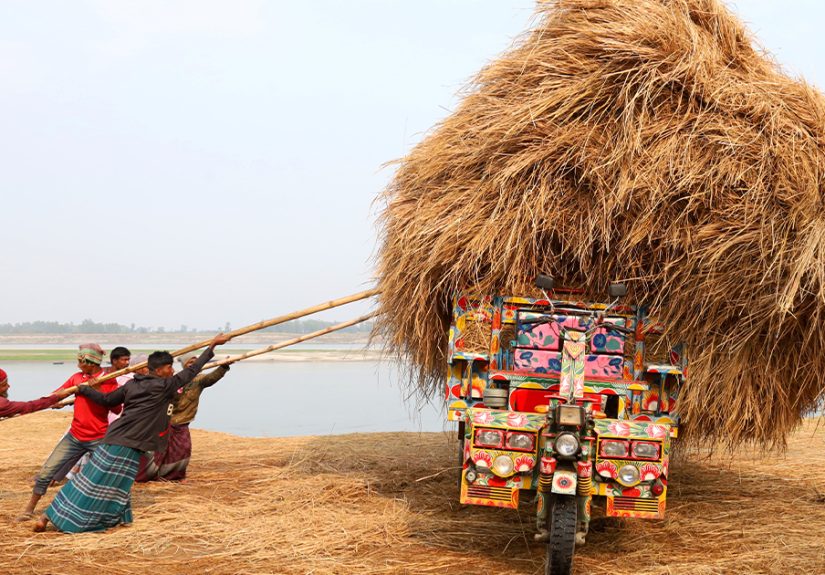
10. Syed Mahabubul Kader “Paddy Straw”
Syed Mahabubul Kader’s finalist image, “Paddy Straw,” was photographed in Kazipur Upazila, Bangladesh. It shows workers unloading rice straw from a truck. Rice straw, a by-product of farming, can be used as cattle feed, fuel, and other practical materials.
This image is a reminder that travel photography is not limited to famous landmarks or dramatic festivals. Labor is also culture. Agriculture is also landscape. A truck full of paddy straw can reveal economy, environment, teamwork, and rural life. The image honors the everyday effort that keeps communities moving. Not every breathtaking travel photograph needs a mountain, a monastery, or a once-in-a-lifetime sky. Sometimes it needs workers, dust, repetition, and the honest choreography of a hard day.
What These Award-Winning Travel Photos Teach Us
Great Travel Photography Tells a Story
The strongest images in the 2024 Travel Photography Awards do not rely only on visual beauty. They answer questions. Who is here? What is happening? Why does this moment matter? Whether it is a frozen supply route in Ladakh or a portrait in Sarnath, each photograph gives viewers a reason to stay with the image longer.
Composition Is the Quiet Hero
Several images use natural lines, reflections, repetition, and scale to guide the eye. The frozen river in Andrew Newey’s winning photograph acts like a visual pathway. Barry Crosthwaite’s stepwell image uses geometry. David Keith Brown’s lake scene uses framing and reflection. Good composition does not shout. It quietly escorts the viewer through the story like a very polite tour guide.
Respect Matters More Than Access
Many of the recognized images involve people, communities, or traditions. That makes respect essential. Travel photographers should understand context, ask permission when appropriate, avoid exploiting vulnerability, and remember that the person in the frame is not a prop. Beautiful travel photography should deepen human connection, not flatten it.
Everyday Life Can Be Extraordinary
One of the biggest lessons from this collection is that ordinary scenes can become extraordinary through timing, light, and attention. A breakfast ritual, a group of workers, a lake crossing, or a child’s quiet gaze can carry as much power as a dramatic vista. The photographer’s job is not always to chase the biggest moment. Sometimes it is to recognize the meaningful one.
How to View Award-Winning Travel Photography Like a Pro
When looking at these images, do not just ask, “Is it pretty?” Ask what the photograph reveals. Notice the use of color, light, gesture, and framing. Look for emotional tension: endurance in Ladakh, grace in Kerala, stillness in Myanmar, pride in Papua New Guinea, resilience in South Sudan, and labor in Bangladesh.
Also pay attention to what is outside the frame. Great travel photography often suggests a larger world beyond the visible moment. The frozen river implies isolation. The Kathakali performer implies centuries of performance tradition. The stepwell implies water scarcity, architecture, and community. A single frame becomes a doorway, and the viewer gets to step through.
Experience: What These Images Feel Like From a Traveler’s Point of View
Spending time with the top 10 images from the 2024 Travel Photography Awards feels a little like taking a long journey without airport security, delayed luggage, or the tragic airport sandwich that costs seventeen dollars and tastes like cardboard with ambition. Each photograph offers a different kind of travel experience, and together they show why photography remains one of the most powerful ways to encounter the world.
The first experience is awe. Andrew Newey’s image of supplies being carried to Phugtal Monastery makes you feel the cold before you fully understand the story. You can almost hear the scrape of sleds and boots against ice. It captures the kind of journey that does not exist for entertainment but for necessity. Looking at it, you are reminded that some roads are rivers, some errands are expeditions, and some communities survive because people keep showing up, even in winter.
Then comes wonder. Thaddäus Biberauer’s Kathakali photograph feels like stepping into a theater where the air is thick with music, color, and anticipation. The blur is not a flaw; it is the heartbeat of the performance. For travelers, this is familiar. Sometimes the most memorable moments are the ones you cannot perfectly explain afterward. You simply say, “You had to be there,” which is both true and deeply annoying to everyone who was not there.
David Keith Brown’s Myanmar lake scene offers another travel feeling: stillness. Some places do not announce themselves loudly. They unfold slowly, with boats moving across water and silhouettes stretching into reflection. This image captures the reward of waiting. It reminds travelers that the best view is not always found by rushing to the next attraction. Sometimes it appears when you stop, stay quiet, and let the place breathe.
The portraits in the collection create a more personal kind of experience. Images of the Huli Wigmen, the Mundari, and Gunja ask viewers to think carefully about encounter. Travel can be thrilling, but it also puts visitors in other people’s homes, streets, ceremonies, and hardships. These photographs remind us that curiosity should come with humility. A camera can open doors, but it should never barge through them wearing muddy shoes.
The landscape images, especially Rainbow Mountain in Peru, capture the physical sensation of travel: distance, altitude, fatigue, and reward. A mountain pass is not just scenery. It is breath, effort, weather, and scale. The tiny figure of the rider against the enormous land makes the viewer feel both small and connected. That is one of travel’s greatest gifts. It shrinks the ego and expands the imagination.
Finally, images like “Paddy Straw” and “Infinite Loop” show that travel experiences are not only built from famous sights. They are built from systems: food, water, work, architecture, farming, religion, transportation, and craft. When a photographer pays attention to those systems, the resulting image becomes richer than a simple snapshot. It becomes evidence of how people live.
For anyone who loves travel, these award-winning photographs are more than beautiful images. They are invitations to travel more slowly, observe more deeply, and return home with stories instead of just storage cards full of duplicates. They remind us that the world is endlessly photogenic, but not because it is polished. It is photogenic because it is alive.
Conclusion
The 2024 Travel Photography Awards prove that breathtaking photography is not just about perfect scenery. It is about story, patience, respect, and the ability to notice meaning in both grand landscapes and ordinary human routines. From Ladakh’s frozen rivers to Kerala’s stage traditions, from Myanmar’s lake life to Bangladesh’s agricultural labor, these images show travel as a living conversation between people and place.
For photographers, the lesson is clear: do not simply chase the prettiest view. Chase the deeper story. Learn the culture, wait for the light, respect the subject, and compose with intention. For viewers, these photographs offer a gift just as valuable: the chance to see the world through someone else’s careful, curious, and compassionate eye.






 Close
Close