
Table of Contents >> Show >> Hide
- The Company Behind the Pencil
- The Mongol Brand: More Than a Pretty Stripe
- What Made the Mongol Stenographic Pencil Different?
- Why Shorthand Needed Its Own Pencil
- Design That Served the Hand
- A Pencil for a Different American Workday
- Why Collectors and Pencil Lovers Still Care
- The Experience of Using a Mongol Stenographic Pencil Today
- Final Thoughts
Some pencils are made to survive math homework, get chewed in meetings, and disappear into sofa cushions. Eberhard Faber’s Mongol Stenographic Pencil belonged to a more demanding world. It was built for speed, for dictated letters, for shorthand notebooks, for hands that had to keep up with human speech without falling apart halfway through a sentence. In other words, this was not your average yellow pencil with a pink eraser and a vague sense of destiny.
The Mongol Stenographic Pencil sits at a fascinating intersection of American pencil history, office culture, industrial design, and the lost art of shorthand. To modern eyes, it looks charmingly simple: slim body, round barrel, double-pointed ends, and a vintage seriousness that practically asks for a gray felt hat and a fast-talking newsroom. But the deeper you look, the more it becomes clear that this little vintage stenographic pencil was a highly specific writing tool designed for one job: writing quickly, cleanly, and for long stretches without fuss.
The Company Behind the Pencil
To understand the Mongol Stenographic Pencil, you have to start with Eberhard Faber, one of the biggest names in American pencil manufacturing. The company’s roots go back to the famous Faber pencil-making family of Germany, but Eberhard Faber built a major American branch in the 19th century. After settling in New York, he opened a stationery business and eventually established what is widely recognized as the first graphite pencil factory in the United States.
That origin story matters because Eberhard Faber did not just make pencils; the company helped shape what Americans expected a pencil to be. After a fire in Manhattan in 1872, operations moved to Brooklyn, where the Greenpoint factory grew into a serious industrial presence. By the late 19th and early 20th centuries, Eberhard Faber was not some quaint workshop with a few aprons and a lot of cedar shavings. It was a large-scale manufacturer producing pencils, office goods, and related products for a nation that was writing more, studying more, and organizing itself into ever more forms, ledgers, files, and frantic office memos.
That broader context gives the Mongol pencil line its significance. These were not random product names printed on lacquer for fun. They were part of a carefully developed branded system that helped turn pencils into recognizable consumer goods with identities, specialties, and loyal followings. The Mongol line, especially, became one of the company’s best-known and most visually distinctive families.
The Mongol Brand: More Than a Pretty Stripe
Collectors and pencil historians often point to the Mongol as one of the iconic American pencil brands. Evidence from trademark history suggests that the Mongol name was in use by about 1900, and by the early 20th century the line had developed the visual personality many people still associate with classic Eberhard Faber design. In the standard Mongol No. 482, that meant a hexagonal yellow barrel, black tip, gold band, and red eraser. It looked confident, a little formal, and just flashy enough to stand out in a pencil case without becoming a circus act.
The Mongol Stenographic Pencil, however, was a specialized offshoot. If the standard Mongol was the star student in a pressed collar, the stenographic version was the office speed specialist with its sleeves rolled up. It traded classroom familiarity for function. It was less concerned with looking like a school pencil and more concerned with helping someone capture speech before it vanished into the air.
What Made the Mongol Stenographic Pencil Different?
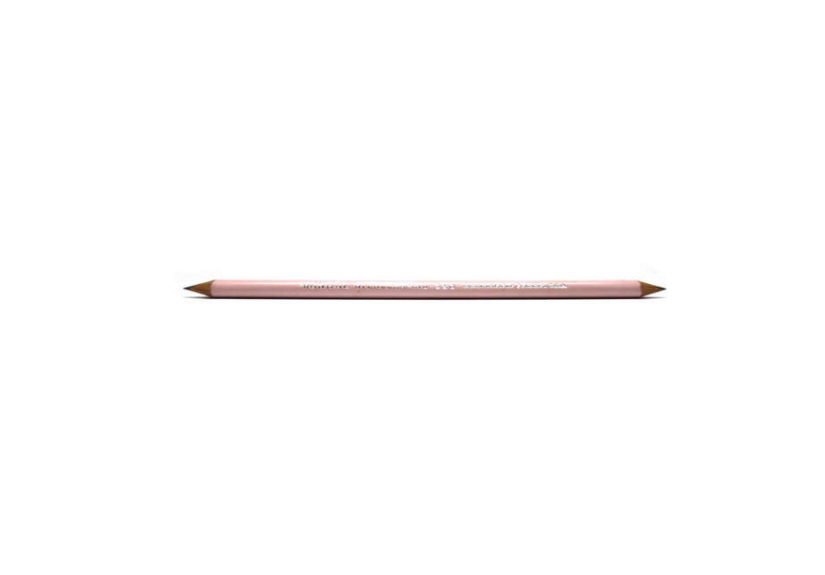
The magic of this pencil is in the details. A 1930 Eberhard Faber catalog lists the No. 596 stenographic pencil as round, thin, natural polish, and fitted with firm lead. Most importantly, it came pointed at both ends. That tiny design choice tells you almost everything about the intended user. A stenographer could write until one point dulled, flip the pencil instantly, and keep moving. No pause. No rummaging for a sharpener. No dramatic collapse into office despair.
The catalog also notes that these pencils were packed by the half-dozen and included a point protector. Later vintage descriptions preserved by specialty pencil retailers echo the same idea: the pencil is small, round, double-pointed, and built with a harder core for quick note-taking. Some surviving examples are described as natural or pink-toned in finish, and they were made in the USA, adding to their appeal for collectors of vintage American pencils.
This combination of features makes perfect sense. A shorthand pencil had to stay sharp longer than an ordinary writing pencil because speed writing rewards consistency. A mushy point or a quickly blunting tip creates drag, thicker lines, and visual clutter. That may not sound dramatic, but when you are trying to keep up with a dictation drill, a courtroom exchange, or a business lecture, a sloppy line is the pencil equivalent of a shoe lace coming untied during a sprint.
Why Shorthand Needed Its Own Pencil
This is where the story gets especially good. The stenographic pencil was not just about “writing fast” in some vague marketing sense. It was tuned to the actual shorthand systems in use at the time, especially Gregg shorthand and Pitman shorthand.
According to Britannica, Gregg shorthand is defined by an absence of shading or thickening, with flowing strokes designed for rapid writing. Pitman, by contrast, relies on light and heavy strokes as part of the system itself. That difference shaped pencil design in a wonderfully nerdy, highly practical way. Eberhard Faber’s own catalog separated these needs by lead type: the No. 596 was a firm-lead stenographic pencil specially recommended for Gregg, the No. 594 Steno-Shading used soft lead for Pitman, and the No. 595 sat in the middle with a medium-soft lead.
That distinction is not trivial. It means the company understood that writing systems were physical systems as much as linguistic ones. Different shorthand methods demanded different pressure, line control, and point behavior. The pencil was not an accessory. It was part of the workflow. In a pre-digital office, the right tool could mean cleaner notes, fewer hesitations, and less hand fatigue over a long day of dictation.
In that sense, the Mongol Stenographic Pencil represents something larger than a collectible writing instrument. It is evidence of a time when office tools were engineered around the body’s movement: finger grip, wrist rhythm, pressure, speed, and repetition. Today we mostly think of keyboards as the place where ergonomics happen. Back then, even a pencil could be job-specific in a very serious way.
Design That Served the Hand
One of the most appealing things about Eberhard Faber’s stenographic design is how stripped down it feels. The standard Mongol pencil was dressed for public life, with its lacquer, ferrule, and eraser. The stenographic model feels more intimate and task-focused. Its round, narrow form encourages a lighter grip. Its double-pointed body implies constant movement. Its compactness suggests portability and efficiency rather than classroom sturdiness.
There is also something psychologically elegant about a pencil sharpened at both ends. It looks ready. It looks prepared. It looks like it already knows your meeting is going to run long and your boss is going to start dictating three paragraphs faster than any reasonable human should. A double-pointed pencil quietly communicates urgency without becoming theatrical. It is the office-supply version of rolling up your sleeves.
Even the absence of an eraser feels meaningful. Whether by design or by the realities of the format, the stenographic model leans into momentum instead of correction. Shorthand is about capture first, cleanup later. The pencil reflects that logic. It says, in effect, “Write now. Fix it when the room stops talking.”
A Pencil for a Different American Workday
It is easy to forget how central shorthand once was to American education and office life. For decades, shorthand was taught in schools, used in business offices, practiced by secretaries and reporters, and valued as a serious employment skill. Before voice notes, before instant transcripts, and long before everybody decided a smartphone could solve all problems except the ones it causes, shorthand was one of the fastest ways to capture speech in real time.
That is the world the Eberhard Faber Mongol Stenographic Pencil belonged to. It lived on desks with correspondence trays, ledger books, steel filing cabinets, carbon paper, and the faint smell of paper dust. It probably rode in handbags, desk drawers, and shirt pockets. It likely spent its best years in offices where speed was a career skill and legibility was not negotiable.
Seen from that angle, the pencil becomes a small artifact of American labor history. It reminds us that productivity once depended not just on machines, but on hand-trained habits. People were expected to hear, translate, and record language at speed. A pencil that helped them do that was not a novelty. It was equipment.
Why Collectors and Pencil Lovers Still Care
So why does this particular pencil still matter? Partly because it is handsome. Partly because it comes from one of the great American pencil makers. But mostly because it captures a very specific vanished use case. Plenty of old pencils survive as nostalgic objects. The Mongol Stenographic Pencil survives as a design answer to a real technical problem.
Collectors love objects like that. They are small enough to hold, but big enough to tell a story. A surviving No. 596 or later Mongol Stenographic example speaks to brand identity, writing culture, shorthand pedagogy, office history, and industrial manufacturing all at once. It is a pencil, yes, but it is also a pocket-sized reminder that even everyday tools used to be engineered with astonishing specificity.
And then there is the emotional appeal. Vintage pencils often attract people because they feel honest. The Mongol Stenographic Pencil takes that honesty a step further. It does not pretend to be universal. It is not trying to be everything for everyone. It was made for a fast hand and a serious page. That kind of clarity is hard not to admire.
The Experience of Using a Mongol Stenographic Pencil Today
Using a vintage Mongol Stenographic Pencil today is a strangely time-bending experience. At first, it feels almost too slim, especially if you are used to chunkier modern pencils or mechanical pencils with rubber grips and enough engineering to qualify as a minor appliance. The Mongol Stenographic does not pamper you. It asks you to meet it halfway. Once you do, it starts making sense very quickly.
The first thing you notice is balance. A double-pointed pencil feels different in the hand because both ends matter. There is no dead weight from an eraser assembly and no visual cue telling your fingers where the “top” is supposed to be. That creates a surprisingly fluid writing rhythm. The pencil feels ready from either direction, and your hand starts moving with less ceremony. You stop “positioning” the pencil and simply write.
The second thing you notice is the point. On a good example, the harder core gives a neat, disciplined line. It is not buttery in the way some beloved soft vintage pencils are, and that is exactly the point. This is not a lounge singer of a pencil. It is a stenographer’s shoe. It wants traction, not drama. The line stays controlled, narrow, and useful. If you write a page of quick notes, the pencil does not seem interested in turning every sentence into a smoky sketch. It behaves itself.
That behavior changes the mood of writing. A soft writing pencil can encourage daydreaming; a firm stenographic pencil encourages momentum. You start abbreviating naturally. Your handwriting tightens. You look for efficient letterforms. Even if you do not know Gregg or Pitman shorthand, the tool nudges you toward speed. It is like driving an old manual car and suddenly sitting up straighter because the machine expects a little competence from you.
There is also a tactile pleasure in the body itself. The round barrel rolls more easily than a hex pencil, which sounds inconvenient until you are actually writing with it. In motion, the shape feels light and smooth, almost like a baton for the fingers. That seems especially fitting for a tool designed around constant directional movement. The natural or lightly colored finish on surviving examples adds to the charm. It looks less like a school supply and more like something from a serious desk where someone was expected to know things.
Then comes the best moment: one point begins to dull, and instead of stopping, you flip the pencil and keep going. That tiny action is absurdly satisfying. It feels efficient in a way modern tools rarely do. You understand, in one flick of the fingers, why the design existed in the first place. The pencil is not showing off. It is solving a problem in real time.
Using one today also sharpens your awareness of how much writing culture has changed. Most of us no longer need to capture rapid speech by hand. We type, record, auto-transcribe, and search later. But a Mongol Stenographic Pencil brings back the older relationship between ear, hand, and page. It reminds you that note-taking used to be a trained physical skill, not just a digital habit.
That is why the experience lingers. Even after the page is full, the pencil leaves behind more than graphite. It leaves behind respect for the people who once used tools like this professionally and well. It turns a simple writing session into a tiny reenactment of office history. And for a piece of painted cedar with graphite in the middle, that is a pretty impressive trick.
Final Thoughts
Eberhard Faber’s Mongol Stenographic Pencil is a small object with an unusually large story. It connects American manufacturing, shorthand education, office labor, and product design in one elegantly specialized form. From the broader fame of the Mongol brand to the precise functional logic of the No. 596, this pencil shows how seriously everyday writing tools were once taken.
That is why it still resonates. It is not merely collectible because it is old. It is memorable because it was purposeful. The Mongol Stenographic Pencil was built for a fast-moving world of spoken words and disciplined hands, and even now, long after shorthand faded from most desks, the design still feels smart, charming, and just a little bit heroic.





 Close
Close