
Table of Contents >> Show >> Hide
- Why “Fully On-Chip” Is the Big Deal (And Not Just a Buzzword)
- Qubits vs. Qudits: Same Entanglement, Bigger Playground
- How Photonic Chips Generate Entangled Light
- The “Turnkey” On-Chip Source: Laser + Filter + Nonlinear Ring
- Entanglement Encodings That Play Nicely With Chips
- From Entangled Qubits to Entangled Qudits: A Concrete Example
- What Good Looks Like: Metrics That Actually Matter
- Material Platforms: Pick Your Superpower (And Your Tradeoffs)
- Design Patterns for Scalable On-Chip Entanglement
- Where Fully On-Chip Entangled Sources Fit in the Real World
- Common Misconceptions (Because Quantum Already Has Enough Confusion)
- FAQ
- Experiences: What It’s Like Working With Fully On-Chip Photonic Entanglement Sources (The Human Side)
If you’ve ever watched a “quantum demo” video and thought, “Neat… but why does it still look like a science fair project had a baby with a server rack?” you’re not alone. For decades, photonic entanglement experiments have been dazzling and, let’s be honest, slightly held together by hope, fiber spools, and a lab’s worth of alignment patience. The big shift happening now is simple to describe and hard to pull off: move the whole entangled-photon factory onto a chip.
And not just “a chip that makes photon pairs if you feed it an expensive laser and pray.” We’re talking about a fully on-chip photonic quantum sourceone that integrates the pieces you need for reliable generation of entangled qubits (two-level quantum states) and entangled qudits (d-level states) in a compact, scalable, and increasingly manufacturable way.
Why “Fully On-Chip” Is the Big Deal (And Not Just a Buzzword)
A chip-based quantum source typically includes a nonlinear element that creates correlated photon pairs. But historically, the “supporting cast” stayed off-chip: a pump laser on the optical table, bulky filters, stabilizers, and enough cabling to knit a sweater for an elephant. A fully on-chip approach aims to integrate (or tightly co-package) the essentials so the system behaves less like a fragile experiment and more like a device.
Practically, “fully on-chip” usually means you’re no longer dependent on an external pump laser and a pile of discrete optics to get clean, stable output. Integration can include the pump laser cavity or gain section, tunable filtering, resonators, routing waveguides, and phase control. The result is a turnkey-style source that can be started, tuned, and deployed with dramatically less overhead. That matters for quantum networking, scalable quantum computing, and field-ready sensorsplaces where “Please don’t bump the table” is not an acceptable operating procedure.
Qubits vs. Qudits: Same Entanglement, Bigger Playground
Most people meet entanglement through qubits: two-level systems (0/1) encoded into photons using a pair of paths, two polarizations, or two time bins. But photons can naturally support more than two “distinguishable bins,” and that’s where qudits come in. A qudit has d levelsthree-level qutrits, four-level ququarts, and so on.
Why qudits are worth the extra math headache
- More information per photon: Higher-dimensional states can pack more payload into each detected event.
- Better noise tolerance in some protocols: High-dimensional entanglement can improve robustness or efficiency depending on the task.
- Richer quantum interference patterns: Which is nerd-speak for “more ways to prove you’re really entangled.”
- Scaling advantages: Some photonic architectures benefit from frequency and time multiplexing, where qudits can be very natural.
In integrated photonics, qudits often show up as frequency-bin entanglement (different wavelength channels), time-bin entanglement (different arrival times), or path-mode entanglement (multiple waveguide paths). Chips are great at manipulating these bins because waveguides, interferometers, and filters are basically the native language of integrated photonics.
How Photonic Chips Generate Entangled Light
On-chip entangled photon generation usually relies on one of two nonlinear processes: spontaneous parametric down-conversion (SPDC) (a second-order nonlinear effect) or spontaneous four-wave mixing (SFWM) (a third-order nonlinear effect). Both convert pump photons into pairs of lower-energy photonscommonly called “signal” and “idler.”
SPDC (χ²): the classic workhorse, now on-chip
In SPDC, one pump photon becomes two photons whose energies add up to the pump energy. Platforms like lithium niobate (especially thin-film LNOI) are attractive because they’re strong in χ² nonlinearities and can also integrate fast electro-optic modulationhandy for controlling phases and switching modes.
SFWM (χ³): microresonators, frequency combs, and qudits galore
In SFWM, two pump photons are converted into a signal-idler pair. Materials such as silicon nitride (SiN), silicon, aluminum gallium arsenide (AlGaAs), and even silicon carbide (SiC) have been explored for SFWM sources. SFWM in microring resonators is especially powerful: the resonance boosts the interaction and naturally produces photons in discrete frequency modesperfect for frequency-bin qubits and qudits.
The “Turnkey” On-Chip Source: Laser + Filter + Nonlinear Ring
If you want a photonic entanglement source that behaves like a product, you need to solve a not-so-glamorous problem: noise and stability. Pump lasers have noise. Chips have thermal drift. Filters leak. Stray pump light can overwhelm single-photon detectors faster than a toddler with a drum set overwhelms your nervous system.
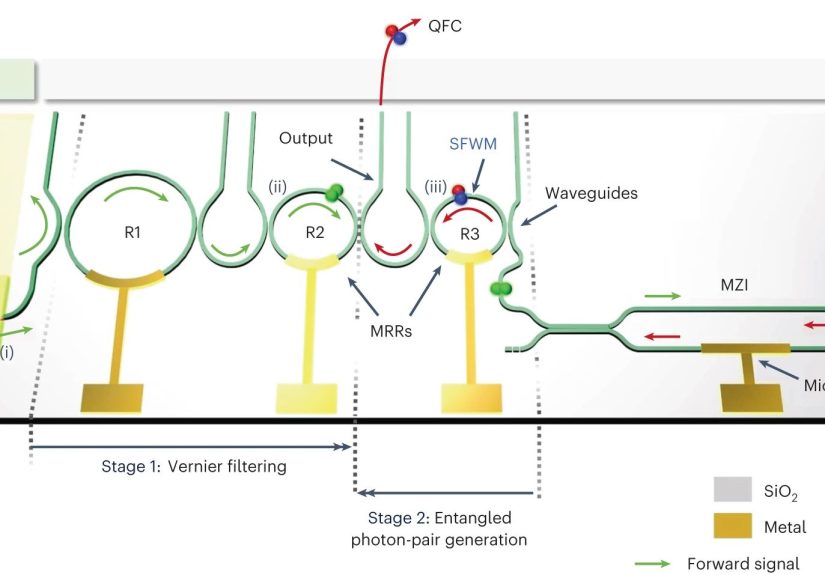
A modern fully integrated design often looks like this:
- On-chip (or co-packaged) pump laser: Often enabled by hybrid integrationcombining a gain medium (like InP) with low-loss waveguides.
- Tunable pump suppression filtering: High rejection is crucial so the pump doesn’t masquerade as “single photons.”
- Nonlinear microring or waveguide: Where photon pairs are generated via SFWM or SPDC.
- Routing and analysis circuitry: Interferometers, demultiplexers, phase shifters, and couplers to create and verify entanglement.
What makes this “turnkey” is not that it’s magicit’s that the chip architecture bakes in the controls that used to live on the bench. When everything is integrated, you can stabilize and scale more reliably, which is exactly what quantum networking and photonic quantum computing demand.
Entanglement Encodings That Play Nicely With Chips
Path entanglement: waveguides as the stage
Path encoding is the most chip-friendly: a photon in waveguide A vs waveguide B is your logical basis. Beam splitters become directional couplers; phase shifts come from thermo-optic heaters or electro-optic modulators; interferometers live as compact circuits. It’s clean, scalable, and the debugging is… well, still debugging, but at least it’s lithographic.
Time-bin entanglement: built for real fiber networks
Time-bin entanglement uses early/late arrival times as basis states. It’s popular for long-distance fiber transmission because it’s relatively robust against polarization drift. Integrated time-bin sources and interferometers can shrink what used to be “meters of stable fiber” into waveguides with controlled delays.
Frequency-bin entanglement: qudits by default
Frequency bins are where qudits often shine. A microring resonator can generate photon pairs across many mode pairs, producing a “quantum frequency comb.” By selecting and coherently mixing these bins, you can create entangled qubits (two bins), qutrits (three bins), or higher-dimensional qudits. Chips also excel at filtering and routing wavelength channels with AWGs, ring-based filters, or other integrated demultiplexers.
From Entangled Qubits to Entangled Qudits: A Concrete Example
Imagine a microring resonator generating photon pairs in multiple resonant frequency pairs around a pump. If the device supports several strong mode pairs, the state can become a coherent superposition across frequency-bin pairsyour qudit resource. You then use integrated filters to select which bins participate, and an on-chip interferometric network (often using phase shifters and couplers) to mix bins and measure high-dimensional interference.
In the lab, “making a qudit” often looks like “convincing multiple channels to interfere while the chip tries to drift with temperature.” On-chip integration helps because the optical paths are stable, repeatable, and easier to control with integrated heaters or modulators. The ultimate goal is a packaged module where selecting a qubit or a higher-dimensional qudit state is a configuration choicenot a weeklong alignment ritual.
What Good Looks Like: Metrics That Actually Matter
Quantum photonics papers can sometimes feel like a competition for who can write the fanciest acronym per square inch. Here are the performance metrics that most directly determine whether your on-chip source is a hero or a “cool demo”:
Brightness (pair generation rate)
Higher brightness means more usable entangled pairs per second. But brightness without quality is just noisy enthusiasm. You want high pair rates and high signal-to-noise after filtering.
Coincidence-to-accidental ratio (CAR) and pump suppression
CAR is a practical indicator of how clean your pair source is relative to background counts and multi-pair noise. Strong pump suppression filtering is criticalespecially in integrated systems that aim for compactness and detector compatibility.
Indistinguishability and interference visibility
Whether you’re doing Hong–Ou–Mandel interference or high-dimensional interference, visibility is your “am I really quantum?” report card. High visibility indicates photons are sufficiently indistinguishable and your circuit isn’t quietly sabotaging coherence.
Entanglement fidelity and Bell-violation strength
Entanglement is not a vibe; it’s a measurable property. Fidelity to a target Bell state (for qubits) or a maximally entangled state (for qudits) is a common figure of merit. Strong Bell inequality violations (when appropriate) are another way to confirm you’re not accidentally generating “classically correlated photons wearing quantum sunglasses.”
Material Platforms: Pick Your Superpower (And Your Tradeoffs)
Silicon nitride (SiN)
SiN is loved for low-loss waveguides and strong microresonator performance for SFWM. It’s a popular path to frequency-bin entanglement and scalable wavelength multiplexing.
Silicon photonics (Si)
Silicon offers high integration maturity and strong χ³ nonlinearity, but nonlinear absorption effects at telecom wavelengths can complicate things. Still, silicon photonics remains a major platform for integrated quantum photonics and complex circuits.
Thin-film lithium niobate (LNOI / TFLN)
TFLN is a rising star for SPDC sources and fast electro-optic control. If you want generation plus high-speed modulation on the same platform, lithium niobate is a compelling option.
AlGaAs-on-insulator
AlGaAs can be exceptionally bright in microring geometries and supports strong nonlinear interactions. It’s attractive for compact sources when you want lots of pairs at lower pump power.
Silicon carbide (SiC)
SiC has momentum both as a nonlinear photonic platform and as a host for color centershinting at hybrid systems that mix photons and solid-state spins. Integrated SiC sources are still emerging, but the platform is exciting for future integrated quantum technologies.
Design Patterns for Scalable On-Chip Entanglement
1) Wavelength multiplexing as the “scaling cheat code”
One of the biggest advantages of microresonator-based sources is that they can generate many channel pairs across a broad bandwidth. That means you can run multiple entangled channels in paralleluseful for higher key rates in quantum communication or higher throughput in photonic processors.
2) Integrated filtering that doesn’t hate you
Pump rejection isn’t optional. High-extinction filters (often ring-based or Vernier-style cascades) protect detectors and keep CAR respectable. A fully integrated architecture can incorporate tunable filtering so you can adapt to fabrication variation and thermal drift.
3) Thermal management and cross-talk control
Chips are small, and heat spreads. A phase shifter that’s meant to tune one interferometer can accidentally nudge its neighbor. Layout, isolation trenches, and careful control schemes help keep “tuning one knob” from becoming “tuning twelve knobs and bargaining with physics.”
4) Packaging: where many promising chips go to cry
Packaging is the grown-up part of the story. Low-loss fiber coupling, robust electrical routing, and stable temperature control determine whether an on-chip source can leave the lab. Advances in couplers, edge coupling, and wafer-scale testing are turning packaging from an artisanal craft into an engineering pipeline.
Where Fully On-Chip Entangled Sources Fit in the Real World
Quantum networking and QKD
Entangled photon sources are foundational for entanglement-based quantum key distribution and for future quantum repeaters. Time-bin and frequency-bin schemes can be especially compatible with deployed fiber networks.
Photonic quantum computing
Photonic approaches to quantum computing often rely on many high-quality indistinguishable photons and stable interferometric circuits. Integrated sources that generate entanglement directly on chip reduce system complexity and support scaling strategies like multiplexing.
Quantum sensing and metrology
Entanglement can improve sensitivity in certain measurement tasks. Integrated sources enable compact, stable architectures that can be deployed outside specialized labsespecially when paired with integrated detection and control.
Common Misconceptions (Because Quantum Already Has Enough Confusion)
“If it’s on a chip, it’s automatically scalable.”
Chips help scalability, but they don’t abolish loss, noise, and fabrication variability. Integration is a pathway to scalingplus a new set of engineering chores.
“Qudits are always better than qubits.”
Qudits are powerful, but they can increase system complexity in state preparation, calibration, and measurement. The best choice depends on the application, the network, and what your hardware can reliably control.
“Turnkey means no tuning.”
Turnkey means the tuning is designed-in, repeatable, and doesn’t require a PhD and a lucky charm. Some calibration remainsjust less of the “ritual.”
FAQ
What’s the simplest way to make entangled qubits on a photonic chip?
A common route is generating photon pairs (via SPDC or SFWM) and using an integrated interferometer to create path entanglement, then measuring with phase-controlled interferometric analyzers.
What’s the most chip-native route to qudits?
Frequency-bin qudits are very chip-native because microresonators naturally create discrete spectral modes, and integrated filters/interferometers can manipulate those modes with high stability.
Why integrate the lasercan’t we just couple in a nice external one?
You can, and many systems do. But integrating (or tightly co-packaging) the laser reduces size, cost, alignment burden, and operational fragility. It’s a major step toward deployment outside the lab.
What are the biggest engineering blockers today?
Loss, pump leakage, thermal drift, and packaging complexity are major hurdles. Integrating detectors and electronics in a manufacturable way is also a key challenge.
Experiences: What It’s Like Working With Fully On-Chip Photonic Entanglement Sources (The Human Side)
If you talk to people building or testing fully on-chip photonic quantum sources, you’ll notice a pattern: the first emotional milestone isn’t “We made entanglement.” It’s “We made the chip behave like a device.” That sounds less poetic, but it’s the difference between a weekend demo and a platform.
Early on, teams often describe a kind of “optical culture shock.” In bulk optics, you can visually trace beams, tweak mirrors, and feel in control (even if the control is mostly vibes). On a chip, everything is inside waveguides. You don’t see the photons; you infer them through counts and interference curves. The experience becomes more like debugging software: you make a change, measure the output, stare at plots, and ask, “Is this a physics issue or did I just forget to account for insertion loss again?”
One surprisingly universal moment is the first time you see a clean coincidence peak after turning on integrated filtering. Before that, the detector clicks can feel like a noisy rainstormpump leakage, Raman background, electronics noise, and the occasional “ghost count” that convinces everyone the universe is trolling you. When the suppression finally works and the coincidences settle into a clear signature, it feels like the chip has stopped shouting and started speaking in complete sentences.
Then comes the tuning dance. Integrated sources are stable, but not perfectly static. Resonators shift with temperature. Phase shifters warm the chip. Nearby components can cross-talk. Teams learn to treat temperature controllers like sacred objects. People swap stories about chasing a drifting resonance the way you’d chase a runaway shopping cartalways close enough to touch, never close enough to finish. This is where “turnkey” architecture shines: not because it eliminates tuning, but because it makes tuning systematic. Instead of a maze of external optics, you work with electrical controls and known transfer functions.
When moving from qubits to qudits, the “feel” of the work changes again. With qubits, you’re often validating entanglement with a relatively compact set of measurements. With qudits, the system becomes richermore channels, more interference settings, more calibration. The upside is thrilling: you’re manipulating a higher-dimensional Hilbert space on a device you can hold between two fingers. The downside is that every extra dimension is another opportunity for a tiny imperfection to show up like a coffee stain on a white shirt. People who do this well become experts in small losses, subtle phase errors, and the fine art of asking, “Are we seeing reduced visibility because the state is mixed, or because the measurement is miscalibrated?”
The most encouraging “experience” reported across groups is what happens when packaging improves. When coupling becomes repeatable and thermal stabilization is designed into the module, the time spent on alignment collapses. Suddenly, the focus shifts from “Can we make it work?” to “What can we build with it?” That’s the pivot photonic quantum tech needs. Because in the end, the promise of fully on-chip entangled qubits and qudits isn’t just academic elegance. It’s the practical possibility that entanglement becomes a componentsomething engineers can integrate into networks, processors, and sensors without requiring a dedicated room, a vibration-isolation table, and a heroic amount of espresso.







 Close
Close