
Table of Contents >> Show >> Hide
- Can You Really Put a Price on Indiana Jones’s Treasures?
- The Ark of the Covenant: Solid Gold and Off-the-Charts Hype
- The Holy Grail: A Humble Cup with an Immodest Price Tag
- The Sankara Stones: Sacred Relics Inspired by Real Objects
- The Chachapoyan Fertility Idol: Jungle Trap, Big Money
- The Crystal Skull of Akator: Shiny, Weird, and Surprisingly Affordable
- The Cross of Coronado, Spear of Destiny, and Other Glittering Relics
- The Dial of Destiny and the Real Antikythera Mechanism
- Ranking Indiana Jones Artifacts by Hypothetical Value
- Experiences, Fandom, and the Real “Worth” of Indiana Jones Artifacts
Indiana Jones doesn’t exactly follow best practices in modern cultural heritage law. He outruns boulders, punches Nazis, falls into snake pits, and then casually mutters,
“That belongs in a museum.” But if those ancient treasures ever made it to a (hypothetical) legal auction block, how much money are we actually talking about?
From the Ark of the Covenant to the Dial of Destiny, Indy’s greatest finds mix real history, religious legend, and pure Hollywood fantasy. That makes exact dollar figures
impossible, but we can make educated guesses by comparing them to real-world artifacts, high-profile auctions, and what collectors have already paid for Indiana Jones
movie props.
Can You Really Put a Price on Indiana Jones’s Treasures?
Before we start mentally bidding on the Ark, there’s one big caveat: most of these relics would never be sold legally. Items tied to major world religions, national heritage,
or ancient tombs are often considered “priceless” by museums and governments. They’re part of humanity’s shared history, and international conventions
heavily discourageor outright forbidtheir sale.
Still, auction records give us a starting point. A single 3,000-year-old bust of Tutankhamun sold for around
several million dollars despite intense protests from Egypt, and much smaller artifacts from ancient Egypt, Greece, and Rome regularly reach hundreds of thousands of
dollars at major auction houses. Even tiny objects with royal or religious connections can sell for well over $400,000. In other words: anything Indy hauls out of a temple
probably sits somewhere between “multi-million dollar masterpiece” and “no amount of money is enough.”
Then there are the movie props. A screen-used Ark of the Covenant prop from Raiders of the Lost Ark has been appraised in the low six figures,
and similar pieces have sold for over $100,000. For hardcore film collectors, the prop version of these artifacts can be as desirable as real antiquities.
The Ark of the Covenant: Solid Gold and Off-the-Charts Hype
Religious relic and cinematic superstar
In the Bible, the Ark of the Covenant is a sacred chest containing the tablets of the Ten Commandments. In Raiders of the Lost Ark, it’s also a weapon that melts
faces and makes your hair stand on end. As an object of faith, the Ark would be beyond pricing. But if we treated it as a physical artifact, what might it be worth?
What the materials might be worth alone
Fans and pop culture writers have tried to crunch the numbers using the biblical description of the Ark’s dimensions and its heavy gold overlay. One detailed estimate suggests
that the gold alone on such a chest could be worth roughly $60 million at contemporary gold pricesbefore you add any spiritual or historical
markup. Once you factor in uniqueness, religious significance, and global demand (if it were legally sold, which it wouldn’t be), you’re easily in the range of
hundreds of millions of dollars, if not more, in purely theoretical value.
The value of a movie Ark
The real-world saleable item we actually have is the film prop. A prototype Ark used in Raiders of the Lost Ark was appraised on Antiques Roadshow in the
$80,000–$120,000 range, with experts admitting it could realistically reach around a quarter of a million dollars at auction depending on demand.
Later Ark-related props have indeed sold for well into six figures.
So on our fictional ledger:
- “Real” Ark of the Covenant: Essentially priceless; easily “hundreds of millions” if a value were forced.
- Screen-used Ark prop: Roughly $100,000–$250,000 (and likely rising as the franchise ages).
The Holy Grail: A Humble Cup with an Immodest Price Tag
In Indiana Jones and the Last Crusade, Indy chooses the plain cup of a “carpenter” rather than an ornate gobletand he’s right. But a relic widely believed to be
the Holy Grail would be the ultimate Christian artifact. How do you price a cup associated (even just in popular belief) with Jesus and eternal life?
The market gives us hints. Relics with strong tiessometimes only traditional, not scientifically provento major religious figures can sell for enormous sums. Single
sculptures, reliquaries, or small ritual objects with royal or religious connections have already crossed the multi-million-dollar line. A cup widely accepted as the Holy Grail
would likely sit above even those values, simply because of the mythic power layered on top of its historical importance.
A reasonable (if conservative) thought experiment:
- Modest estimate: $50–$100+ million, if anyone could legally sell it.
- Realistic outcome: Declared a nationaland probably globaltreasure and removed from the market entirely.
The catch, of course, is proof. Without ironclad evidence, the Holy Grail quickly becomes “a very old cup with an incredible story,” and buyers become cautious.
That uncertainty would be a bigger price limiter than the cup’s material or age.
The Sankara Stones: Sacred Relics Inspired by Real Objects
The Sankara Stones from Temple of Doom are glowing, magical stones said to contain the power of the gods. In the real world, they’re inspired by sacred stones used
in Hindu worshipespecially lingams and other carved stones associated with deities like Shiva.
Real ritual stones aren’t typically treated as commodities the way ancient vases or statues are. Their value is often more spiritual than financial. But if we imagined
something like Indy’s Sankara Stones appearing at an auction as centuries-old carved religious objects, inlaid with precious gems and carrying a powerful story, you could
easily see:
- Low end: $250,000–$500,000 each as rare, heavily decorated sacred relics.
- High end: $1–$5 million each if the stones had royal or temple provenance and a sensational backstory.
Multiply that by three “canon” stones, and you’re suddenly looking at a cluster of artifacts thatwhile less universally famous than the Arkwould still make any museum curator faint.
The Chachapoyan Fertility Idol: Jungle Trap, Big Money
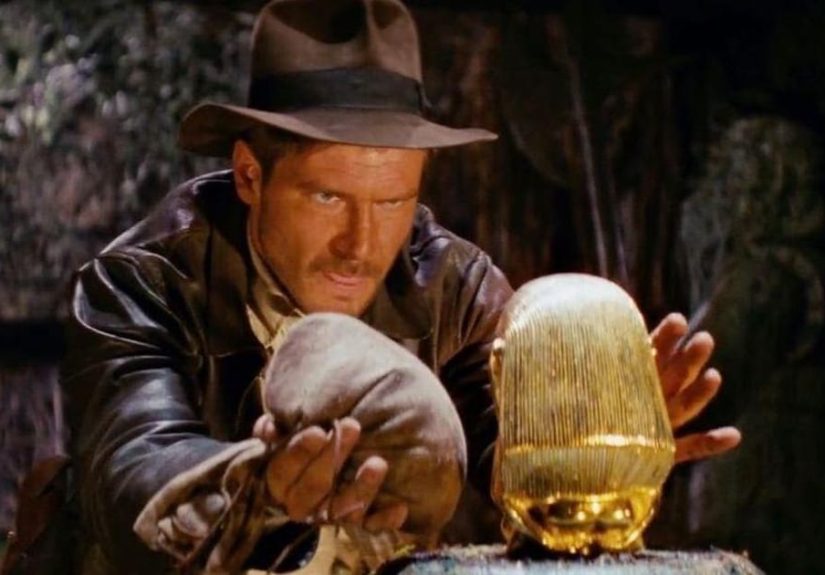
The golden idol Indy tries (and fails) to swap for a bag of sand in the opening of Raiders may be fictional, but it’s based on a real object. The design draws heavily
on an Aztec birthing figure in the Dumbarton Oaks collection in Washington, D.C.a sculpture that, ironically, later testing suggested might itself be a 19th-century
“ancient-looking” creation rather than a genuine pre-Columbian artifact.
Either way, a life-sized solid gold idol with that level of craftsmanship and mystique would command a huge price on the open marketif it were legally tradeable:
- As a genuine ancient gold idol: Low seven figures would be plausible, especially with ritual associations.
- As a documented 19th-century “fake” with a famous history: High six figures is not unrealistic; collectors pay dearly for iconic objects even when
they’re known to be later creations. - As an original screen-used idol prop: Likely in the $100,000+ range, given what other major movie props have fetched.
So when Indy risks his life for that idol, he’s chasing something thaton papercould rival high-end contemporary art in price, even before you add the emotional value of
having outrun a giant rolling boulder to get it.
The Crystal Skull of Akator: Shiny, Weird, and Surprisingly Affordable
Kingdom of the Crystal Skull takes inspiration from the real-world phenomenon of carved crystal skulls. Many of the famous skulls that circulated in the 19th and
20th centuries were later found to be modern creations, carved with steel tools unavailable in the ancient Americas.
That hasn’t stopped them from selling, but their values are way lower than Indy’s other finds. High-quality rock crystal carvings can fetch five figures, occasionally low
six figures if they’re large, detailed, and have a romantic (if dubious) backstory. But in general:
- Realistic market range for a crystal skull: Thousands to tens of thousands of dollars.
- True ancient, scientifically verified skull (if one existed): Could shoot into mid six figures or higher.
So while aliens and psychic visions make for fun cinema, a crystal skull is likely one of the cheapest major “Indiana Jones artifacts” in terms of real-world analogues.
The Cross of Coronado, Spear of Destiny, and Other Glittering Relics
Indy encounters a whole supporting cast of artifacts besides the big headliners. A few standouts:
The Cross of Coronado
The Cross of Coronado in Last Crusade is a jewel-studded gold crucifix linked to a Spanish explorer. As a historical type, it’s similar to ornate reliquary crosses
and colonial-era church treasures.
- Estimated range: $1–$5 million, assuming solid gold, high-grade gems, and verifiable 16th–17th century origins.
The Spear of Destiny
Versions of the Spear of Longinus (or Spear of Destiny) appear throughout pop culture, including in Indiana Jones tie-in material. An actual spear believed by many to
have pierced Christ’s side would be competing with the Holy Grail for “most blasphemously expensive relic.”
- Real-world analogue: A high medieval, heavily venerated relic with royal and papal connections. Think tens of millions of dollars in theoretical value.
Headpiece to the Staff of Ra and other “key” artifacts
Items like the Headpiece to the Staff of Ra or the Grail tablet function more as maps than treasures. As inscribed, symbol-rich stone or metal objects, they’re still
highly desirable artifacts, but their physical composition is less impressive than their narrative role.
- Estimate for a unique inscribed tablet or headpiece: low to mid six figures, potentially more with strong provenance or religious significance.
The Dial of Destiny and the Real Antikythera Mechanism
Indiana Jones and the Dial of Destiny centers on a device inspired by the real Antikythera mechanism, a 2,000-year-old Greek machine used to chart
movements of the sun, moon, and planets. The actual mechanism, pulled from a shipwreck near the island of Antikythera, is often described as the world’s first analog computer.
The real device is in a museum and absolutely not for sale. But if it were?
- It’s one of a kind, technologically centuries ahead of its time.
- It’s in every history of science textbook and a star of countless documentaries.
- It bridges high art, engineering genius, and historical mystery.
Those qualities would likely put it in the company of the most valuable artifacts on Earth. If a “Dial of Destiny” that was genuinely the Antikythera mechanism ever went on
the block, it could plausibly set recordswell into the tens or even hundreds of millions of dollarsbefore a government stepped in to stop the sale.
Ranking Indiana Jones Artifacts by Hypothetical Value
Putting it all together, here’s a tongue-in-cheek but semi-grounded ranking of Indy’s most famous artifacts by theoretical value:
- Ark of the Covenant – “Priceless,” with the gold alone in the tens of millions and the spiritual/cultural value off the charts.
- Holy Grail – A humble-looking cup potentially worth more than most museums’ entire collections if its identity were widely accepted.
- Spear of Destiny (Longinus) – Another religious megarelic that could, in theory, command tens of millions.
- Dial of Destiny / Antikythera analogue – A world-changing scientific artifact; think record-breaking auction territory.
- Cross of Coronado – A lavish gold and gemstone relic easily sitting in the low millions.
- Sankara Stones – Rare sacred stones with legendary power, potentially seven-figure objects in a purely hypothetical sale.
- Chachapoyan Fertility Idol – A striking gold idol likely in the high six- to low seven-figure range.
- Headpiece to the Staff of Ra, Grail tablet, and other “keys” – Six figures or more as unique inscribed artifacts.
- Crystal Skull of Akator – Real crystal skulls are comparatively modest: thousands to maybe low six figures.
Remember: in the real world, almost all of these would be locked behind glass with a label that says “Not For Sale” long before an auctioneer could clear their throat.
Experiences, Fandom, and the Real “Worth” of Indiana Jones Artifacts
It’s fun to fantasize about dollar signs, but for most of us, the real value of Indiana Jones’s artifacts comes from the experiences they createnot their hypothetical auction prices.
Think about what happens when you walk into a museum that leans into the Indiana Jones vibe. Maybe you’re standing in front of an ancient statue, a sarcophagus, or a case of
gold jewelry. There’s a little voice in your head saying, “Somewhere, Indy is trying to steal this… for a museum.” You know those objects are protected by climate control and
security systems, not rolling boulders, but the movie has rewired your imagination. Suddenly, an old pot isn’t boring anymore; it’s evidence of a lost world.
Replica props tap into the same feeling. A fan who buys a carefully crafted Ark of the Covenant or fertility idol replica isn’t really paying for resin and paint. They’re paying
for the moment when friends walk into their living room, spot the prop on a shelf, and immediately start humming the Raiders theme. Even a relatively inexpensive
replica becomes a conversation piece, a memory generator, and a personal connection to a beloved story.
Movie exhibitions push this even further. When screen-used Indiana Jones props go on displayfedoras, whips, idols, grail cupsthey attract crowds who want to stand a few
inches away from the physical objects that once shared a frame with Harrison Ford. The appraisal numbers are interesting, but the real thrill is emotional: you’re face-to-face
with a piece of your own pop-culture history.
There’s also a serious side to all this. The franchise has sparked a lifelong love of archaeology for countless people. Many modern archaeologists will admit that Indy was
their gateway into the fieldeven though real archaeology involves more paperwork and less whip-cracking. Exhibits that juxtapose Indiana Jones props with actual artifacts
invite visitors to ask important questions: Who owns the past? How should artifacts be excavated? When should items return to their countries of origin?
In that sense, the “value” of Indy’s artifacts shows up not just in hypothetical auction figures but in increased museum attendance, kids who decide to study history,
and ongoing debates about repatriation and ethics. A movie Ark might appraise at $120,000, but if it inspires thousands of people to care about preserving real-world sites
and objects, its cultural value is many times higher.
Finally, there’s the simple joy of imagination. When fans argue online about whether the Ark, the Grail, or the Dial of Destiny would be worth more, they’re really performing
a kind of playful thought experiment about what we, as a society, find priceless. Do we value spiritual relics more than scientific breakthroughs? Are we more impressed by
glittering gold or by complicated ancient gears? Every debate reveals a little about our prioritiesand that’s something no price tag can fully capture.
So, how much are the ancient artifacts in Indiana Jones actually worth? On paper, many would outrun even the most expensive real-world auction results. But in practice,
they’re worth exactly what they’ve always been to fans: a ticket to adventure, a nudge toward curiosity, and a reminder that the past is anything but boring.







 Close
Close