
Table of Contents >> Show >> Hide
- What “Accessible” Really Means (Spoiler: It’s Not Just a Ramp)
- Step 1: Pick the Right Space (and Measure Like You Mean It)
- Step 2: Design the Layout So It’s Not an Obstacle Course
- Step 3: Flooring, Lighting, and SoundThe “Invisible” Accessibility Upgrades
- Step 4: Choose Accessible Equipment (You Don’t Need a Warehouse of Machines)
- Step 5: Make Controls and Storage Easy (So Independence Isn’t Optional)
- Step 6: Build Safety Into the Setup (Not Just Your Warm-Up)
- Step 7: Program Your Gym for Real Life (Not Just Instagram)
- Budgeting: Accessible Doesn’t Have to Mean Expensive
- Common Mistakes (and How to Avoid Them)
- Real-World Experiences: What People Notice After They Build an Accessible Home Gym (500+ Words)
- Conclusion
Building a home gym is easy. Building an accessible home gym is also easyonce you stop treating your workout space like a game of “guess where the ankle-twisting hazard is.”
Accessibility isn’t a luxury add-on. It’s smart design that helps people with disabilities, older adults, people recovering from injury, and frankly anyone who has ever tried to carry a kettlebell while opening a door with their elbow.
In this guide, you’ll learn how to create an accessible home gym that’s safe, functional, and genuinely enjoyable to use. We’ll cover layout, flooring, lighting, equipment choices,
and practical details like storage and controlsplus specific examples you can copy without needing an architecture degree.
What “Accessible” Really Means (Spoiler: It’s Not Just a Ramp)
An accessible home gym is designed so people can enter, move around, and use equipment comfortablywhether they use a wheelchair, walker, cane, prosthetic, hearing aids,
have low vision, chronic pain, balance challenges, or sensory sensitivities. It’s also built to reduce injury risks (for everyone), because no one wants their fitness journey to include
“unexpected visit to urgent care.”
Accessibility basics you can actually apply at home
- Clear paths: You can get to the equipment without squeezing past clutter or doing a sideways crab-walk.
- Turning and maneuvering space: A wheelchair (or just a human carrying dumbbells) can turn around without rearranging furniture.
- Reachable controls: Lights, fans, music, and equipment adjustments aren’t mounted where only a giraffe can reach them.
- Stable, slip-resistant flooring: Because “slip ‘n slide burpees” shouldn’t be a thing.
- Flexible equipment options: Multiple ways to train strength and cardioseated, standing, supported, or with transfers.
Step 1: Pick the Right Space (and Measure Like You Mean It)
Start by choosing the most reachable place in your homenot necessarily the biggest. The best spot is often the one you can enter easily, with minimal barriers like
narrow doorways, steep steps, or tight corners.
Good home gym locations
- Spare bedroom: Usually climate-controlled and quieter. Great for mats, bands, dumbbells, and a compact cable setup.
- Garage: More room for racks and larger equipment, but watch out for temperature swings, uneven floors, and step-ups.
- Living room corner: Ideal for minimalist setups. Bonus: you’re already thereno “commute” required.
- Basement: Can be spacious, but check for stairs and low lighting before committing.
Use helpful accessibility benchmarks (even if you’re not “doing ADA”)
ADA standards are written for public facilities, but the measurements are useful targets for planning a home gym. Consider these practical benchmarks:
- Doorway clear width: Aim for about 32 inches of clear width through the doorway so mobility devices can pass comfortably.
- Clear route width: Plan for roughly 36 inches of continuous clear path where possible, so moving through the room feels natural, not like a puzzle.
- Turning space: If a wheelchair user will train in the space, try to preserve a 60-inch diameter turning area (or an equivalent T-turn zone).
- Clear floor space at equipment: A common planning minimum is 30 by 48 inches of clear space positioned for approach or transfer near key stations.
- Reach range for controls: Keep key controls and switches within a practical reach bandoften around 15 to 48 inches from the floor for many seated users.
If you can’t hit every measurement, don’t panic. Home spaces are real life, not a textbook diagram. The goal is to reduce barriers and make movement predictable and safe.
Step 2: Design the Layout So It’s Not an Obstacle Course
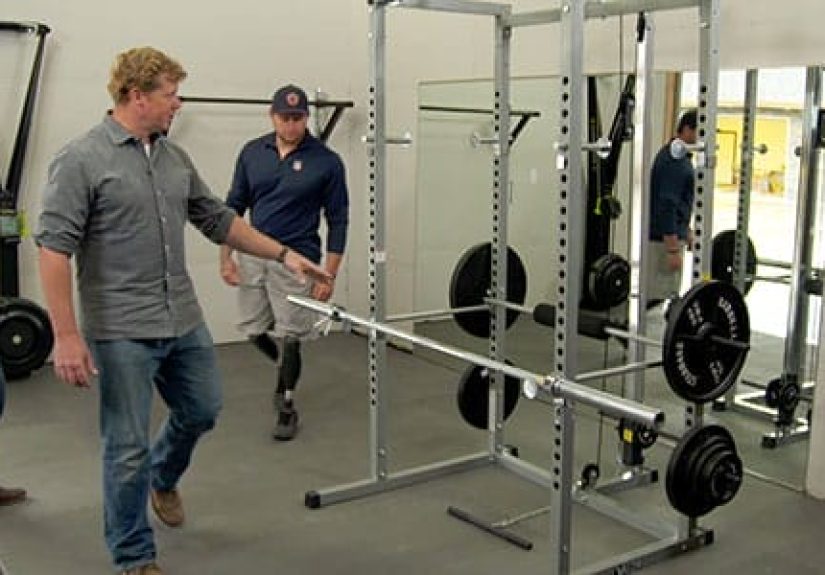
The layout matters more than fancy gear. A single treadmill shoved into a tight corner can be less usable than a few well-placed resistance bands in an open area.
Think in “zones” and leave room for approach, transfers, and stable positioning.
Recommended zones
- Warm-up & mobility zone: Open floor area, mat, foam roller, stretching strap, chair or bench for support.
- Strength zone: Dumbbells, kettlebell, bands, cable system, bench (ideally adjustable), or a wall-mounted pulley.
- Cardio zone: Options like seated cardio, arm ergometer, recumbent bike, or space for marching/low-impact movement.
- Recovery zone: A sturdy chair, massage ball, heat/ice storage, and a calm corner for breathing work.
Layout tips that improve accessibility immediately
- Keep the “main path” clear: Put frequently used items on the easiest-to-reach route, not behind the “just move the bike first” blockade.
- Anchor unstable items: Use wall hooks for bands, secure mats, and avoid loose rugs (they’re basically banana peels in disguise).
- Face equipment toward open space: Transfers and positioning are easier when there’s room to the side of a bench or seat.
- Plan for a helper when needed: If a caregiver assists, leave standing space beside primary stationsespecially near benches and cable systems.
Step 3: Flooring, Lighting, and SoundThe “Invisible” Accessibility Upgrades
Flooring: stable beats stylish
Flooring impacts traction, rolling resistance, fatigue, and fall risk. In general:
- Rubber flooring tiles are a popular choice: durable, supportive, and easy to clean.
- Low-pile commercial carpet can work for some, but it may increase rolling resistance for wheelchairs.
- Avoid thick plush rugs or anything with curled edges; they can trip walkers, catch canes, and fight wheelchair casters.
- Use non-slip mats under equipment to prevent sliding and protect floors.
Lighting: reduce glare, increase confidence
- Bright, even lighting helps people with low vision and reduces missteps.
- Avoid harsh glare off mirrors or glossy floorsdiffused LED lighting usually feels best.
- Use contrast cues: Dark equipment on dark flooring can disappear visually; adding contrast (mat color, edge tape, or lighting strips) improves navigation.
Sound and sensory comfort
Some people train better with high energy music; others need calmer sensory input. Build options:
- Noise control: Rubber flooring and wall panels can reduce echo (especially in garages).
- Quiet corner: A small “low stimulation” space can help people with migraines, PTSD, or sensory sensitivity keep the routine consistent.
- Visual simplicity: Storage bins and labeled zones reduce mental load. Your gym shouldn’t feel like a scavenger hunt.
Step 4: Choose Accessible Equipment (You Don’t Need a Warehouse of Machines)
The best equipment is the gear you can set up, use safely, and progress with. For accessibility, prioritize:
adjustability, stable support points, easy-grip options, and multiple positions (seated/standing/supported).
Strength training staples that work for many bodies
- Resistance bands (loop + handled): Cheap, portable, adaptable for seated or standing workouts.
- Adjustable dumbbells or dumbbell set: Lets you scale gradually without buying 37 pairs.
- Kettlebell(s): Great for hip hinge patterns and carrieschoose a handle shape that feels secure.
- Adjustable bench or sturdy chair: A stable seat can enable pressing, supported rows, step-ups, and sit-to-stands.
- Cable/pulley system: A wall-mounted pulley or functional trainer-style setup can be excellent for controlled range-of-motion work.
Cardio options with accessibility in mind
- Recumbent bike: Often easier for balance and transfers than upright bikes.
- Arm ergometer (hand cycle): A strong option for seated cardio and shoulder-friendly conditioning when used with good form.
- Seated cardio circuits: Bands, light dumbbells, and timed intervals can raise heart rate without dedicated machines.
- Treadmill (with caution): If used, prioritize side rails, stable entry/exit, and generous clearance around the machine.
Grip and control modifications (small changes, big payoff)
- Use adaptive grips (strap handles, thicker grips, or gloves) if tight grasping is hard.
- Choose lever-style adjustments when possibletiny twist knobs can be frustrating for limited hand dexterity.
- Label adjustments with large print or tactile markers so settings are repeatable.
Make equipment “approachable” with clear space
If a wheelchair user will use or transfer to equipment, leave deliberate clear floor space beside or in front of stations. As a planning concept used in accessibility standards,
exercise equipment benefits from clear floor space positioned for transfer or for use while seated in a wheelchair. That doesn’t mean you need to rebuild your homeit means you
don’t wedge the bench into the world’s tightest corner and call it a day.
Step 5: Make Controls and Storage Easy (So Independence Isn’t Optional)
Put daily-use items in the “golden zone”
Place the essentials (bands, collars, gloves, wipes, water bottle, phone stand) within comfortable reachoften between about mid-thigh and shoulder height for seated users,
and not buried in a bottom bin that requires a deadlift just to access a yoga strap.
Storage ideas that improve accessibility
- Wall-mounted pegboard with hooks for bands and handles
- Open shelving instead of deep drawers (less rummaging)
- Labeled bins with large print and/or tactile labels
- Rolling cart for frequently used items (especially useful in multi-purpose rooms)
Smart home upgrades that help
- Voice-controlled lights and fans (smart bulbs or smart plugs)
- Remote-controlled music so you’re not crossing the room mid-set
- Timer automation for intervals and restgreat for cognitive load and pacing
Step 6: Build Safety Into the Setup (Not Just Your Warm-Up)
Safety isn’t about being “careful.” It’s about designing a space where the safe option is the easy option.
Practical home gym safety checklist
- Stable support points: Keep a sturdy chair, bench, or anchored rail available for balance.
- Cable management: Route cords along walls; use cord covers to prevent trips.
- Emergency plan: Phone within reach, medical alert device if needed, and a clear way to call for help.
- Ventilation and temperature: Fans, dehumidifier, or heater as appropriatecomfort helps consistency.
- Start slow: Progress gradually, especially after injury or inactivity. Good form beats “hero reps.”
If balance is a concern, consider programming that includes strength and balance elements. Falls aren’t an inevitable part of agingtraining can reduce risk, and your gym can support that
with good lighting, clear paths, and stable surfaces.
Step 7: Program Your Gym for Real Life (Not Just Instagram)
An accessible home gym should match your goals and energybecause “train like a pro athlete” is not a requirement for health, and your body doesn’t care how aesthetic your squat rack looks.
Most adults benefit from a mix of aerobic activity plus muscle-strengthening work each week. Adults with disabilities can follow the same overall goals, adapted to their abilities and health status.
Simple weekly structure (adjust as needed)
- 2–3 days strength: Full body or split routine, using bands, dumbbells, cables, or bodyweight.
- 2–5 days cardio: Seated cardio, wheeling intervals, recumbent bike, arm cycle, or low-impact circuits.
- Daily mobility: 5–10 minutes of joint-friendly movement and stretching.
Concrete example: accessible full-body strength session
- Warm-up (5 minutes): Seated marching or arm swings, gentle shoulder circles, ankle pumps.
- Push: Seated dumbbell press or band chest press (3 sets of 8–12).
- Pull: Seated row with band/cable (3 sets of 8–12).
- Lower body: Sit-to-stand from a chair, supported squats, or seated leg extensions with bands (2–3 sets).
- Core/stability: Pallof press with a band, seated anti-rotation holds, or supported carries (2–3 sets).
- Cool-down: Gentle stretching and breathing (3–5 minutes).
If you’re living with paralysis, MS, or another condition that changes fatigue and recovery, it’s often helpful to use shorter intervals and track how your body responds.
A physical therapist or adaptive fitness professional can help tailor exercises and protect jointsespecially shoulders for wheelchair users.
Budgeting: Accessible Doesn’t Have to Mean Expensive
Accessibility can be surprisingly budget-friendly because it rewards space planning and smart choices over flashy gear.
Budget setup (starter)
- Resistance bands (loop + handled)
- Door anchor for bands (used safely with a solid door and correct positioning)
- Non-slip exercise mat
- Sturdy chair or basic bench
- Storage bin + wall hooks
Mid-range setup (most versatile)
- Adjustable dumbbells
- Adjustable bench
- Wall-mounted pulley/cable attachment
- Rubber floor tiles
- Smart plug for fan/lights
Higher investment setup (if you want “gym vibes”)
- Functional trainer or accessible cable system
- Recumbent bike or arm ergometer
- More robust flooring and sound control
- Dedicated storage and mirrors with glare control
Common Mistakes (and How to Avoid Them)
- Mistake: Buying equipment first, then realizing there’s no room to use it.
Fix: Tape out the footprint and clear space on the floor before you buy. - Mistake: Clutter “temporarily” living in the gym area forever.
Fix: Make storage part of the build, not a later apology. - Mistake: Controls and accessories placed too high or too low.
Fix: Keep daily-use items in an easy reach band and test from the positions you actually train in. - Mistake: Ignoring flooring and lighting.
Fix: Upgrade the environment first; it improves safety and follow-through immediately.
Real-World Experiences: What People Notice After They Build an Accessible Home Gym (500+ Words)
When people talk about building an accessible home gym, the first thing they mention is often equipment. But the experiences that stickgood and badusually come down to the “boring”
details: space, setup time, and whether the gym feels welcoming on low-energy days.
One common experience is the “I didn’t realize how exhausting barriers are” moment. Someone might be fully motivated to train, but if they have to move three boxes,
squeeze around a bike, and reposition a bench just to start, the workout becomes a chore before the first rep. After they redesign the layoutkeeping clear paths,
storing bands on hooks, and leaving a dedicated open area for transfers or seated movementtraining suddenly feels more independent and less draining. The workout becomes about
exercise, not about wrestling the room.
Another frequent takeaway: the floor matters more than expected. People often assume a mat is enough. Then they notice how a wheelchair caster catches on the edge,
or how a walker slips slightly on dusty concrete, or how a plush rug makes every movement feel unstable. Once they switch to stable, slip-resistant flooring (or even just
secure everything so it doesn’t shift), confidence improves. That confidence changes behavior: they try more exercises, they move more freely, and they stop “saving” workouts
for days when they feel perfectly steadywhich is a huge win for consistency.
Many people also learn that accessibility isn’t only physical. For someone with migraines, PTSD, or sensory overload, the gym experience can be derailed by harsh lighting,
echo, or a visually chaotic space. A small changelike softer lighting, fewer reflective surfaces, a quieter fan, or a calmer corner for recoverycan make the room usable
on days when symptoms flare. People often describe this as “giving themselves permission” to work out without pushing through unnecessary discomfort.
There’s also a pattern where users discover their “best” workouts are the ones that are easiest to start. For example, a wheelchair user might keep resistance bands attached
to a wall anchor at the right height, so a quick pull session takes two minutes to set up. Or someone with balance challenges might keep a sturdy chair positioned next to
their strength station, so supported squats and sit-to-stands are always an option. These setups reduce decision fatigueno daily negotiation with the environment.
The gym becomes reliable, and reliability is what turns good intentions into a routine.
Finally, people often report that an accessible home gym changes how they think about progress. Instead of chasing “perfect” workouts, they build a system where movement is always possible:
seated strength on fatigue days, mobility and breathing when pain is higher, cardio intervals when energy is good. That flexibility is empowering. It’s not about lowering standardsit’s about
designing a gym that respects real bodies, real schedules, and real life.
Conclusion
An accessible home gym is a space where more people can train more safely, more comfortably, and more consistently. Focus on layout first, then environment (flooring, lighting, sound),
then equipment. Aim for clear paths, reachable controls, stable surfaces, and flexible tools that support seated and standing movement. When the space works with you instead of against you,
the hardest part becomes the workout itselfexactly as it should be.




 Close
Close