
Table of Contents >> Show >> Hide
- Jump to a Method
- The No-Soggy Basics (Prep That Actually Matters)
- 1) Roasted: Sheet-Pan Caramelization
- 2) Broiled: Fast Char in Minutes
- 3) Grilled: Smoky, Stripey, and Snackable
- 4) Sautéed: Quick Skillet, Real Browning
- 5) Stir-Fried: Wok Heat, Crisp-Tender Bites
- 6) Air-Fried: Crisp Edges, Minimal Oil
- 7) Steamed (or Microwaved): Gentle and Bright
- 8) Baked: Stuffed Boats & Cozy Casseroles
- 9) Raw & Quick-Pickled: Crunchy, Zingy, Zero Heat
- of Real-World Summer Squash Experiences (That Will Feel Familiar)
- Conclusion
Summer squash is the friend who shows up to the party early, stays late, and somehow still asks if you need help cleaning up. Zucchini, yellow squash, pattypanthese tender, mild veggies are everywhere in warm weather, and they’ll happily take on whatever flavor you throw at them.
The catch? Summer squash is basically 95% “I’m holding water for later.” If you cook it the wrong way, it goes from “golden and flavorful” to “sad, squeaky, and suspiciously wet.” The good news: once you learn a few moisture-smart moves, you can cook summer squash in ways that are roasted and caramelized, grilled and smoky, sautéed and quick, or air-fried and crisp.
The No-Soggy Basics (Prep That Actually Matters)
Pick the right squash
For the best texture, choose small-to-medium summer squash (zucchini, yellow squash, or pattypan) that feels firm and heavy for its size. Bigger isn’t better here: oversized squash often has more seeds, thicker skin, and a texture that can lean spongy.
Cut with a purpose
- For roasting/broiling: thicker chunks or spears (they hold shape and brown better).
- For sautéing/stir-fry: half-moons or batons about 1/4–1/2 inch thick so they sear instead of collapse.
- For grilling: planks or thick coins so they don’t fall through the grates or turn floppy.
- For raw/pickled: ribbons or paper-thin coins for maximum crunch and zing.
When (and when not) to salt
Salting draws out moisturegreat for sautéing, air-frying, fritters, and anything where you want browning instead of steaming. But for grilling, a lot of cooks skip pre-salting because the hot grill naturally evaporates moisture, and pre-salting can push the squash toward limp-ville faster than you can say “where’s the tongs?”
Give it space
Whether you’re roasting on a sheet pan or sautéing in a skillet, crowding is the fastest route to soggy squash. Squash releases water, water turns into steam, and steam is basically the opposite of “golden brown.” If you want browning, spread it out and cook in batches.
Seasoning strategy (the small hack that tastes big)
Summer squash is mild, which is a polite way of saying “it’s waiting for instructions.” Use a two-step approach: season lightly before cooking (salt, pepper, maybe garlic powder), then finish with a “pop” after cooking: lemon zest, fresh herbs, grated Parmesan, chili crisp, toasted nuts, or a drizzle of good olive oil.
1) Roasted: Sheet-Pan Caramelization
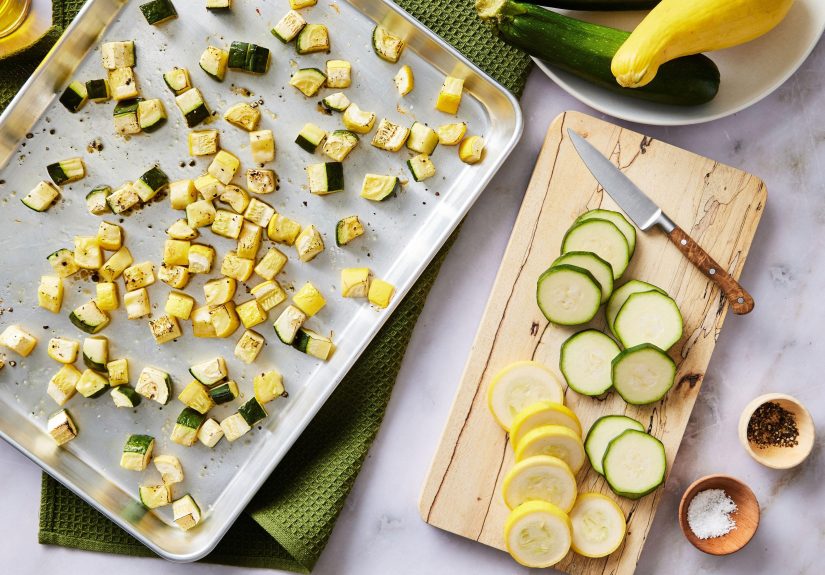
Roasting is the “set it and forget it” method that rewards you with browned edges and concentrated flavor. The trick is high heat and not too much oilenough to coat, not enough to create a squash slip-n-slide.
How to do it
- Heat the oven to 425–450°F.
- Cut squash into spears or 1-inch chunks (thicker pieces roast better than thin coins).
- Toss with olive oil, salt, pepper. Add dry spices now (Italian seasoning, smoked paprika, cumin).
- Spread in a single layer with breathing room.
- Roast 12–18 minutes, flipping once, until browned at the edges and tender.
Flavor ideas that don’t feel like homework
- Lemon-Parmesan: finish with lemon zest + Parmesan + black pepper.
- Southwest: chili powder + cumin, then lime + cotija.
- Mediterranean: oregano + garlic, then feta + chopped dill.
Common mistake: slicing too thin and crowding the pan. Thin slices steam fast; give them thickness and space.
2) Broiled: Fast Char in Minutes
Broiling is roasting’s impatient cousin. You get quick blistered spots and a little smoky flavorwithout stepping outside or negotiating with mosquitoes.
How to do it
- Set broiler to high and position a rack about 5–6 inches from the heat.
- Slice squash into 1/2-inch coins or planks.
- Toss with oil, salt, pepper. Add a pinch of sugar if you want extra browning (optional, but fun).
- Broil 3–5 minutes, flip, then broil another 2–4 minutes until lightly charred.
Best finishing moves
- Drizzle with balsamic glaze or a quick vinaigrette.
- Top with chopped basil + toasted pine nuts.
- Add a spoonful of herby yogurt sauce for a cool contrast.
Common mistake: walking away. Broilers do not “simmer down.” They escalate.
3) Grilled: Smoky, Stripey, and Snackable
Grilling makes summer squash taste like summer. Use thicker cuts so the squash stays crisp-tender and picks up grill marks instead of becoming a floppy bookmark.
How to do it
- Heat grill to medium (or medium-high if your grill runs gentle).
- Cut into thick coins (3/4–1 inch) or planks.
- Brush lightly with oil and season with salt and pepper.
- Grill until just tender with marks: typically 8–10 minutes total, turning once or twice.
Marinade tip
If you marinate, keep it shortespecially with acidic marinades. Too long and the squash can soften before it ever hits the grate.
Flavor ideas
- Sweet & spicy: honey + soy + chili paste glaze.
- Classic: olive oil + garlic + oregano, then finish with feta.
- Bright: lime + cilantro + sesame seeds.
4) Sautéed: Quick Skillet, Real Browning
This is the Tuesday-night method: one pan, fast results, and you can still pretend you “cooked” even if you ate it standing at the counter. The key is high heat and not overcrowding.
How to do it
- Slice into half-moons (1/4–1/2 inch thick).
- If you want extra browning, salt the slices for 15–30 minutes, then pat dry.
- Heat a wide skillet over medium-high with a tablespoon of oil.
- Add squash in a single layer; let it sit so it browns.
- Cook 6–10 minutes, tossing occasionally, until tender with browned spots.
Make it taste expensive
- Add minced garlic in the last minute so it doesn’t burn.
- Finish with lemon juice + Parmesan.
- Toss in cherry tomatoes at the end for a quick pan sauce.
5) Stir-Fried: Wok Heat, Crisp-Tender Bites
Stir-frying is your best friend when you want summer squash with bite. High heat cooks fast, and you can pair it with anything: tofu, chicken, shrimp, noodles, ricewhatever is currently living in your fridge.
How to do it
- Cut into batons (think “short fries”) so they don’t over-soften.
- Heat a wok or large skillet until very hot; add a high-smoke-point oil.
- Add squash and stir-fry 2–4 minutes until bright and lightly browned.
- Add aromatics (ginger, garlic, scallions) near the end to keep them fragrant.
- Finish with sauce quickly: soy + sesame + splash of rice vinegar, or miso + butter.
Shortcut sauce combo
Mix 1 tablespoon soy sauce + 1 teaspoon sesame oil + 1 teaspoon honey + squeeze of lime. Toss at the very end.
6) Air-Fried: Crisp Edges, Minimal Oil
Air-frying is the modern miracle that makes squash feel snacky. It’s especially great when you want crispness without deep-frying. The main rule: dry squash + single layer.
Two easy styles
Option A: “Naked” air-fried coins (fast)
- Slice into 1/2-inch coins. Salt 10–20 minutes, then pat dry (optional but helps).
- Toss with a small amount of oil, salt, pepper, and garlic powder.
- Air-fry at 380–400°F for 7–10 minutes, shaking halfway.
Option B: Lightly breaded (crispier)
- Pat squash very dry.
- Dip in beaten egg (or buttermilk), then coat with panko + Parmesan.
- Air-fry at 400°F for 6–8 minutes until golden, working in batches.
Dip ideas: ranch (classic), garlicky yogurt, marinara, or a quick spicy mayo.
7) Steamed (or Microwaved): Gentle and Bright
Steaming gets a bad rap because it’s often under-seasoned. But it’s genuinely useful when you want squash that tastes clean and fresh, especially as a base for bold sauces (pesto, romesco, chimichurri, tahini dressing).
Stovetop steaming
- Slice into 1/4–1/2 inch coins.
- Steam 3–5 minutes until just tender.
- Season after steaming: salt, pepper, olive oil, and something punchy (lemon, herbs, cheese).
Microwave “steam” (weekday magic)
- Put sliced squash in a microwave-safe bowl with 1–2 tablespoons water.
- Cover (loosely) and microwave on high 4–6 minutes, stirring once.
- Drain if needed, then season generously.
Best use: fold into pasta with pesto, or top with toasted breadcrumbs and Parmesan.
8) Baked: Stuffed Boats & Cozy Casseroles
Baking turns summer squash into dinner instead of “side dish that disappears behind the chicken.” The trick is to treat squash like a vessel: scoop a little, fill it with flavor, and bake until everything is melty and unified like a feel-good movie montage.
Stuffed zucchini or yellow squash boats
- Halve squash lengthwise. Scoop out some center to make room (save the pulp).
- Salt the shells lightly and let them sit 10 minutes; pat dry.
- Cook a filling: browned sausage or ground turkey, onion, garlic, the chopped squash pulp, and marinara.
- Fill the boats, top with mozzarella or Parmesan.
- Bake at 375–400°F for 25–40 minutes until tender and bubbling.
Easy casserole/gratin idea
Layer sliced squash with sautéed onions, a little cream or tomato sauce, and a crunchy topping (panko + Parmesan). Bake until browned. This is how you use up a pile of squash without admitting your garden is now your landlord.
9) Raw & Quick-Pickled: Crunchy, Zingy, Zero Heat
Yes, you can eat summer squash raw. When it’s fresh and firm, it’s crisp, mild, and perfect for saladsespecially with lemon, vinegar, and salty cheese. Quick-pickling pushes it even further into “I could eat this straight from the jar” territory.
Shaved summer squash salad
- Use a vegetable peeler to shave ribbons (or slice very thin).
- Toss with olive oil, lemon juice, salt, and pepper.
- Add shaved Parmesan, toasted almonds, and basil or mint.
Quick-pickled squash (refrigerator style)
- Slice thin. Salt for 15 minutes, then pat dry.
- Cover with warm vinegar brine (vinegar + water + sugar + salt). Add turmeric, mustard seed, dill, or chili if you want.
- Chill at least 1 hour. Snack relentlessly.
Where to use it: burgers, sandwiches, grain bowls, tacos, or as a crunchy side for grilled anything.
of Real-World Summer Squash Experiences (That Will Feel Familiar)
If summer had a soundtrack, summer squash would be the background vocals: always present, sometimes overlooked, and occasionally so loud you wonder how it got in the studio. When squash season hits, it’s rarely “one zucchini.” It’s a bag. Or a box. Or a neighbor casually handing you a zucchini the size of a small canoe and saying, “We just have so many.”
That’s usually when the first common experience happens: the “everything tastes like wet squash” week. You sauté it, it releases water. You bake it, it releases water. You blink, and suddenly there’s a pale green puddle mocking you from the bottom of the pan. This is the moment most home cooks learn the single most important lesson: squash doesn’t need more timeit needs the right conditions. High heat, enough space, and a plan for moisture. When you switch from “let’s cook it gently” to “let’s brown it on purpose,” the flavor shows up like it finally got the invite.
Another familiar moment: the “I tried to be healthy and now I’m chewing a sponge” situation. This usually happens when zucchini coins go into a lukewarm skillet with not enough oil, too much crowding, and a lot of optimism. The fix is surprisingly simple: make the pan hotter, keep the layer thinner (in the pan, not in the slices), and let the squash sit long enough to actually brown before you start stirring like you’re whisking a soufflé. Browning equals flavor, and flavor equals you not ordering takeout at 9:12 p.m.
Then there’s the air fryer phasethe one where you realize you can turn summer squash into a snack that disappears faster than chips. The experience most people share here is “Why is this soggy?” followed by “Oh… I stacked it.” Air fryers are not magical portals; they’re tiny convection ovens that demand airflow. Dry the squash, avoid overcrowding, and you’ll get crisp edges that make you feel like a kitchen genius.
Grilling brings its own classic memory: the first time you flip a too-thin slice and it folds like a sad little paperback. Once you graduate to thicker planks or coins, grilling becomes a highlightespecially when you finish with something bold like feta, herbs, or a sweet-spicy glaze. It’s also the method that convinces skeptics, because smoky char makes squash taste like it belongs next to burgers instead of being a “health side.”
Finally, the sleeper hit: raw and quick-pickled squash. People often assume zucchini is only for cooking, then they shave it into ribbons, toss it with lemon, Parmesan, and mint, and suddenly it’s a bright salad that feels restaurant-y with almost no effort. Quick-pickles are even more addictive: they solve the “too much squash” problem by turning it into something crunchy and tangy that you’ll actively look for excuses to eat.
The overall experience? Summer squash is wildly versatile once you stop asking it to behave like a dry vegetable. Treat it like what it istender, watery, mildand it will reward you with everything from caramelized roasted bites to crisp air-fried coins and zingy pickled ribbons.





 Close
Close