
Table of Contents >> Show >> Hide
- What Is a Checkerboard Cake?
- Two Methods That Actually Work
- Tools and Ingredients You’ll Want on Your Side
- Step 1: Choose Your Cake Strategy (Sturdy Beats Fluffy Here)
- Step 2: Bake Even Layers (Because Geometry Is Not Forgiving)
- Step 3: Build the Checkerboard (Pick Your Method)
- Step 4: Stack, Fill, and Frost Like You Mean It
- How to Slice for the Best Reveal
- Troubleshooting: Fix the Most Common Checkerboard Problems
- Flavor Ideas That Look Cool and Taste Even Better
- Make-Ahead and Storage Tips
- Extra “Experience” Notes: What It’s Really Like Making a Checkerboard Cake (and Why You’ll Do It Again)
- Conclusion
A checkerboard cake is basically a magic trick you can eat. One minute it looks like a normal frosted layer cake.
The next minuteslice!everyone’s staring at perfect squares like you smuggled a bakery wizard into your kitchen.
The good news: you don’t need wizard blood. You need a plan, a little patience, and the willingness to embrace the fact
that frosting is basically edible glue (and honestly, we love that for us).
What Is a Checkerboard Cake?
A checkerboard cake is a layer cake with an interior pattern made by alternating rings (or sections) of two different
cake colors/flavorsthink vanilla + chocolate, or white cake dyed pink + blue. When stacked correctly, the rings line up
into a checkerboard pattern when sliced.
The “wow” factor comes from contrast. The “win” comes from structure. The best checkerboard cakes use sturdy, even layers
that cut cleanly and stack without slumping.
Two Methods That Actually Work
There are two reliable ways to build a checkerboard cake. Pick the one that matches your tools (and your personality).
Method 1: The Checkerboard Pan Insert (Fast, Neat, Minimal Drama)
This method uses a special set with a dividing ring that fits into the cake pan. You pipe or spoon different batters into
the ring’s sections, remove the ring, and bake a layer that already has concentric “bullseye” bands baked in. Stack the
layers with the color order alternating and you’re done.
Method 2: The Cut-and-Swap Ring Method (No Special Pan, Maximum Bragging Rights)
Bake solid-colored layers (two colors), then cut each layer into concentric rings with round cutters. Swap the rings like
a pastry puzzle. This is the most common “I can’t believe I pulled that off” methodand it’s easier than it sounds when
you follow the steps.
Tools and Ingredients You’ll Want on Your Side
Tools
- 2–4 round cake pans (8-inch or 9-inch are easiest to find and decorate)
- Parchment paper + nonstick spray or butter/flour
- Kitchen scale (highly recommended for even layers)
- Offset spatula and/or bench scraper (for frosting without chaos)
- Round cutters (for the cut-and-swap method): e.g., 6"/4"/2" for 8" cakes, or 6"/3" for 9" cakes
- Long serrated knife (for clean slicing and leveling)
- Optional but helpful: cake turntable, cake leveler, piping bags, baking strips
Ingredients
- Cake batter in two contrasting colors (either two flavors or one batter split and colored)
- Frosting that spreads easily (buttercream is the classic choice)
- Gel food coloring (if you’re tinting batter or frosting)
- Optional fillings: jam, ganache, curd, or sprinkles (keep it not-too-runny)
Step 1: Choose Your Cake Strategy (Sturdy Beats Fluffy Here)
Checkerboard cakes love structure. Super airy sponge cakes can work, but they’re more likely to tear when you cut rings.
A classic butter cake, vanilla layer cake, or chocolate layer cake tends to slice cleanly and hold its shape.
You have two easy flavor paths:
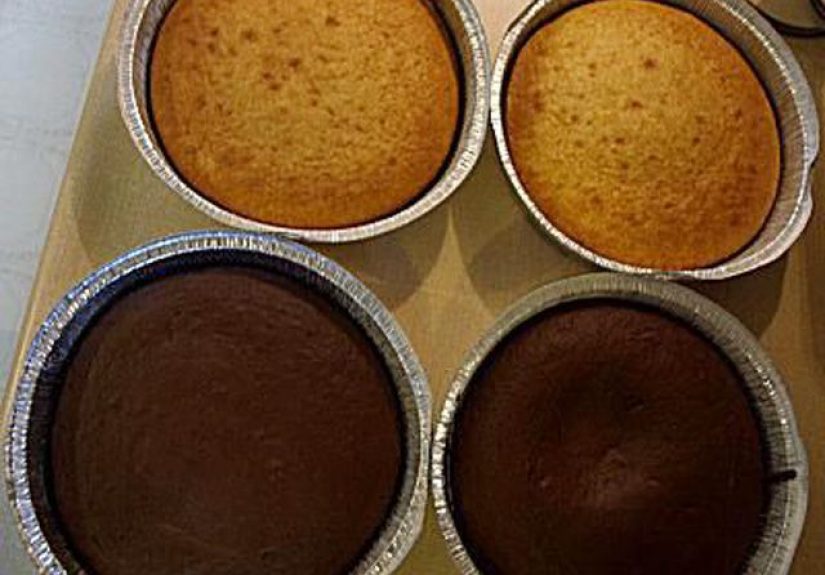
- Two batters: bake a vanilla cake and a chocolate cake (same pan size, same thickness).
- One batter, split and tint: make one vanilla batter, divide it evenly, then color half with gel coloring (or add cocoa to one portion).
If you add cocoa powder to change color, remember you’re also changing dryness. Balance it with a splash of milk, sour cream,
or coffee so your “dark” rings don’t end up moodier and drier than your “light” rings.
Step 2: Bake Even Layers (Because Geometry Is Not Forgiving)
Prep the pans
Line the bottoms with parchment and grease the sides. Even if your pans are “nonstick,” cake is a confident liar. Give
yourself the insurance policy.
Measure batter for consistent thickness
The #1 secret to a crisp checkerboard is layers that are the same height. Use a scale: weigh your batter and divide it so
each pan gets the same amount. Aim for layers about 1 inch tall after levelingthick enough to handle, thin enough to cut
cleanly.
Bake and cool fully
Bake until the cake springs back lightly when touched and a tester comes out with a few moist crumbs (not wet batter).
Let layers cool in the pan briefly, then turn out and cool completely. If you try to cut warm cake, you’ll create a
delicious pile of crumbs and regret.
Pro move: once cooled, wrap layers and chill for 30–60 minutes. Cold cake cuts cleaner. Warm cake cuts like
a sad cloud.
Step 3: Build the Checkerboard (Pick Your Method)
Method 1: Using a Checkerboard Pan Insert
- Place the dividing ring in the pan. It will separate the pan into concentric sections.
- Fill the sections with alternating batters. Many bakers use piping bags so the batter lands exactly where it should.
- Remove the ring carefully. Smooth the top gently if needed.
- Bake and cool. Repeat for additional layers, changing the color order for the next layer to create the checkerboard when stacked.
This method is ideal if you want clean results with fewer steps. The tradeoff is buying the pan setworth it if you plan to
make this cake more than once (or if you just enjoy gadgets the way some people enjoy sunsets).
Method 2: Cut-and-Swap Rings (The Classic)
This method uses two colors of baked layers. You’ll cut each layer into rings and reassemble them with alternating colors.
Here’s the play-by-play.
1) Level the cakes
If your layers domed, slice off the tops with a serrated knife so each layer is flat. Flat layers stack neatly. Domed layers
stack like a toddler building a block tower during a sugar rush.
2) Cut concentric rings
For an 8-inch cake, a common setup is three cuts: 6", 4", and 2" (giving you an outer ring, a middle ring, and a center).
For a 9-inch cake, many bakers use 6" and 3" cutters to create an outer ring, a middle ring, and a center.
Press the cutters straight down. Don’t twist aggressivelytwisting can tear the crumb and make jagged edges.
3) Reassemble like a puzzle
Take one layer of Color A and one layer of Color B. For the first assembled layer:
- Outer ring: Color A
- Middle ring: Color B
- Center: Color A
For the next assembled layer, flip the pattern:
- Outer ring: Color B
- Middle ring: Color A
- Center: Color B
4) “Glue” the rings (yes, with frosting)
Before stacking layers, spread a thin swipe of frosting on the cut edges where rings meet. This helps the cake
hold together when sliced. Think of it as edible spackledelicious home improvement.
Step 4: Stack, Fill, and Frost Like You Mean It
Stacking basics
- Anchor the first layer with a small dollop of frosting on the cake board/plate so it doesn’t slide.
- Add your first checkerboard layer, then spread an even layer of frosting on top.
- Repeat with alternating checkerboard layers, checking alignment as you go.
Use a crumb coat (your future self will thank you)
A crumb coat is a thin, first layer of frosting that traps loose crumbs so your final coat looks smooth and clean.
Spread a light layer over the whole cake, then chill it until the frosting firms up. After that, apply your final frosting
layer without dragging crumbs everywhere.
Final coat and decoration
Once the crumb coat is chilled, frost the cake smoothly. Keep decorations simple if you want the inside to be the headline:
a clean buttercream finish, sprinkles around the base, or a drizzle that doesn’t hide your hard work.
How to Slice for the Best Reveal
The first cut is the moment. Make it count:
- Chill the cake 20–30 minutes before slicing for cleaner edges.
- Use a long serrated knife and saw gently (no aggressive hacking).
- Wipe the blade between slices so colors stay crisp.
Troubleshooting: Fix the Most Common Checkerboard Problems
Problem: My rings don’t line up (pattern looks wobbly)
- Cause: Uneven layer height or off-center cutting.
- Fix: Level layers carefully, use a scale for batter, and center cutters before pressing down.
Problem: Gaps between rings
- Cause: Rough cuts or rings shrinking a bit after cutting.
- Fix: Use a thin swipe of frosting on ring edges before assembling. Press gently to snug pieces together.
Problem: Cake crumbles when cutting
- Cause: Cake is too warm, too delicate, or slightly overbaked/dry.
- Fix: Chill layers before cutting. Consider a sturdier cake recipe and avoid baking until “bone dry.”
Problem: Colors are dull
- Cause: Weak coloring or too little contrast.
- Fix: Use gel food coloring for bold color with less liquid. Choose high-contrast pairings.
Problem: Cake leans after frosting
- Cause: Uneven layers or too-soft frosting.
- Fix: Chill between steps, stack on a flat surface, and keep frosting at a spreadablebut not runnyconsistency.
Flavor Ideas That Look Cool and Taste Even Better
- Classic: Vanilla + chocolate (crowd-pleasing and clearly visible)
- Birthday party: Funfetti + blue vanilla (or any bright tint)
- Holiday: Red velvet + vanilla cream
- Spring: Lemon + raspberry-tinted vanilla
- Grown-up: Espresso chocolate + vanilla bean
Keep the flavors compatibleyour eyes might love neon green and deep purple, but your taste buds still want something that
makes sense together.
Make-Ahead and Storage Tips
- Make ahead: Bake layers a day early, wrap tightly, and chill. Cold layers cut cleaner and frost easier.
- Short storage: Frosted cake holds well in the fridge for a couple of days; bring to room temp for best texture.
- Freezing: Unfrosted layers freeze well when wrapped tightly. Thaw in the fridge overnight.
Extra “Experience” Notes: What It’s Really Like Making a Checkerboard Cake (and Why You’ll Do It Again)
Let’s talk about the part no one tells you in those perfect, glossy photos: a checkerboard cake is a tiny emotional journey.
Not a traumatic onemore like a sitcom episode where the kitchen is the set and you’re the main character learning “a valuable
lesson” while covered in powdered sugar.
The first “experience” most home bakers have is realizing the cake layers don’t magically bake flat. You pull them out,
they’re domed, and suddenly you’re negotiating with a serrated knife like it’s a delicate art project. This is where people
discover that leveling isn’t just for professionals; it’s the difference between crisp checkerboard squares and a pattern
that looks like it was designed by a friendly earthquake. Once you level a couple layers and see them stack cleanly, you’ll
start doing it for every layer cake foreverbecause now you know what “easy mode” feels like.
Next comes cutting the rings. The first press of the cutter is usually satisfying… and the second is when you notice you’re
slightly off-center. The good news? Checkerboard cakes are forgiving when you stay consistent. If your rings are a little
uneven but you repeat the same pattern across layers, the inside still looks intentional. It’s the baking version of
“confidence sells it.” Also: chilled cake is a game-changer. People who try to cut warm cake learn quickly that warm cake
doesn’t “cut,” it “crumbles artistically.” Pop those layers in the fridge and suddenly you’re slicing clean circles like you
meant to do this all along.
Another common real-world moment: discovering that frosting is not just decorationit’s construction material. When you dab a
thin layer of buttercream on the ring edges, your cake goes from “precarious puzzle” to “stable showpiece.” Many bakers
describe the first successful stack as oddly thrilling, like building IKEA furniture that actually comes out straight. The
crumb coat is the next graduation level. The first time you crumb-coat and chill, then apply a smooth final coat without
dragging crumbs, you’ll feel like you unlocked a secret baking perk.
Color is its own chapter of experience. People often start with liquid food coloring, then wonder why they need half the
bottle to get a decent shadeand why the batter suddenly looks thinner. That’s why gel colors become the “ohhh, this is what
the pros do” upgrade. The best part? You don’t need extreme shades. A strong contrastlike chocolate and vanillareads as
“wow” every time, even if you’re not trying to match a unicorn-themed balloon arch in the background.
Finally, there’s the reveal. Even bakers who swear they’re “not that sentimental” get a little spark when the first slice
comes out and the pattern is actually there. People lean in. Phones appear. Someone says, “Wait, you MADE that?” and you get
to casually nod like this is just what happens in your kitchen now. The funny thing is, after one successful checkerboard
cake, you stop thinking of it as impossible. You start thinking of it as a repeatable processbake, chill, cut, swap, glue,
crumb coat, finish. And once it becomes a process, it becomes a party trick you can pull out anytime you want maximum
applause with minimum mystery.
Conclusion
A checkerboard cake looks complicated, but it’s really a series of simple steps: bake even layers, cut clean rings (or use a
pan insert), alternate colors, and frost with intention. Chill often, measure when you can, and treat frosting like the
delicious structural support it is. Do that, and you’ll get sharp squares, clean slices, and a “how did you DO that?” moment
every single time.





 Close
Close