
Table of Contents >> Show >> Hide
- Step 1: Make a Shade Game Plan for Your Pergola
- Popular DIY Pergola Shade Options (and When to Use Each)
- DIY Project: Build a Simple Fabric Canopy for Your Pergola
- DIY Project: Add Side Shade with Curtains or Panels
- Pro-Level Design and Safety Tips for Pergola Shade
- Budget and Time: What to Expect
- Real-Life DIY Pergola Shade Experiences
- Conclusion: Turn Your Pergola into a Cool, Shady Retreat
You finally built that beautiful pergola… and then discovered that it’s basically a very fancy
sun magnifier. Great for tomatoes, not so great for your forehead. The good news? Adding shade
to a pergola is one of the easiest outdoor upgrades you can DIY, and you’ve got a ton of stylish
optionsfrom breezy fabric canopies to lush, leafy “living roofs.”
In this guide, we’ll walk through the best DIY pergola shade ideas, then dive into step-by-step
instructions for building a fabric canopy and adding side shade like curtains or panels.
We’ll also talk budget, safety, and real-life lessons so you can enjoy your outdoor space
without feeling like you’re sitting on the surface of the sun.
Step 1: Make a Shade Game Plan for Your Pergola
Before you start ordering fabric and hardware, take a few minutes to plan. A little “shade
strategy” up front will make your project look intentional instead of improvised.
Map the sun and wind
- Watch where the sun hits: Check your pergola in the morning, midday, and late afternoon. Is the sun mostly overhead, or blasting in from one side?
- Note your hottest time of day: If evenings are brutal, you may need side shade (like curtains) in addition to a top cover.
- Consider wind: A breezy yard is great for comfort but rough on loose fabric and sails. Choose sturdy mounting and breathable materials.
Decide how permanent you want the shade to be
- Seasonal shade: Removable shade cloth, simple fabric panels, or shade sails you can take down in winter.
- Year-round shade: Lattice panels, slatted wood, metal or polycarbonate roofing, or a louvered system.
- Flexible shade: Retractable pergola canopies and outdoor curtains you can open and close.
Set a realistic budget and skill level
Most DIY pergola shade projects fall somewhere between “weekend project with basic tools”
and “I now know my local hardware staff by first name.” A simple fixed fabric canopy can cost
under a couple hundred dollars in materials, while more complex retractable systems or solid
roofs can climb higher. Think honestly about:
- Your comfort with drills, ladders, and measuring.
- Whether you’re okay climbing on a ladder to install hardware safely.
- Local rules or HOA guidelines about permanent roof structures.
Popular DIY Pergola Shade Options (and When to Use Each)
There’s no one “right” way to shade a pergola. Mix and match these ideas depending on your sun,
style, and budget.
1. Retractable fabric canopy
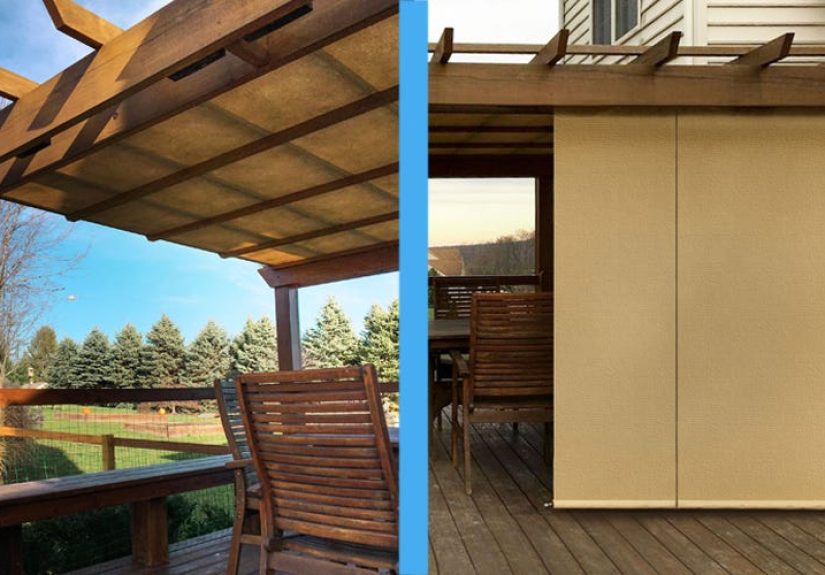
A retractable pergola canopy uses fabric panels that slide along tracks or cables. You can pull
them closed for full shade or stack them open to enjoy the sky. This option is perfect if you:
- Want control over how much sun you get.
- Have hot summers but pleasant spring and fall sunshine.
- Like a slightly more polished, “resort” look.
2. Fixed fabric canopy or shade cloth
A fixed canopy is the simplest DIY pergola shade: stretch shade cloth or outdoor fabric across
the top and secure it to the beams or using battens. It’s ideal if you:
- Want affordable, quick shade.
- Don’t mind leaving the cover up most of the time.
- Like a casual, relaxed vibe.
3. Shade sails
Shade sails are triangular or rectangular pieces of tensioned fabric that attach to posts,
walls, or pergola beams. They add a modern look and work well when:
- Your pergola doesn’t fully align with the sun’s path.
- You want dramatic angles and visual interest.
- You’re okay with some open gaps instead of full coverage.
4. Lattice panels and slatted roofs
Adding wood slats or lattice on top of your pergola boosts shade and gives it a more finished
roof. The closer the spacing, the more shade you get. This is good for:
- Homeowners who want a permanent structure.
- Classic or traditional backyard styles.
- Pairing with climbing plants for a “secret garden” feel.
5. Climbing plants and a living green roof
Vines like wisteria, grapevines, jasmine, or climbing roses will eventually create a lush,
dappled shade on your pergola. This option:
- Looks gorgeous and natural.
- Works best if you’re patient (plants need time).
- May still need a backup shade cloth in intense climates.
6. Outdoor curtains and side panels
Curtains don’t shade the top, but they block low-angle sun from the sides and add privacy and
softness. You can combine curtains with any top cover to create a cozy outdoor room feel.
7. Solid panels: metal, polycarbonate, or louvered roofs
If you want shade and some rain protection, you can add solid roofing such as corrugated
metal, polycarbonate panels, or an adjustable louver system. These are a bigger investment
and may require permits, but they transform your pergola into a more all-weather space.
DIY Project: Build a Simple Fabric Canopy for Your Pergola
Let’s walk through a straightforward DIY pergola shade project: a fabric canopy that runs on
cables or wood battens. This is a great middle ground between easy and impressive.
Tools and materials (typical list)
- Measuring tape and marker.
- Drill/driver with appropriate bits.
- Ladder (rated for outdoor use).
- Outdoor fabric or shade cloth (UV-resistant, 60–90% shade).
- Stainless steel eye screws or pad eyes.
- Wire rope or stainless steel cable (or conduit/wood battens).
- Cable clamps, turnbuckles, and anchors (if using wire rope).
- Grommet kit or curtain clips.
- Wood screws and washers if attaching battens to rafters.
Step 1: Measure your pergola and plan your panel layout
Measure the inside span of your pergola where the shade will go: length and width between
beams. Decide if you want:
- One large panel that covers the whole top, or
- Several narrower panels that can stack and create a “striped” look.
Multiple panels are easier to tension and handle, and they look great when loosely draped in
soft waves.
Step 2: Choose the right fabric
For a pergola shade, you want fabric that:
- Is rated for outdoor use (UV-resistant and mildew-resistant).
- Provides enough shade (look for 80–90% shade rating for hot climates).
- Either breathes (shade cloth) or sheds water (outdoor canvas or coated fabric), depending on your climate.
Breathable shade cloth is usually more forgiving in wind and heat, while waterproof fabrics
can trap hot air if the top is fully sealed.
Step 3: Install cables or support battens
You need something for your fabric panels to ride on. Two common approaches:
-
Wire-rope system: Install pairs of stainless steel eye screws or pad eyes
along opposing beams, then run wire rope between them. Use turnbuckles to tension the
cables so they don’t sag. -
Wood battens or conduit: Attach thin, straight boards (like 1x2s or 2x2s)
or metal conduit across the pergola, parallel to one another. Your fabric panels can be
stapled or screwed to these battens.
Space the cables or battens to match the width of each panel so the canopy drapes evenly and
doesn’t gather awkwardly in the middle.
Step 4: Cut and finish your fabric panels
-
Cut each fabric strip a bit longer than the measured span so there’s extra length to sag
gently and wrap around end hardware. - Hem the edges (if your fabric frays) with an iron-on hem tape or a sewing machine.
- Add grommets along the long edges or ends where you’ll attach clips, hooks, or ties.
No sewing machine? Use shade cloth with heat-sealed edges or have a local awning or upholstery
shop finish the panels for you.
Step 5: Hang the panels and adjust the drape
- Attach the fabric to the cables using curtain clips, carabiners, or S-hooks through the grommets.
- Slide the panels back and forth to test the retractable motion.
- Tension the cables with the turnbuckles until the fabric hangs in neat waves without flapping wildly.
- Fine-tune how much sag you want: more sag = softer look, less sag = crisper and less wind-prone.
Step 6: Test for wind and water
Give the canopy a gentle tug and shake to mimic a gusty day. If it moves too much, tighten the
cables and reduce the fabric sag. In rainy climates, make sure the fabric slopes slightly so
water doesn’t poolpanels can be angled to one side or center to encourage runoff.
DIY Project: Add Side Shade with Curtains or Panels
Top shade is half the battle. If the sun slants in from the sidesespecially in late afternoon
outdoor curtains or shade panels can make your pergola dramatically more comfortable and private.
What you’ll need
- Outdoor curtain rods, conduit, or cable kits.
- Mounting brackets or eye screws.
- Outdoor curtains or DIY curtain panels (outdoor fabric or shade cloth).
- Tiebacks or simple hooks to secure curtains when open.
Step 1: Decide where you need side shade most
Watch where low sun hits your seating area. Usually, curtains go on the west or southwest side.
You don’t have to enclose the whole pergola; sometimes one or two well-placed panels are enough.
Step 2: Mount curtain rods or cables
- Mark mounting locations on pergola posts or beams so rods are level.
- Install brackets or eye screws according to the hardware instructions.
- Slide the rod in or run cable between eye screws, keeping it taut and secure.
Step 3: Hang and manage your curtains
- Thread curtains onto the rod or attach them with rings/clips.
- Check that they slide easily; sand or repaint any rough wood that snags fabric.
- Add tiebacks or wall hooks where you can secure curtains on breezy days.
For a more tailored look, hem curtains so the bottoms just skim the deck rather than puddling
in a way that collects dirt and water.
Pro-Level Design and Safety Tips for Pergola Shade
Think about structure and load
- Don’t overload your pergola: Heavy roofing or thick wet fabric adds weight. Make sure posts, beams, and footings are sized and anchored properly.
- Mind the wind: In very windy areas, consider removable shade cloth or panels you can take down before storms.
- Use outdoor-rated hardware: Stainless steel or galvanized fasteners resist rust and extend the life of your project.
Plan for maintenance from day one
- Choose fabrics that are washable or at least hose-off friendly.
- Seal or stain wood slats or lattice to resist sun and moisture.
- Check hardware every season and tighten any loose screws or cables.
Keep it safe around heat sources
If you have a grill, firepit, or outdoor heater under or near your pergola, use non-combustible
or high-temperature-rated materials overhead. Give grills and open flames plenty of clearance
from fabric and plants. A shady pergola is lovely; a flaming one, not so much.
Don’t forget the finishing touches
Once your shade is in place, layer in the fun stuff:
- String lights woven through rafters or along the canopy edges.
- Outdoor rugs to define the seating area.
- Cushions and throw pillows in colors that echo your canopy fabric.
- Potted plants or hanging baskets at the corners for a garden-room feel.
Budget and Time: What to Expect
Costs vary by size and materials, but here’s a ballpark:
- Simple fixed shade cloth: Often the least expensive; expect to pay mainly for fabric and basic fasteners.
- DIY retractable canopy: Slightly more due to cable hardware, grommets, and heavier fabric, but still very DIY-friendly.
- Lattice/slat roof: More lumber and fasteners, plus finish (stain/paint), but long-lasting and low-maintenance once built.
- Solid or louvered roof systems: Higher cost and may be closer to a renovation than a quick project, but they create a true outdoor room.
Timewise, a small pergola shade cloth install can be a half-day project. A custom retractable
canopy may take a full weekend once you factor in measuring, fabric prep, and careful hardware
installation.
Real-Life DIY Pergola Shade Experiences
Theory is nice, but the real learning happens after you’ve climbed the ladder eighteen times and
discovered your “perfect” plan needs adjusting. Here are some common lessons and experiences
homeowners share after adding shade to their pergolas.
Lesson 1: Measure twice, then measure again in the afternoon
Many people measure their pergola once in the morning, build a beautiful canopy, and then
discover that by late afternoon the sun has shifted and is now blazing in from the side.
One homeowner in a hot desert climate planned a top canopy only, then realized the 5 p.m.
sun still turned the space into a toaster. The fix? Adding a single panel of outdoor curtains
on the west side. Moral of the story: measure the space and observe the sun at different times
before deciding where your shade should go.
Lesson 2: Wind is the silent troublemaker
Light, flowing fabric looks dreamy on Pinterest, but if you live in a breezy area, loose
panels quickly become airborne parachutes. DIYers often report that their first attempt with
very lightweight curtains or loosely draped sheets ended with tangled fabric, broken clips,
and a lot of dramatic flapping. The successful version usually involves:
- Heavier outdoor fabric or shade cloth.
- More attachment points (closer-spaced grommets or clips).
- Tiebacks or weights at the bottom of curtains.
If your area gets strong storms, having a setup that you can easily unclip and store before bad
weather is a huge stress reducer.
Lesson 3: A little slope goes a long way
Flat fabric looks clean but can secretly become a water bucket. Many homeowners find out during
the first rain that their canopy holds water instead of shedding it, stretching the fabric and
straining the hardware. After one especially soggy storm, a DIYer realized they needed a slight
pitch from one side of the pergola to the other, plus tighter cable tension. After re-installing
with a bit of slope, the water ran off instead of pooling, and the fabric lasted much longer.
Lesson 4: Comfort isn’t just about shade
People often focus only on blocking sunlight, but once they start using the space, they realize
comfort is also about airflow and brightness. A pergola with a solid, dark-colored cover might
technically be shady, but it can feel cave-like and stuffy. Some DIYers switch to lighter,
breathable shade cloth or combine lattice and fabric to keep some light and air movement.
Others add a ceiling fan or portable fan to keep air moving under dense coverings.
Lesson 5: Your pergola quickly becomes the favorite “room”
Once shade is dialed in, people tend to use their pergola much more than they expected. Morning
coffee, kids’ homework, weekend barbecues, even laptop workdays migrate outdoors. Many
homeowners who start with a basic shade project find themselves gradually upgrading: adding
string lights, a small outdoor bar, an area rug, heaters for shoulder seasons, or a sound system.
The shaded pergola turns into a genuine extension of the house, not just something pretty in
the backyard.
Lesson 6: It’s okay to start simple and upgrade later
Real-world projects rarely turn out exactly like the first sketch. A lot of people begin with
an inexpensive fixed shade cloth while they test how they actually use the space. Over time,
they may upgrade to a retractable canopy, add curtains, or pair shade cloth with climbing vines
for a softer look. Starting simple lets you learn what works in your climate and for your
lifestyle before committing to a more permanent build.
The big takeaway from these experiences: don’t stress about perfection on day one. Focus on a
safe, solid installation and a shade solution that fits your budget now. You can always tweak
fabrics, layouts, and accessories until your pergola feels like the outdoor living room you’ve
always wanted.
Conclusion: Turn Your Pergola into a Cool, Shady Retreat
Shading your pergola doesn’t have to be complicated or expensive. With a basic plan, a few
measurements, and some outdoor-friendly materials, you can build a DIY pergola shade that fits
your climate, style, and budget. Whether you choose a simple shade cloth, a retractable canopy,
or a combination of curtains, lattice, and plants, the goal is the same: more comfort and more
time outside.
Start with the sun path, pick a shade strategy that suits your space, and take your time
installing hardware securely. Add in lighting, textiles, and plants, and your pergola will go
from “too bright to sit” to “why didn’t we do this years ago?” every time you step outside.





 Close
Close