
Table of Contents >> Show >> Hide
- Why measure body fat instead of just weight?
- Quick primer: the kinds of fat that matter
- The most accurate ways to measure body fat (clinical & lab methods)
- Practical ways to measure body fat at home (and how to make them less wrong)
- Body fat percentage ranges for adults (what’s typical and what’s risky)
- Which method should you choose?
- A simple protocol for tracking body fat without losing your mind
- Example: what “good tracking” looks like in real life
- 500+ words of real-world experiences: what people notice when measuring body fat
- Wrap-up: the best body fat measurement is the one you can repeat
If you’ve ever stepped on a “smart” scale and watched your body fat percentage jump like it saw a spider, welcome to the club. Measuring body fat can be incredibly usefuland also incredibly easy to do poorly. The good news: once you understand what each method is actually measuring (and what it’s guessing), you can get numbers that are accurate enough for your goals, whether you’re chasing performance, managing health risks, or just trying to figure out why your jeans suddenly have trust issues.
This guide breaks down the most accurate ways to measure body fat, the best practical at-home options, and the typical body fat percentage ranges for adults. Along the way, we’ll talk error margins, real-world examples, and how to track changes without spiraling over a decimal point.
Why measure body fat instead of just weight?
Body weight is a single number. Body composition is the story behind the numberhow much is fat mass, lean mass (muscle, organs, water), and bone. Two people can weigh the same and look completely different because their proportions differ.
That’s also why metrics like BMI can miss the plot. BMI uses only height and weight, so it can’t separate muscle from fat or tell you where fat is stored. Measuring body fat (and related measurements like waist circumference) can add clarity, especially if you’re trying to improve health markers or performance.
Quick primer: the kinds of fat that matter
- Essential fat: The minimum fat your body needs to function (hormones, organs, nervous system).
- Subcutaneous fat: The fat under your skin. Not automatically “bad”it’s also energy storage.
- Visceral fat: Fat stored around organs in the abdomen. Higher levels are linked to higher metabolic risk.
Most consumer methods estimate total body fat. Some clinical methods can estimate regional fat distribution, and imaging can assess visceral fat more directlyuseful when health risk is the main concern.
The most accurate ways to measure body fat (clinical & lab methods)
If you want the tightest accuracy, these are the heavy hitters. They’re also usually the most expensive and the least “I’ll do it before breakfast.”
1) DXA/DEXA scan (Dual-energy X-ray Absorptiometry)
A DXA scan uses low-dose X-rays to break your body into compartments: bone mineral content, lean soft tissue, and fat mass. It can also report regional values (arms, legs, trunk) anddepending on the systemestimates of central fat distribution.
Why people like it:
- Excellent repeatability for tracking changes over time.
- Provides regional breakdowns, not just a single percentage.
- Often used in clinical research and sports medicine settings.
Limitations:
- Access and cost vary widely by location.
- Results can differ slightly between machines and software versions (so try to use the same facility).
- “Visceral fat” may be estimated rather than directly measured.
Practical tip: for tracking, consistency beats perfection. A DXA scan at baseline and another 8–16 weeks later can be more meaningful than weekly measurements from different tools.
2) Hydrostatic weighing (underwater weighing)
Hydrostatic weighing estimates body density using Archimedes’ principle: your “underwater weight” is different because water provides buoyancy. From density, equations estimate fat mass and fat-free mass.
Why people like it:
- Historically considered a “gold standard” for decades.
- Strong accuracy when done well, especially when lung volume is properly accounted for.
Limitations:
- Technique-sensitive: fully exhaling underwater matters (yes, it’s as fun as it sounds).
- Not ideal if you hate being submerged, have anxiety in water, or can’t comfortably follow the protocol.
3) Air displacement plethysmography (ADP / Bod Pod)
The Bod Pod estimates body volume by measuring how much air you displace in a sealed chamber, then calculates body density and estimates body fat percentage.
Why people like it:
- Fast, noninvasive, and less “underwater panic” than hydrostatic weighing.
- Common in university labs and some wellness programs.
Limitations:
- Can show bias at very low or very high body fat levels compared with DXA in some studies.
- Protocol matters: clothing, hair, and moisture can affect readings (yes, your damp hair can weigh in).
4) MRI and CT imaging (mostly for visceral fat)
MRI and CT can assess fat distribution and quantify visceral fat more directly than most other methods. These are typically used in medical or research settings, not routine fitness tracking.
- MRI: no ionizing radiation, but expensive and less accessible.
- CT: can quantify visceral fat well, but uses ionizing radiation, so it’s not a casual “monthly check-in.”
Practical ways to measure body fat at home (and how to make them less wrong)
If you’re not getting a DXA scan every time you think about pizza (financially wise), these methods can still be very usefulespecially for tracking trends.
1) Bioelectrical impedance analysis (BIA): smart scales and handheld devices
BIA devices send a small electrical signal through the body and estimate total body water. From there, they estimate fat-free mass and fat mass using prediction equations.
Pros: quick, easy, widely available, great for routine trend tracking.
Cons: hydration status can swing results. Food, alcohol, sodium, hard workouts, sweating, and even menstrual cycle shifts can change water balanceso your scale may mistake “salty dinner” for “instant fat gain.”
Make BIA more consistent:
- Measure at the same time of day (morning is best).
- Use the bathroom first (your body is not a closed system).
- Measure before eating and before coffee if possible.
- Avoid hard exercise, alcohol, or big salty meals the night before measurement when you can.
- Track a weekly average, not a single reading.
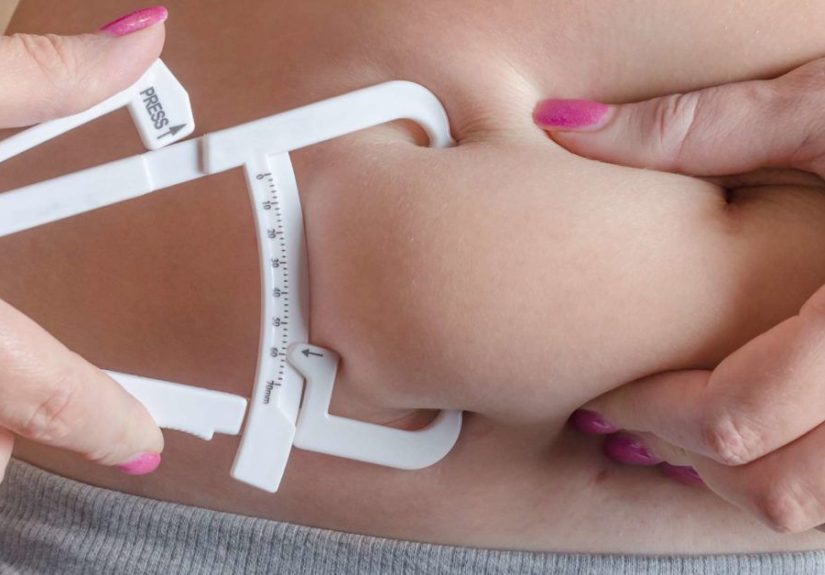
2) Skinfold calipers (anthropometric testing)
Skinfold testing estimates body fat by measuring the thickness of pinched subcutaneous fat at specific sites, then applying validated equations (commonly 3-site or 7-site protocols).
Pros: inexpensive, portable, and useful when performed by a trained person.
Cons: operator skill matters a lot. Different calipers, site location errors, and inconsistent pinching technique can shift results. Many clinics and fitness centers cite a typical error margin in the “few percentage points” range for this style of testing.
How to get better results with calipers:
- Use the same tester each time (your friend who “watched a tutorial once” is not a standardized instrument).
- Use the same protocol (3-site vs 7-site) every time.
- Take multiple readings per site and use the average.
- Track changes over time rather than obsessing over the exact number.
3) Tape-measure methods: the U.S. Navy body fat method
The U.S. Navy method estimates body fat percentage using circumference measurements and formulas. It’s popular because it’s cheap and surprisingly decent for a method that costs about $7 in measuring tape.
What you measure:
- Men: height, neck, waist/abdomen circumference
- Women: height, neck, waist, hip circumference
How to make it less chaotic:
- Measure on bare skin (or thin clothing) with the tape level and snug, not strangling.
- Measure at the same anatomical landmarks each time.
- Take measurements after a normal exhale and avoid “sucking in” (it’s not a photo shoot).
- Repeat 2–3 times and average.
Like other field methods, the Navy approach is best used to track trends, not to crown a single reading as “the truth.”
4) Waist circumference and waist-to-hip ratio (not body fat %, but very useful)
Waist measurements don’t tell you your body fat percentage, but they’re excellent for tracking abdominal fat trends and health risk. Major U.S. health agencies commonly cite higher risk thresholds at about 35 inches for women and 40 inches for men.
How to measure your waist correctly:
- Stand tall, relaxed.
- Place the tape measure around your middle just above your hipbones.
- Exhale normally (don’t force it), then measure.
If your main goal is health risk reduction, waist circumference plus overall fitness markers (blood pressure, lipids, glucose, endurance, strength) can be more actionable than chasing a “perfect” body fat number.
Body fat percentage ranges for adults (what’s typical and what’s risky)
“Healthy” body fat depends on sex, age, genetics, and athletic demands. But broad categories can provide context. One commonly referenced set of categories comes from the American Council on Exercise (ACE).
| Category | Men | Women |
|---|---|---|
| Essential fat | 2–5% | 10–13% |
| Athletes | 6–13% | 14–20% |
| Fitness | 14–17% | 21–24% |
| Average | 18–24% | 25–31% |
| Obese | 25%+ | 32%+ |
Two important reality checks:
- Lower isn’t always better. Extremely low body fat can come with real health risks (hormonal disruption, low energy availability, poor recovery).
- Age changes the baseline. Many adults see body fat percentage rise with age even if weight stays stable, partly due to changes in muscle mass and activity patterns.
Which method should you choose?
Here’s a practical way to match the tool to the job:
- Highest accuracy / detailed breakdown: DXA (best for baseline + periodic check-ins).
- Very accurate but more “involved”: hydrostatic weighing or Bod Pod (great if you have access).
- At-home trend tracking: BIA scale, taken consistently + combined with waist measurements.
- Budget-friendly and surprisingly useful: Navy tape method + waist circumference trend.
- Performance-focused athletes: consider DXA for regional lean mass tracking, plus consistent field measures between scans.
A simple protocol for tracking body fat without losing your mind
If you want data that actually helps, steal this boring-but-effective routine:
- Pick one primary method (BIA scale, tape method, or calipers) and stick to it.
- Measure 1–2 times per week under similar conditions (same time, same hydration pattern).
- Record a weekly average (or median) instead of obsessing over a single reading.
- Add waist circumference once per week as your “truth serum” for abdominal changes.
- Optional: Get a DXA scan every 2–4 months if you want a high-quality checkpoint.
Example: what “good tracking” looks like in real life
Let’s say Maya wants to lose fat while keeping strength. She does this:
- Week 0: DXA scan for baseline.
- Weeks 1–12: BIA scale twice weekly (morning), plus waist circumference weekly.
- She ignores single-day spikes and watches the 4-week trend line.
- Week 12–16: Repeat DXA scan at the same facility.
If the DXA shows fat mass down and lean mass stable, she’s winningeven if her scale weight barely moved because strength training increased muscle glycogen and water. The point of measuring body fat is to see what weight alone can’t.
500+ words of real-world experiences: what people notice when measuring body fat
Measuring body fat in the real world is less like reading a thermometer and more like dating: you’ll get better results when you stop expecting perfection and start looking for patterns.
One of the most common experiences is the “scale stall, body change” surprise. People start lifting, eat a bit more protein, and suddenly the bathroom scale refuses to budge. But their waist measurement drops, their arms look more defined, and a periodic DXA scan shows fat mass down and lean mass up. The takeaway: your body can recompositionlose fat and gain musclewithout giving the scale dramatic headlines.
Then there’s the BIA emotional roller coaster. Many people notice their smart scale reads leaner after a sweaty workout (because fluid shifts change impedance) or reads higher body fat after a salty meal or a long flight (hello, water retention). The best “fix” isn’t buying a fancier gadgetit’s using a repeatable protocol. Morning readings, similar hydration, and weekly averages can turn BIA from chaos goblin to “pretty useful trend tool.”
Calipers bring their own character development arc. In gyms and wellness clinics, people often report that their first skinfold test feels oddly specificlike being graded on a group project you didn’t know you signed up for. The results can also vary depending on who measures you. That’s why experienced testers matter. When the same trained person repeats the same protocol every time, calipers can provide a steady signal of progress, especially for tracking changes in subcutaneous fat.
Tape measurements (including the Navy method) are a crowd favorite because they feel “old school” in the best way: simple, cheap, and hard to accidentally update with a software patch. People who succeed with tape tracking usually do one thing right: they measure in the same place, the same way, every time. People who struggle tend to “move the tape around” until they find the number that feels emotionally supportive. (Respectfully: your tape measure is not your therapist.)
Finally, people who try DXA often describe it as a reality checksometimes pleasantly, sometimes not. It’s common to learn that you carry more (or less) body fat than you assumed, or that your fat distribution is different than expected. The best outcome of that surprise is clarity: you can stop guessing and build a plan based on actual measurements. The worst outcome is obsessing over tiny changes between scans. A healthy mindset is to treat DXA like a quarterly audit, not a daily report card.
The most consistent “success story” across methods is this: people get better results when they combine measurements (body fat trend + waist circumference + performance markers), and when they track trends over weeksnot mood swings over days. Your body is a biological system, not a spreadsheet cell. Give it time to show the signal through the noise.
Wrap-up: the best body fat measurement is the one you can repeat
If you want maximum accuracy, choose a clinical method like DXA, hydrostatic weighing, or Bod Pod. If you want practical, affordable tracking, use a consistent BIA routine and pair it with waist circumference. Whatever you choose, remember the golden rule: one method, same conditions, track the trend. That’s how body fat measurements become usefulrather than just a new way to argue with your bathroom.






 Close
Close