
Table of Contents >> Show >> Hide
- What Counts as a “Fake” Dating Profile?
- 13 Ways to Spot a Fake Dating Profile
- 1) The Photos Look Too Perfect (or Weirdly “Stock Photo”)
- 2) They Have Very Few Photos (and They’re All the Same Vibe)
- 3) Reverse Image Search Reveals the Photos Belong to Someone Else
- 4) Their Bio Is Super Generic (or Sounds Like a Movie Trailer)
- 5) The Details Don’t Add Up
- 6) They Push the Conversation Off the App Right Away
- 7) Love-Bombing: Instant Intensity That Doesn’t Match Reality
- 8) They Avoid Video Calls (or Always Have a Convenient Tech Problem)
- 9) They Ask for Money, Gift Cards, Crypto, or “Help With an Emergency”
- 10) They Try to Collect Personal Info Early
- 11) They Send Links, Downloads, or “Verification” Requests
- 12) Their Messages Feel Scripted, Vague, or Weirdly “Universal”
- 13) They Want Secrecy or Try to Isolate You
- Quick “Fake Profile” Checklist
- What to Do If You Think a Dating Profile Is Fake
- Safety Tips That Make Fake Profiles Less Effective
- Conclusion: Real-World Experiences & Lessons (Bonus)
Online dating can be fun, flattering, and occasionally confusingkind of like trying to assemble furniture with “helpful” instructions that are mostly pictures of existential dread.
The tricky part? Not every profile is a real person looking for a real connection. Some are bots. Some are scammers. Some are “catfish” accounts using stolen photos.
And some are just… suspiciously perfect humans who apparently exist only in soft lighting and international first-class lounges.
The good news: fake dating profiles usually leave clues. The better news: you don’t need to be a detective with a corkboard and red string to spot them.
This guide breaks down 13 practical ways to tell if a dating profile is fake, plus what to do next so you can keep swiping with more confidence (and fewer “Wait… why are they asking for my bank?” moments).
Important note: Many mainstream dating apps require users to be 18+. Follow the rules of any platform you use.
If you’re a teen, prioritize safety, privacy, and involving a trusted adult if something feels off.
What Counts as a “Fake” Dating Profile?
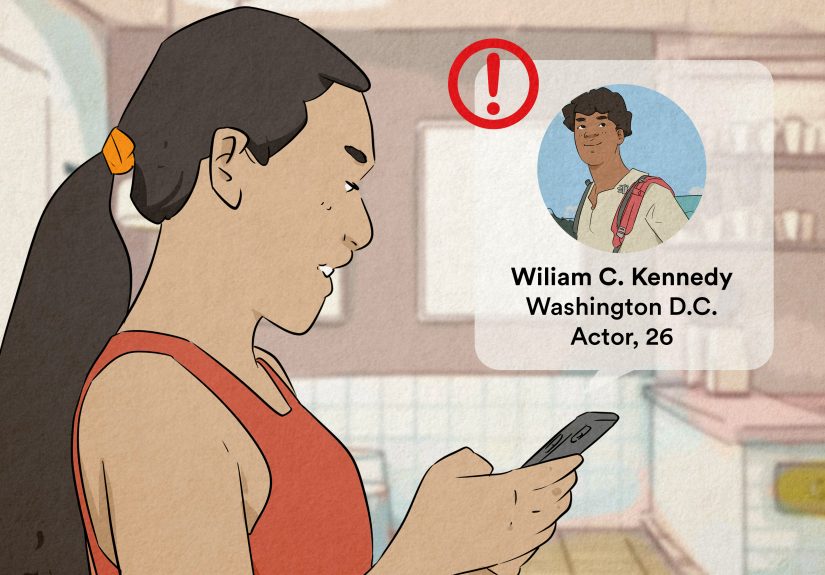
A fake profile is any account that misrepresents who’s behind it. That can include:
- Scam profiles designed to get money, gift cards, crypto, or personal information.
- Catfishing accounts using someone else’s photos or identity.
- Bots that send automated messages to keep you chatting (or clicking links).
- Impersonators posing as a real person (sometimes even pretending to be a public figure).
Not every weird profile is “fake,” and not every real person is a great communicator. But when you see multiple red flags together, it’s time to slow down and verify.
13 Ways to Spot a Fake Dating Profile
1) The Photos Look Too Perfect (or Weirdly “Stock Photo”)
If every photo looks like it came from a luxury watch adperfect lighting, zero candid shots, no friends, no casual momentsthat can be a sign the images are stolen, heavily edited, or AI-generated.
Real profiles usually have some variety: different locations, different outfits, different “I was not expecting this picture to be taken” energy.
Example: A profile with 6 photos, all studio-quality headshots, all with the same expression, and none that show normal everyday life.
2) They Have Very Few Photos (and They’re All the Same Vibe)
Fake profiles often keep it minimal: 1–3 photos, often similar angles, sometimes oddly cropped or blurry. That’s convenient if you’re borrowing images and trying not to get caught.
Tip: A real person can still be private, but if the profile is thin and the chat feels scripted, pay attention.
3) Reverse Image Search Reveals the Photos Belong to Someone Else
This is one of the quickest reality checks. If a profile photo shows up online under a different nameor on random sitesit’s a strong sign the profile isn’t authentic.
How it helps: Scammers frequently recycle photos across platforms. If the same face is “Ashley from Dallas” on one site and “Mia, living abroad” on another, that’s not a cute coincidence.
4) Their Bio Is Super Generic (or Sounds Like a Movie Trailer)
Fake profiles often use vague, copy-paste bios that could describe literally anyone:
“I love to laugh, travel, and have fun.” (Okay, so do puppies.)
Or the opposite: dramatic bios that feel like a character intro:
“I’m a humble soul seeking a serious, honest partner to share my destiny.”
Green flag: Specific details that sound lived-infavorite local coffee order, a hobby they can actually describe, a quirky but believable interest.
5) The Details Don’t Add Up
Inconsistent facts are a classic giveaway: their age changes, their job story shifts, their location keeps hopping, or they contradict themselves in casual conversation.
A scammer can memorize a script, but it’s harder to maintain a whole fake life under normal follow-up questions.
Example: They say they live near you, but they don’t recognize any common local placesand their “time zone” is always suspiciously inconvenient.
6) They Push the Conversation Off the App Right Away
A common tactic is to move you to texting or another messaging app quickly. Why? Many platforms have monitoring tools and reporting systems that make it harder to run scams.
Off-platform, they have fewer guardrailsand more freedom to pressure you.
Reality check: A real person might prefer texting eventually, but rushing it early (especially with excuses like “I’m never on here”) is a red flag.
7) Love-Bombing: Instant Intensity That Doesn’t Match Reality
If someone is calling you “my soulmate” after three messages, that’s not romanceit’s acceleration.
Fake profiles often try to fast-forward emotional closeness to lower your defenses.
Example lines: “I’ve never felt this connection before.” “You’re different from everyone.” “I can’t stop thinking about you.” (…after 12 minutes.)
8) They Avoid Video Calls (or Always Have a Convenient Tech Problem)
A simple video chat can confirm a person matches their photos and basic story. Many fake profiles dodge this with endless reasons:
broken camera, work restrictions, traveling, “shy,” or “my connection is bad.”
Note: Some real people are cautious about video calls. But if they refuse consistently and they’re pushing for trust, money, or secrecytreat it as a serious warning.
9) They Ask for Money, Gift Cards, Crypto, or “Help With an Emergency”
This is the biggest, brightest, neon-red flag. Fake profiles often build rapport and then introduce a crisis:
medical bills, travel problems, family emergencies, or “I just need a little help until payday.”
Bottom line: Do not send money to someone you haven’t verified in real life. Not for emergencies, not for plane tickets, not for “investments,” not for gift cards, not for crypto.
10) They Try to Collect Personal Info Early
Scammers may ask for your phone number, home address, workplace, school, full name, or other identifying details right away.
Sometimes it seems harmless (“Where do you go to school?”). Sometimes it’s framed as safety (“I just want to know you’re real.”).
Safer approach: Keep early conversations general. Use in-app chat features. Share personal details only after trust is earned and identity is verified.
11) They Send Links, Downloads, or “Verification” Requests
Watch out for links to sketchy sites, “private photos,” or “exclusive” videos. Another common trick: asking you to send a code you received by text to “prove you’re real.”
That code can be used to hijack accounts or sign up for services in your name.
Rule: Don’t click unknown links. Don’t download files. Don’t share verification codesever.
12) Their Messages Feel Scripted, Vague, or Weirdly “Universal”
Bots and scammers often write in a style that could be sent to anyone:
“Hello dear. You seem like a nice person. Tell me about your life.”
They may dodge specific questions, reply with filler, or pivot back to their own agenda.
Quick test: Ask something specific and normal, like “What do you like to do on a weekend around here?”
A real person usually answers with actual details. A fake profile often responds with something vague or unrelated.
13) They Want Secrecy or Try to Isolate You
One of the more concerning red flags is pressure to keep the relationship private:
“Don’t tell anyone about us.” “People wouldn’t understand.” “Your friends are jealous.”
Healthy connections don’t require secrecy as a condition. Isolation makes it easier for a scammer to control the storyand harder for you to reality-check.
Quick “Fake Profile” Checklist
Ask yourself:
- Do the photos look stolen, AI-generated, or unrealistically perfect?
- Is the profile thin, generic, or inconsistent?
- Are they rushing emotional closeness or pushing you off the app?
- Do they avoid video calls or real-world verification?
- Are they asking for money, codes, links, or personal info?
One “maybe” isn’t proof. But multiple yeses = pause, verify, and protect yourself.
What to Do If You Think a Dating Profile Is Fake
- Stop sharing information. Don’t give more details “to clear things up.”
- Screenshot key messages (especially money requests, links, or threats).
- Use the app’s report/block tools. Reporting helps protect other users too.
- Tell someone you trust. A friend, parent/guardian, or another trusted adult can help you reality-check fast.
- If money or identity theft is involved, report it to the appropriate official channels in your country.
Safety Tips That Make Fake Profiles Less Effective
- Stay on-platform early. Built-in tools are there for a reason.
- Keep your socials private. Don’t let strangers browse your whole life in one scroll.
- Watch for urgency. Pressure is a tactic, not a love language.
- Verify before you trust. A quick video call beats 200 “trust me” texts.
- Never send money or codes. If it becomes financial, it’s not “just a misunderstanding.”
Conclusion: Real-World Experiences & Lessons (Bonus)
The internet is full of genuine peopleand also full of accounts that exist purely to waste your time, take your money, or harvest your personal information.
If that sounds dramatic, it’s because scammers are, by nature, professional dramatists. Their job is to make a story feel real long enough for you to overlook the gaps.
The most useful mindset isn’t “trust no one,” but verify before you investemotionally, socially, or financially.
Here are a few composite, real-world-style scenarios based on patterns people commonly report. (These aren’t about one specific person; they’re examples of how red flags often show up in everyday chats.)
Scenario 1: The “Too Perfect” Profile. Someone matches with a profile that looks like it belongs on a magazine cover: flawless photos, glamorous travel shots, and a bio that says almost nothing.
The conversation starts friendly but quickly becomes repetitivecompliments, vague questions, and a push to move off the app. The lesson:
perfection without proof is a reason to slow down, not speed up.
Scenario 2: The Fast-Forward Feelings. After a day of messaging, the match starts using intense language: “I’ve never met anyone like you,” “I feel like we’re meant to be,” “I want something serious right now.”
It can feel flatteringuntil you notice they dodge basic questions and don’t respond to specifics. The lesson:
real connection grows with shared reality, not just emotional volume.
Scenario 3: The “Verification Code” Trap. A match claims the app is full of bots and asks you to “prove you’re real” by sending a code you receive via text.
It sounds harmless, almost like a safety step. But codes are often used to log into accounts or create new ones.
The lesson: verification codes are private. If someone asks for one, treat it as a hard stop.
Scenario 4: The Sudden Emergency. After a week of daily messages, a match says they’re dealing with a crisislost wallet, travel problem, family emergencyand they “hate to ask” but need financial help.
The story is urgent and emotional, and it comes with pressure: “I can’t ask anyone else.”
The lesson: urgency is a tool. A real person won’t require your money to prove your care.
Scenario 5: The “Let’s Keep This Between Us” Angle. A match becomes defensive when you mention talking to a friend about the relationship.
They say friends “ruin everything” or insist you keep it private.
The lesson: isolation increases risk. Healthy connections can handle sunlight.
If you remember nothing else, remember this: a fake profile usually relies on one of three shortcutsspeed (rushing closeness),
secrecy (moving off-platform or isolating you), or stakes (money, codes, links, personal info).
The safest move is to pause, verify with low-risk checks (like a video call and consistent details), and use reporting tools when things don’t add up.
Your time, your privacy, and your peace of mind are worth protectingno matter how charming the profile is.






 Close
Close