
Table of Contents >> Show >> Hide
- Why Finland Is a Dream Location for Milky Way Photography
- The Desolate Landmarks That Made the Milky Way Feel Close
- Planning the Shot: Darkness, Moon Phase, Weather, and Patience
- Camera Gear That Actually Helped
- My Go-To Milky Way Camera Settings in Finland
- Composition: How to Make the Galaxy Feel Like a Story
- The Human Side of Standing Alone Under the Milky Way
- Practical Tips for Photographing the Milky Way in Finland
- Experience Notes: What the Journey Really Felt Like
- Conclusion
There are places where the night sky looks pretty. Then there is Finland’s far north, where the sky looks like it has been quietly rehearsing for 13 billion years and finally decided to perform. I went searching for the Milky Way in Finland’s most desolate landmarks, carrying a camera, a tripod, too many batteries, and the misplaced confidence of someone who thought Arctic wind was “just weather.”
The result was worth every frozen fingertip. Above empty fells, silent pine forests, snow-covered rivers, and roadless wilderness, the Milky Way appeared not as a faint decoration but as a glowing road across the universe. In cities, we often forget the galaxy is there. In Finnish Lapland, it feels like the galaxy has been waiting patiently for us to look up.
This article is part travel story, part astrophotography guide, and part love letter to Finland’s lonely landscapes. If you have ever dreamed of Milky Way photography in Finland, dark sky travel, Arctic night photography, or simply standing somewhere so quiet that your thoughts start whispering, this is the kind of journey that rewires your definition of darkness.
Why Finland Is a Dream Location for Milky Way Photography
The Milky Way is our home galaxy, a vast barred spiral galaxy filled with stars, gas, dust, and cosmic drama. From Earth, we see it edge-on as a pale, milky band crossing the night sky. But there is a catch: to see it properly, you need darkness. Real darkness. Not “the porch light is off” darkness, but “I can no longer tell whether that shape is a tree or a moose with opinions” darkness.
Much of the modern world lives under light-polluted skies, where artificial glow washes out stars and turns the Milky Way into a rumor. Finland, especially its northern regions, still offers vast areas where darkness has room to breathe. Lapland’s national parks, wilderness areas, and remote fell landscapes are far from large cities, making them ideal for night sky photography when the moon is low, clouds behave themselves, and the season cooperates.
Of course, Finland is not dark all year. Summer brings the famous Midnight Sun, especially in Lapland, where nights can remain bright for weeks. That is magical for hiking, kayaking, and pretending bedtime is optional, but it is terrible for Milky Way photography. For stars, autumn, winter, and early spring are the real treasure chest. From roughly September through March, the nights become long enough for serious astrophotography, and in the depths of winter, darkness arrives with the dedication of a full-time employee.
The Desolate Landmarks That Made the Milky Way Feel Close
Finland’s wilderness does not shout. It does not need to. Its power comes from space, silence, and distance. The best Milky Way photos I captured were not taken beside famous city landmarks or busy viewpoints. They came from places where the landscape felt stripped down to its essentials: snow, trees, rock, sky, and the occasional sound of my tripod leg sinking into a suspiciously soft patch of snow.
Pallas-Yllästunturi National Park: Fells Under a Galactic River
Pallas-Yllästunturi National Park is one of Finland’s great northern landscapes, known for its rounded fells, boreal forests, and long chains of open high ground. The fells are not jagged like the Alps; they are older, softer, more weathered, as if time itself has sanded them down. That shape makes them extraordinary foreground subjects for Milky Way photography.
On a clear night, the open fell tops give you wide views of the sky. Snow reflects faint starlight. The horizon stretches cleanly. There are no skyscrapers, neon signs, or traffic lights trying to photobomb the cosmos. I framed the Milky Way above a rolling ridge, using the dark curve of the fell as a simple foreground. The composition worked because it did not compete with the sky. In astrophotography, sometimes the landscape’s job is to stand still and let the universe be dramatic.
Lemmenjoki National Park: Silence So Deep It Becomes Part of the Photo
Lemmenjoki National Park is Finland’s largest national park and one of the largest wilderness areas in Europe. It is the kind of place that makes your phone signal give up and pursue a quieter life. The park is known for river valleys, old pine forests, mires, fells, Sámi cultural heritage, and a sense of remoteness that feels increasingly rare.
Photographing the Milky Way here felt different from photographing it near a roadside viewpoint. There was no easy exit, no café around the corner, and no casual crowd waiting for the aurora. The darkness had texture. The forest absorbed sound. The river corridor created a natural line leading into the frame. When I reviewed the images later, the stars were beautiful, but what stayed with me was the feeling of space around them. Lemmenjoki did not just provide a backdrop; it provided mood.
Urho Kekkonen National Park: Arctic Vastness and a Sky Full of Fire
Urho Kekkonen National Park stretches through a broad area of Finnish Lapland, from the Saariselkä region toward wild eastern landscapes. It is a classic Arctic wilderness of fells, forests, rivers, and huts, with room for long treks and winter journeys. At night, it can feel almost lunar, especially when snow softens the ground and the horizon becomes a pale line beneath the stars.
Here, I learned that Milky Way photography in Finland is not only about the Milky Way. Sometimes the aurora appears. Sometimes thin cloud moves in and turns stars into watercolor. Sometimes frost builds on your lens like the camera is trying to grow a beard. The best image from this area came after several failed attempts, when the sky briefly cleared and the Milky Way arched over a line of dark spruce trees. The foreground was simple, but the atmosphere was enormous.
Planning the Shot: Darkness, Moon Phase, Weather, and Patience
Beautiful Milky Way images rarely happen by accident. Yes, luck helps, but luck prefers photographers who check the moon phase. The first rule is to avoid bright moonlight when you want strong detail in the galactic band. A new moon or thin crescent usually gives the best results. The second rule is to escape artificial light. Even in a dark country, a village, ski resort, or road can brighten the horizon more than expected.
The third rule is to obsess over weather, because clouds are the unpaid villains of astrophotography. In Finland, conditions can change quickly. A forecast that looks promising in the afternoon may become a gray blanket by midnight. I learned to scout multiple locations in daylight, choose safe access routes, and keep backup compositions ready. Nothing builds character like walking through snow to a perfect viewpoint and finding the sky has turned into a ceiling.
Season matters too. Autumn can offer darker skies before extreme cold arrives. Winter gives long nights, snow-bright foregrounds, and a stronger Arctic atmosphere, but it also demands serious clothing and battery management. Early spring may bring clearer nights and slightly friendlier temperatures. Summer is wonderful for travel, but the bright nights in the north make Milky Way photography nearly impossible.
Camera Gear That Actually Helped
You do not need a spaceship-grade camera to photograph the Milky Way, though if someone offers you one, be polite and accept. The essential setup is simpler: a camera that allows manual exposure, a wide-angle lens, a sturdy tripod, extra batteries, a remote shutter or timer, and warm gloves that still let you press buttons without accidentally changing the language menu to Finnish.
A wide-angle lens helps capture more of the sky and reduces visible star trailing at longer shutter speeds. A fast aperture, such as f/2.8 or wider, lets in more light. A strong tripod is non-negotiable because night exposures are long, and Arctic wind has a personal grudge against blurry photographers. I also carried a headlamp with a red-light mode, lens cloths, hand warmers, and a simple plastic bag to protect gear from sudden snow.
Cold weather changes everything. Batteries drain faster. Metal tripod legs become tiny frozen traps. Lens fog and frost can ruin an otherwise perfect night. I kept spare batteries inside an inner pocket and resisted the urge to breathe near the lens, which is surprisingly difficult when you are excited and your face is freezing.
My Go-To Milky Way Camera Settings in Finland
Settings always depend on your camera, lens, sky brightness, and creative goal, but a useful starting point is a wide aperture, a high ISO, and a shutter speed long enough to collect starlight without turning stars into obvious streaks. For many wide-angle setups, I began around 10 to 20 seconds, f/2.8 or wider, and ISO 3200 to 6400. Then I adjusted after checking the histogram and zooming in on the stars.
Manual focus is critical. Autofocus usually panics in the dark and starts making decisions like a raccoon in a keyboard factory. I focused on a bright star or distant light when available, magnified the live view, and fine-tuned until the star looked as small and sharp as possible. After that, I taped or carefully locked the focus ring to avoid bumping it in the dark.
For stronger results, I often took multiple exposures. One frame captured the sky. Another, sometimes with a longer exposure or lower ISO, captured the foreground. In very dark locations, I avoided harsh light painting and preferred natural starlight or subtle reflected snow glow. The goal was not to make the landscape look like noon. The goal was to preserve the feeling of being there at night.
Composition: How to Make the Galaxy Feel Like a Story
A Milky Way photo needs more than stars. Without a strong foreground, even a beautiful sky can look like a screenshot from space. Finland offers excellent natural foregrounds: lone pines, frozen lakes, fell silhouettes, wilderness huts, winding rivers, snowdrifts, and old trails disappearing into darkness.
In Pallas-Yllästunturi, I used fell ridges as clean shapes beneath the sky. In Lemmenjoki, the river valley gave depth and direction. In Urho Kekkonen, spruce trees created a jagged black edge against the stars. These elements helped the images feel anchored. The Milky Way became not just an object in the sky but part of a place.
One of the best lessons I learned was to simplify. In daylight, a scene with many details can be beautiful. At night, clutter becomes confusion. Strong silhouettes, open horizons, and clear lines work better. The viewer should understand the image quickly, then stay because the sky keeps revealing more.
The Human Side of Standing Alone Under the Milky Way
There is a strange emotional effect that comes from photographing the Milky Way in remote Finland. At first, you are busy with practical things: checking focus, adjusting exposure, keeping snow out of your camera bag, wondering why your snack has become a brick. Then the camera clicks through a long exposure, and you look up.
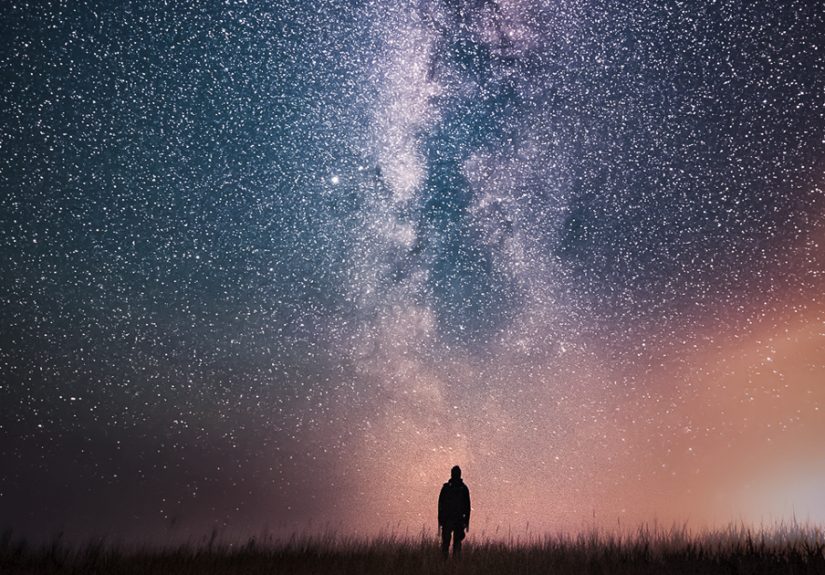
That is when the scale hits. Every star you can see belongs to our galaxy. The glowing band above you is not an aesthetic filter; it is the edge-on view of the galactic disk. You are standing on a small planet, in a cold forest, trying to photograph home from the inside. It is both humbling and hilarious. Humbling because the universe is vast. Hilarious because you are worried about whether your tripod is level.
In Finland’s desolate landmarks, the silence makes the experience stronger. There are no crowds clapping for the stars. No traffic. No city hum. Just the shutter, the snow, the wind, and a sky that makes ordinary worries feel temporarily smaller.
Practical Tips for Photographing the Milky Way in Finland
Start by choosing the right season. Avoid the bright summer months in northern Finland if your main goal is the Milky Way. Aim for dark periods from autumn through early spring, and plan around a new moon. Check light pollution maps, weather forecasts, and local access conditions before heading out.
Scout during daylight whenever possible. In winter, snow can hide rocks, ditches, weak ice, and trail edges. A location that looks easy on a map may become complicated in darkness. Tell someone where you are going, dress in layers, and bring more warmth than you think you need. The sky may be romantic, but frostbite has no poetry department.
Respect the landscape. Finland’s wilderness is beautiful because it is still wild. Stay on appropriate routes when required, avoid disturbing wildlife, follow local rules, and leave no trash. If you photograph near Sámi cultural areas or traditional sites, approach with respect. A great photo is never worth damaging a place or treating someone else’s heritage as a prop.
Experience Notes: What the Journey Really Felt Like
The most memorable part of this Milky Way photography trip was not a single perfect image. It was the rhythm of the nights. I would leave warmth behind, step into a darkness that felt almost physical, and let my eyes slowly adjust. At first, the forest was only black shapes. Then the snow began to glow faintly. Then stars appeared by the hundreds, then thousands, until the sky looked crowded enough to need traffic control.
In Pallas-Yllästunturi, the wind moved over the fells with a low, steady voice. My tripod stood in the snow, and I kept checking the composition with stiff fingers. The first test shot was terrible. The second was less terrible. By the fifth, the Milky Way had settled into the frame like a silver river. I remember laughing out loud because the camera had captured more than my eyes could see. That is one of the joys of astrophotography: it reveals the hidden patience of light.
In Lemmenjoki, the experience was quieter and more intense. The landscape felt enormous, but not empty. There were tracks in the snow, old trees leaning over the trail, and a sense that many lives had passed through that wilderness long before my camera arrived. I took fewer photos there. I spent more time listening. Sometimes the best creative decision is to stop pressing buttons and let a place introduce itself.
Urho Kekkonen National Park gave me the hardest night. Clouds kept sliding across the sky, the cold found every weak point in my clothing, and one battery died so quickly it deserved a tiny dramatic funeral. I almost packed up. Then, for about twelve minutes, the cloud broke. The Milky Way appeared above the spruce line, faint but unmistakable. I shot quickly, adjusting ISO and shutter speed while trying not to rush. The final image was not technically perfect, but it carried the story of waiting. That made it one of my favorites.
These experiences taught me that Milky Way photography is not only about sharp stars and clean files. It is about effort, timing, humility, and the willingness to be uncomfortable for something beautiful. Finland’s desolate landmarks are not empty places. They are full of darkness, weather, memory, and sky. The camera records photons, but the photographer remembers the cold, the silence, the failed shots, the sudden clearing, and the ridiculous joy of seeing our galaxy stretch over a frozen world.
Conclusion
Capturing stunning pictures of the Milky Way in Finland’s most desolate landmarks was both a technical challenge and a deeply human experience. The combination of dark skies, remote national parks, Arctic weather, and silent landscapes created conditions that were demanding but unforgettable. Pallas-Yllästunturi offered open fell horizons, Lemmenjoki delivered wilderness solitude, and Urho Kekkonen National Park added scale, snow, and atmosphere.
For photographers, Finland rewards preparation. Choose the right season, plan around moonless nights, bring reliable gear, protect your batteries from the cold, and scout compositions before darkness falls. For travelers, it offers something even rarer than a good photograph: the chance to stand beneath the Milky Way and feel, for a moment, exactly where you are in the universe.
The best images from this journey were not just pictures of stars. They were portraits of silence. They showed what happens when a wild landscape and a dark sky meet, with one small photographer standing between them, trying very hard not to trip over a tripod.





 Close
Close