
Table of Contents >> Show >> Hide
- The Strange Beauty of the Thames Estuary Gun Towers
- What Were the Maunsell Forts?
- Why the Towers Were Built in the Water
- Photographing Red Sands Fort
- Photographing Shivering Sands Fort
- The Human Story Behind the Steel
- Why Abandoned Military Structures Fascinate Us
- Photography Tips for Capturing the Maunsell Forts
- The Forts as Accidental Art
- The Challenge of Preserving Offshore History
- Why This Photo Journey Matters
- Additional Personal Experience: Photographing the Towers From the Water
- Conclusion
Some places whisper history. The WWII gun towers in the Thames Estuary do not whisper. They creak, rust, glare at the horizon, and look as if they have been waiting 80 years for someone to explain why they are still standing in the middle of the water like a committee of iron-legged ghosts.
Photographing the Maunsell Forts, the famous wartime sea forts off the coast of Kent and Essex, is not like visiting a museum with clean glass cases and polite labels. There is no gift shop selling “I survived the gift shop” mugs. There are no velvet ropes. There is only a wide estuary, moody British weather, gulls with questionable manners, and a group of abandoned towers that once helped defend London and vital shipping routes during World War II.
These forts were designed by British civil engineer Guy Maunsell and installed during the early 1940s as part of Britain’s coastal and anti-aircraft defense system. Their job was practical, urgent, and deadly serious: spot enemy aircraft, defend the Thames approach, protect shipping lanes, and help prevent attacks from reaching London and other strategic targets. Today, they are no longer military machines. They are ruins, landmarks, engineering oddities, and dream subjects for photographers who enjoy history served with fog, salt, and a side order of mild seasickness.
The Strange Beauty of the Thames Estuary Gun Towers
The Thames Estuary is already a place full of atmosphere. It is neither fully sea nor fully river, neither urban nor wild. The water stretches wide and gray, changing mood every few minutes. On a bright day, it can look silver and calm. On a stormy day, it looks like it has read too much Gothic fiction and taken notes.
Then the forts appear.
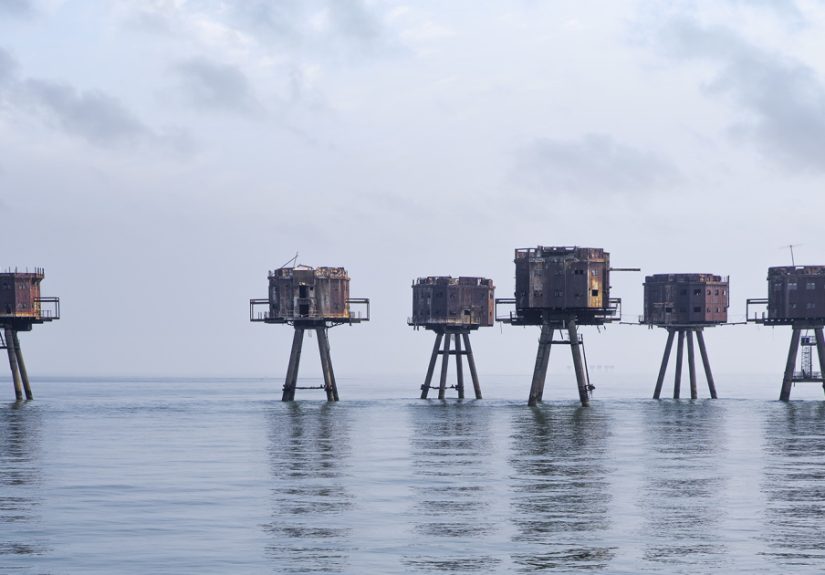
At first, they look unreal. Thin towers rise from the water on metal legs, connected by rusting walkways, their angular silhouettes standing against the sky like props from a dystopian film. The Red Sands Fort and Shivering Sands Fort are among the best-known Maunsell Army Forts in the Thames Estuary. Each was originally made up of several towers linked together, with separate platforms for guns, control, accommodation, and searchlights. The structure was functional, but time has turned it into accidental sculpture.
For a photographer, that contrast is irresistible. These towers were built for war, yet now they are strangely peaceful. They are industrial, but also elegant in a battered, stubborn way. They are abandoned, yet full of presence. You point the camera at them, and the image already feels like it has a backstory.
What Were the Maunsell Forts?
The Maunsell Forts were offshore defensive structures built during World War II in the Thames and Mersey estuaries. They were named after Guy Maunsell, the engineer who designed them. There were two main types: naval forts and army anti-aircraft forts.
The naval forts were concrete-and-steel structures positioned in the Thames Estuary to help defend important waterways from enemy aircraft and sea threats. The army forts, which include Red Sands and Shivering Sands, were clusters of steel towers linked by walkways. They were placed in strategic locations where they could monitor and defend the approaches to London and the Thames. Historical records note that these Thames Estuary forts played a role in wartime air defense and later became famous for another reason entirely: pirate radio.
After World War II, the forts were decommissioned. During the 1960s, some were used by offshore pirate radio stations broadcasting pop music outside normal licensing systems. That twist gives the forts one of the strangest second acts in British history: from anti-aircraft defense to rebellious radio culture. One decade they were scanning the sky for enemy aircraft; later, they were helping beam music across the water. History, apparently, enjoys a remix.
Why the Towers Were Built in the Water
To understand the forts, you have to understand the geography. The River Thames was not just a river during World War II. It was a route, a landmark, and a strategic vulnerability. Enemy aircraft could use the river’s shape as a guide toward London, including the docks and industrial areas that were crucial to Britain’s wartime effort.
Building defensive towers out in the estuary created an early warning and defensive line before threats reached inland targets. The forts gave crews a place to observe, communicate, and operate anti-aircraft defenses from offshore positions. It was a bold engineering solution for a frightening problem: how do you defend a huge, open approach to one of the most important cities in the country?
The answer, in true wartime engineering fashion, was: build metal towers in the sea and staff them with crews who probably developed very strong opinions about damp socks.
Photographing Red Sands Fort
Red Sands Fort is one of the most visually striking of the Thames Estuary gun tower groups. From a distance, its towers seem to hover above the water. Up close, they become more imposing. The rust, broken walkways, missing sections, and weather-beaten surfaces show how brutally the sea treats anything humans are bold enough to leave in its path.
The best photographs of Red Sands often emphasize scale and isolation. A wide shot can show the fort as a lonely mechanical island. A closer frame can reveal the texture of corrosion, the geometry of the legs, and the fragile-looking walkways that once connected working military platforms. The towers look strongest when surrounded by negative space: gray water below, big sky above, nothing else competing for attention.
Lighting matters enormously. In flat midday light, the fort can look documentary and stark. At sunrise or sunset, it becomes cinematic. Mist softens the towers and turns them into silhouettes. Storm clouds add drama. Bright winter light can make every rusty edge and shadow snap into focus. The same structure can feel historical, haunted, heroic, or post-apocalyptic depending on the weather.
Photographing Shivering Sands Fort
Shivering Sands Fort has its own personality. The name alone sounds like it belongs in a ghost story told by someone wearing a wool coat beside a fireplace. Like Red Sands, it was built as an anti-aircraft fort in the Thames Estuary, but time and accident have changed its shape. One tower was lost after a collision in the 1960s, leaving the group visually broken and even more haunting.
Photographically, Shivering Sands is powerful because it feels incomplete. The missing connections make the remaining towers seem more vulnerable. The gaps become part of the composition. They suggest absence, damage, and survival all at once. When photographed from the water, the towers can look like they are marching across the horizon, but the broken pattern reminds you that the sea always gets a vote.
For close-up photography, details tell the story: ladders, platforms, railings, cables, peeling surfaces, and birdlife nesting where soldiers once worked. These details transform the forts from distant icons into lived-in ruins. They stop being “old military things” and become places where real people once slept, watched, waited, and counted the days until they could return to land.
The Human Story Behind the Steel
It is easy to photograph the Maunsell Forts as objects, but they were once full of people. Crews lived and worked there during wartime, surrounded by water and exposed to weather, isolation, and the constant pressure of military duty. The towers were not romantic ruins then. They were cold, cramped, functional places built for survival.
That human layer matters. When I photographed the forts, I kept thinking about how strange it must have been to live out there. The horizon would have been both beautiful and threatening. Every aircraft sound could mean danger. Every storm would make the metal structure groan. Supplies had to arrive by boat. Privacy would have been limited. Comfort was probably not a design priority.
Modern viewers see the forts as dramatic photography subjects, but wartime crews saw them as workplaces. That difference creates emotional depth. A good image should capture not just the shape of the towers, but the tension between their original purpose and their present silence.
Why Abandoned Military Structures Fascinate Us
Abandoned military sites have a strange pull. They are built to project strength, but abandonment reveals vulnerability. Concrete cracks. Steel rusts. Paint peels. Birds move in without asking permission. The result is a visible argument between human ambition and nature’s patience.
The Thames Estuary gun towers are especially fascinating because they sit offshore. Many abandoned buildings can be reached by road or footpath. These forts require distance. You usually see them from a boat, from the coast, or through a long lens. That separation makes them feel mysterious. They are close enough to photograph, but far enough to remain untouchable.
They also combine multiple stories in one place: World War II defense, British engineering, coastal geography, postwar neglect, pirate radio, heritage preservation, and visual culture. That is a lot for a cluster of rusty towers to carry, but they do it with excellent posture.
Photography Tips for Capturing the Maunsell Forts
Use the Weather Instead of Fighting It
Do not wait only for perfect blue skies. The forts often look better in dramatic weather. Cloud, mist, rain, and winter light can add mood and historical weight. A clean sunny day may create a pleasant image, but a brooding sky can make the towers feel alive.
Think in Silhouettes
The forts have instantly recognizable shapes. Shooting them against a bright sky or low sun can create powerful silhouettes. This works especially well when the water is calm enough to reflect some of the structure.
Include Scale
If possible, include a boat, bird, horizon line, or distant coastline to show scale. Without context, the towers may look like models. With context, their size and isolation become much clearer.
Capture Details
Wide shots are essential, but details give your photo essay texture. Rust patterns, broken platforms, ladders, weathered surfaces, and structural lines can tell quieter stories than the grand scenic shots.
Respect Safety and Access Rules
These forts are old, unstable, and exposed to harsh marine conditions. They should be photographed responsibly, typically from a safe boat or legal viewing point. Climbing, landing, or entering unsafe structures is not worth the risk. No photograph is improved by needing a rescue team afterward.
The Forts as Accidental Art
One of the most surprising things about photographing the Thames Estuary gun towers is how artistic they appear. They were not designed to be beautiful. They were designed to function. Yet their shapes, repetition, and decay create something visually poetic.
The towers resemble giant mechanical insects, offshore temples, alien tripods, or industrial treehouses depending on the angle. Their geometry is stark, but the decay softens it. Rust adds color. Water adds reflection. Sky adds scale. Birds add life. Together, these elements turn military infrastructure into a kind of open-air installation.
This is why the forts appeal to photographers, historians, urban explorers, architects, and curious travelers alike. They are not only relics of war. They are reminders that objects can outlive their original purpose and gather new meanings over time.
The Challenge of Preserving Offshore History
Preserving the Maunsell Forts is complicated. They stand in a punishing environment, surrounded by salt water, wind, tides, and storms. Restoration is expensive and technically difficult. Access is limited. Safety concerns are real. Every year, the structures face more corrosion and more uncertainty.
Yet their cultural value is significant. They are rare examples of wartime offshore defense engineering. They are part of the story of London’s defense during World War II. They influenced later thinking about offshore structures. They also became part of Britain’s pop-culture history through pirate radio.
Photography plays a role in preservation, even when it does not physically save a structure. Images document change. They build public interest. They help people care about places they may never visit. A photograph can make a distant rusting tower feel immediate, emotional, and worth remembering.
Why This Photo Journey Matters
Photographing the WWII gun towers in the Thames Estuary is not just about capturing an unusual landmark. It is about standing, camera in hand, between past and present. The forts are no longer active defenses, but they still defend something: memory.
They remind us that history is not always neat. It does not always live in restored castles or polished memorials. Sometimes it stands offshore, rusting in the wind, looking slightly annoyed but still magnificent.
For anyone interested in World War II history, abandoned architecture, coastal photography, or unusual UK landmarks, the Maunsell Forts are unforgettable. They are eerie without being theatrical, dramatic without trying too hard, and historically important without needing a shiny plaque to prove it.
Additional Personal Experience: Photographing the Towers From the Water
The first thing I learned while photographing the WWII gun towers in the Thames Estuary is that the sea has a sense of humor. Not a friendly sitcom sense of humor, either. More like a dry British comedian who waits until you are changing lenses before nudging the boat sideways.
Approaching the towers by boat changed everything. From shore, they look distant and almost abstract. Through a long lens, they become graphic shapes on the horizon. But from the water, they feel enormous. Their legs rise out of the estuary with a strange confidence, as if they never received the memo that the war ended decades ago.
I remember watching the towers grow slowly larger through the viewfinder. At first, I focused on the full structure: the group of platforms, the gaps between them, the hard lines against the sky. Then I started noticing smaller things. Birds perched on railings. Shadows under the platforms. Rust running down the sides like dark orange rain. Every surface looked marked by time.
The sound was just as memorable as the view. Water slapped against the boat. Wind moved across the open estuary. Gulls called overhead with the confidence of creatures who know they own the place. The forts themselves seemed silent, but not empty. They had that powerful stillness old structures sometimes have, as though they are not abandoned but simply done talking.
Photographing from a moving boat required patience. Framing was tricky. The horizon shifted. The towers moved in and out of alignment. Just when the composition looked perfect, a wave would lift the boat and turn my carefully planned shot into a modern art experiment titled “Blur With Historical Intent.” I learned to shoot in bursts, keep the shutter speed high, and accept that not every frame would be a masterpiece. Some would simply be proof that I was there and that gravity remained undefeated.
The most powerful moment came when the light changed. A break in the clouds sent a pale wash of sunlight across the towers. For a few seconds, the rust glowed, the water brightened, and the whole fort looked less like a ruin and more like a monument. It was not pretty in the usual postcard sense. It was better than pretty. It was honest.
That is what makes these towers so compelling. They do not ask to be admired. They simply endure. They have survived war, weather, neglect, radio rebels, curious photographers, and the endless appetite of the sea. Photographing them felt like borrowing a few seconds from a much longer story.
If you plan to photograph the Maunsell Forts, bring a zoom lens, weather protection, patience, and respect. Do not expect comfort. Expect wind. Expect salt spray. Expect your hair to make bold creative decisions. But also expect images that feel different from ordinary travel photography. These towers are not just scenery. They are history standing on metal legs.
By the time I lowered the camera, I understood why so many photographers are drawn to them. The Thames Estuary gun towers are strange, serious, beautiful, battered, and unforgettable. They are proof that even the most practical wartime structures can become symbols, stories, and art when time gets involved.
Conclusion
The WWII gun towers in the Thames Estuary are among the most haunting historic landmarks in the United Kingdom. Built for defense, abandoned after their military purpose faded, and later woven into pirate radio history, the Maunsell Forts remain powerful subjects for photography and storytelling. Their rusting silhouettes capture the tension between engineering and nature, war and peace, memory and decay.
Photographing them is more than a visual exercise. It is a reminder that history does not always stay politely on land. Sometimes it waits offshore, surrounded by gray water, daring you to look closer.
Note: Historical details are based on reputable references about the Maunsell Forts, including documented information on their World War II defense role, Thames Estuary locations, Red Sands, Shivering Sands, and postwar history. Key reference bases include sources on Maunsell Fort design and deployment, Project Redsand preservation information, and historical summaries of the Thames Estuary sea forts.






 Close
Close