
Table of Contents >> Show >> Hide
- Who Is Erik Johansson and Why Does His Work Hit So Hard?
- How Erik Johansson Creates Surreal Photo Manipulations That Look Real
- What Makes Erik Johansson’s Photoshop Art So Addictive to Look At?
- 30 Mind-Bending Erik Johansson Photo Manipulations to Explore
- Behind the Scenes: Real Examples of Johansson’s Creative Process
- Why Erik Johansson Matters for Photoshop, Photography, and Digital Art
- Experience: What It Feels Like to Spend Time With Erik Johansson’s Work (Extended Reflection)
- Conclusion
Some artists take photos. Erik Johansson takes reality, politely asks it to sit down, and then rearranges it into something your brain can’t quite file. The result is the kind of surreal photography that makes you squint, smile, and wonder whether you need more sleepor less.
Johansson is a Swedish visual artist and photographer known for creating impossible scenes that still look eerily believable. His signature style blends photography, Photoshop compositing, meticulous planning, and old-school problem-solving. In other words: this is not “click a filter and call it a day” art. It’s more like architectural storytelling with a camera, props, and a lot of patience.
In this deep dive, we’ll explore what makes Erik Johansson’s photo manipulations so captivating, how his creative process works, and 30 standout pieces that show why he remains one of the most recognizable names in surreal photo art.
Who Is Erik Johansson and Why Does His Work Hit So Hard?
Erik Johansson (born in 1985) is a Swedish photographer and visual artist based in Prague, Czech Republic. He’s famous for creating surreal worlds by combining photographs into one seamless image, with a core creative philosophy that can be summed up like this: he aims to capture ideas, not moments.
That single idea explains almost everything about his work. He isn’t chasing spontaneous street photography or documentary realism. He’s building visual narrativesimpossible but emotionally grounded scenes that often feel like memories, dreams, or metaphors you almost had words for.
And yes, the “Photoshop master” label is deserved. But what makes Johansson stand out is that he treats Photoshop as the final stage, not the whole show. He plans heavily, shoots his own source material, builds props, controls lighting, and handles post-production himself. The polish comes from the software; the magic comes from the concept.
How Erik Johansson Creates Surreal Photo Manipulations That Look Real
1) He starts with an idea, then sketches it
In interviews, Johansson has explained that every image begins with a simple idea and a sketch. That planning stage can take days, months, or even years depending on the complexity. It’s not just artistic brainstormingit’s technical problem-solving: perspective, reflections, materials, shadows, and light all have to agree before the final composite can work.
2) He shoots his own materials instead of using stock
One of Johansson’s most important creative rules is that he doesn’t rely on stock photography. He wants complete control over the light, perspective, and consistency of each element. That’s why his images feel cohesive even when the concept is wildly surreal. Every component is captured for that specific scene.
3) He builds props and shoots on location whenever possible
This is where the behind-the-scenes stories get great. Johansson often builds physical objects or stages elaborate setups to make the final image more believable. He has talked about making custom props (including oversized objects) simply because it helps the story read better and gives the model something real to interact with.
4) He uses Photoshop for compositing, not shortcuts
Johansson has repeatedly stated that he doesn’t use stock images, illustrations, or AI-generated material in his artwork. He combines his own photographs in Photoshop and Lightroom, and he’s known for keeping the final image realistic enough that the impossible idea lands harder. That balancefantasy concept, realistic executionis the whole Johansson formula.
5) He produces slowly on purpose
According to his own site and recent artist profiles, the process is so time-intensive that he creates only around ten new works per year. That pace says a lot: these images aren’t content churn. They’re crafted pieces.
What Makes Erik Johansson’s Photoshop Art So Addictive to Look At?
Johansson’s best images work because they combine three things at once: a clear visual idea, believable lighting, and a tiny emotional hook. You don’t just look at a clever illusion; you feel a story.
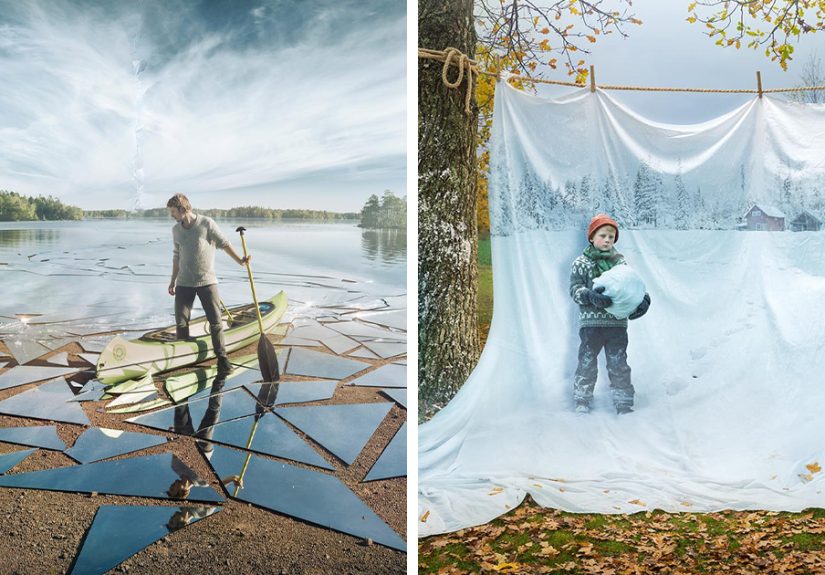
Take Cut & Fold, one of his well-known works. The road appears cut and folded like paperan impossible visual that somehow reads instantly. Or Impact, where a lake seems to crack like shattered mirror glass. The trick is bold, but the realism is what sells it.
His work also carries recurring themes: nature versus human systems, home and memory, movement and transition, and the tension between comfort and change. Even the titles of his newer workslike Level of Change, Layers of Change, Deadline, and A Place Like Homeshow how often he builds visual metaphors around modern life.
He’s also not limited to gallery art. Johansson has done commissioned work for major brands and institutions, including projects connected to Adobe, National Geographic’s Brain Games, School of Visual Arts in New York, Microsoft-sponsored illusion work, and Adobe MAX branding. That mix of fine art and commercial precision is part of why his compositing style is so influential.
30 Mind-Bending Erik Johansson Photo Manipulations to Explore
Below is a curated list of 30 standout Erik Johansson works (with years), mixing newer portfolio pieces and iconic classics. For the recent titles, even the naming alone hints at the conceptual storytelling he’s known for; for the classics, the behind-the-scenes process has become almost as famous as the final image.
- Brighter Future (2026) A recent work that continues Johansson’s “impossible but believable” storytelling style, with a title that suggests optimism built through visual metaphor.
- Memories of a Storm (2025) Johansson often plays with memory and atmosphere, and this title fits his talent for making emotional ideas feel physically present.
- New Goals (2025) A concept-driven piece that likely leans into progress, ambition, and his signature visual twist on everyday aspirations.
- The Marriage (2025) Johansson is excellent at turning abstract relationships into surreal scenes; this title signals a strong narrative anchor.
- Together in Harmony (2025) A classic Johansson-style theme: balance, connection, and visual order hiding inside impossibility.
- Dreaming of Sleeping Outside (2024) The title alone sounds like Johansson: cozy, strange, and quietly cinematic.
- Level of Change (2024) Change is a recurring Johansson motif, often expressed through layered landscapes or shifting environments.
- Bucket List (2024) A playful concept title that likely gives Johansson plenty of room for literal-meets-metaphorical imagery.
- Rise & Shine (2024) He frequently reimagines daily routines in surreal ways, and this title fits that pattern perfectly.
- First Day of School (2024) Johansson’s work often transforms familiar life moments into dreamlike scenes, making the ordinary feel uncanny.
- Play Outside (2024) A title that suggests nostalgia, imagination, and his ongoing interest in landscape-based storytelling.
- Thoughts of Trains (2024) Trains, roads, and travel themes appear often in surreal art because they map so well onto memory and motion.
- Between the Shadows (2024) Johansson is a master of mood, and shadow-heavy concepts suit his realism-first compositing style.
- Shores of Home (2024) Home, place, and belonging are long-running themes in his interviews and visual language.
- Until the Storm Ends (2024) Johansson often uses weather as metaphor, not just scenery, which makes titles like this especially evocative.
- Dreaming of Snow (2024) Dream-state titles and natural elements are a Johansson specialty: calm on the surface, surreal underneath.
- River Hotel (2024) He has a gift for merging architecture and landscape into one impossible scene, and this title sounds built for it.
- Night Shift (2023) A strong conceptual title that fits Johansson’s ability to turn modern work-life pressure into visual allegory.
- The Swedish Space Program (2023) A playful, unexpected title that reflects his humor and love of grounded absurdity.
- Deadline (2023) Johansson excels at making stress visible; this title practically begs for a surreal twist.
- Night Comes (2023) He often uses time-of-day transitions to create emotional tension in a scene.
- Make Purpose (2023) A concept-heavy title that aligns with his interest in meaning, labor, and identity.
- Layers of Change (2023) “Layers” is a perfect Johansson keyword, both emotionally and technically (hello, Photoshop layers).
- Fear of Heights (2022) Johansson’s work frequently plays with perspective and scale, so this title fits his strengths exactly.
- A Place Like Home (2022) Home is one of his most consistent themes, often tied to memory, comfort, and subtle unease.
- Fishy Island (2009) One of his early iconic works, widely referenced in U.S. coverage; a real fish was reportedly used in the image.
- Cut & Fold (2012) A signature Johansson illusion: a road appears cut and folded like paper, with documented behind-the-scenes production and significant post time.
- Impact (2016) A standout classic where a lake appears to crack like mirror shards; Johansson used real mirrors cut into shapes to make the effect believable.
- Wake Up! (2016) A major process-driven piece, famous for its elaborate physical setup and a surreal scene built from multiple carefully matched shoots.
- All Above the Sky (2017) Another fan favorite, featuring a reality-bending ladder/sky concept that shows Johansson’s blend of location shooting and compositing precision.
Behind the Scenes: Real Examples of Johansson’s Creative Process
Impact (2016): Mirror shards on a lake
Impact is a perfect Erik Johansson case study. In his own behind-the-scenes notes, he described thinking about the “lake cracking like a mirror” idea for a long time and then sourcing real mirrors from an old gym, cutting them into triangle shapes, and hauling themalong with a boat and a modelto a stone pit. This is peak Johansson: surreal idea, physical prep, then compositing.
All Above the Sky (2017): Reality flipped inside out
Coverage of All Above the Sky highlighted how Johansson shot elements at Lake Vänern in Sweden and combined separate images of the ladder, rocks, and model. The behind-the-scenes breakdown shows his obsession with matching light, which is exactly why the final illusion looks so seamless.
Wake Up! (2016): Big idea, bigger logistics
Another process-heavy favorite, Wake Up!, gained attention because the physical production was so ambitious. Reports describing the build mention trees placed in a calm lake, the model shot separately in a pool, and additional elements captured from elevated positionsall before Photoshop stitched the impossible world together.
Full Moon Service and the “magic hour” problem
In interview comments, Johansson described Full Moon Service as especially memorable because the scene came to life during the shoot itself: he brought rice lamps, models, and a car into a field and waited for the light to align. That detail explains why his surrealism still feels photographic instead of synthetic. He’s not faking atmosphere later; he’s building it from the start.
Why Erik Johansson Matters for Photoshop, Photography, and Digital Art
Johansson sits in a rare lane between photographer, retoucher, and visual storyteller. For Photoshop artists, he’s a masterclass in compositing discipline. For photographers, he’s proof that image-making doesn’t have to stop when you press the shutter. For viewers, he’s a reminder that surreal art doesn’t need to look fake to feel imaginative.
His influence also extends beyond the internet. U.S. institutions like the American Swedish Institute have featured his work in major exhibitions, and coverage around that show emphasized just how well his large-format prints translate in person. That matters, because Johansson’s images reward close looking: seams vanish, lighting holds up, and little details keep the illusion alive.
If you’re creating your own surreal photo manipulations, Johansson’s biggest lesson is simple: realism is a storytelling tool. The more believable the materials, shadows, and perspective, the more emotional the impossible idea becomes.
Experience: What It Feels Like to Spend Time With Erik Johansson’s Work (Extended Reflection)
Looking through a big set of Erik Johansson images feels less like scrolling a gallery and more like flipping through someone’s dream journal after they went to engineering school. That combination is exactly why the work sticks. There’s imagination, yes, but there’s also structure. Even his strangest scenes feel built, not merely invented.
The first experience most people have with Johansson’s work is confusion followed by delight. Your eyes lock onto a scene that looks normal at first glancea road, a lake, a house, a fieldand then the logic breaks. The road folds. The lake cracks. The sky becomes water. Your brain tries to correct the image, but it can’t, because the lighting and perspective are too convincing. That moment of “Wait… what?” is the Johansson effect.
The second experience is usually admiration for the craft. Once you know how much of the image is physically shot, staged, and planned, the work gets even better. It’s not only surreal photography; it’s production design, visual engineering, and storytelling all working together. You start noticing how carefully the shadows line up, how consistent the horizon feels, and how the impossible element is almost always supported by ordinary details around it. That’s what makes the illusion believable.
The third experienceespecially if you’re a designer, photographer, or Photoshop useris motivation. Johansson’s process makes you want to slow down and make better images. He’s a strong reminder that creative work doesn’t have to be fast to be powerful. In a world full of instant edits and one-click effects, his work says, “Take the extra shot. Build the prop. Fix the light. Sketch the idea first.” It’s oddly refreshing.
There’s also something emotionally generous about his art. Even when the concept is technical, the image often lands like a feeling: homesickness, pressure, nostalgia, uncertainty, hope. Many titles read like thoughts you’d write in a notebook on a sleepless night, and the visuals give those thoughts a body. That’s why people who don’t know anything about Photoshop still connect with the work. The images are clever, but they’re not just clever.
And honestly, that’s the best part of Erik Johansson’s photo manipulations: they don’t just show you what Photoshop can do. They show you what visual imagination can do when patience, craft, and story all show up to work. Also, they make normal roads look suspicious forever, which feels like a fair trade.
Conclusion
Erik Johansson remains one of the most compelling surreal photographers working today because he doesn’t treat photo manipulation like a shortcut. He treats it like filmmaking in a single frame. From early classics like Fishy Island and Cut & Fold to newer concept-rich works such as Brighter Future and Memories of a Storm, his portfolio shows how far Photoshop compositing can go when the idea comes first.
If you love surreal photography, visual storytelling, or advanced Photoshop art, Johansson’s work is more than inspirationit’s a blueprint for making impossible images feel real.





 Close
Close