
Table of Contents >> Show >> Hide
- The Viral Grocery Fight, in Plain English
- Why So Many People Took Mom’s Side
- Groceries Are Not Cheap, and the Numbers Back That Up
- The Real Problem Wasn’t Dinner. It Was Unclear Expectations.
- What Families Can Learn From This Without Reenacting It
- The Bigger Issue: Living at Home Changes Family Dynamics
- Experiences Many Families and Couples Recognize in This Situation
- Final Take
Few things light up the internet faster than family drama involving money, food, and one sentence so bold it practically deserves its own soundtrack: “Mom, give her the card.” That line came from a viral story about a mother who let her adult son and his girlfriend stay in her home rent-free, only to hit the brakes when the household grocery bill started acting like it had celebrity status. The girlfriend had offered to cook dinners for the family, which sounded generous and wholesome on paper. In practice, however, it slowly turned into multiple shopping trips, pricier ingredients, and a menu that wandered from “helpful contribution” into “who exactly is funding this surf-and-turf era?”
The story struck a nerve because it was never really just about steak. It was about boundaries, expectations, gratitude, budgeting, and the weird emotional fog that settles over shared households when nobody wants to discuss money until money becomes the main character. In other words, it was a grocery story on the surface and a relationship story underneath. And that is exactly why people cared.
This viral moment also landed in a very real American context. Groceries are expensive, even when inflation is calmer than it was a few years ago. Families are still watching their food budgets closely, adult children are more likely than many parents expected to live at home for a stretch, and a lot of households are learning the same lesson the hard way: generosity without structure is basically a future argument wearing fuzzy slippers.
The Viral Grocery Fight, in Plain English
According to the original account, the mom’s 23-year-old son had moved back home after college, and his 21-year-old girlfriend soon moved in as well because she needed somewhere to stay before the couple got their own place. Neither was paying rent. The mother did not frame that as a burden at first. In fact, she sounded warm, flexible, and pretty welcoming. Her only expectations were simple: clean up after yourselves, be respectful, and don’t turn the house into a low-budget reality show.
The girlfriend, trying to contribute, offered to cook dinner most nights. That is the sort of gesture people love because it sounds mature and considerate. And for a while, it worked. The problem began when cooking dinner also meant using the mother’s money to buy ingredients, then making multiple grocery runs every week, then choosing pricier foods like steak and seafood. At that point, the arrangement stopped feeling like a favor and started feeling like someone else had quietly volunteered the homeowner to sponsor a nicer menu.
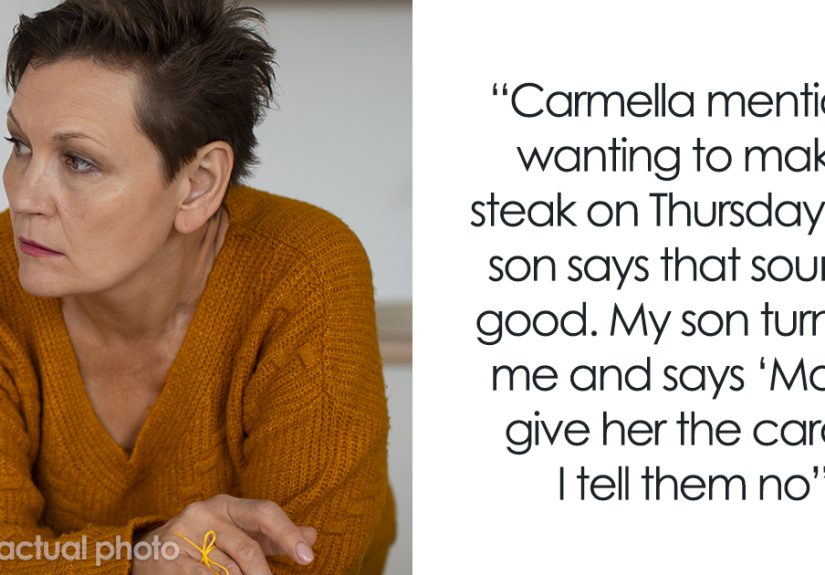
The turning point came when the girlfriend mentioned wanting to make steak for six people later in the week and needing another grocery run. The son then turned to his mother and told her to hand over the card. That did not go well. The mother said no, explained that she had already provided money for groceries, noted that steaks for six were not in the budget, and told the girlfriend that if she wanted to keep cooking, there would need to be a spending limit. The girlfriend looked upset. The son felt she had been embarrassed. The mother felt she had finally said the quiet part out loud.
Internet readers largely sided with the mom, and it is not hard to see why. “Helpful” only counts as helpful if it does not quietly cost the host more than they can afford. When someone else is buying the food, cooking is generous, yes, but it is not a blank check with garlic butter on top.
Why So Many People Took Mom’s Side
The mother’s position resonated because it felt deeply practical. She was already providing housing. She was not charging rent. She was not asking for utilities. She was not billing anyone for the everyday wear and tear that magically appears when more adults live in a house and use electricity like it is a personality trait. In that context, setting a grocery budget did not look mean. It looked sane.
People also reacted to the son’s wording. “Mom, give her the card” is the kind of sentence that sounds tiny but carries a whole moving truck of assumptions. It suggests the money is available, the mother should not question the request, and her role is to fund the plan rather than discuss it. That rubbed many readers the wrong way, especially because the son was free to contribute his own money if he felt strongly about ribeye diplomacy.
There is also a maturity gap hidden inside this story. A lot of young adults do not fully understand grocery math until they are the ones standing in the aisle deciding whether a “nice dinner” is worth blowing the week’s food budget. When you are not paying, steak can look casual. When you are paying for a household of six, steak starts looking like a holiday decision, not a random Thursday mood.
That is why the story felt familiar. Many families have some version of this conflict. One person thinks, “I’m helping.” Another thinks, “You are helping yourself to my wallet.” Nobody speaks clearly enough at the start, and eventually a supermarket receipt becomes a trust exercise nobody wanted.
Groceries Are Not Cheap, and the Numbers Back That Up
The internet loves to act as if “it’s just groceries” should end the discussion. Unfortunately, the checkout lane does not accept vibes as legal tender. In the United States, household spending on food at home averaged more than six thousand dollars in 2024. That is not a rounding error. It is a serious budget category, and it gets more intense when several adults are eating from the same kitchen.
Federal food-plan estimates tell a similar story. Even a thrifty monthly grocery plan for adults adds up fast, and the totals climb quickly when you scale from one person to a whole household. Once you start adding higher-cost foods, repeat shopping trips, convenience buys, and those “while we’re here” extras that jump into the cart like caffeinated squirrels, a manageable grocery plan can go off the rails in a hurry.
Then there is the menu itself. Some ingredients carry emotional weight because people associate them with comfort or hospitality, but they also carry literal price weight. Beef, seafood, specialty ingredients, and frequent midweek restocks can turn a thoughtful dinner plan into a budget ambush. That does not mean families can never enjoy them. It means somebody has to decide when they make sense financially.
This is where the mother in the story seems less controlling and more realistic. She was not banning good food. She was saying, in effect, “We cannot eat like this every week on my budget.” That is not selfish. That is how adults keep the lights on and the fridge full at the same time.
The Real Problem Wasn’t Dinner. It Was Unclear Expectations.
Here is the uncomfortable truth: this fight probably could have been prevented with one awkward conversation at the beginning. Not a dramatic conversation. Not a courtroom speech. Just a simple, boring, gloriously unromantic household talk.
Something like: “We’re glad you’re here. We can help for a while. Here’s what we can cover. Here’s what we can’t. If you want to cook dinner, great, but let’s plan meals, make one list, and keep the weekly grocery budget at this amount.” That is it. No villain music. No steak-based betrayal. Just clarity.
Instead, the arrangement evolved organically, which is a polite way of saying it wandered into trouble unsupervised. At first, the mother handed over the card because it seemed useful. The girlfriend likely interpreted that as permission. The son may have assumed his mom did not mind. The mom may have assumed the shopping would stay reasonable. Everyone was making guesses, and guesses are terrible accountants.
The son also missed an important social cue. When your parent is already doing you a major favor, your job is not to expand the favor by default. Your job is to reduce pressure, show appreciation, and definitely avoid speaking to your mother like she is the finance department for your girlfriend’s dinner ideas. That is not mature partnership. That is outsourced adulthood.
What Families Can Learn From This Without Reenacting It
1. Put the numbers on the table early
Money conversations feel awkward right up until they become necessary, and then they feel explosive. It is better to say, “Our weekly grocery budget is this amount,” than to pretend everything is fine until a six-person steak dinner appears on the horizon like a fiscal jump scare.
2. Separate generosity from unlimited spending
Helping adult children or their partners is not the same thing as silently absorbing every cost that follows. Support works best when it has edges. In fact, boundaries often protect relationships because they reduce resentment. “Yes, but within limits” is kinder in the long run than “sure, whatever” followed by simmering frustration.
3. Meal planning beats emergency shopping
One of the most practical takeaways from consumer guidance is that meal planning matters. A list, a schedule, and a quick check of what is already in the pantry can save real money. Multiple grocery trips in one week almost always invite overspending. They also make it easier to buy based on cravings instead of a plan, and cravings are charming but not budget-friendly.
4. Guests can contribute without controlling the household budget
Cooking, cleaning, babysitting, yard work, and errands are all valid ways to contribute. But contribution does not automatically include choosing premium ingredients on someone else’s dime. If the girlfriend truly wanted to treat the family, there were many ways to do that within a set budget. Good cooking is not defined by price tags. Plenty of great family meals are built on pasta, rice, beans, chicken, soup, casseroles, tacos, and leftovers that know how to pull their weight.
5. Adult children need practice with real household costs
Parents often want to make life easier for their kids. Completely understandable. But one hidden downside of cushioning every cost is that young adults may not fully learn how quickly food, utilities, rent, and routine household spending stack up. Budgeting is not glamorous, but it is a core life skill. Sometimes the most helpful thing a parent can do is refuse to pretend money is infinite.
The Bigger Issue: Living at Home Changes Family Dynamics
This story also lands because more young adults are living with parents than many people realize. That arrangement can be good for finances, but it changes the emotional weather in a home. Parents may still feel protective. Adult children may want independence without full responsibility. Partners entering the household add another layer. Suddenly the house is part family, part launchpad, part negotiation table, and part accidental group project.
That does not mean living together is doomed. It means everyone needs a shared understanding of rules, timelines, expenses, and respect. Food in particular becomes symbolic very quickly. Who buys it? Who chooses it? Who cooks it? Who cleans up? Who decides what counts as reasonable? These are small questions until they become giant ones.
In the viral story, the mother was not rejecting the girlfriend. She was rejecting an undefined expense. That distinction matters. Budget limits are not personal insults, even though they can feel personal in the moment. A spending cap is often just a household saying, “We have to live in reality, not in appetizer language.”
Experiences Many Families and Couples Recognize in This Situation
A lot of people saw themselves somewhere in this story, even if their version did not involve steak. Some remember moving back home after college and being shocked by how expensive the basics were once they were no longer magically appearing in the kitchen. Milk, bread, eggs, produce, snacks, coffee, paper towels, dish soap, and that one ingredient you buy for a recipe and use exactly once can add up with cartoon speed. A dinner that feels simple in your head can look very different when the receipt prints.
Others recognize the host’s side of it. Many parents do not mind opening the door for a child who needs help. What wears them down is not the extra plate at dinner. It is the slow creep of added expenses mixed with the feeling that nobody notices. A grocery budget stretches. Utility use rises. Toiletries disappear faster. The fridge empties more quickly. And because the parent wants to be kind, they keep swallowing the frustration until one moment finally makes it impossible to stay polite. Usually that moment sounds small to outsiders. Inside the home, it has been building for weeks.
Couples also run into a version of this problem when they first start sharing food costs. One person shops like they are provisioning a sensible submarine. The other shops like the kitchen has just been acquired by a streaming service. Neither is automatically wrong, but they are absolutely not operating from the same spreadsheet. That mismatch creates friction fast. The person spending less feels anxious. The person spending more feels judged. The relationship ends up having an argument about groceries that is secretly an argument about values, comfort, family background, and money habits.
Roommates know this pain too. Shared households often discover that “we’ll just figure it out” is not a plan. It is a suspense genre. Someone buys staples. Someone else buys luxury snacks. Somebody keeps replacing everything. Somebody contributes exactly one lime and a dream. Before long, people are labeling yogurt and developing strong political opinions about who used the good olive oil.
And then there is the emotional side. Being told there is a budget can sting, especially if you thought you were helping. It can feel embarrassing. But embarrassment is not always evidence that the boundary was unfair. Sometimes it simply means a reality check arrived before you were emotionally dressed for it. Many adults can look back and remember a moment when they learned, in one uncomfortable conversation, that generosity from family still came with limits. It was awkward. It was humbling. And it was useful.
That is why this story spread so widely. It was not outrageous in some unbelievable internet way. It was ordinary in the most recognizable way possible. Plenty of families have had their own version of “Mom, give her the card.” Different house, different meal, same lesson: love does not replace a budget, and a budget does not cancel love.
Final Take
So, was the mother wrong for setting a grocery budget? Not really. If anything, she waited longer than many people would have. Her mistake was not having the boundary sooner, not having it at all. The son and girlfriend may not have intended to be rude, but intention does not erase impact, and household finances are not something hosts should be expected to absorb silently just to keep the mood pleasant.
The most useful lesson here is not “never help family” or “never cook for people.” It is much simpler: define the arrangement before the arrangement defines you. If people are living together, sharing meals, or leaning on one another during a transitional season, clear expectations are not cold. They are compassionate. They preserve dignity. They protect budgets. And they make it much less likely that anyone will have to explain, in front of a stove, why Thursday is not actually a six-steak kind of Thursday.







 Close
Close